As demand for artificial intelligence computing rapidly increases, traditional cloud computing faces high costs, centralized resources, and access barriers—driving the rise of decentralized hash power networks.
Structurally, AITECH Cloud Network is built around high-performance computing, AI services, blockchain infrastructure, and tokenomics. Its core covers network architecture, service mechanisms, and application ecosystems.
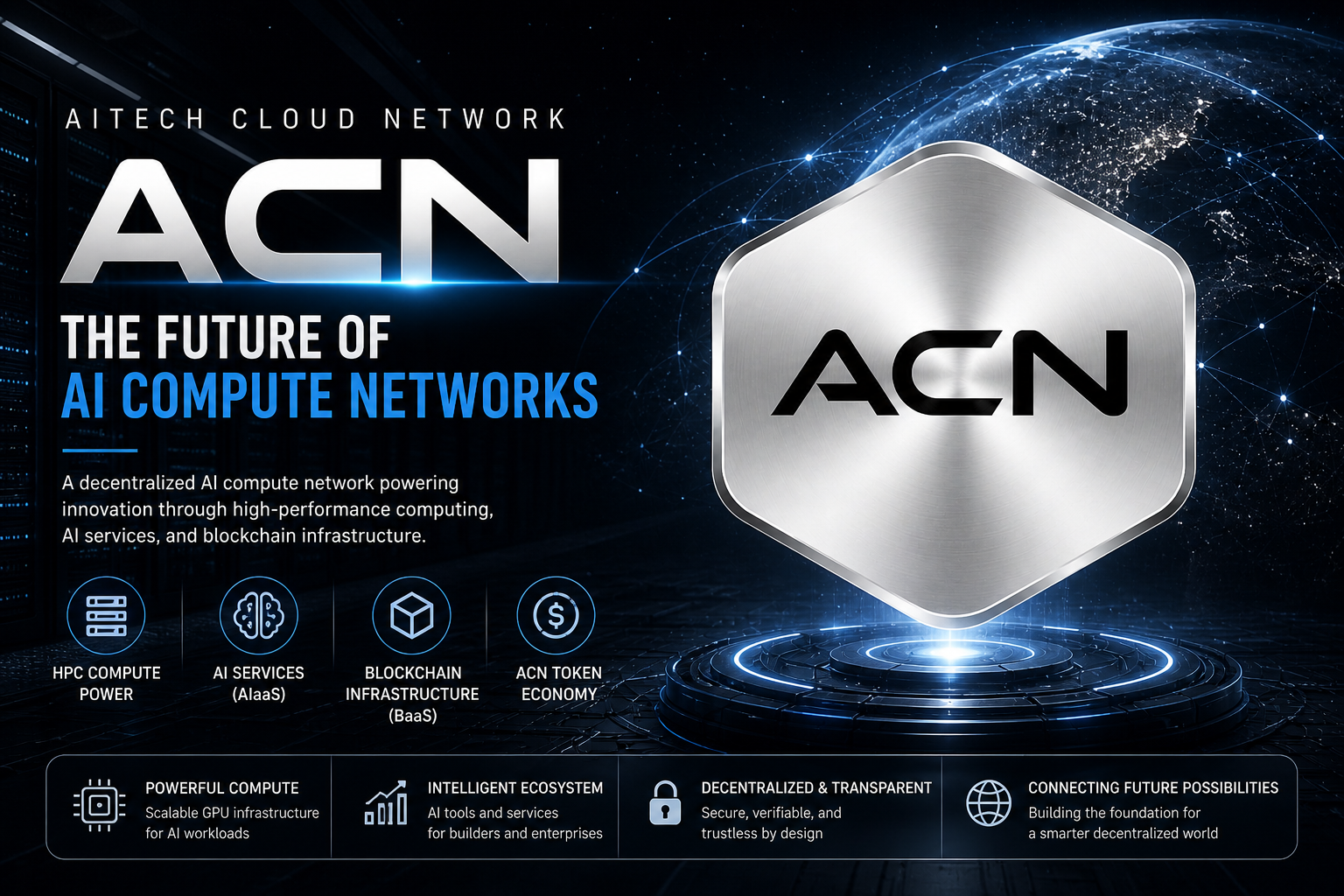
What Is AITECH Cloud Network (ACN)
AITECH Cloud Network serves as hash power infrastructure designed for AI applications. Its core lies in integrating high-performance computing resources with blockchain settlement to create a unified AI service network. The network maps traditional data center capabilities onto an on-chain economic system, making hash power a tradable asset.
Operationally, the network delivers GPU resources through centralized high-performance computing centers, while the blockchain system manages fee settlement and access control. Users access AI models, data analytics, or computational power via tokens.
This design is significant because it merges AI computing demand with blockchain economics, allowing market mechanisms to regulate hash power supply and demand—boosting resource efficiency.
ACN’s Core Architecture and Operating Model
ACN’s architecture features a high-performance computing layer, an AI service layer, and a blockchain settlement layer, each separating computing resources, service interfaces, and the economic system.
Specifically, the high-performance computing layer supplies GPU hash power, the AI service layer manages model invocation and data processing, and the blockchain layer handles trade records and payments. This layered approach separates compute, service, and settlement.
| Layer |
Function |
Role |
| HPC Layer |
Provides hash power |
Supports AI training and inference |
| AI Service Layer |
Offers AI tools |
Enables data analysis and automation |
| Blockchain Layer |
Records & settles |
Ensures trade transparency |
This architecture improves scalability and reduces coupling between functional modules, enabling the network to support a wide range of AI applications.
High-performance computing underpins AITECH Cloud Network by delivering large-scale GPU hash power for complex AI workloads. This layer forms the network’s resource foundation.
Resources are centrally managed in data centers and allocated based on user demand. When a user submits a compute request, the system dispatches the required hash power to execute the task.
This capability is essential, as AI model training and inference require substantial hash power. High-performance computing shortens task execution time and increases efficiency.
How AI Services (AIaaS) Build the Application Ecosystem
The AI service layer is the application gateway for AITECH Cloud Network, encapsulating advanced AI capabilities as callable services—a modular approach to AI delivery.
Developers access AI models via API for data analysis, automation, or predictive tasks. Users leverage AI functions without managing underlying hash power.
This structure lowers the development barrier, enabling more applications to integrate AI capabilities and driving ecosystem growth.
Blockchain Services (BaaS) and Their Role in the System
The blockchain service layer underpins trade recording and settlement in ACN, leveraging on-chain technology for data transparency and secure payments. This layer is the network’s economic backbone.
All hash power usage and AI service calls are recorded on-chain and settled with ACN tokens. Once users pay, the system distributes funds to hash power providers.
This design minimizes trust requirements, allowing participants to exchange resources securely without relying on intermediaries.
ACN’s Business Model and Revenue Streams
AITECH Cloud Network’s business model is based on charging for hash power and AI services, generating revenue through resource leasing and service invocation.
Users first purchase hash power or AI services, then pay with tokens. The network distributes fees to resource providers and service operators.
This model ties network revenue directly to hash power demand and AI service usage, ensuring scalability.
Application Scenarios for AITECH Cloud Network
AITECH Cloud Network excels in high hash power use cases, leveraging AI computation to solve complex problems.
In practice, the network supports financial analysis, medical data processing, supply chain optimization, and automation systems—scenarios that rely on AI models and large-scale compute resources.
By providing a unified hash power platform, the network makes AI capabilities more accessible across industries.
ACN differs from traditional cloud computing in resource management, payment mechanisms, and data control, with blockchain economics at its core.
| Comparison |
ACN |
Traditional Cloud Computing |
| Resource Model |
Tokenized hash power |
Resource leasing |
| Payment Method |
Token settlement |
Fiat settlement |
| Data Control |
Decentralized |
Platform-controlled |
| Transparency |
On-chain verifiable |
Opaque |
| Application Model |
Open ecosystem |
Closed services |
ACN’s blockchain and token mechanisms deliver greater transparency and openness, while traditional cloud platforms focus on centralized management and stable service.
ACN’s Advantages and Potential Limitations
ACN’s strengths include improved resource efficiency and transparency by integrating AI hash power with blockchain, building an open AI compute network.
Tokenization and distributed settlement reduce trust costs and enhance liquidity. However, this architecture introduces technical complexity and cost pressures.
Potential limitations include high infrastructure costs, market competition, and reliance on actual demand—all impacting network growth.
Summary
AITECH Cloud Network combines high-performance computing, AI services, and blockchain settlement to create a hash power network for AI applications. Its core structure features computing, service, and settlement layers.
Overall, the network connects hash power supply and demand via tokens and supports diverse applications with modular services, while facing cost and competitive challenges.
FAQ
What Is AITECH Cloud Network (ACN)
AITECH Cloud Network is an AI hash power network that integrates high-performance computing and blockchain to deliver AI services and computing resources, with payments and settlements handled via tokens.
What Is the Role of the ACN Token
The ACN token is used for paying hash power and AI service fees, and for participating in network economic activities—it is the system’s core settlement tool.
How Does ACN Differ From Traditional Cloud Computing
ACN uses blockchain for tokenized settlement and data transparency, while traditional cloud computing relies on centralized platforms for service delivery.
What Are the Application Scenarios for AITECH Cloud Network
Key use cases include financial analysis, medical data processing, supply chain optimization, and automation systems—fields requiring high hash power.
What Is ACN’s Business Model
The business model is based on hash power leasing and AI service fees, distributing revenue through user payments.







