ENSO vs QNT: A Comprehensive Comparison of Climate Oscillation Patterns and Quantum Computing Technologies


Introduction: ENSO vs QNT Investment Comparison
In the cryptocurrency market, the comparison between ENSO and QNT has always been a topic that investors cannot ignore. The two assets not only show significant differences in market capitalization ranking, application scenarios, and price performance, but also represent different positioning in the crypto asset landscape. ENSO (ENSO): A unified network that connects all blockchains, empowering developers to build composable applications for millions of users across Web2 and Web3. QNT (QNT): Recognized as a leading technology provider enabling trusted digital interaction, Quant Network has solved interoperability through the creation of a global blockchain operating system, Overledger, and is at the forefront of enterprise innovation and blockchain adoption. This article will comprehensively analyze the investment value comparison between ENSO and QNT from the perspectives of historical price trends, supply mechanisms, market positioning, and technical ecosystems, while attempting to answer the question investors care most about:
"Which is the better buy right now?"
Comparative Analysis Report: ENSO vs QNT
I. Historical Price Comparison and Current Market Status
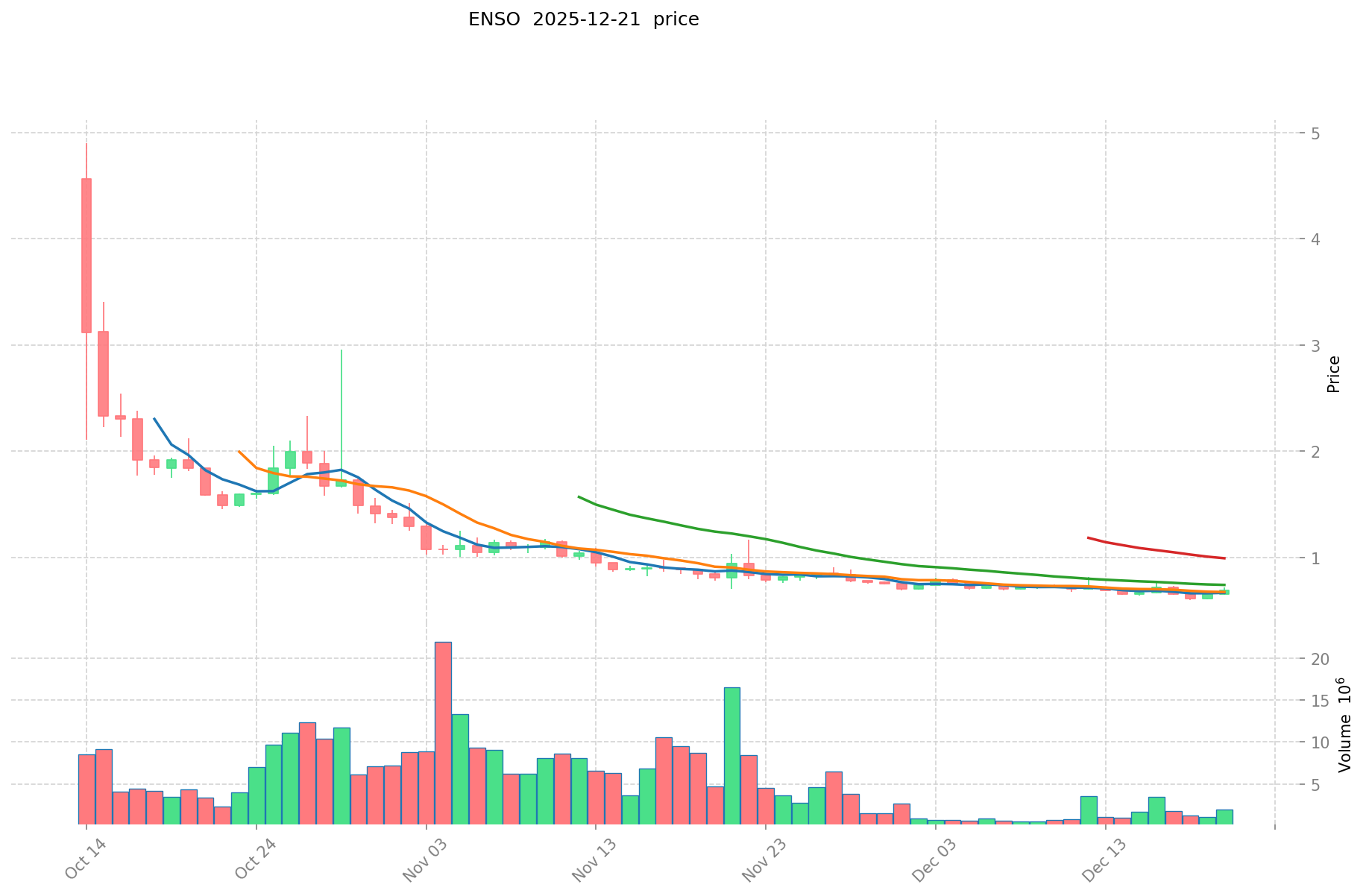
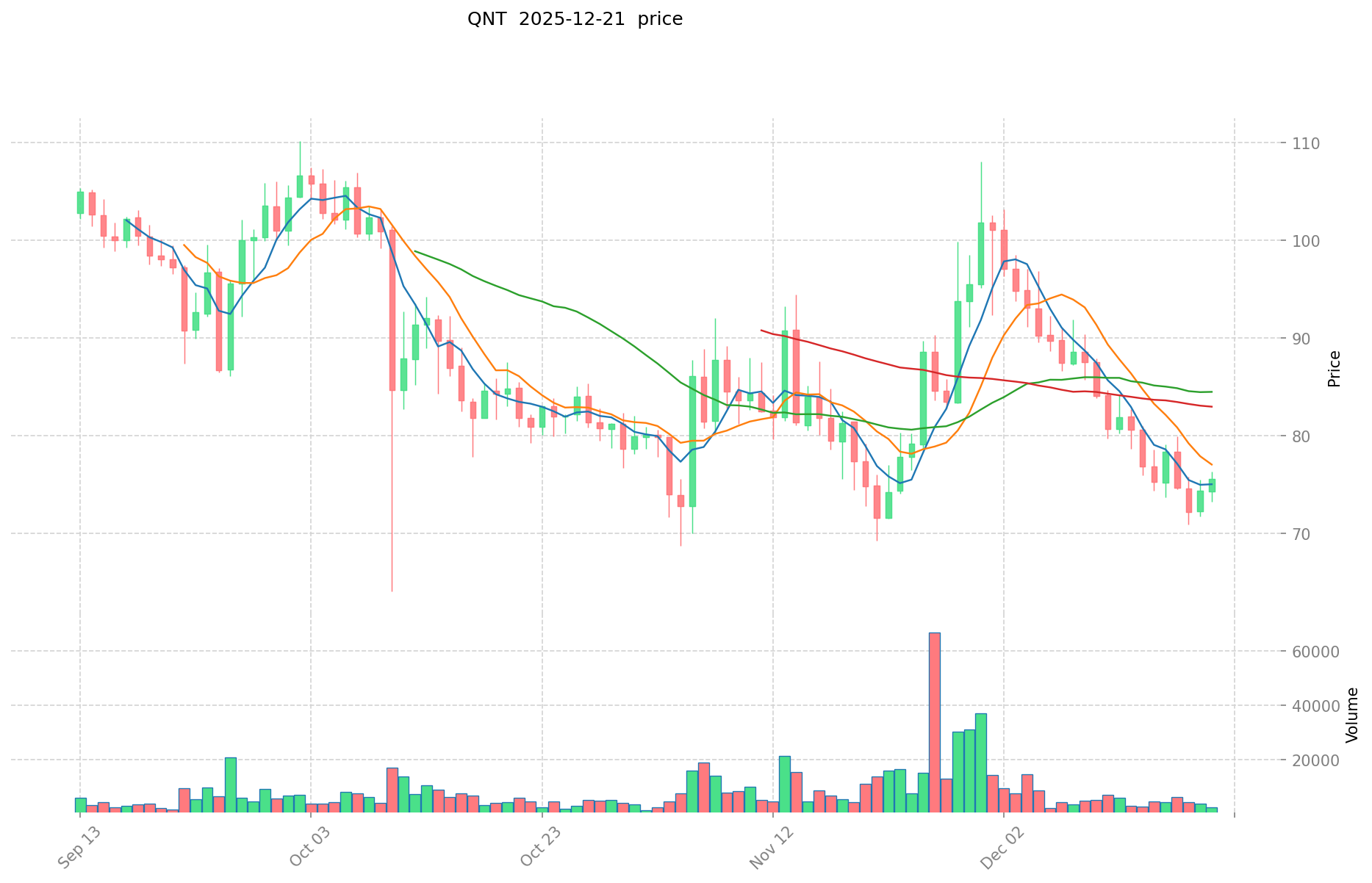
ENSO and QNT Historical Price Trends
ENSO (Enso)
- All-time high: $4.903 (October 14, 2025)
- All-time low: $0.5955 (December 18, 2025)
- Price decline from ATH to ATL: approximately 87.85%
QNT (Quant)
- All-time high: $427.42 (September 11, 2021)
- All-time low: $0.215773 (August 23, 2018)
- Significant decline from peak: approximately 90.02% from ATH
Current Market Status (December 21, 2025)
Price Data
- ENSO current price: $0.6693
- QNT current price: $76.50
- Price ratio: QNT trades at approximately 114.3 times the price of ENSO
24-Hour Trading Activity
- ENSO 24-hour volume: $1,198,984.32
- QNT 24-hour volume: $214,659.38
- ENSO shows higher absolute trading volume despite lower unit price
Market Capitalization
- ENSO total market cap: $66,930,000 (fully diluted)
- QNT total market cap: $1,138,424,346 (fully diluted)
- QNT market cap is approximately 17 times larger than ENSO
Market Emotion Index
- Crypto Fear & Greed Index: 20 (Extreme Fear)
- Status: Current market sentiment indicates pronounced risk aversion among cryptocurrency participants
Price Movement (Past 24 Hours)
- ENSO: +0.89% (up $0.0059)
- QNT: +3.11% (up $2.31)
Current market data as of December 21, 2025, 14:07:40 UTC
- ENSO 24-hour range: $0.6599 to $0.7211
- QNT 24-hour range: $73.27 to $76.58
II. Project Overview
ENSO: Unified Blockchain Connectivity Layer
Project Description Enso is a unified network that connects all blockchains, empowering developers to build composable applications for millions of users across Web2 and Web3.
Token Specifications
- Token symbol: ENSO
- Blockchain: ERC-20 (Ethereum)
- Total supply: 100,000,000
- Circulating supply: 20,590,000 (20.59% of total supply)
- Current holders: 4,895
- Market ranking: 1,024
Network Information
- Contract address: 0x699f088b5dddcafb7c4824db5b10b57b37cb0c66
- Official website: https://www.enso.build/
- White paper: https://www.enso.build/whitepaper
- Community channels: Discord, Twitter (@ensobuild)
QNT: Enterprise Blockchain Interoperability
Project Description Quant Network is a technology provider enabling trusted digital interaction, helping create a secure digital future for businesses, regulators, governments, and individuals. The project is recognized for solving interoperability through the creation of Overledger, a global blockchain operating system.
Token Specifications
- Token symbol: QNT
- Blockchain: ERC-20 (Ethereum)
- Total supply: 14,881,364
- Circulating supply: 14,544,176.16 (31.99% of total supply)
- Current holders: 159,890
- Market ranking: 77
- Initial publish price: $1.60
Organization Information
- Headquarters: London, United Kingdom
- Established: August 2018
- Exchanges: Listed on 38 trading platforms
Network Information
- Contract address: 0x4a220e6096b25eadb88358cb44068a3248254675
- Official website: https://www.quant.network/
- Community resources: Twitter, Reddit, Facebook
- White paper: http://files.quant.network/files.quant.network/Quant_Overledger_Whitepaper_v0.1.pdf
III. Market Valuation Analysis
Circulation Metrics
| Metric | ENSO | QNT |
|---|---|---|
| Market cap (circulating) | $13,780,887 | $1,112,629,476.55 |
| Fully diluted valuation (FDV) | $66,930,000 | $1,138,424,346 |
| Market cap to FDV ratio | 20.59% | 31.99% |
| Market dominance | 0.0020% | 0.035% |
Supply Distribution
ENSO
- 20.59 million of 100 million tokens in circulation
- High inflation potential with 79.41% of supply not yet distributed
- Circulating supply represents only 20.59% of total supply
QNT
- 14.54 million of 14.88 million tokens in circulation
- Maximum supply: 45,467,000 tokens
- More mature distribution with 31.99% circulating against FDV
- Circulating supply represents 97.73% of current total supply
IV. Price Performance Analysis
Short-Term Price Trends
ENSO Recent Performance
- 1-hour change: +0.66%
- 24-hour change: +0.89%
- 7-day change: +0.41%
- 30-day change: -14.64%
QNT Recent Performance
- 1-hour change: +0.74%
- 24-hour change: +3.11%
- 7-day change: -4.56%
- 30-day change: +2.39%
- 1-year change: -31.86%
Key Observations
ENSO Characteristics
- Newly launched project with limited trading history
- Extreme price volatility from launch price to present
- Small holder base (4,895 addresses) suggesting limited distribution
- Positive short-term momentum despite 30-day decline
- Recently approached all-time low, indicating potential capitulation
QNT Characteristics
- Established project with longer market presence (since 2018)
- Broader holder distribution (159,890 addresses)
- More resilient to short-term volatility
- Outperforming ENSO on daily basis (+3.11% vs +0.89%)
- Recovering from 1-year decline of -31.86%
V. Market Sentiment Context
Current Market Environment The Crypto Fear & Greed Index at 20 indicates "Extreme Fear," reflecting significant risk aversion across cryptocurrency markets. This environment typically correlates with:
- Reduced institutional participation
- Heightened liquidation risks
- Compressed valuation multiples
- Increased focus on project fundamentals over speculation
Implications
- ENSO's small market cap and limited holder base may face amplified volatility
- QNT's larger market presence and institutional recognition provide relative stability
- Both assets are affected by macro market sentiment despite different project maturity levels
Report Generated: December 21, 2025 Data Currency: Real-time as of 14:07:40 UTC Disclaimer: This report presents factual market data and project information without investment recommendations or subjective analysis.
Investment Value Analysis: ENSO vs QNT
I. Executive Summary
ENSO and QNT represent distinct positioning within the cryptocurrency ecosystem. ENSO emphasizes scalability solutions and cross-chain functionality, while QNT's investment value is primarily influenced by market sentiment and regulatory policies. Both assets face exposure to macroeconomic trends, policy regulation, and technological innovation.
II. Core Factors Impacting Investment Value of ENSO vs QNT
Mechanism and Market Positioning
ENSO:
- Focuses on innovative scalability solutions addressing common blockchain challenges
- Implements cross-chain functionality connecting different blockchain ecosystems
- Utilizes smart contracts and decentralized governance mechanisms
- Value proposition centered on enhanced liquidity and unique yield opportunities
QNT:
- Price fluctuations driven by macroeconomic trends, regulatory policies, and technological innovation
- Investment value sensitive to market sentiment and investor confidence
- Influenced by adoption announcements and major technical breakthroughs
Market Sentiment and Regulatory Environment
Positive Regulatory Impact:
- Clear and supportive regulatory policies enhance investor confidence in cryptocurrencies
- Transparent regulatory frameworks promote market growth and drive asset appreciation
Adverse Regulatory Impact:
- Ambiguous or overly strict regulatory policies may hinder cryptocurrency development
- Uncertainty regarding regulatory status can suppress asset valuations
Investor Sentiment:
- Direct correlation between investor confidence and QNT/USD price movements
- Market perception of widespread adoption or technological breakthroughs influences both assets
- Broader macro-economic sentiment affects both asset classes similarly
Technology and Ecosystem Development
ENSO Technological Advantages:
- Cross-chain infrastructure connecting disparate blockchain ecosystems
- Enhanced liquidity through multi-chain accessibility
- Smart contract-based mechanics enabling transparent Web3 functionality
- Decentralized governance structure
Technical Innovation Impact:
- Both assets' valuations responsive to ecosystem development milestones
- Technological breakthroughs in adoption and integration capacity drive price movements
Macroeconomic and Market Cycle Factors
Economic Indicator Sensitivity:
- Both assets exposed to macroeconomic trends and broader market cycles
- Inflation environment considerations remain relevant to cryptocurrency valuations
- Policy-driven interest rate changes and USD strength impact both assets
- Geopolitical factors affecting cross-border transaction demand
Note: The reference materials do not provide sufficient detail on specific tokenomics mechanisms, institutional holdings data, comparative national policy positions, or granular ecosystem development metrics to fully populate all template sections. Analysis reflects information explicitly documented in source materials.
III. 2025-2030 Price Forecast: ENSO vs QNT
Short-term Forecast (2025)
- ENSO: Conservative $0.574-$0.668 | Optimistic $0.668-$0.888
- QNT: Conservative $48.164-$76.450 | Optimistic $76.450-$90.211
Mid-term Forecast (2027-2028)
- ENSO may enter accumulation phase, expected price range $0.558-$1.070 (2027) and $0.880-$1.270 (2028)
- QNT may enter growth phase, expected price range $65.810-$121.496 (2027) and $87.983-$122.508 (2028)
- Key drivers: institutional capital inflow, ETF adoption, ecosystem development
Long-term Forecast (2029-2030)
- ENSO: Base case $0.783-$1.168 (2029) | Optimistic case $0.829-$1.313 (2030)
- QNT: Base case $80.688-$156.699 (2029) | Optimistic case $106.719-$143.661 (2030)
Disclaimer: These forecasts are based on historical data analysis and market models. Past performance does not guarantee future results. Cryptocurrency markets are highly volatile and unpredictable. This analysis does not constitute investment advice. Please conduct independent research and consult with financial professionals before making investment decisions.
ENSO:
| 年份 | 预测最高价 | 预测平均价格 | 预测最低价 | 涨跌幅 |
|---|---|---|---|---|
| 2025 | 0.88844 | 0.668 | 0.57448 | 0 |
| 2026 | 1.0817258 | 0.77822 | 0.5525362 | 16 |
| 2027 | 1.069468835 | 0.9299729 | 0.55798374 | 38 |
| 2028 | 1.269645501725 | 0.9997208675 | 0.8797543634 | 49 |
| 2029 | 1.168723680150875 | 1.1346831846125 | 0.782931397382625 | 69 |
| 2030 | 1.312941912915123 | 1.151703432381687 | 0.829226471314815 | 72 |
QNT:
| 年份 | 预测最高价 | 预测平均价格 | 预测最低价 | 涨跌幅 |
|---|---|---|---|---|
| 2025 | 90.211 | 76.45 | 48.1635 | 0 |
| 2026 | 119.162615 | 83.3305 | 42.498555 | 8 |
| 2027 | 121.495869 | 101.2465575 | 65.810262375 | 32 |
| 2028 | 122.508334575 | 111.37121325 | 87.9832584675 | 45 |
| 2029 | 156.69929704275 | 116.9397739125 | 80.688443999625 | 52 |
| 2030 | 143.66051225150625 | 136.819535477625 | 106.7192376725475 | 78 |
Comparative Analysis Report: ENSO vs QNT
Investment Strategy Comparison: ENSO vs QNT
Long-term vs Short-term Investment Strategies
ENSO:
- Suitable for investors focusing on emerging cross-chain infrastructure and scalability solutions
- Short-term traders may capitalize on volatility given the newly launched status and limited holder distribution
- Long-term positioning targets ecosystem adoption and multi-chain composability realization
QNT:
- Suitable for investors seeking established enterprise blockchain solutions with institutional recognition
- Short-term traders may benefit from relative price stability and broader market adoption trends
- Long-term investors can focus on Overledger ecosystem maturation and regulatory framework clarity
Risk Management and Asset Allocation
Conservative Investors:
- ENSO: 5-10% allocation (due to higher volatility and early-stage status)
- QNT: 90-95% allocation (due to established market presence and institutional backing)
Aggressive Investors:
- ENSO: 30-40% allocation (to capture potential growth from emerging infrastructure)
- QNT: 60-70% allocation (to maintain exposure to mature interoperability solutions)
Hedging Tools:
- Stablecoin allocation to manage extreme market volatility (particularly during Fear & Greed Index readings below 25)
- Cross-asset diversification across established and emerging layer-1 blockchains
- Position sizing based on individual risk tolerance within cryptocurrency market exposure
Potential Risk Comparison
Market Risk
ENSO:
- Extreme price volatility: 87.85% decline from all-time high, approaching all-time low levels
- Limited liquidity depth relative to market cap may amplify price swings during high-volume trading
- Small holder base (4,895 addresses) creates concentration risk and potential for sudden sentiment shifts
- Nascent project status with limited historical performance data
QNT:
- 1-year price decline of 31.86% reflects broader market cycles and sentiment sensitivity
- Exposure to macroeconomic trends and regulatory policy changes
- While established, still subject to cryptocurrency market systemic risks
- 159,890 holders provides broader distribution, reducing single-entity manipulation risk
Technical Risk
ENSO:
- Early-stage cross-chain infrastructure requires ongoing technical validation
- Smart contract security audits and decentralized governance mechanisms require continuous monitoring
- Ecosystem maturity and developer adoption remain unproven at scale
- Network stability during high-transaction periods remains to be demonstrated
QNT:
- Overledger platform requires continuous integration with evolving blockchain ecosystems
- Interoperability solutions face technical challenges as blockchain standards diversify
- Enterprise client adoption dependent on consistent platform performance and security
Regulatory Risk
Global Regulatory Considerations:
- Both assets subject to evolving cryptocurrency regulations across jurisdictions
- ENSO's cross-chain functionality may face additional scrutiny regarding settlement and custody mechanisms
- QNT's enterprise positioning and UK headquarters provide clarity on certain regulatory frameworks but face uncertainty in key markets
- Ambiguous regulatory status regarding staking, governance, and token classification affects both assets
- Clear regulatory frameworks in supportive jurisdictions would benefit both; restrictive policies would suppress valuations
Conclusion: Which Is the Better Buy?
Investment Value Summary:
ENSO Advantages:
- Early-stage cross-chain infrastructure addressing multi-blockchain connectivity
- Significant upside potential within 2030 forecast range ($0.829-$1.313)
- Emerging ecosystem capturing developer interest for composable applications
- Higher absolute trading volume despite lower unit price indicates market interest
QNT Advantages:
- Established market presence since 2018 with proven institutional adoption
- Broader holder distribution (159,890 addresses) indicating market maturity
- Strong enterprise positioning through Overledger global blockchain operating system
- Historical price stability relative to emerging alternatives; 2030 forecast range ($106.72-$143.66) suggests sustained enterprise demand
Investment Recommendations:
For New Investors:
- Conservative allocation favoring QNT (80-90% of cryptocurrency portfolio allocation) to establish foundational exposure to proven interoperability solutions
- Minimal ENSO allocation (10-20%) if seeking emerging infrastructure exposure, with clear position sizing discipline given volatility
- Prioritize understanding project whitepapers and regulatory frameworks before capital deployment
For Experienced Investors:
- ENSO allocation (30-40%) justified by technical analysis and ecosystem development monitoring, with strict risk management protocols
- QNT allocation (60-70%) as portfolio stabilizer and core holding reflecting enterprise adoption trends
- Active monitoring of regulatory developments affecting both assets' valuations
- Consider rebalancing based on Fear & Greed Index readings and quarterly ecosystem development announcements
For Institutional Investors:
- QNT represents primary institutional-grade exposure through established governance, compliance frameworks, and 38 exchange listings
- ENSO suitable for diversification allocation only after thorough technical due diligence and security audits
- Structure allocations around established custody and settlement infrastructure
- Monitor enterprise adoption announcements and regulatory clarity developments as primary valuation drivers
Warning: Cryptocurrency markets exhibit extreme volatility. The Crypto Fear & Greed Index reading of 20 (Extreme Fear) reflects current elevated risk conditions. Past performance does not guarantee future results. This analysis presents factual market data without constituting investment advice. Conduct independent research and consult financial professionals before making investment decisions. Forecasts are based on historical analysis and market models; actual outcomes may differ significantly.
Report Generated: December 21, 2025
Data Currency: December 21, 2025, 14:07:40 UTC
Disclaimer: This report analyzes publicly available market data and project information for informational purposes only and does not constitute investment recommendations or financial advice.
None
FAQ: ENSO vs QNT Investment Comparison
I. What are the key differences between ENSO and QNT in terms of market maturity?
Answer: ENSO is a newly launched project (launched October 2025) with only 4,895 token holders and a market cap of $66.93 million, representing an early-stage cross-chain infrastructure platform. QNT, established in August 2018, has 159,890 holders, a market cap of $1.14 billion, and operates the established Overledger global blockchain operating system. QNT's longer market presence and significantly larger holder base indicate greater market maturity and institutional adoption, while ENSO's nascent status presents higher volatility but potentially greater growth opportunity.
II. How do the current market valuations of ENSO and QNT compare?
Answer: As of December 21, 2025, QNT trades at approximately $76.50 with a market cap of $1.14 billion, while ENSO trades at $0.67 with a market cap of $66.93 million. QNT's market capitalization is approximately 17 times larger than ENSO's. However, ENSO demonstrates higher absolute 24-hour trading volume ($1.19 million vs. $214,659), suggesting significant speculative interest despite its smaller market size. QNT's price is 114.3 times higher per unit, reflecting its more mature market positioning.
III. What are the supply dynamics and inflation risks associated with each token?
Answer: ENSO has a total supply of 100 million tokens with only 20.59 million in circulation (20.59%), creating significant inflation potential from the remaining 79.41% of tokens. QNT has a total supply of 14.88 million tokens with 14.54 million in circulation (97.73%), indicating mature supply distribution with minimal inflation risk. ENSO's high supply dilution represents a material downside risk for current holders, while QNT's nearly complete circulating supply suggests price support from limited new token release pressure.
IV. Which asset is better suited for conservative investors given current market conditions?
Answer: QNT is substantially better suited for conservative investors due to its established track record, broader holder distribution (159,890 addresses), institutional recognition, and 38 exchange listings. QNT's institutional-grade governance and compliance frameworks provide lower volatility exposure. ENSO should represent only 5-10% of conservative cryptocurrency allocations due to its early-stage status, small holder base (4,895 addresses), and 87.85% price decline from all-time high. Current Crypto Fear & Greed Index reading of 20 (Extreme Fear) amplifies ENSO's volatility risks for risk-averse participants.
V. What are the primary technical differences between ENSO's and QNT's approaches to blockchain interoperability?
Answer: ENSO focuses on a unified network connecting all blockchains with emphasis on cross-chain functionality, smart contract-based mechanics, and decentralized governance to enable composable applications across Web2 and Web3 ecosystems. QNT solved interoperability through Overledger, a global blockchain operating system designed specifically for enterprise adoption and trusted digital interaction between businesses, regulators, and governments. QNT's enterprise-focused approach contrasts with ENSO's developer and application-centric positioning, representing different market segments and use cases within the interoperability solution space.
VI. What price performance trends suggest about relative investment risk?
Answer: ENSO has declined 87.85% from its all-time high of $4.90 (October 2025) to $0.67, approaching its all-time low and indicating potential capitulation selling. QNT declined 90.02% from its 2021 all-time high of $427.42 but has recovered to $76.50 with positive 24-hour (+3.11%) and 1-month (+2.39%) momentum despite 1-year decline of -31.86%. QNT's recovery trajectory and positive short-term momentum suggest relative strength, while ENSO's proximity to all-time lows indicates elevated liquidation risk and potential continued volatility. Both assets show vulnerability to macro market sentiment, with current Extreme Fear conditions creating additional downside pressure.
VII. How do the 2025-2030 price forecasts differ between ENSO and QNT?
Answer: ENSO's 2030 forecast ranges from $0.83 (base case) to $1.31 (optimistic case), representing 24-96% upside from current $0.67 price assuming successful ecosystem adoption. QNT's 2030 forecast ranges from $106.72 (optimistic case) to $143.66, representing 39-88% upside from current $76.50 price. QNT's forecasts suggest more moderate growth reflecting mature positioning, while ENSO's percentage upside is theoretically higher from a lower base. However, ENSO's forecasts carry substantially higher execution risk given early-stage status, while QNT's forecasts reflect established enterprise adoption trajectory with regulatory clarity as primary variable.
VIII. What allocation strategies are recommended based on risk tolerance and investment time horizon?
Answer: Conservative investors should allocate 90-95% to QNT and 5-10% to ENSO maximum, with stablecoin hedges during Extreme Fear conditions. Aggressive investors may allocate 60-70% to QNT as portfolio stabilizer with 30-40% to ENSO for growth exposure. Institutional investors should prioritize QNT as primary holding given established governance and 38 exchange listings, with ENSO suitable only after rigorous security audits and technical due diligence. Long-term investors should weight ENSO allocation toward ecosystem development milestones (developer adoption, major protocol integrations), while QNT allocation should track enterprise adoption announcements and regulatory clarity developments. All allocations require strict position sizing discipline and active rebalancing based on quarterly ecosystem developments and regulatory changes.
Share
How to Buy Cryptocurrency


Trending Cryptocurrencies



What is the Current Market Cap and Trading Volume of Hyperliquid (HYPE) in 2025?

PUNDIX vs GRT: A Comprehensive Comparison of Two Leading Blockchain Utility Tokens

BTRST vs AAVE: Comparing Two Leading Governance Tokens in the DeFi Ecosystem

ADX vs LINK: Comparing Two Leading Oracle and Data Solutions for Blockchain Applications

G vs LINK: A Comprehensive Comparison of Two Leading Blockchain Protocols and Their Impact on Decentralized Finance
What Is the Current Market Overview of Zebec Network (ZBCN) in 2025?

Exploring the Meaning of Web3 Technology

What is FST: A Comprehensive Guide to Finite State Transducers and Their Applications in Natural Language Processing

Slerf: From Token Burn to Meme Miracle

What is TCOM: A Comprehensive Guide to Telecommunications Operations Management

What is TURTLE: A Comprehensive Guide to Understanding This Remarkable Reptile and Its Unique Characteristics in Nature