PAAL vs MANA: Comparing Two Innovative Blockchain Protocols for Decentralized Applications

11-19-2025, 3:14:04 PM
AI
Altcoins
Investing In Crypto
Metaverse Crypto
New Cryptocurrencies
Article Rating : 4.6
half-star
0 ratings
The article "PAAL vs MANA: Comparing Two Innovative Blockchain Protocols for Decentralized Applications" examines the investment potential of PAAL AI and Decentraland's MANA, focusing on historical price trends and market status. It addresses investors' concerns about which token is preferable, considering factors like tokenomics, institutional adoption, and ecosystem development. The article includes price predictions for 2025-2030, investment strategies, potential risks, and concludes with investment value summaries and advice, tailored for novice, experienced, and institutional investors. Visit Gate for real-time prices and predictions.
PAAL vs MANA: Comparing Two Innovative Blockchain Protocols for Decentralized Applications

Introduction: Investment Comparison of PAAL vs MANA

In the cryptocurrency market, the comparison between PAAL and MANA has been an unavoidable topic for investors. The two not only show significant differences in market cap ranking, application scenarios, and price performance, but also represent different cryptocurrency asset positions.

PAAL AI (PAAL): Launched in 2023, it has gained market recognition for its advanced AI and ML-based chatbot ecosystem designed to streamline complex tasks.

Decentraland (MANA): Since its inception in 2017, it has been hailed as a pioneer in blockchain-based virtual worlds, representing one of the earliest attempts at creating a decentralized metaverse platform.

This article will comprehensively analyze the investment value comparison between PAAL and MANA, focusing on historical price trends, supply mechanisms, institutional adoption, technological ecosystems, and future predictions, attempting to answer the question investors are most concerned about:

"Which is the better buy right now?" I. Price History Comparison and Current Market Status

  • 2024: PAAL reached its all-time high of $0.88 on March 10, 2024.
  • 2021: MANA surged to its all-time high of $5.85 on November 25, 2021, influenced by the metaverse hype.
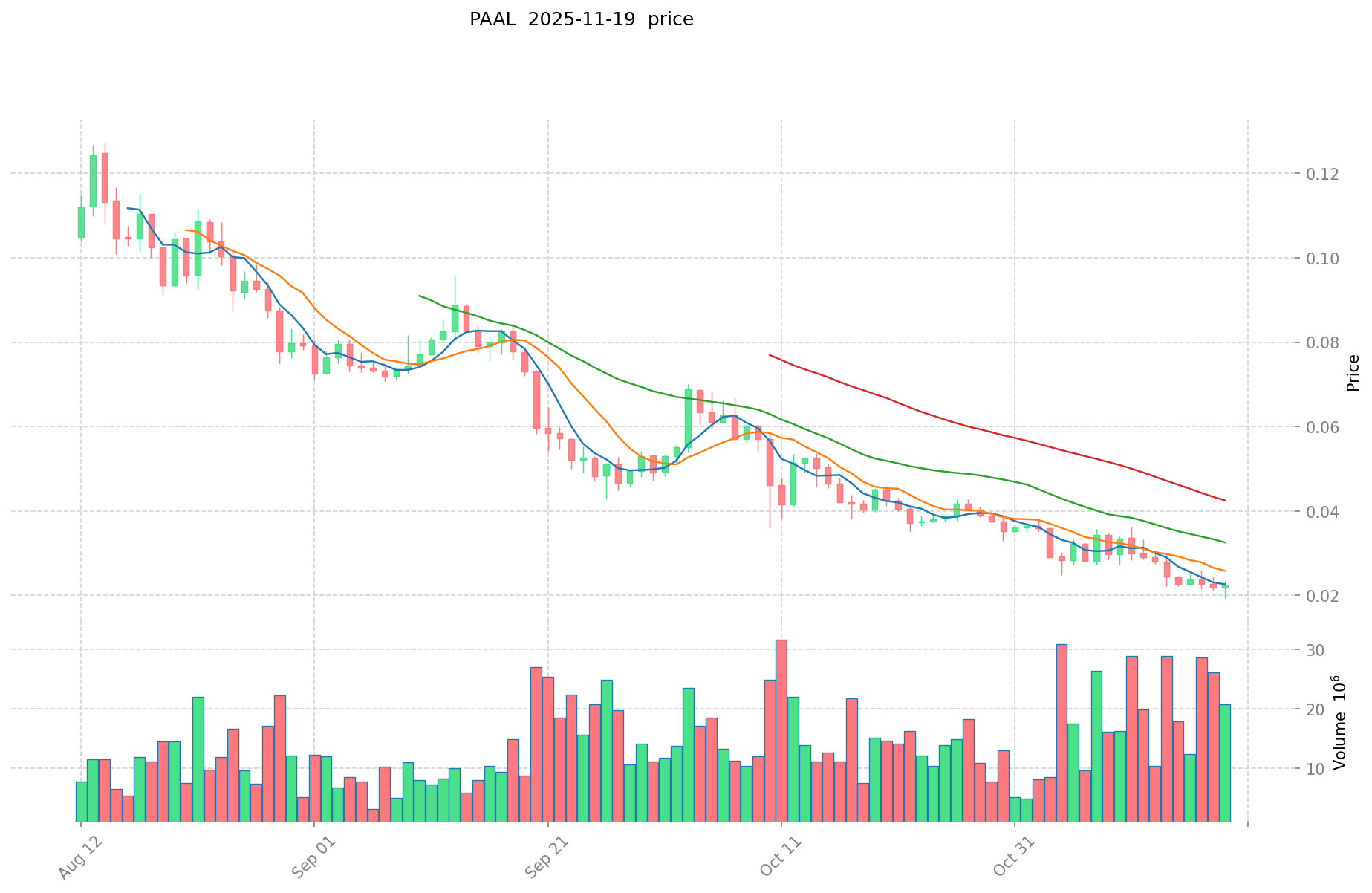
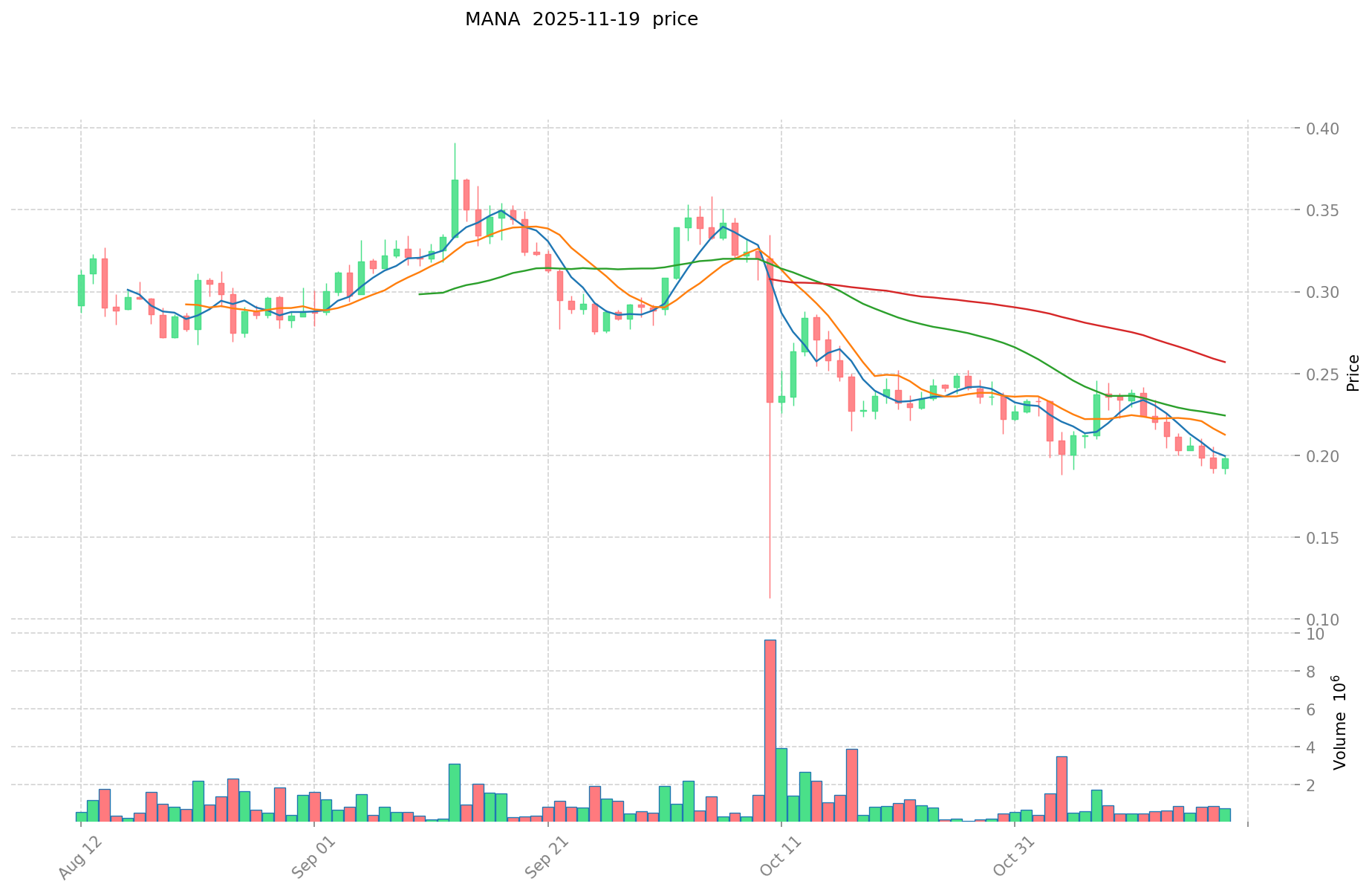
  • Comparative analysis: In the recent market cycle, PAAL dropped from its high of $0.88 to a current price of $0.02058, while MANA declined from $5.85 to $0.193.

Current Market Situation (2025-11-19)

  • PAAL current price: $0.02058
  • MANA current price: $0.193
  • 24-hour trading volume: $293,710.95 (PAAL) vs $91,093.84 (MANA)
  • Market Sentiment Index (Fear & Greed Index): 15 (Extreme Fear)

Click to view real-time prices:

price_image1 price_image2

Core Factors Influencing PAAL vs MANA Investment Value

Supply Mechanism Comparison (Tokenomics)

  • PAAL: Limited information available about supply mechanism
  • MANA: Decentraland's native token with fixed supply model
  • 📌 Historical Pattern: Supply mechanisms drive price cycles through scarcity and demand dynamics.

Institutional Adoption and Market Applications

  • Institutional Holdings: Insufficient data on institutional preference
  • Enterprise Adoption: Both tokens have varying levels of adoption in different sectors
  • Regulatory Attitudes: Regulatory frameworks vary by jurisdiction, affecting both tokens differently

Technical Development and Ecosystem Building

  • PAAL Technical Upgrades: Limited information on development roadmap
  • MANA Technical Development: Powers Decentraland metaverse economy
  • Ecosystem Comparison: MANA has established presence in metaverse and NFT applications

Macroeconomic Factors and Market Cycles

  • Performance in Inflationary Environments: Both cryptocurrencies subject to market volatility
  • Monetary Policy Impact: Interest rates and dollar strength affect overall crypto market sentiment
  • Geopolitical Factors: Cross-border transaction needs influence demand for both tokens

III. 2025-2030 Price Prediction: PAAL vs MANA

Short-term Prediction (2025)

  • PAAL: Conservative $0.0182-$0.0207 | Optimistic $0.0207-$0.0270
  • MANA: Conservative $0.0992-$0.1947 | Optimistic $0.1947-$0.2881

Mid-term Prediction (2027)

  • PAAL may enter a growth phase, with an estimated price range of $0.0179-$0.0412
  • MANA may enter a consolidation phase, with an estimated price range of $0.2295-$0.3399
  • Key drivers: Institutional capital inflow, ETF, ecosystem development

Long-term Prediction (2030)

  • PAAL: Base scenario $0.0446-$0.0607 | Optimistic scenario $0.0607-$0.0747
  • MANA: Base scenario $0.3567-$0.4209 | Optimistic scenario $0.4209-$0.4850

View detailed price predictions for PAAL and MANA

Disclaimer: The above predictions are based on historical data and market analysis. Cryptocurrency markets are highly volatile and subject to change. This information should not be considered as financial advice. Always conduct your own research before making investment decisions.

PAAL:

年份 预测最高价 预测平均价格 预测最低价 涨跌幅
2025 0.027001 0.02077 0.0182776 0
2026 0.034156265 0.0238855 0.018869545 16
2027 0.04120965315 0.0290208825 0.01799294715 41
2028 0.039329099964 0.035115267825 0.03195489372075 70
2029 0.0521110574523 0.0372221838945 0.033127743666105 80
2030 0.060746604115824 0.0446666206734 0.026353306197306 117

MANA:

年份 预测最高价 预测平均价格 预测最低价 涨跌幅
2025 0.288156 0.1947 0.099297 0
2026 0.35489916 0.241428 0.22452804 25
2027 0.3399064812 0.29816358 0.2295859566 54
2028 0.35093853366 0.3190350306 0.28713152754 65
2029 0.3785350638069 0.33498678213 0.2981382360957 73
2030 0.420977889102771 0.35676092296845 0.299679175293498 84

IV. Investment Strategy Comparison: PAAL vs MANA

Long-term vs Short-term Investment Strategies

  • PAAL: Suitable for investors focused on AI and ML-based ecosystems
  • MANA: Suitable for investors interested in metaverse and virtual world applications

Risk Management and Asset Allocation

  • Conservative investors: PAAL: 30% vs MANA: 70%
  • Aggressive investors: PAAL: 60% vs MANA: 40%
  • Hedging tools: Stablecoin allocation, options, cross-currency portfolio

V. Potential Risk Comparison

Market Risks

  • PAAL: Relatively new project, potentially higher volatility
  • MANA: Dependent on metaverse adoption rates

Technical Risks

  • PAAL: Scalability, network stability
  • MANA: Computing power concentration, security vulnerabilities

Regulatory Risks

  • Global regulatory policies may impact both tokens differently

VI. Conclusion: Which Is the Better Buy?

📌 Investment Value Summary:

  • PAAL advantages: Advanced AI and ML-based chatbot ecosystem, potential for growth in AI applications
  • MANA advantages: Established presence in metaverse and NFT applications, longer market history

✅ Investment Advice:

  • Novice investors: Consider a balanced approach, leaning towards MANA for its established market presence
  • Experienced investors: Explore opportunities in both, with a higher allocation to PAAL for potential growth
  • Institutional investors: Conduct thorough due diligence on both projects, considering MANA for its established ecosystem and PAAL for its innovative AI applications

⚠️ Risk Warning: The cryptocurrency market is highly volatile, and this article does not constitute investment advice. None

VII. FAQ

Q1: What are the main differences between PAAL and MANA? A: PAAL is a newer project focused on AI and ML-based chatbot ecosystems, while MANA is an established token powering the Decentraland metaverse platform. PAAL was launched in 2023, whereas MANA has been around since 2017.

Q2: Which token has performed better in terms of price history? A: MANA reached a higher all-time high of $5.85 in November 2021, compared to PAAL's all-time high of $0.88 in March 2024. However, both have seen significant drops from their peaks, with PAAL currently at $0.02058 and MANA at $0.193.

Q3: How do the supply mechanisms of PAAL and MANA compare? A: Limited information is available about PAAL's supply mechanism. MANA has a fixed supply model as Decentraland's native token.

Q4: What are the key factors influencing the investment value of these tokens? A: Key factors include institutional adoption, technical development, ecosystem building, macroeconomic factors, and market cycles. Both tokens are influenced differently by these factors based on their unique characteristics and use cases.

Q5: What are the predicted price ranges for PAAL and MANA in 2030? A: For PAAL, the base scenario predicts a range of $0.0446-$0.0607, with an optimistic scenario of $0.0607-$0.0747. For MANA, the base scenario predicts $0.3567-$0.4209, with an optimistic scenario of $0.4209-$0.4850.

Q6: How should investors allocate their portfolio between PAAL and MANA? A: Conservative investors might consider allocating 30% to PAAL and 70% to MANA, while aggressive investors might opt for 60% PAAL and 40% MANA. However, individual allocations should be based on personal risk tolerance and investment goals.

Q7: What are the main risks associated with investing in PAAL and MANA? A: Both tokens face market risks, technical risks, and regulatory risks. PAAL, being a newer project, may have higher volatility. MANA's value is closely tied to metaverse adoption rates. Both are subject to potential regulatory changes in the cryptocurrency space.

* The information is not intended to be and does not constitute financial advice or any other recommendation of any sort offered or endorsed by Gate.
Related Articles
Is AI Meta Club (AMC) a good investment?: Analyzing the potential and risks of this emerging crypto project

Is AI Meta Club (AMC) a good investment?: Analyzing the potential and risks of this emerging crypto project

The article examines whether AI Meta Club (AMC) is a wise investment by evaluating its market performance, technological foundation, and potential risks. It addresses key investor concerns such as AMC's price trends, token utility, and future value forecasts. Targeting crypto enthusiasts and potential investors, the piece advises on market entry strategies and risk management. Structured into sections, it covers AMC's price history, project overview, and investment considerations. This guide benefits those interested in AI and Metaverse opportunities, emphasizing keywords like AMC investment, AI technology, market risks, and growth potential for clarity and SEO optimization.
11-27-2025, 5:21:31 PM
Is Sparkle (SSS) a good investment?: Analyzing the potential and risks of this emerging cryptocurrency

Is Sparkle (SSS) a good investment?: Analyzing the potential and risks of this emerging cryptocurrency

The article examines the investment potential of Sparkle (SSS), a cryptocurrency prominent in the AI-powered social metaverse sector, and provides traders with insights on its historical price trends, current market sentiment, and future outlook. It answers key questions about Sparkle’s differentiation from other cryptocurrencies, factors affecting its price, and its volatility as an investment. The article serves new and experienced investors, offering strategies for investing in Sparkle through Gate, while outlining market, regulatory, and technical risks. Readers gain a condensed guide for assessing whether Sparkle is a prudent investment choice.
11-25-2025, 12:21:40 PM
Is Alchemist AI (ALCH) a Good Investment? Analyzing Potential Returns and Risks in the Emerging AI Token Market

Is Alchemist AI (ALCH) a Good Investment? Analyzing Potential Returns and Risks in the Emerging AI Token Market

This article examines the investment potential of Alchemist AI (ALCH), focusing on its historical price performance, current market status, and future outlook. It discusses key influencing factors such as token scarcity, institutional investment, macroeconomic conditions, and technological advancements. Targeted at investors considering ALCH, the piece explores strategies like HODL and active trading, along with risk management principles. It addresses the tangible risks involved, offering insights into whether ALCH is a viable long-term investment. Real-time market data is available via Gate.com, optimizing reader engagement and SEO effectiveness.
9-30-2025, 1:57:54 PM
IN vs MANA: Exploring the Key Differences Between Indian Rupee and Decentraland's Digital Currency

IN vs MANA: Exploring the Key Differences Between Indian Rupee and Decentraland's Digital Currency

This article explores the key differences between the Indian Rupee (IN) and Decentraland's digital currency (MANA), focusing on investment value, price history, and market status. It addresses investor concerns about which currency is the better buy, considering supply mechanisms, institutional adoption, and technical development. The piece provides insights into short, mid, and long-term price predictions and compares investment strategies for IN and MANA. Targeting investors interested in AI-powered DeFi and metaverse projects, the article also highlights potential risks and offers asset allocation advice. Readers can check real-time prices via Gate.
10-4-2025, 12:29:23 AM
Is tokenbot (CLANKER) a good investment?: Analyzing the potential and risks of this emerging digital asset

Is tokenbot (CLANKER) a good investment?: Analyzing the potential and risks of this emerging digital asset

This article dives into the investment potential of tokenbot (CLANKER) by analyzing its historical trends, current market status, and investment risks. It paints a comprehensive picture, addressing whether CLANKER stands as a good investment based on its supply mechanics, adoption prospects, and macroeconomic influences. Targeting cryptocurrency investors, it offers valuable insights into investment strategies and risk management, championing CLANKER's innovative AI-driven token deployment. The article systematically guides readers through CLANKER's price history, influencing factors, investment outlook, strategy, and inherent risks, fostering informed decision-making for potential and active investors.
10-3-2025, 12:27:49 PM
DNX vs SAND: Comparing Two Emerging Blockchain Platforms for DeFi Applications

DNX vs SAND: Comparing Two Emerging Blockchain Platforms for DeFi Applications

The article compares Dynex (DNX) and The Sandbox (SAND) as emerging blockchain platforms for DeFi applications, offering insights into their investment potential. It addresses key questions like "Which is the better buy," focusing on price trends, technology, and market adoption. Readers interested in crypto investments gain valuable analysis of DNX's neuromorphic computing versus SAND's metaverse gaming. Structured in sections, it discusses historical price comparisons, technological features, market positioning, investment strategies, and risk assessment, providing a comprehensive overview for informed decision-making. Visit Gate for real-time pricing.
10-12-2025, 12:24:37 AM
Recommended for You
Top ASIC Devices for Efficient Cryptocurrency Mining
Top ASIC Devices for Efficient Cryptocurrency Mining

The article reviews the top ASIC devices for efficient cryptocurrency mining, focusing on the balance between hash rate, power consumption, and device cost. It addresses the crucial choice of ASIC miners, emphasizing their impact on profitability due to operational expenses and energy use. Targeting crypto miners, it presents a structured analysis of nine leading ASIC miners, highlighting performance, efficiency, and unique features. It provides actionable insights for miners on optimizing their operations to ensure competitive and profitable engagements in the evolving crypto industry. Key topics include hardware specifications, efficiency metrics, and market competitiveness.
12-12-2025, 10:52:18 AM
Understanding the Bitcoin Proof of Work Consensus Mechanism
Understanding the Bitcoin Proof of Work Consensus Mechanism

The article explores Bitcoin's Proof of Work (PoW) consensus mechanism, a crucial innovation ensuring network security and decentralization. It covers PoW's history, operational process, security features, benefits, and the challenges it faces, including scalability, centralization, and environmental concerns. By comparing PoW with mechanisms like Proof of Stake, the article delivers valuable insights for participants in the cryptocurrency ecosystem. Keywords such as Bitcoin, Proof of Work, security, decentralization, and cryptocurrency are optimized for quick comprehension, providing readers a comprehensive framework on Bitcoin's foundational technology.
12-12-2025, 10:45:09 AM
Understanding Ethereum Gas Costs and How to Minimize Them
Understanding Ethereum Gas Costs and How to Minimize Them

This article dives into understanding Ethereum gas fees and strategies for minimizing them. As Ethereum gains traction in DeFi, ether gas fees are skyrocketing, causing network congestion. Key topics include gas limits, transaction costs, and influential factors like function complexity and network status. Solutions for reducing fees encompass timing, DApps, gas tokens, and Layer-2 options. Ideal for Ethereum users seeking efficient transaction strategies, this guide offers insights into optimizing costs and maintaining network security. Keywords enhance readability, promoting quick scans for essential details.
12-12-2025, 10:42:40 AM
Understanding ERC-20: A Comprehensive Guide to Token Standards

Understanding ERC-20: A Comprehensive Guide to Token Standards

The article "Understanding ERC-20: A Comprehensive Guide to Token Standards" delves into the significance of the ERC-20 token standard in simplifying Ethereum blockchain development. It addresses issues like interoperability, development complexity, and efficiency, making it crucial for developers and crypto enthusiasts. The article covers a range of topics, from the technicalities and benefits of ERC-20 to its limitations and popular examples. It provides an overview of alternative token standards and concludes with the transformative impact of ERC-20 on the Ethereum ecosystem. Keywords like "ERC-20 tokens," "Ethereum blockchain," and "token standards" optimize readability and targeting.
12-12-2025, 10:40:16 AM
Understanding Directed Acyclic Graph (DAG) in Blockchain Technology
Understanding Directed Acyclic Graph (DAG) in Blockchain Technology

This article provides a comprehensive overview of Directed Acyclic Graph (DAG) technology in blockchain, highlighting its advantages such as faster transaction speeds, scalability, and zero transaction fees. It contrasts DAG with blockchain, explaining structural and operational differences, while addressing decentralization concerns. Real-world applications and examples like IOTA, Nano, and BlockDAG demonstrate DAG's potential in the crypto ecosystem. Despite challenges, DAG serves as a complementary solution for specific use cases. Keywords: DAG technology, blockchain, cryptocurrency, transaction speed, scalability, decentralization.
12-12-2025, 10:37:15 AM
Understanding Ordinal NFTs: What They Are and How They Function

Understanding Ordinal NFTs: What They Are and How They Function

The article explores the revolutionary concept of Bitcoin ordinals, which allow the creation of unique digital collectibles directly on the Bitcoin blockchain through a novel protocol. It addresses the fundamental differences between traditional NFTs and Bitcoin ordinals, explaining ordinal theory and its impact on tracking satoshis. The piece also delves into the inscription process, recursive inscriptions, and the potential market influence on Ethereum's dominance. Aimed at both beginners and advanced users, the article offers insights into the development, benefits, and challenges of ordinal NFTs, appealing to those interested in blockchain innovations and digital ownership.
12-12-2025, 10:33:46 AM