


QUAI vs OP: Comparing Two Innovative Layer-2 Scaling Solutions for Blockchain Ecosystems


Introduction: QUAI vs OP Investment Comparison
In the cryptocurrency market, the comparison between Quai Network (QUAI) vs Optimism (OP) has been an unavoidable topic for investors. The two not only show significant differences in market cap ranking, application scenarios, and price performance, but also represent different positioning in crypto assets.
Quai Network (QUAI): Since its launch, it has gained market recognition for its next-generation proof-of-work Layer 1 blockchain aimed at creating a new decentralized global monetary system.
Optimism (OP): Introduced as a low-cost, lightning-fast Ethereum Layer 2 blockchain, it has been addressing the practical needs of developers and users since its inception.
This article will provide a comprehensive analysis of the investment value comparison between QUAI and OP, focusing on historical price trends, supply mechanisms, institutional adoption, technological ecosystems, and future predictions, attempting to answer the question most crucial to investors:
"Which is the better buy right now?"
I. Price History Comparison and Current Market Status
QUAI and OP Historical Price Trends
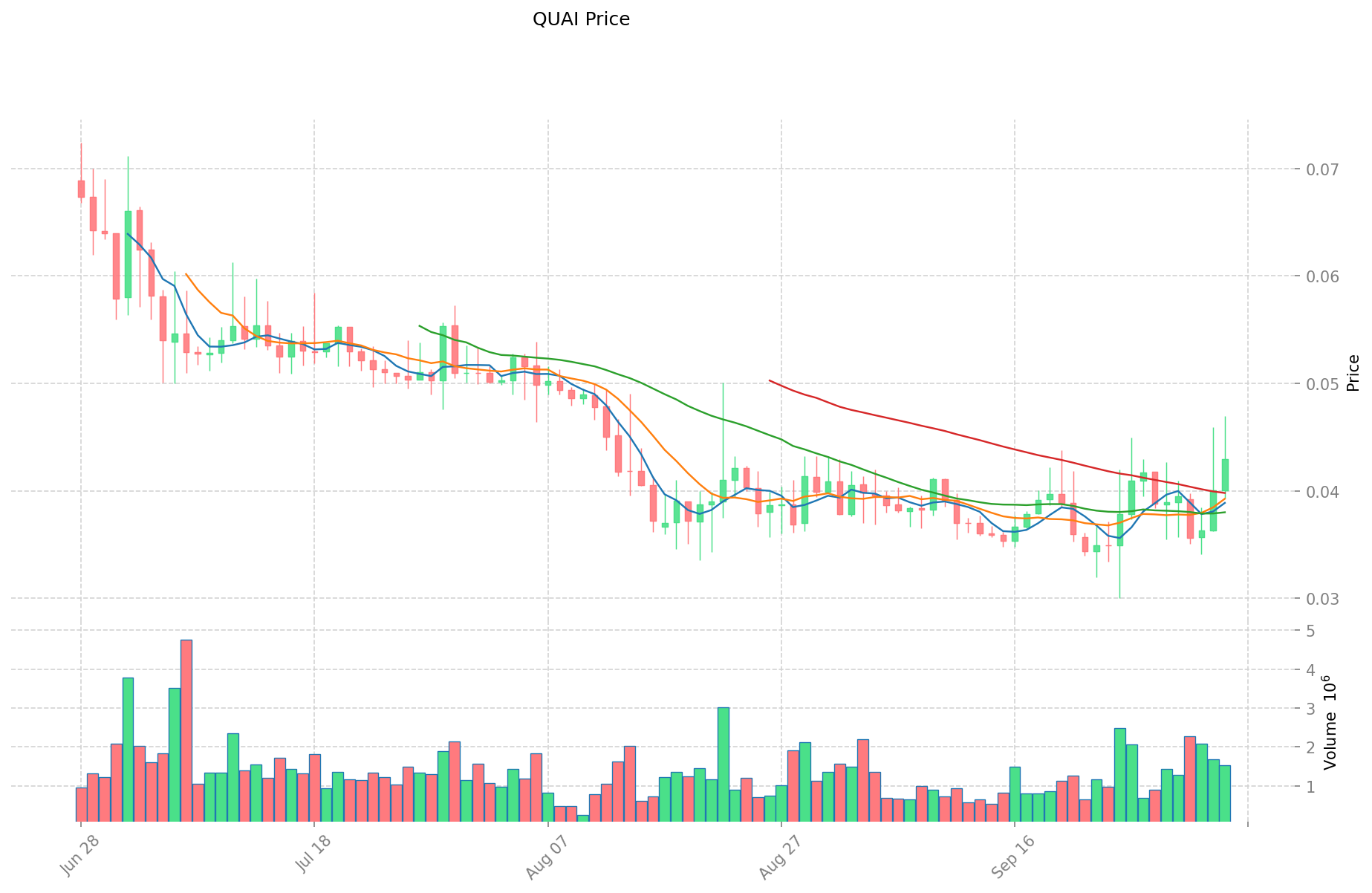
- 2025: QUAI reached its all-time high of $0.37141 on February 24, 2025.
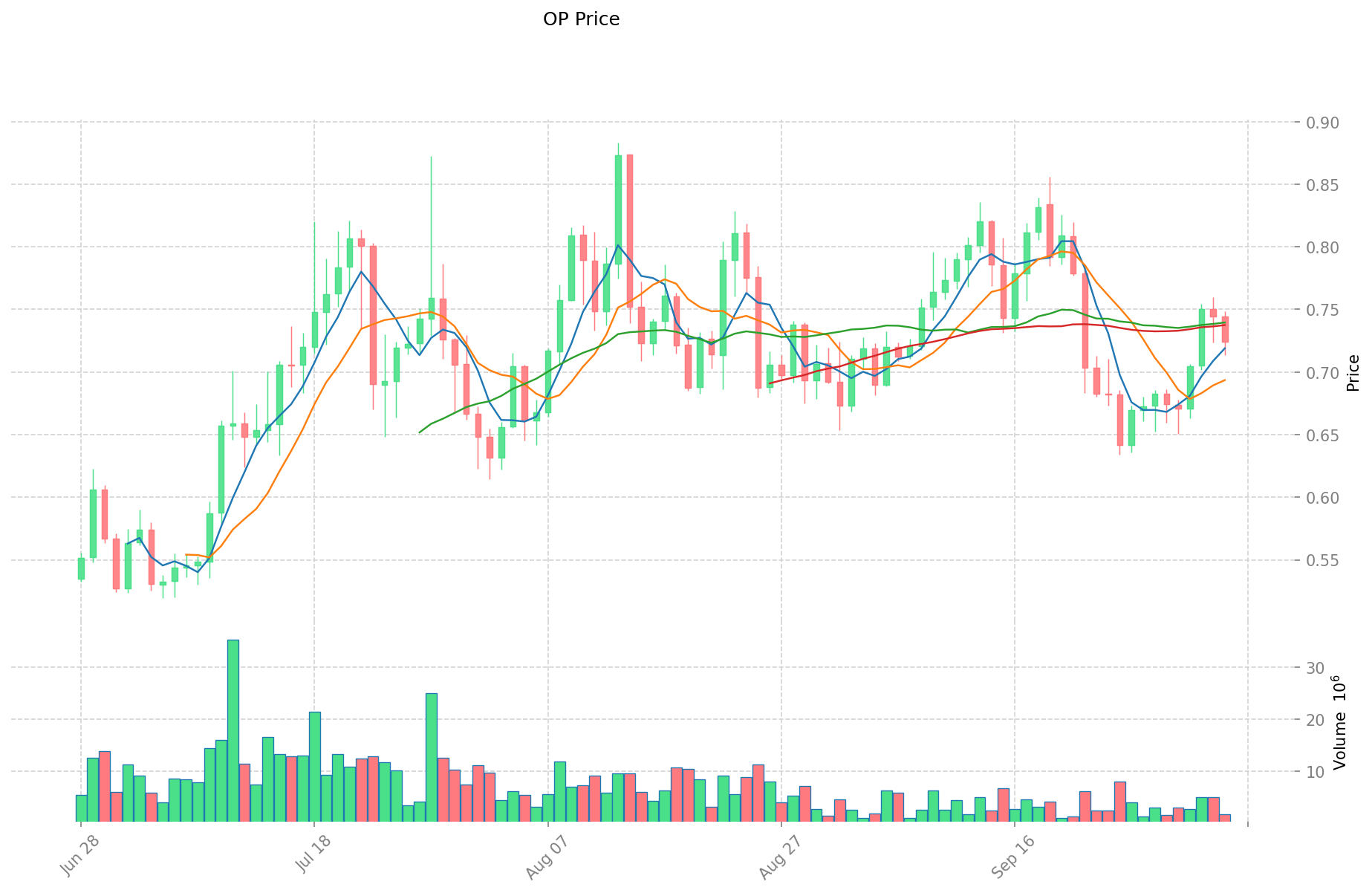
- 2025: OP hit its all-time high of $4.84 on March 6, 2025.
- Comparative analysis: In the recent market cycle, QUAI dropped from its high of $0.37141 to a low of $0.03, while OP fell from $4.84 to its current price of $0.7252.
Current Market Situation (2025-10-05)
- QUAI current price: $0.0429
- OP current price: $0.7252
- 24-hour trading volume: QUAI $63,944.15 vs OP $1,291,988.78
- Market Sentiment Index (Fear & Greed Index): 71 (Greed)
Click to view real-time prices:
- Check QUAI current price Market Price
- Check OP current price Market Price
II. Core Factors Affecting QUAI vs OP Investment Value
Supply Mechanism Comparison (Tokenomics)
- Quai Network: Features the Qi token as an energy-backed "flatcoin" where value is directly linked to the energy costs of mining, allowing supply to flexibly respond to market demand and mining costs
- OP: Not mentioned in the provided references
Institutional Adoption and Market Applications
- Quai Network appears to be positioning itself in the PayFi ecosystem, though specific institutional holdings are not detailed in the references
- Both tokens received new funding in recent months, with Quai Network being mentioned specifically as one of three Layer 1 blockchains that secured financing in August 2024
Technical Development and Ecosystem Building
- Quai Network: Positioned as a crypto infrastructure project driving both technology and applications, particularly in the PayFi space
- Quai's dual-token system includes Qi, which functions as an energy-backed "flatcoin"
Macroeconomic Factors and Market Cycles
- Quai Network's "flatcoin" model may provide a different value proposition compared to traditional cryptocurrencies, as its value is tied to energy costs rather than purely market speculation
- The recent funding secured by Quai Network suggests investor confidence in its growth potential during the current market cycle
III. 2025-2030 Price Prediction: QUAI vs OP
Short-term Prediction (2025)
- QUAI: Conservative $0.0360 - $0.0429 | Optimistic $0.0429 - $0.0510
- OP: Conservative $0.6384 - $0.7254 | Optimistic $0.7254 - $0.8342
Mid-term Prediction (2027)
- QUAI may enter a growth phase, with estimated prices $0.0373 - $0.0578
- OP may enter a bullish market, with estimated prices $0.7074 - $1.0612
- Key drivers: Institutional capital inflow, ETF, ecosystem development
Long-term Prediction (2030)
- QUAI: Base scenario $0.0681 - $0.0852 | Optimistic scenario $0.0852 - $0.1000
- OP: Base scenario $0.8538 - $1.3340 | Optimistic scenario $1.3340 - $1.8542
Disclaimer: The above predictions are based on historical data and market analysis. Cryptocurrency markets are highly volatile and subject to change. This information should not be considered as financial advice. Always conduct your own research before making investment decisions.
QUAI:
| 年份 | 预测最高价 | 预测平均价格 | 预测最低价 | 涨跌幅 |
|---|---|---|---|---|
| 2025 | 0.0510272 | 0.04288 | 0.0360192 | 0 |
| 2026 | 0.06103968 | 0.0469536 | 0.036623808 | 9 |
| 2027 | 0.0577764048 | 0.05399664 | 0.0372576816 | 25 |
| 2028 | 0.077682266136 | 0.0558865224 | 0.032414182992 | 30 |
| 2029 | 0.06945577003872 | 0.066784394268 | 0.06478086243996 | 55 |
| 2030 | 0.0851501026917 | 0.06812008215336 | 0.05313366407962 | 58 |
OP:
| 年份 | 预测最高价 | 预测平均价格 | 预测最低价 | 涨跌幅 |
|---|---|---|---|---|
| 2025 | 0.83421 | 0.7254 | 0.638352 | 0 |
| 2026 | 0.9045738 | 0.779805 | 0.7330167 | 7 |
| 2027 | 1.061158644 | 0.8421894 | 0.707439096 | 16 |
| 2028 | 1.39896081234 | 0.951674022 | 0.6185881143 | 31 |
| 2029 | 1.4926531198059 | 1.17531741717 | 1.1047983721398 | 62 |
| 2030 | 1.85423952319825 | 1.33398526848795 | 0.853750571832288 | 83 |
IV. Investment Strategy Comparison: QUAI vs OP
Long-term vs Short-term Investment Strategies
- QUAI: Suitable for investors focused on PayFi ecosystem and energy-backed value proposition
- OP: Suitable for investors seeking Ethereum Layer 2 scalability solutions
Risk Management and Asset Allocation
- Conservative investors: QUAI: 30% vs OP: 70%
- Aggressive investors: QUAI: 60% vs OP: 40%
- Hedging tools: Stablecoin allocation, options, cross-currency portfolio
V. Potential Risk Comparison
Market Risk
- QUAI: Volatility due to newer market entry and less established market presence
- OP: Dependency on Ethereum ecosystem performance and Layer 2 adoption rates
Technical Risk
- QUAI: Scalability, network stability
- OP: Reliance on Ethereum's development, potential Layer 2 competition
Regulatory Risk
- Global regulatory policies may have differing impacts on both tokens, particularly regarding energy consumption for QUAI and Layer 2 solutions for OP
VI. Conclusion: Which Is the Better Buy?
📌 Investment Value Summary:
- QUAI advantages: Energy-backed "flatcoin" model, potential in PayFi ecosystem
- OP advantages: Established Ethereum Layer 2 solution, larger market presence
✅ Investment Advice:
- New investors: Consider a balanced approach, leaning towards OP for its more established market position
- Experienced investors: Explore QUAI for its innovative model while maintaining OP exposure
- Institutional investors: Diversify between both, with a focus on OP for current market applications and QUAI for potential future growth
⚠️ Risk Warning: The cryptocurrency market is highly volatile. This article does not constitute investment advice. None
VII. FAQ
Q1: What are the key differences between QUAI and OP? A: QUAI is positioned as a next-generation proof-of-work Layer 1 blockchain with a focus on creating a decentralized global monetary system, while OP is an Ethereum Layer 2 solution aimed at providing low-cost, fast transactions. QUAI features an energy-backed "flatcoin" model, while OP is more established in the Ethereum ecosystem.
Q2: Which token has shown better price performance recently? A: Based on the provided data, OP has shown better price performance. While QUAI's all-time high was $0.37141, it has dropped to $0.0429. OP reached an all-time high of $4.84 and is currently trading at $0.7252, representing a smaller percentage decline from its peak.
Q3: What are the main factors affecting the investment value of QUAI and OP? A: Key factors include supply mechanisms (tokenomics), institutional adoption, technical development, ecosystem building, and macroeconomic conditions. QUAI's energy-backed "flatcoin" model and focus on PayFi are unique factors, while OP benefits from its established position in the Ethereum Layer 2 ecosystem.
Q4: How do the long-term price predictions for QUAI and OP compare? A: For 2030, QUAI's base scenario predicts a range of $0.0681 - $0.0852, with an optimistic scenario of $0.0852 - $0.1000. OP's base scenario for 2030 is $0.8538 - $1.3340, with an optimistic scenario of $1.3340 - $1.8542. These predictions suggest potentially higher percentage gains for OP in the long term.
Q5: What are the main risks associated with investing in QUAI and OP? A: Both tokens face market risks due to cryptocurrency volatility. QUAI may face additional volatility due to its newer market entry and less established presence. Technical risks for QUAI include scalability and network stability, while OP's risks are tied to Ethereum's development and Layer 2 competition. Both face potential regulatory risks, with QUAI potentially more affected by energy consumption regulations.
Q6: How should different types of investors approach QUAI and OP? A: New investors might consider a balanced approach with a lean towards OP for its more established market position. Experienced investors could explore QUAI for its innovative model while maintaining OP exposure. Institutional investors might diversify between both, focusing on OP for current market applications and QUAI for potential future growth.
Share
Content
Introduction: QUAI vs OP Investment Comparison
I. Price History Comparison and Current Market Status
II. Core Factors Affecting QUAI vs OP Investment Value
III. 2025-2030 Price Prediction: QUAI vs OP
IV. Investment Strategy Comparison: QUAI vs OP
V. Potential Risk Comparison
VI. Conclusion: Which Is the Better Buy?
VII. FAQ
How to Buy Cryptocurrency


Trending Cryptocurrencies



XION vs OP: Comparing Layer 2 Solutions for Ethereum Scalability and Performance
2025 LINEA Price Prediction: Bullish Outlook as Layer 2 Adoption Accelerates
Understanding Mantle Network: A Comprehensive Guide to Crypto Solutions
Aptos vs Giants: Performance Analysis & Market Share of This Rising Layer 1 Blockchain

Crypto Assets bankruptcy news

2025 SUI价格预测:区块链新贵的未来发展与投资价值分析
Do Kwon’s Prison Sentence Marks a New Chapter for Terra and the Legacy of LUNA

Xenea Daily Quiz Answer December 14, 2025

Beginner's Guide to Understanding Crypto Terminology

Understanding Soulbound Tokens: A New Frontier in NFTs

Understanding Tendermint's Consensus Mechanism in Blockchain Technology
