What is AO: Exploring the Advanced Oxidation Process in Water Treatment

11-18-2025, 6:43:44 PM
Altcoins
Blockchain
Crypto Ecosystem
Crypto Insights
Web 3.0
Article Rating : 3.9
half-star
0 ratings
The article explores AO, an innovative decentralized compute system launched in 2025 within the blockchain industry. It details AO's technical architecture, market performance, and its integration into decentralized applications. This comprehensive analysis addresses challenges AO faces, such as technical hurdles and adoption barriers. It offers insights for developers, investors, and blockchain enthusiasts interested in parallel processing and message-passing ecosystems. With a focus on AO’s market dynamics and future potential, the article provides valuable information for those looking to participate in AO through platforms like Gate.
What is AO: Exploring the Advanced Oxidation Process in Water Treatment

AO's Positioning and Significance

In 2025, AO (AO) was introduced as a decentralized compute system. As a pioneering platform for parallel process interaction, AO plays a crucial role in distributed computing and decentralized applications.

As of 2025, AO has become an innovative project in the blockchain industry, offering a unique approach to decentralized computing. This article will analyze its technical architecture, market performance, and future potential.

Origins and Development History

Birth Background

AO was created in 2025, aiming to provide a decentralized compute system where countless parallel processes interact within a single, cohesive environment. It was born in the context of advancing blockchain technology, with the goal of revolutionizing distributed computing through seamless process interaction and native message-passing.

AO's launch brought new possibilities for developers and users seeking a unified environment for decentralized applications.

Important Milestones

  • 2025: Mainnet launch, achieving a cohesive environment for parallel processes.

With the support of its community and developers, AO continues to optimize its technology, security, and real-world applications.

How Does AO Work?

No Central Control

AO operates on a decentralized network of computers (nodes) spread across the globe, free from control by any single entity. These nodes collaborate to validate interactions, ensuring system transparency and attack resistance, granting users greater autonomy and enhancing network resilience.

Blockchain Core

AO's blockchain is a public, immutable digital ledger that records every interaction. Transactions are grouped into blocks and linked through cryptographic hashes, forming a secure chain. Anyone can view the records, establishing trust without intermediaries.

Ensuring Fairness

AO uses its native consensus mechanism to validate interactions and prevent fraudulent behavior. Participants maintain network security through running nodes and are rewarded with AO tokens.

Secure Transactions

AO uses public-key cryptography to protect transactions:

  • Private keys (like secret passwords) are used to sign transactions
  • Public keys (like account numbers) are used to verify ownership

This mechanism ensures fund security, while transactions maintain a pseudonymous nature.

AO's Market Performance

Circulation Overview

As of November 19, 2025, AO's circulating supply is 5,063,698.871358 tokens, with a total supply of 3,565,638 tokens.

Price Fluctuations

AO reached its all-time high of $28.32 on March 20, 2025. Its lowest price was $3.8, occurring on October 26, 2025. These fluctuations reflect market sentiment, adoption trends, and external factors.

Click to view the current market price of AO
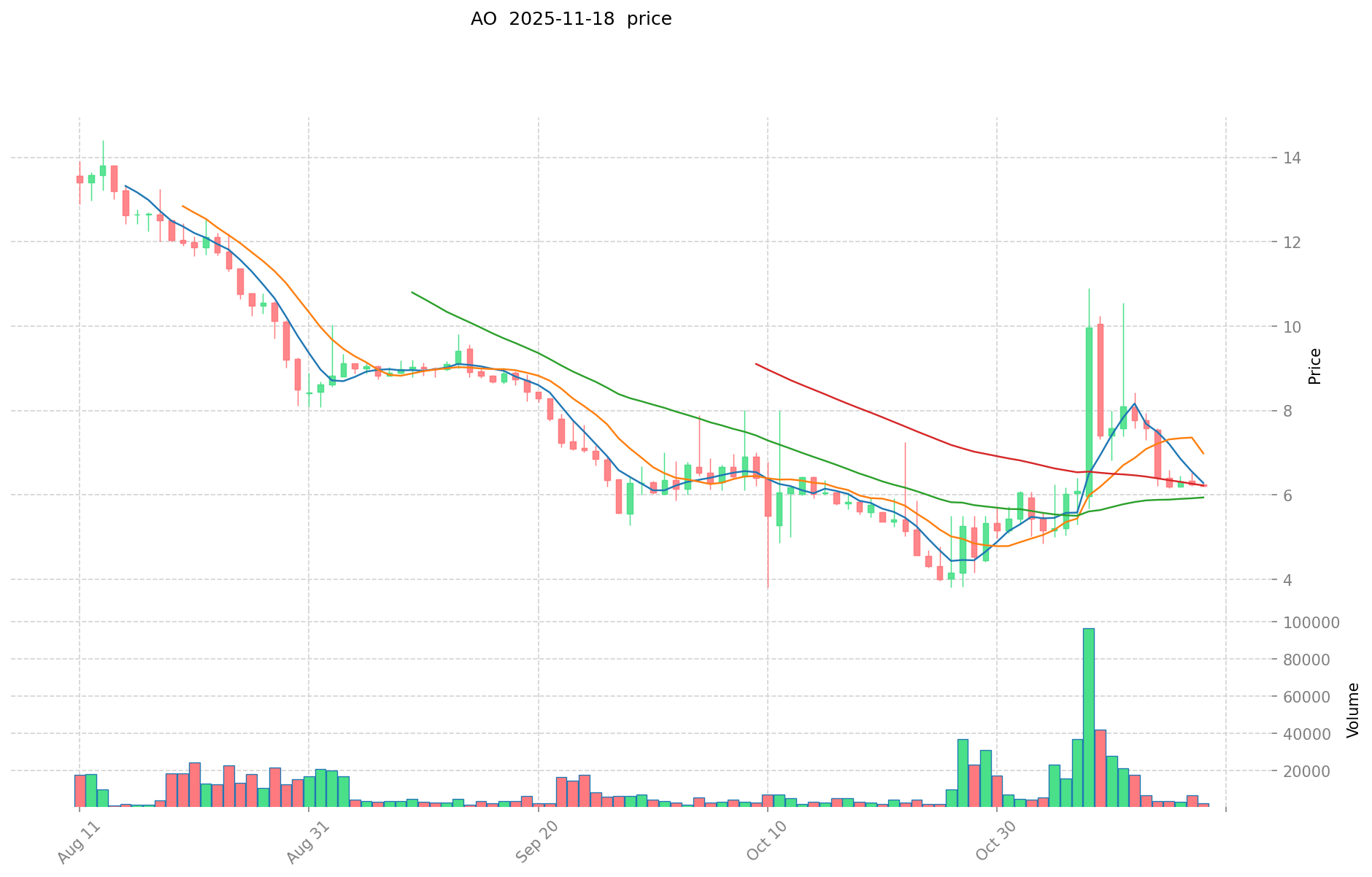
price-image

AO Ecosystem Applications and Partnerships

Core Use Cases

AO's ecosystem supports various applications:

  • Decentralized Computing: Countless parallel processes interact within a single, cohesive environment.
  • Message Passing: Processes are seamlessly connected through a native message-passing layer.

Strategic Partnerships

Information about AO's strategic partnerships is not available in the provided context.

Controversies and Challenges

AO faces the following challenges:

  • Technical Challenges: Implementing a decentralized compute system with countless parallel processes.
  • Adoption Hurdles: Gaining widespread acceptance for its unique approach to decentralized computing.

These issues drive ongoing innovation within the AO project.

AO Community and Social Media Atmosphere

Fan Enthusiasm

AO's community metrics are not provided in the given context.

Social Media Sentiment

X platform sentiment for AO is not available in the provided information.

Hot Topics

Specific hot topics related to AO are not mentioned in the given context.

More Information Sources for AO

  • Official Website: Visit AO official website for features, use cases, and latest updates.
  • Whitepaper: AO whitepaper details its technical architecture, goals, and vision.
  • X Updates: On X platform, AO uses @aoTheComputer. Follower count and engagement metrics are not provided.

AO Future Roadmap

Specific future roadmap details for AO are not available in the given context.

How to Participate in AO?

  1. Purchase Channels: AO can be purchased on Gate.com.
  2. Storage Solutions: Specific wallet recommendations for AO are not provided.
  3. Governance Participation: Information on AO's governance process is not available.
  4. Ecosystem Building: Visit AO Explorer for more information on the AO network.

Summary

AO redefines decentralized computing through blockchain technology, offering a system where countless parallel processes interact within a single, cohesive environment. Its approach to native message-passing, similar to how websites form the World Wide Web, sets it apart in the cryptocurrency landscape.

While facing challenges in implementing its unique decentralized compute system and gaining widespread adoption, AO's innovative spirit positions it as an interesting project in the future of decentralized technologies.

As of November 19, 2025, AO has a market cap of $32,351,972.09 and is ranked 745th in the cryptocurrency market. With a circulating supply of 5,063,698.87 AO and a total supply of 3,565,638 AO, the project shows potential for growth and development in the decentralized computing space.

Whether you're a newcomer or an experienced player in the crypto space, AO presents an intriguing concept worth watching and potentially engaging with.

FAQ

What does AO stand for?

AO stands for Area of Operations. It defines the geographic boundaries for military activities and strategic planning.

What is the AO company?

AO is a major distributor of Globe Life insurance products in North America, focusing on serving working families with life insurance solutions.

What is AO in medical terms?

AO stands for Alert and Oriented, indicating a patient's awareness and ability to recognize time, place, and person.

What does AO.com stand for?

AO.com stands for 'Anything Online', reflecting the company's broad e-commerce focus beyond just appliances.

* The information is not intended to be and does not constitute financial advice or any other recommendation of any sort offered or endorsed by Gate.
Related Articles
What is ABT: Understanding the Art of Narrative Structure in Storytelling

What is ABT: Understanding the Art of Narrative Structure in Storytelling

This article explores the essence and impact of ArcBlock (ABT), a pioneering blockchain ecosystem launched in 2018, which integrates blockchain with cloud computing to bolster decentralized application development. It delves into ArcBlock's technical architecture, market trajectory, and ecosystem applications, highlighting its significance amid market competitors. The article addresses challenges such as scalability and regulatory risks, suitable for blockchain professionals and enthusiasts seeking comprehensive insights into ArcBlock’s operational dynamics and community engagement. Key sections include ArcBlock's history, market performance, real-world applications, and a future roadmap, emphasizing its transformative potential in the decentralized tech landscape.
9-29-2025, 8:27:53 AM
How Have Security Breaches Impacted Stellar (XLM) Since 2017?

How Have Security Breaches Impacted Stellar (XLM) Since 2017?

This article examines the impact of security breaches on Stellar (XLM) since 2017, highlighting vulnerabilities and responses. It discusses significant exploits, including the 2017 smart contract bug causing $10 million inflation, the 2018 DNS hijacking attack stealing $400,000, and ongoing custody risks on centralized exchanges like Gate. The piece offers insights into risks for XLM holders, emphasizing thorough security practices and alternative storage solutions for minimizing vulnerabilities, targeting developers, investors, and security-conscious cryptocurrency users seeking to safeguard their assets.
10-28-2025, 12:15:00 PM
What is SMART: A Goal-Setting Framework for Achieving Success

What is SMART: A Goal-Setting Framework for Achieving Success

This article explores SMART, a strategic framework for goal-setting with a focus on blockchain development, offering insights into its impact and market position. It addresses efficiency in decentralized network creation, highlighting SMART's foundational role in the blockchain space. Readers will learn about SMART's technical architecture, key milestones, and market performance, relevant for developers, investors, and businesses seeking blockchain solutions. Through a clear, concise structure, the article enhances understanding of SMART's ecosystem applications, community engagement, and future prospects, making it essential reading for anyone interested in decentralized innovations.
11-14-2025, 7:42:18 AM
What is CBK: Understanding the Core Banking Knowledge Framework and Its Importance in Modern Banking Systems

What is CBK: Understanding the Core Banking Knowledge Framework and Its Importance in Modern Banking Systems

This article explores Cobak (CBK), a decentralized community platform launched in 2020 to enhance communication between crypto investors and projects. It covers Cobak's positioning in the crypto space, technical architecture, market performance, ecosystem applications, and challenges. The piece addresses the need for effective community management and information dissemination in cryptocurrency, catering to investors and project teams alike. Structured in sections, it delves into Cobak's historical milestones, operational dynamics, market metrics, partnerships, controversies, and user engagement strategies. The reader will gain insights into Cobak's role in the crypto ecosystem and its roadmap for future expansion.
9-30-2025, 8:36:19 AM
What is CCD: The Technology Behind Digital Imaging Sensors

What is CCD: The Technology Behind Digital Imaging Sensors

The article explores the technological foundation of Concordium (CCD), a proof-of-stake blockchain emphasizing regulatory compliance and identity verification. It addresses business needs for secure, decentralized identity solutions and regulatory adherence in blockchain applications. Content unfolds logically from Concordium's inception and development milestones to its operational mechanics and market performance. Highlighting partnerships and controversies, it provides insights into its ecosystem and community dynamics. Readers gain an understanding of CCD’s market impact, ecosystem applications, and strategic collaborations with access to purchase options via Gate.
11-15-2025, 9:41:17 AM
What is MDT: Exploring the Mountain Daylight Time Zone and Its Impact on Global Communications
What is MDT: Exploring the Mountain Daylight Time Zone and Its Impact on Global Communications

This article explores the MeasurableDataToken (MDT) and its significance in the decentralized data economy. Launched in 2017, MDT addresses data privacy and fair value exchange, becoming a key player in blockchain data monetization. It discusses the technical architecture, market performance, and ecosystem applications, highlighting MDT's decentralized network and secure transactions. Challenges such as market competition and privacy concerns are examined. For those interested in participating, purchase channels like Gate and storage solutions are provided alongside future goals. Readers gain insights into MDT's potential impact on data trading advancements.
11-21-2025, 12:41:15 PM
Recommended for You
Xenea Daily Quiz Answer December 13, 2025
Xenea Daily Quiz Answer December 13, 2025

Discover how Xenea Wallet's Daily Quiz on December 13, 2025, transforms crypto learning into rewarding experiences. This article provides today's quiz answer, details past ones for enhanced learning, and guides users on submission methods. It explores Xenea Wallet's features, including decentralized access and the ability to earn $XENE tokens through educational missions. Users will learn how to join the engaging airdrop campaign and stay informed about wallet updates and ecosystem expansions. Ideal for crypto enthusiasts, this piece ensures readers keep pace with Web3 innovation.
12-13-2025, 4:22:34 PM
Guide to Bridging Assets to the Polygon Network

Guide to Bridging Assets to the Polygon Network

This article is a comprehensive guide for cryptocurrency users on bridging assets to the Polygon network. It explains blockchain bridging's role in enabling interoperability between different networks, emphasizing Polygon's cost-effectiveness and speed. Readers will learn how to select wallets and assets for bridging and explore decentralized and centralized bridge services like Polygon Portal and Gate. The article outlines a step-by-step bridging process, discusses fee structures, timelines, and security measures, and provides troubleshooting tips. It's ideal for users looking to leverage the advantages of multiple blockchain ecosystems efficiently.
12-13-2025, 2:55:07 PM
Guide to Integrating Polygon Network with Your Crypto Wallet
Guide to Integrating Polygon Network with Your Crypto Wallet

This article provides a step-by-step guide to integrating the Polygon network with MetaMask, highlighting its benefits such as fast transactions and low fees. It addresses how to leverage Polygon for decentralized applications, including DeFi, NFTs, and gaming, ideal for developers and users seeking affordable blockchain solutions. The structured content covers adding Polygon to MetaMask, understanding its network features, and practical tips for optimized use. Enhance your crypto experience by following best practices for a secure integration and utilizing Polygon’s scalable ecosystem.
12-13-2025, 2:47:37 PM
Beginner's Guide to Secure Digital Asset Storage with BEP2
Beginner's Guide to Secure Digital Asset Storage with BEP2

"Beginner's Guide to Secure Digital Asset Storage with BEP2" explores BEP2 as a pivotal token standard in digital asset ecosystems, specifically on BNB Beacon Chain. The article compares BEP2 with BEP-20 and ERC-20 standards, detailing their operational differences and implications for users, especially in DeFi contexts. Readers unfamiliar with blockchain and seeking secure storage solutions can learn about BEP2's role, advantages, and limitations. Key insights include token migration, consensus mechanisms, and compatibility issues for asset management. Ideal for those engaging in decentralized trading and selecting suitable wallets.
12-13-2025, 2:44:20 PM
Guide to Bridging Assets to Polygon PoS Network
Guide to Bridging Assets to Polygon PoS Network

This article offers a detailed guide on bridging assets to the Polygon PoS Network, catering to cryptocurrency users seeking efficient cross-chain asset management. It addresses preparation steps, decentralized and centralized bridging methods, fee structures, security practices, and troubleshooting tips. Suitable for individuals new to blockchain bridging as well as those looking to optimize their transactions, it emphasizes the significance of wallets, asset selection, and reputable services like Polygon POS Bridge and Gate. Key themes include Polygon's advantages, interoperability, and practical strategies for secure asset transfers.
12-13-2025, 2:41:21 PM
Exploring Utility Tokens in Blockchain Technology

Exploring Utility Tokens in Blockchain Technology

This article explores the transformative role of utility tokens within blockchain technology, detailing how they extend beyond traditional cryptocurrencies to provide unique functionalities and governance within decentralized ecosystems. It addresses the differences between cryptocurrencies and crypto tokens, with a focus on real-world applications, especially in gaming, DeFi, and digital advertising sectors. Through illustrating examples such as The Sandbox (SAND) and Uniswap (UNI), readers learn about earning and utilizing these tokens. Designed for those interested in the dynamic Web3 landscape, it clarifies acquisition methods and enhances understanding of the cryptocurrency market. Key terms include utility tokens, decentralized applications, DeFi, and blockchain gaming.
12-13-2025, 2:37:53 PM

