In brief
- Google publicly set a 2029 deadline to transition its systems to post-quantum cryptography.
- Bitcoin faces long-term cryptographic risk as quantum breakthroughs compress security timelines.
- Crypto must coordinate a slow, decentralized migration to quantum-resistant standards under external pressure.
Google is done treating quantum computing as a future problem. On Tuesday, the company published a formal timeline for transitioning its entire infrastructure to post-quantum cryptography (PQC) by 2029—calling the move urgent and saying quantum frontiers “may be closer than they appear.”
“As a pioneer in both quantum and PQC, it’s our responsibility to lead by example and share an ambitious timeline,” the blog reads. “Quantum computers will pose a significant threat to current cryptographic standards, and specifically to encryption and digital signature.”
The announcement, signed by Google VP of Security Engineering Heather Adkins and Senior Cryptography Engineer Sophie Schmieg, describes the 2029 target as a response to rapid advances in quantum hardware, error correction, and factoring resource estimates.
In plain English: The machines that could theoretically crack today’s encryption are getting real, faster than expected.
Google’s warning rests on two distinct threats. The first is already happening. So-called “harvest now, decrypt later” attacks allow bad actors to steal encrypted data today and sit on it, confident they’ll be able to unlock it once quantum computers are powerful enough. That threat is present-tense. The second is future-facing: digital signatures, the cryptographic foundation of authentication across the internet, will need to be replaced before a cryptographically relevant quantum computer—a CRQC—arrives.
To lead by example, Google announced that Android 17 will integrate post-quantum digital signature protection using ML-DSA, an algorithm recently standardized by the U.S. National Institute of Standards and Technology (NIST). The company is also pushing PQC across Google Cloud and internal communications systems.
The 2029 deadline is not arbitrary. IBM has its own roadmap targeting fault-tolerant quantum systems by the same year. As both companies race toward that threshold, 2025 marked a turning point in the field—when error correction breakthroughs, new processor architectures, and a Caltech result trapping over 6,000 atomic qubits at once shifted the conversation from “if” to “when.”
What does it mean for Bitcoin?
Bitcoin runs on elliptic curve cryptography (or ECDSA signatures), the same class of math that quantum computers—running what’s known as Shor’s algorithm—could eventually reverse-engineer. That means: Given your public key, a sufficiently powerful quantum machine could derive your private key.
Normal computers would take centuries to crack something like this. Quantum computers may take that problem and turn it into something solvable in practical time.
The exposure is larger than most people realize. According to Project Eleven, a cybersecurity and crypto-focused startup working on protecting crypto from future quantum computer attacks, over 6.8 million Bitcoin—over $470 billion worth—sits in addresses that are vulnerable to quantum attacks, including coins from Bitcoin’s earliest days. A separate estimate from Ark Invest and Unchained puts roughly 35% of the total Bitcoin supply in address types theoretically vulnerable to a future quantum attack.
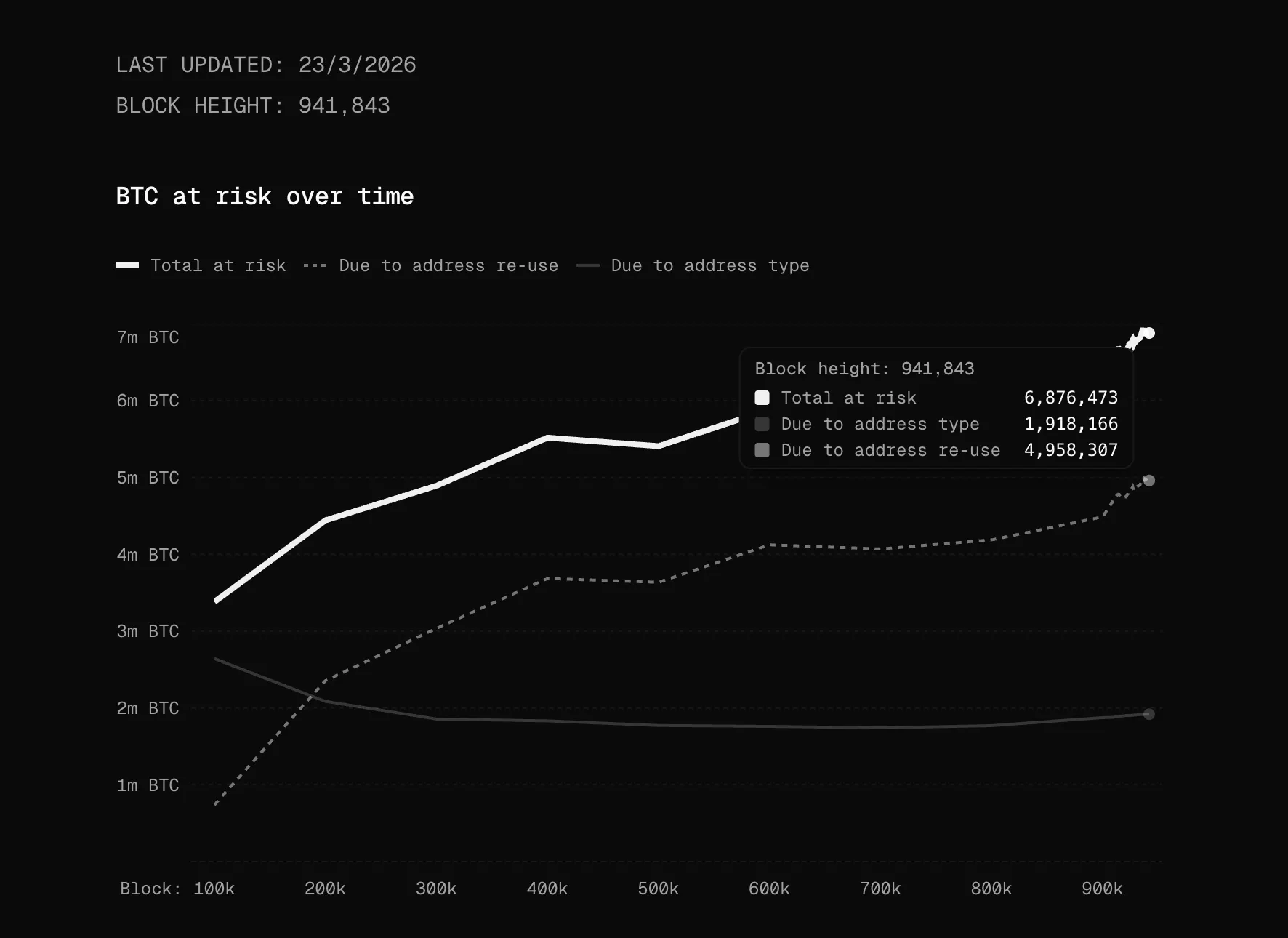
Source: Project eleven
Google’s researchers recently found that cracking RSA encryption may require 20 times fewer quantum resources than previously estimated—a finding that compressed the security timeline for everything that relies on similar mathematical structures, Bitcoin included. Earlier estimates put the qubit count needed to crack Bitcoin at around 20 million. Researchers at Iceberg Quantum now suggest the number could fall to roughly 100,000.
Quantum computers have achieved almost a 10x growth in power in the last five years.
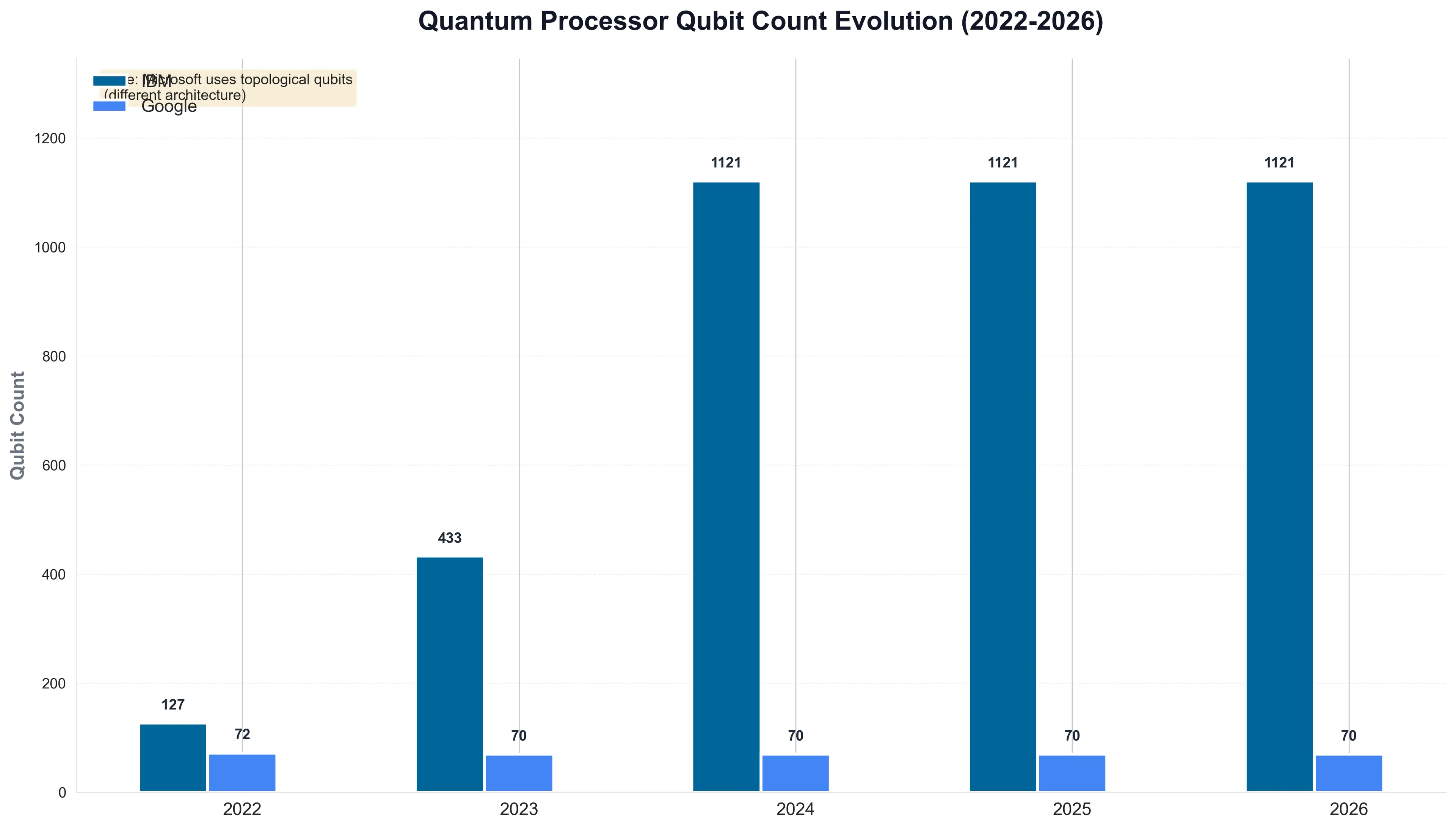
Source: Programming-Helper.com
So, should we all panic and sell our coins? Not really—but we should pay attention.
First of all, Google isn’t saying quantum computers will break cryptography by 2029. It’s simply saying it plans to be ready before they do.
Also, Bitcoin developers are not asleep at the wheel. BIP 360, a proposal introducing a quantum-resistant address format called Pay-to-Merkle-Root, was recently merged into Bitcoin’s formal improvement repository. It doesn’t activate anything—but it starts the clock on a serious overhaul.
Jameson Lopp, co-founder of Bitcoin custody firm Casa, believes that even if quantum computers remain years away from posing a real threat, upgrading Bitcoin’s protocol and migrating billions in user funds could take five to 10 years on its own.
“Right now, we’re several orders of magnitude away from having a cryptographically relevant quantum computer, at least as far as we know,” Loop told Decrypt earlier this year. “If innovation in quantum computing continues at a similar, fairly linear rate, it’s going to take many years—probably over a decade, maybe even several decades—before we get to that point.”
Bitcoin’s decentralized governance means no single team can flip a switch. Miners, wallet developers, exchanges, and millions of individual users would all need to move simultaneously.
Google can set a 2029 deadline because it controls its own infrastructure. Bitcoin cannot. And that asymmetry is exactly what makes Google’s announcement matter for crypto—not as a death sentence, but as a hard deadline the network didn’t set for itself and can’t afford to ignore.
Avertissement : Les informations contenues dans cette page peuvent provenir de tiers et ne représentent pas les points de vue ou les opinions de Gate. Le contenu de cette page est fourni à titre de référence uniquement et ne constitue pas un conseil financier, d'investissement ou juridique. Gate ne garantit pas l'exactitude ou l'exhaustivité des informations et n'est pas responsable des pertes résultant de l'utilisation de ces informations. Les investissements en actifs virtuels comportent des risques élevés et sont soumis à une forte volatilité des prix. Vous pouvez perdre la totalité du capital investi. Veuillez comprendre pleinement les risques pertinents et prendre des décisions prudentes en fonction de votre propre situation financière et de votre tolérance au risque. Pour plus de détails, veuillez consulter l'
avertissement.
Articles similaires
Les ETF Bitcoin enregistrent 89,7 M$ de sorties; BlackRock mène les rachats
Les fonds négociés en bourse (ETF) sur le Bitcoin au comptant cotés aux États-Unis ont enregistré 89,7 millions de dollars de rachats nets lors de la dernière séance de négociation, selon des données consolidées sur les flux de fonds. La séance a marqué un revirement par rapport à une série d’entrées sur plusieurs séances plus tôt dans le mois, reflétant une posture institutionnelle plus prudente.
CryptoFrontierIl y a 20m
L’adresse Bitcoin du Bhoutan transfère 102 BTC d’une valeur de 7,89 M$ dans le dernier mouvement
Selon les données d’Arkham, l’adresse bitcoin du Bhoutan a transféré 102 BTC environ il y a trois heures le 29 avril, pour une valeur d’environ 7,89 millions de dollars. L’adresse de réception détient désormais un total de 184 BTC précédemment transférés par le Bhoutan.
GateNewsIl y a 21m
Les données clients de Zondacrypto proposées à la vente sur le darknet pour 550 euros et 0,6 BTC
Selon Bitcoin.pl, des données clients provenant de l’échange polonais en faillite Zondacrypto auraient été proposées à la vente sur le darknet, avec deux lots disponibles. Le plus petit lot, contenant des adresses e-mail et des données d’identification de base, est proposé à environ 550 euros, tandis que le lot le plus important—y compris
GateNewsIl y a 53m
Mezo lance des coffres-forts Bitcoin avec Anchorage, Bullish s’engage à investir 250 BTC
Selon Mezo et ses partenaires, la plateforme de finance native de Bitcoin a lancé Mezo Prime, un produit institutionnel offrant du rendement et des prêts adossés à du Bitcoin détenu, aujourd’hui. Bullish (NYSE: BLSH) est le client de lancement, investissant 250 BTC dans Mezo et déployant une partie de sa trésorerie en Bitcoin d’entreprise via le produit tout en conservant la garde au sein de son infrastructure de conformité existante.
Mezo Prime introduit des coffres-forts Bitcoin cloisonnés appelés « Enclaves », isolés par déposant, sans mise en commun des actifs et sans réhypothécation. La garde est assurée par Anchorage Digital Bank, la première banque d’actifs numériques agréée au niveau fédéral aux États-Unis. Le Bitcoin détenu dans une Enclave peut être verrouillé en veBTC pour percevoir des frais de protocole ou utilisé comme garantie pour émettre MUSD, le stablecoin adossé au Bitcoin de Mezo.
GateNewsIl y a 1h
Une baleine ouvre un short sur $13M Bitcoin sur Hyperliquid avec un levier de 9x à 77 627 $ le 29 avril
Selon la surveillance d’Hyperinsight, une baleine sur Hyperliquid a ouvert une position short sur BTC avec un levier de 9x, d’une valeur de $13 millions, à un prix d’entrée moyen de 77 627 $ le 29 avril. La transaction a été lancée alors que le Bitcoin revenait à environ 77 700 $, près d’un niveau clé support-résistance issu du repli du marché sur le 2
GateNewsIl y a 1h
Les ETF spot sur le Bitcoin enregistrent 89,7 M$ de sorties nettes sur la dernière séance, iShares de BlackRock mène la baisse
Selon des données de flux de fonds compilées, les ETF spot sur le Bitcoin cotés aux États-Unis ont enregistré des sorties nettes de 89,7 millions de dollars lors de la dernière séance de trading, le fonds iShares Bitcoin Trust de BlackRock affichant le plus grand retrait à 112,2 millions de dollars. Des sorties plus faibles ont également été enregistrées dans FBTC de Fidelity et BITB de Bitwise, partiellement compensées par des entrées dans ARKB d'ARK 21Shares
GateNewsIl y a 2h


