 The Dollar Index (DXY) has dropped below 100, which is linked to the recent price surge of Bitcoin, resulting in an increase of over 500% in the last two instances.
Currently, as trade tensions escalate and the U.S. Treasury faces a sell-off, some analysts believe that China may be actively undermining the USD.
This pressure increases the likelihood that the DXY could once again act as a catalyst for another strong rally for Bitcoin.
Is China weakening the USD?
According to a report on April 9 by Reuters, China’s central bank has instructed state-owned lending institutions to “reduce USD purchases” as the yuan faces significant downward pressure.
Major banks are said to be “required to strengthen checks when executing USD purchase orders for their customers,” signaling efforts to “curb speculative transactions.”
Some analysts speculate whether China may be trying to weaken the USD in response to the recent increase in import tariffs by the United States. However, Jim Bianco, president of Bianco Research, holds a different view.
Bianco doubts the rumors that China is selling U.S. Treasury bonds with the aim of harming the American economy. He points out that the DXY remains stable around 102. Although China can sell bonds without converting the proceeds into other currencies, thus impacting the bond market without destabilizing the USD, this approach seems counterproductive.
According to Jim Bianco, there is very little evidence that China is selling U.S. Treasury bonds.
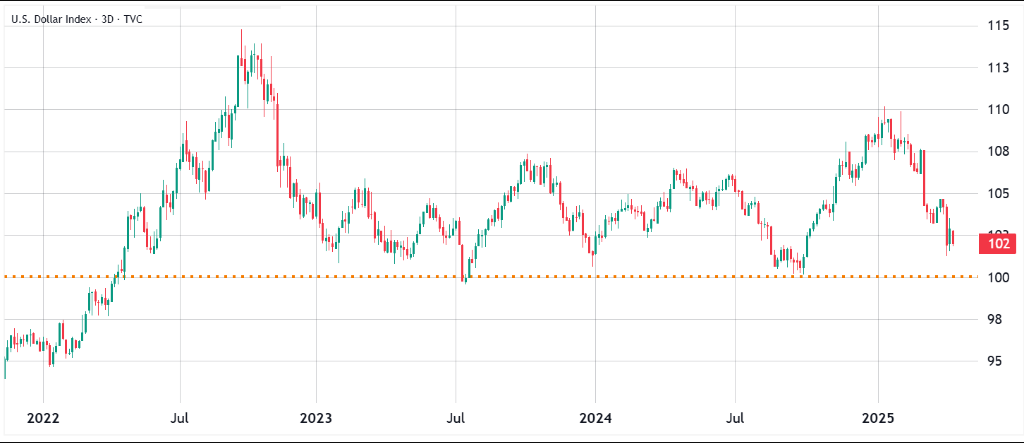 The US Dollar Index (DXY) | Source: TradingViewThe DXY index has remained near 104 since March 9 and has continuously maintained within the range of 100 – 110 since November 2022. Therefore, claims that the current level of this index reflects skepticism towards the USD or signals an imminent collapse seem unfounded.
In reality, the performance of the stock market is not an accurate measure of investors’ perception of risk related to the economy.
Bitcoin often surges after DXY falls below the 100 mark
The last time the DXY Index fell below 100 was in June 2020, coinciding with the price surge of Bitcoin. During those 9 months, Bitcoin skyrocketed from $9,450 to $57,490.
Similarly, when the DXY fell below 100 in mid-April 2017, the price of Bitcoin skyrocketed from $1,200 to $17,610 within 8 months. Whether by coincidence or not, the level of 100 in the past has always coincided with significant price increases of Bitcoin.
The weakening DXY indicates that the USD has depreciated against a basket of major currencies such as the euro, Swiss franc, British pound, and Japanese yen. This decline impacts US-based companies by reducing the amount of (USD) they earn from foreign revenue, thereby decreasing tax contributions to the US government. This issue is particularly significant as the US is facing an annual budget deficit exceeding 1.8 trillion USD.
Similarly, U.S. imports for individuals and businesses become more expensive ( in USD) when this currency weakens, even if prices remain unchanged in foreign currencies.
Although the United States is the largest economy in the world, it still imports 160 billion USD of oil, 215 billion USD of passenger cars, and 255 billion USD of computers, smartphones, data servers, and similar products annually.
A weaker USD has a double negative impact on the economy. The USD tends to slow consumption as imports become more expensive while simultaneously reducing tax revenue from the international income of US-based companies.
For instance, more than 49% of the revenue of large corporations such as Microsoft, Apple, Tesla, Visa and Meta comes from outside the United States. Similarly, companies like Google and Nvidia are estimated to have 35% or more of their revenue overseas.
The price of Bitcoin has the potential to recover to $82,000 regardless of the fluctuations of the DXY Index. This could happen as investors become increasingly concerned about the possibility of the Federal Reserve (Fed) pumping liquidity to prevent an economic recession.
However, if the DXY Index falls below 100, investors may find stronger momentum to shift to alternative instruments like Bitcoin.
You can view the BTC price here.
Disclaimer: This article is for informational purposes only and is not investment advice. Investors should conduct thorough research before making decisions. We are not responsible for your investment decisions.
- SEC approves options trading for spot Ethereum ETFs
- Sell or buy? How do cryptocurrency whales react to market downturns due to tariffs?
- Cryptocurrencies can cause financial instability: ESMA
Viet Cuong
@media only screen and (min-width: 0px) and (min-height: 0px) {
div[id^=“wrapper-sevio-d89f58f5-7b63-40be-98c0-6b1fd62584fb”] {
width:320px;
height: 100px;
}
}
@media only screen and (min-width: 728px) and (min-height: 0px) {
div[id^=“wrapper-sevio-d89f58f5-7b63-40be-98c0-6b1fd62584fb”] {
width: 728px;
height: 90px;
}
}
Disclaimer: The information on this page may come from third parties and does not represent the views or opinions of Gate. The content displayed on this page is for reference only and does not constitute any financial, investment, or legal advice. Gate does not guarantee the accuracy or completeness of the information and shall not be liable for any losses arising from the use of this information. Virtual asset investments carry high risks and are subject to significant price volatility. You may lose all of your invested principal. Please fully understand the relevant risks and make prudent decisions based on your own financial situation and risk tolerance. For details, please refer to
Disclaimer.


