


Futures
Access hundreds of perpetual contracts
TradFi
Gold
One platform for global traditional assets
Options
Hot
Trade European-style vanilla options
Unified Account
Maximize your capital efficiency
Demo Trading
Introduction to Futures Trading
Learn the basics of futures trading
Futures Events
Join events to earn rewards
Demo Trading
Use virtual funds to practice risk-free trading
Launch
CandyDrop
Collect candies to earn airdrops
Launchpool
Quick staking, earn potential new tokens
HODLer Airdrop
Hold GT and get massive airdrops for free
Launchpad
Be early to the next big token project
Alpha Points
Trade on-chain assets and earn airdrops
Futures Points
Earn futures points and claim airdrop rewards


More


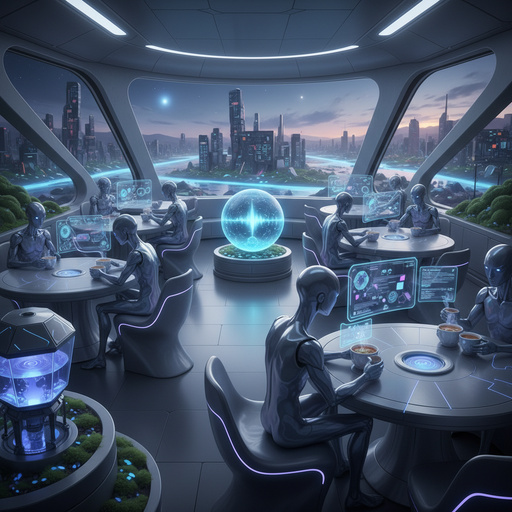

Feiduo Technology Chairman He Wenhu: Beyond Digital Twins, Spatial Intelligence is Reshaping Urban and Industrial Operating Logic
When it comes to stock trading, rely on Golden Kylin Analysts’ reports—authoritative, professional, timely, comprehensive—helping you uncover potential thematic opportunities!
Text | Sina Finance Shanghai Office Chen Xiuying
On March 18th, just as the lights dimmed at Feidou Technology’s press conference, another in-depth conversation began.
Feidou Technology Chairman He Wenwu, Senior Vice President Dong Xiao, and CTO Zhu Xuping were interviewed exclusively by Sina Finance. They started addressing a longer-term question: what does it really mean when spatial intelligence moves from concept to industry?
It all begins with fresh sources of innovation. In this dialogue, Feidou repeatedly emphasized that it’s not about a single isolated technology, but about how a complete set of capabilities can be interconnected—from the bottom layer to scenarios, from models to industry—gradually forming a coherent pathway.
(图:Feidou Technology Chairman He Wenwu)
He Wenwu’s words first focused on two keywords: “safety” and “barriers.” He stated that the significance of full-stack indigenous innovation is not just about replacement, but about reconstruction. When the industrial chain is built on a controllable system, stability and sustainability become possible. He believes that relying on foreign software in the past seemed mature, but once entering deep customization, limitations quickly emerged; more importantly, external environmental changes can rapidly expose systemic risks.
He summarized that the first change brought by full-stack domesticization is the removal of “bottlenecks”; the second is a significant lowering of barriers. Previously difficult to scale, spatial intelligence now has the potential to penetrate more industries. Many clients who “wanted to do it but couldn’t, could do it but not deeply” are now seeing these constraints loosen as hardware and software integration matures.
If He Wenwu explains “why we should do it,” Zhu Xuping and Dong Xiao answer “why now it’s possible.”
(图:Feidou Technology CTO Zhu Xuping)
Zhu Xuping recalled that as early as around 2021, his team had begun contemplating the future form of 3D data. He said there was no clear concept of “spatial intelligence” at the time, but there was a consensus: 3D data must be fluid, and more cost-effective to acquire and use. He believes that relying solely on manual efforts would keep the marginal costs high; only with AI could breakthroughs be achieved.
He emphasized that initially it was just a “vague but correct direction,” and after nearly two years of exploration, the path gradually became clearer. From recognizing the physical world, modeling cities, to understanding and simulating reality—this chain was not built overnight but developed through trial and error.
This pace isn’t aggressive but more aligned with the true evolution of industry. Rather than chasing a wave of AI hype, Feidou is steadily accumulating technology in a relatively niche but deeper track.
Dong Xiao used a more concrete analogy to elaborate this path further. He said that current large language models are more like “the human left brain,” good at processing text, images, and symbols; while spatial intelligence corresponds to “the right brain,” involving spatial reasoning, physical understanding, and real-world operations. He believes the rapid development of the left brain is due to the vast amount of data accumulated from the internet, whereas the right brain depends on high-precision spatial data, often stored in engineering, urban planning, and infrastructure, which are hard to access publicly.
He emphasized that this is where Feidou’s advantage lies. The company has long served complex industry clients, accumulating a large amount of spatial data assets in real scenarios. These data are not easily copied but are built up gradually through long-term projects and services.
In Feidou’s narrative, technical barriers are not just about algorithm superiority but are the result of “long-term accumulation”: data, scenarios, and experience intertwined to form irreplaceable foundational capabilities.
When the topic shifts to “how to align the digital and physical worlds,” Zhu Xuping’s answer is very clear. He said that ideally, all data would be real, but in reality, this is almost impossible. Costs are too high, and many extreme scenarios are inherently difficult to obtain data for. Therefore, synthetic data becomes a necessary supplement.
He believes there is always some bias between synthetic and real data, and this “illusion” cannot be completely eliminated, but the key is to keep approaching reality rather than seeking absolute accuracy. He used a simple analogy: human cognition is not entirely based on reality—dreams and imagination also influence judgment. Therefore, incorporating synthetic data into training systems is an acceptable and necessary approach.
This reflects a pragmatic technical view: acknowledging imperfection but continuously converging through iteration.
Extending further to “decision-making ability,” Zhu Xuping said that the path of spatial intelligence can be broken down into three stages: modeling, understanding, and simulation. Only in the simulation stage can the system perform deductions, enabling prediction and decision-making. He emphasized that the industry is still in the first two stages, and true “decision capability” is still under development.
(图:Feidou Technology Senior Vice President Dong Xiao)
Dong Xiao added that many current applications are still “assistive decision-making,” because AI itself has no execution capability. He believes that only when models are integrated with drones, robots, and various terminal devices to form “embodied intelligence” will decision-making truly become a closed loop. Until then, even the most precise reasoning still requires human execution, and deviations during execution are unavoidable.
Compared to grand narratives, this description more closely reflects industry realities.
In terms of practical implementation, Shanghai is a repeatedly mentioned case. Dong Xiao said that Shanghai is a city with extremely high data density, from buildings and roads to traffic operations, with huge and complex data structures. How to integrate these scattered data into a unified platform is a typical world-class challenge.
He mentioned that Feidou’s team spent nearly a year and a half consolidating spatial data from the past two decades, enabling previously fragmented information to flow on a single platform. Only after this step could AI be further involved in city governance.
He described that an even more important step is to let AI “learn” the city. By inputting historical planning, design processes, and various data into the system, models can be trained to reason from individual buildings to district-level planning. He believes that the future of urban governance lies not in adding more systems but in forming a more comprehensive “global perspective.”
He gave an example: the essence of congestion is the lack of real-time overall traffic calculation. When individual scales grow from tens to hundreds of thousands or millions, human experience cannot support global optimization. But with advances in computing power and algorithms, such global deduction is becoming possible.
On the market front, Dong Xiao’s attitude is also straightforward. He said that holding a press conference now is essentially about “conveying confidence.” It’s about demonstrating to clients and partners the commitment to continuous investment, and signaling that Feidou is still actively advancing in this track.
Zhu Xuping offered another perspective. He believes AI will not eliminate all software but will change its form. For tool-based applications, substitution is possible; but for platform-based products, especially foundational infrastructure that AI can invoke, there is potential for new growth.
He emphasized that Feidou’s platform is designed for AI, with numerous API interfaces. As AI programming capabilities improve, these interfaces will become the foundation for new applications. Meanwhile, the company must also continuously strengthen its AI capabilities, rather than remaining just a “consumer” of AI.
At the end of the interview, the topic returned to a longer-term vision. He Wenwu said that as spatial intelligence matures, in the future, a single sentence or a picture could enable the system to generate a corresponding 3D world. He believes this ability will not only transform industries but also gradually enter everyday life.
Dong Xiao extended this vision further. He thinks that future gaming, film, and other content creation methods could be reshaped. As creation becomes easier, expression will become more diverse. But he also emphasizes that the most important thing now is to solve the “bottleneck” issues and strengthen foundational capabilities.
“Steady progress and long-term development.” If there’s a fitting conclusion for this interview, perhaps this phrase is most appropriate.
Feidou does not seek to amplify its voice but aims to clarify its technological pathway: from data to models, from models to scenarios, and back to industry. It neither rushes to give final answers nor avoids current limitations.
He Wenwu said, “Let 3D data flow and realize value”; Dong Xiao said, “The future is in the human right brain”; Zhu Xuping said, “We were born for AI.”
These three statements may not be glamorous, but they point in the same direction.
On the still-growing track of spatial intelligence, Feidou perhaps is not the first to shout out the concept, but the one who gradually brings it into reality.