As blockchain and Web3 applications continue to grow rapidly, underlying network performance is becoming a key factor limiting the industry's ability to scale. This is especially true in areas such as DeFi, high frequency trading, and onchain gaming, where latency and bandwidth directly affect user experience and system efficiency. Yet most blockchain applications still rely on the public internet, and its built-in limitations make meaningful performance breakthroughs difficult.
Against this backdrop, DoubleZero (2Z), a Solana based decentralized physical infrastructure network, or DePIN, project, aims to rebuild the communication layer for Web3. By integrating unused fiber resources and dedicated hardware from around the world, DoubleZero delivers low latency, high throughput data transmission and has secured an important place in the DePIN infrastructure sector.
What is DoubleZero (2Z)?
DoubleZero (2Z) is a DePIN project focused on optimizing network communications. Its goal is to build a high performance data transmission network through decentralization. By connecting dedicated fiber links and hardware devices contributed by users globally, it creates a low latency network layer independent of the public internet, offering a more stable communication environment for blockchains and distributed systems.
At its core, DoubleZero is a “network acceleration layer” for Web3. Its main value lies in improving the efficiency of data transmission between nodes, which in turn enhances overall system performance.
The DoubleZero team brings deep experience from the Web3 industry. Co founder and CEO Austin Federa was previously Head of Strategy and Communications at the Solana Foundation and was one of the key figures behind the early rise of the Solana ecosystem. COO David McIntyre previously led financial planning and analysis at the Solana Foundation.
What problem is DoubleZero trying to solve?
DoubleZero emerged in response to the limitations of the public internet in blockchain environments. Traditional networks face clear problems such as routing congestion, DDoS attacks, and high latency, all of which can directly undermine validator communications, oracle data updates, and the execution efficiency of high frequency trades.
On a global scale, these issues also show up as “geographic inequality,” meaning that nodes in different regions experience significant differences in network quality. That, in turn, affects the fairness and consistency of distributed systems.
By building a dedicated network layer, DoubleZero offers predictable latency below 10ms along with higher throughput, enabling Web3 applications to operate at a much higher level of performance. This capability is highly significant for advancing blockchain scalability.
DoubleZero’s core architecture and features
DoubleZero uses a dual ring architecture that divides the network into two layers, the outer ring (Ingress/Egress Ring) and the inner ring (Data Flow Ring), allowing it to strike a balance between security and performance.
The outer ring mainly connects to the public internet and handles external traffic. Using FPGA hardware, it filters data, verifies signatures, and protects against attacks. This layer functions much like a security gateway, blocking invalid or malicious traffic.
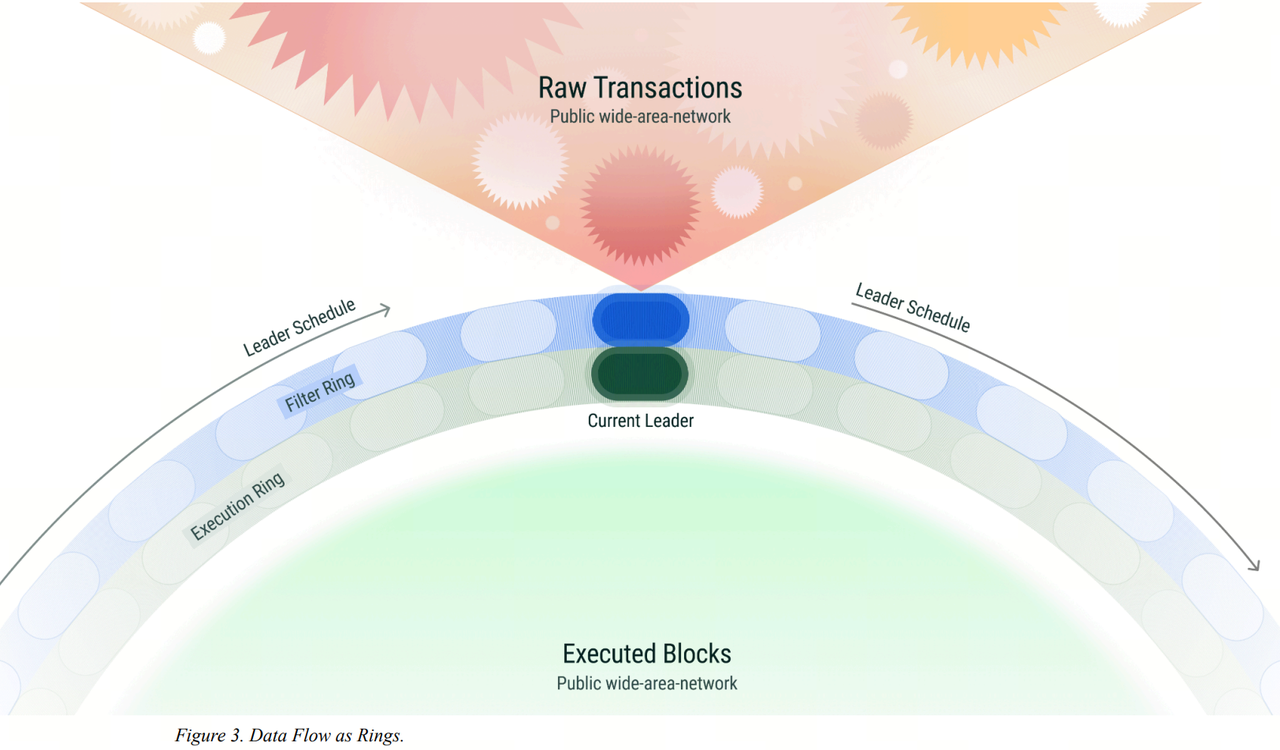
The inner ring, by contrast, handles core data transmission through a dedicated fiber network and directly serves blockchain consensus and high performance applications. This layer prioritizes low latency and high reliability and is central to the network’s overall performance.
In addition, DoubleZero introduces intelligent routing algorithms and edge data filtering mechanisms. It also uses smart contracts for link verification and service level agreement, or SLA, management, giving the network dynamic scalability and automated governance features.
How does DoubleZero work?
DoubleZero runs on infrastructure contributed by participants distributed around the world. Users can deploy dedicated fiber links between data centers and install designated devices to connect to the network. Once verified by the protocol, those resources become part of the network.
In actual operation, nodes are aggregated through metropolitan exchange points, enabling efficient interconnection and automatic routing between links. The network uses multicast technology and hardware accelerated filtering to move data quickly to target nodes, significantly improving communication efficiency.
On the incentive side, contributors receive 2Z token rewards based on the network performance they provide, and some allocation models are based on marginal contribution. This encourages nodes to keep improving performance, which helps raise the quality of the network as a whole. According to disclosed information, the network can improve blockchain consensus efficiency by about 77%.
DoubleZero’s main use cases
DoubleZero is mainly used in Web3 scenarios that demand strong network performance. At the blockchain validator layer, it can optimize communication between nodes, improving block production efficiency and consensus stability. In RPC services, DoubleZero can significantly reduce response latency, improving both developer and user experience.
In DeFi, its low latency characteristics make high frequency trading and arbitrage strategies more efficient. In GameFi, it can support real time interaction and low latency operations. It also holds important value in more complex scenarios such as cross chain communication and Layer2 multi sequencer synchronization.
2Z tokenomics and core use cases
2Z is the core token of the DoubleZero network. It is used to pay network service fees, incentivize resource providers, and maintain network security. Users must pay 2Z to use network connectivity services, while nodes earn rewards by contributing fiber and hardware resources.
On the security side, nodes are required to stake 2Z to ensure they provide stable and reliable service. If their performance falls short, they may face penalties. In addition, some mechanisms may introduce a burn model, which could increase token scarcity as demand grows.
In terms of allocation, 2Z tokens are distributed among the foundation, investors, the team, and the community, with vesting and linear unlock mechanisms designed to balance early stage development with long term stability.
DoubleZero vs Render: A comparison of DePIN projects
Overall, DoubleZero is more focused on the network infrastructure layer, while Render belongs to the computing resource layer. The two occupy different but complementary positions within the DePIN ecosystem.
| Dimension |
DoubleZero (2Z) |
Render (RNDR) |
| Core Focus |
Network layer (low latency fiber DePIN) |
Compute layer (GPU rendering) |
| Target Problem |
Communication latency and bandwidth bottlenecks |
Rendering and AI computing demand |
| Base Chain |
Solana |
Multi chain, primarily Ethereum |
| Token Utility |
Payments, rewards, staking |
Rendering payments, node incentives |
| Performance Advantage |
Sub 10 ms latency with improved communication efficiency |
Highly parallel GPU computing |
| Sector Positioning |
DePIN network infrastructure |
DePIN computing and AI |
DoubleZero’s strengths, limitations, and potential risks
DoubleZero’s core strength lies in its ability to significantly improve data transmission efficiency through dedicated hardware and fiber networks, providing more stable infrastructure for Web3 applications. At the same time, its open source protocol and incentive model could help attract more resource providers to the network and create synergies with the Solana ecosystem.
That said, the project also faces certain limitations. For example, it depends heavily on contributors of global fiber resources, and before the network reaches sufficient scale, overall performance may be affected. In addition, infrastructure projects typically require a longer timeline before achieving adoption at scale.
As for risks, market pressure from token unlocks, changes in the regulatory environment, and intensifying competition in the DePIN sector could all affect its development. For that reason, its long term performance still needs to be evaluated based on real world adoption.
Conclusion
By building a decentralized, high performance network layer, DoubleZero (2Z) provides low latency, high throughput data transmission for blockchain and Web3 applications, making it a representative infrastructure project in the DePIN sector.
Its core value lies in solving communication bottlenecks and improving the efficiency of distributed systems as a whole. As Web3 applications continue to demand higher performance, DoubleZero has the potential to become one of the key pieces of infrastructure, though its long term growth will still depend on network scale and practical adoption.
FAQs
What problem does DoubleZero solve?
It mainly addresses the public internet’s high latency, congestion, and instability.
What is the 2Z token used for?
It is used to pay for network services, reward contributors, and serve as node staking collateral.
How is DoubleZero different from Render?
DoubleZero focuses on the network communication layer, while Render specializes in GPU computing.
What is DoubleZero’s core advantage?
It delivers low latency, high throughput data transmission, improving blockchain performance.