Polygon Labs announced the launch of Polygon Agent CLI on March 5th, an end-to-end on-chain toolkit specifically designed for AI agents. With a single installation command, AI agents can immediately access a comprehensive suite of capabilities including wallet management, stablecoin payments, cross-chain bridging, token swaps, and on-chain identity verification. All transactions are paid with USDC, eliminating the need to hold any native gas tokens.
Solving Fragmentation: Overview of Agent CLI Features
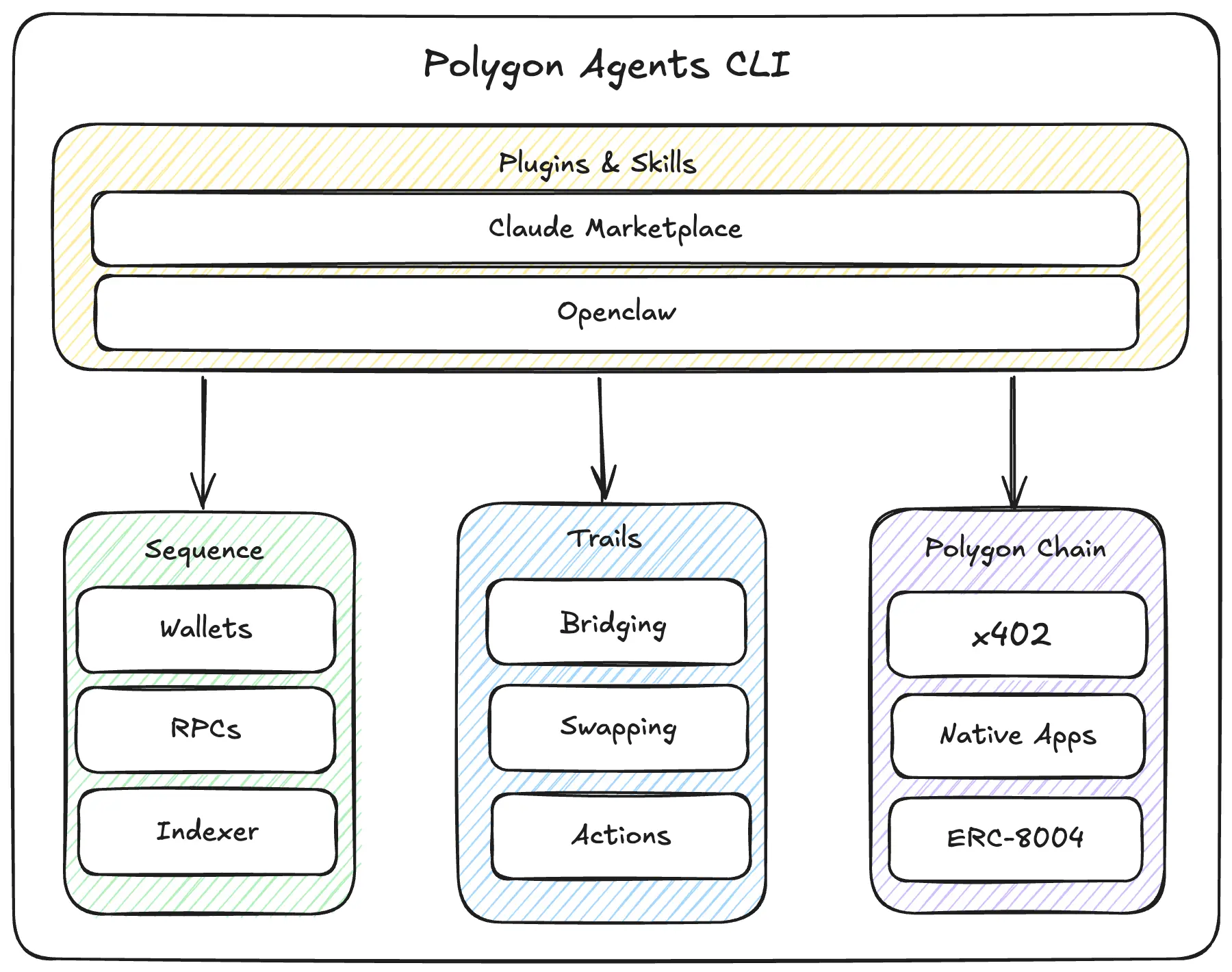 (Source: Github)
Before the rapid rise of AI agents, enabling on-chain operations for agents typically required integrating multiple independent components such as wallet libraries, gas abstraction layers, swap APIs, bridging APIs, and identity systems from different providers. Each component was not designed with the threat model of agents in mind, resulting in a fragmented underlying infrastructure. Polygon Agent CLI replaces this fragmented architecture with an integrated toolkit:
Smart Contract Wallet: A session-based smart wallet supporting per-token spending limits, contract whitelists, and 24-hour auto-expiry. Private keys are never exposed within the LLM’s context window.
On-Chain Transaction Execution: Polygon’s Trails system automatically manages routing, price discovery, and execution at the protocol level. Agents only need to send commands without needing to know which DEX is used underneath.
ERC-8004 Agent Identity: A standard jointly developed by MetaMask, Ethereum Foundation, Google, and Coinbase, enabling identity registration with a single command. Agents can accumulate verifiable on-chain reputation.
x402 Protocol Support: Agents pay API and data service fees in stablecoins during standard HTTP requests, without managing API keys or subscriptions.
Integrated API Queries: Use dedicated RPC endpoints and token indexers to query cross-chain balances, transaction history, and on-chain status.
Three Core Security Mechanisms: Private Key Isolation, Gas Abstraction, and Dry Run Verification
Polygon Agent CLI’s security design features three key points, directly addressing the main risks associated with on-chain AI agent operations.
Complete Isolation of Private Keys and LLMs: The session wallet architecture encrypts and stores private keys separately from the agent’s context window. Even if prompt injection attacks occur, attackers cannot access the private keys the agent does not hold, significantly reducing common security threats faced by AI agents.
Full Gas Abstraction: Agents pay all on-chain operation fees in USDC, with gas abstraction handled automatically at the protocol level. Developers and agents do not need to manage POL, ETH, or any native gas tokens, greatly simplifying multi-chain deployment.
Default Dry Run Mechanism: Before broadcasting any transaction, the CLI provides an exact execution preview to the agent. In scenarios requiring thousands of automated decisions, this pre-submission confirmation is a critical security layer to ensure human oversight of on-chain operations.
Frequently Asked Questions
What is ERC-8004, and why is it crucial for agent economy?
ERC-8004 is an Ethereum agent identity standard jointly developed by MetaMask, Ethereum Foundation, Google, and Coinbase. It enables agents to establish verifiable identities and reputation records on-chain, making trustless transactions between agents possible. With Polygon Agent CLI, registering an ERC-8004 agent identity on-chain can be done with a single command.
How does the x402 protocol enable AI agents to perform API micro-payments?
x402 allows agents to pay API and data service fees in stablecoins based on usage during standard HTTP requests, without pre-subscribing or managing API keys. This pay-as-you-go model aligns with the autonomous execution of tasks by AI agents and is a foundational protocol for commercializing agent economies.
How does Polygon Agent CLI prevent prompt injection attacks?
The toolkit employs a session wallet architecture, encrypting private keys that never enter the LLM’s context window. Even if an attacker attempts prompt injection to extract private keys, the agent cannot leak them because it has never accessed the private keys, eliminating this attack vector at the architectural level.
Disclaimer: The information on this page may come from third parties and does not represent the views or opinions of Gate. The content displayed on this page is for reference only and does not constitute any financial, investment, or legal advice. Gate does not guarantee the accuracy or completeness of the information and shall not be liable for any losses arising from the use of this information. Virtual asset investments carry high risks and are subject to significant price volatility. You may lose all of your invested principal. Please fully understand the relevant risks and make prudent decisions based on your own financial situation and risk tolerance. For details, please refer to
Disclaimer.


