
VanEck Digital Asset Research Director Matthew Sigel told CNBC that Bitcoin miners have already secured what AI data centers have spent years trying to build—power infrastructure—and the market’s current pricing has not fully reflected this. Sigel pointed out that, based on market value per megawatt, the stock trading prices of Bitcoin mining machines are still significantly below those of data center peers.
Why Bitcoin Miners Hold the Most Scarce Resource in AI
Building new data centers from scratch means waiting in line for grid interconnection, which could delay until 2028 or later. Bitcoin miners have bypassed this bottleneck because their existing infrastructure happens to align closely with the needs of AI data centers:
Locked-in Grid Relationships: Miners have long-term power contracts and grid interconnection, which are the hardest first-mover advantages to replicate quickly and are resources that AI data centers desperately need but cannot access immediately.
Cooling and Power Systems: The demand for intensive computing power in mining has driven the development of advanced cooling and stable power supply systems, perfectly matching the requirements of AI computing.
Grid Flexibility Services: This is a widely overlooked revenue angle. Miners can flexibly shut down computing power based on grid demand, providing “dispatchable load” services to grid operators. As AI clusters and enterprise backflows continue to pressure the grid, this flexibility has evolved into a directly sellable commercial service.
Valuation Gap Reality: Mining Machines Target 20 GW Expansion Goal
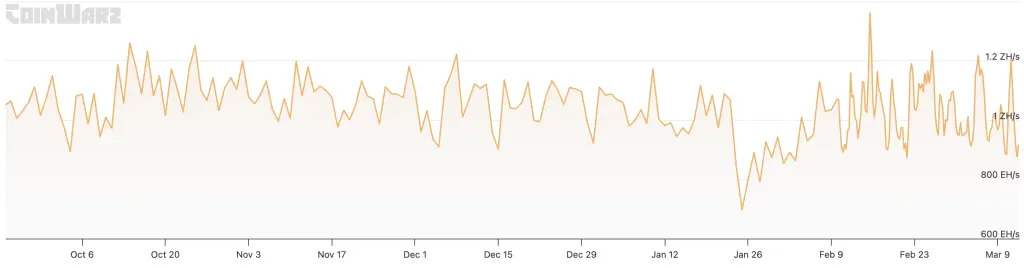
(Source: CoinWarz)
Public mining equipment currently has about 7 GW of capacity, with a target to expand to 20 GW by 2027, nearly tripling. Meanwhile, AI data centers’ power demand is expected to grow at 24% annually until 2030. The intersection of these two growth curves provides a structural tailwind for miners with suitable infrastructure.
Global mining hash rate has declined about 6% since its peak in November 2025, partly because hash resources are being reallocated to AI workloads. This indicates a measurable shift in mining capacity.
Concrete Examples of Mining Industry Transformation: From Concept to Execution
Current major listed miners’ AI transformation progress:
MARA: Converting mining farms into large-scale data center campuses.
Core Scientific: Secured up to $1 billion in funding from Morgan Stanley to support AI transformation.
CleanSpark: In Q1 2026, explicitly stated that, at current hash rate prices, Bitcoin mining ROI is less than AI business, and has adjusted capital allocation accordingly.
Bitdeer: Deployed 50,000 self-developed ASIC chips on a 413 MW grid, expected to add 33 EH/s of network hash rate, which at current Bitcoin prices translates to approximately $335 million in additional annual revenue.
Sigel said that the Q1 2026 financial report will be a real test, and the market needs to closely monitor three key indicators: power capacity data, AI contract announcements, and revenue from curtailment services.
Frequently Asked Questions
What inherent advantages do Bitcoin miners have in the AI infrastructure race?
Main advantages include: established grid interconnection (new applications may need to wait until after 2028), existing land, power contracts, cooling systems, and the ability to offer “dispatchable load” curtailment services to grid operators. These assets are scarce resources that AI data centers seek but are difficult to replicate quickly.
What does VanEck mean by “the market has not yet priced in” this potential?
Matthew Sigel pointed out that, based on market value per megawatt, the stock prices of listed Bitcoin mining machines are still far below those of data center peers. This suggests the market has not fully accounted for the potential of miners’ transition to AI infrastructure, and valuation gaps may narrow as data on mining transformation continues to emerge.
How does a 6% decline in global hash rate affect the Bitcoin network?
Since its peak in November 2025, the global hash rate has decreased about 6%, partly because hash resources are being reallocated to AI workloads. This change is not yet enough to threaten Bitcoin network security but indicates a substantial reallocation of resources between Bitcoin mining and AI computing, which warrants ongoing attention.
Disclaimer: The information on this page may come from third parties and does not represent the views or opinions of Gate. The content displayed on this page is for reference only and does not constitute any financial, investment, or legal advice. Gate does not guarantee the accuracy or completeness of the information and shall not be liable for any losses arising from the use of this information. Virtual asset investments carry high risks and are subject to significant price volatility. You may lose all of your invested principal. Please fully understand the relevant risks and make prudent decisions based on your own financial situation and risk tolerance. For details, please refer to
Disclaimer.
Related Articles
Bitmine promoted to the NYSE main board! Tom Lee: U.S. stocks may be near a bottom, and selling pressure on Ether may ease
Bitmine has officially moved from the NYSE American board to the main board in the United States, marking a major milestone for the company. Despite a sharp drop in the stock price, it has still increased the share repurchase program to $4 billion. The company holds a large amount of Ethereum, and expects that a rebound in the crypto market will help improve its assets and stock price performance.
CryptoCity1h ago
Crypto Market Records Dip While Sentiment Remains Neutral
The global crypto market is undergoing a correction, with a 0.86% drop in total capitalization to $2.41T. Bitcoin and Ethereum fell by 1.21% and 1.33%, respectively. Despite declines in DeFi TVL and NFT sales, some altcoins surged significantly.
BlockChainReporter2h ago
William Blair: After a certain CEX callback, risk is released, and prospects are boosted by USDC growth
Investment bank William Blair said that after a decline in its stock price in the first quarter, a certain CEX has already completed risk clearing, and the market has fully priced in expectations of weak trading volume and revenue. Although the trading data is soft, the impact is limited; the exchange has strengthened its competitiveness through a diversified layout. The stablecoin USDC continues to grow, raising its market share and generating synergistic benefits. Institutional investors are bullish on a market recovery and believe the exchange has upside potential.
GateNews3h ago
BTC 15-minute rise 0.48%: stronger spot buy-side demand combined with shrinking liquidity driving the move
2026-04-13 14:30 to 2026-04-13 14:45 (UTC), BTC saw a +0.48% return within a 0.55% amplitude range (71600.7–71997.0 USDT). During this period, market volatility increased; both spot and on-chain data indicate that short-term capital flows were notably active, market attention rose, and sentiment remains cautious.
The main driver behind this deviation is stronger spot-market buy pressure and the continued net outflow of exchange funds. Specifically, over the past 24 hours, BTC spot trading volume was about $33.15B, compared with the 7-day average
GateNews4h ago
Bitmine gets promoted to the NYSE main board! Tom Lee: US stocks may be at their bottom, and selling pressure on Ether could ease
Bitmine has officially transferred from the NYSE American board to the main board in the United States, marking an important milestone for the company. Despite a significant drop in its share price, it has still increased the share repurchase plan amount to $4.0 billion. The company holds a large amount of Ether, and it expects that a rebound in the crypto market will help improve its assets and share price performance.
CryptoCity4h ago
Gold and silver fall across the board, and the BTC/ETH volatility index rises slightly
On April 13, gold and silver prices fell to $4,732.92 per ounce and $74.209 per ounce, respectively. The BTC volatility index rose by 0.42%, and the ETH volatility index rose by 0.31%. The U.S. dollar versus the Chinese yuan and the Japanese yen edged up slightly, major European stock indexes generally fell, while WTI and Brent crude oil prices rose. The Gate platform supports trading for multiple asset types.
GateNews4h ago


