
After Nvidia released a demonstration video showcasing DLSS 5 technology for “Resident Evil 9: Village of Shadows,” it received approximately 90,000 dislikes. Nvidia CEO Jensen Huang responded by stating that critics are entirely mistaken, emphasizing that DLSS 5 combines geometric control with generative AI within a “neural rendering” architecture, granting developers full creative control. However, Capcom developers stated they learned about the demo content at the same time as the public and were not notified in advance.
DLSS 5 Demonstration Controversy: The Battle Over Creative Sovereignty Behind 90,000 Dislikes
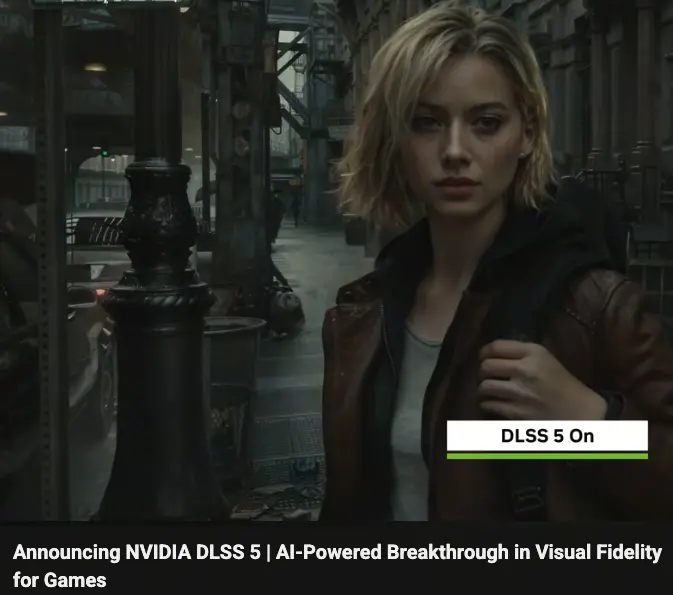
Nvidia’s official DLSS 5 demo video primarily showcases the visual transformation of protagonist Grace Ashcroft. Both players and creators widely criticized the visuals for being overly smooth and lacking realism, believing that AI processing obscures the carefully crafted art style originally designed by the development team. Based on Steam review metrics, such likes and dislikes are considered an “overwhelming negative.”
Former Rockstar animator Mike York pointed out that DLSS 5 causes AI to re-render each frame from scratch, making it impossible to fully preserve the original image. As a result, players ultimately see an AI-interpreted version rather than the developer’s original design. IGN senior editor Simon Cardy also raised deeper questions: if generative AI becomes widely adopted as a solution for image quality, does it implicitly allow developers to reduce artistic guidance efforts, letting AI fill in the gaps?
Jensen Huang’s Technical Stance: Neural Rendering Is Controllable AI, Not Art Replacement
Jensen Huang clearly stated during the GTC 2026 Q&A that players criticizing DLSS 5 are “completely wrong.” He explained that the core of DLSS 5 is controlling the geometry and textures within the game engine, combined with the reasoning capabilities of generative AI at a geometric level. Developers can set style parameters, including cartoon rendering or glass material effects, with all content control fully in the hands of the developers.
Industry Divide: Supporters of Technology vs. Creators’ Concerns
Supporters of the technology: Epic Games chief producer Jean Pierre Kellams praised DLSS 5’s improvements in lighting and shadow rendering, believing that if it were showcased as next-generation hardware rather than AI, player reactions would be very different.
Supporters of the technology: Former Intel executive and Signal65 president Ryan Shrout argued that the public over-focuses on character faces and overlooks the overall scene enhancements, such as lighting accuracy and object three-dimensionality.
Creators’ concerns: Former Rockstar animator Mike York warned that DLSS 5 essentially replaces the original creative work of developers rather than enhancing it.
Creators’ concerns: IGN senior editor Simon Cardy expressed her desire to see “artworks created by humans,” rather than images filled in by AI.
Capcom Employees: A Reactive Revelation of the Demo Event
Another core issue in the controversy is the lack of prior notification to the involved collaborators. According to Insider Gaming, both Capcom and Ubisoft developers stated they saw the demo content at the same time as the general public, with no prior notice. An Ubisoft employee bluntly said, “We learned about it together with everyone.”
Capcom developers noted that the company’s attitude toward AI technology has been relatively conservative. Capcom’s technical director, Kazuki Abe, revealed that their current main use of generative AI is to improve early production efficiency, not directly affecting the final game visuals. Some internal staff worry that this demo event may signal a shift in the publisher’s stance on generative AI applications, a shift that was not sufficiently communicated to the development teams.
Frequently Asked Questions
What are the fundamental differences between DLSS 5 and previous DLSS technologies?
Previous versions of DLSS mainly used the original rendered image as a base, employing AI super-resolution to enhance image quality and frame rate. DLSS 5 adopts a neural rendering architecture, allowing AI to intervene directly in each frame’s rendering process, affecting lighting, textures, and even scene generation. Critics argue this departs from faithful reproduction of the original images.
What is “neural rendering” as Jensen Huang described?
Neural rendering refers to integrating the game engine’s geometry and textures with generative AI at a geometric level, assisting in rendering and scene generation. Huang emphasizes that developers can still set style parameters to control the final effect, theoretically maintaining creative control.
Why are Capcom employees dissatisfied with the DLSS 5 demo?
According to Insider Gaming, Capcom developers said their work was used as a demo example but they were not notified beforehand, learning about it simultaneously with the public. This has raised concerns about Nvidia’s communication transparency and some staff worry that the company’s stance on applying generative AI is quietly shifting without proper internal discussion.
Disclaimer: The information on this page may come from third parties and does not represent the views or opinions of Gate. The content displayed on this page is for reference only and does not constitute any financial, investment, or legal advice. Gate does not guarantee the accuracy or completeness of the information and shall not be liable for any losses arising from the use of this information. Virtual asset investments carry high risks and are subject to significant price volatility. You may lose all of your invested principal. Please fully understand the relevant risks and make prudent decisions based on your own financial situation and risk tolerance. For details, please refer to
Disclaimer.


