DeFi Protocol Balancer Loses $128 Million in Hack, Announces Shutdown Due to Lack of Revenue and Legal Risks. Future Operations to Be Maintained by DAO, Token Issuance Ceased, Founders to Exit, Highlighting Challenges of Old Models.
Balancer Has No Income After Hack, Gradually Ceasing Operations
Decentralized Finance (DeFi) protocol Balancer announced earlier today (3/24) that it is gradually shutting down. Since the $128 million vulnerability exploit in November 2025, the platform has faced ongoing legal risks.
As Balancer no longer has sustainable revenue, its developer, Balancer Labs, has chosen to wind down operations. In the future, the protocol will continue to operate through a decentralized autonomous organization (DAO), foundation, and service providers, with core team members expected to transition to a new operational entity after governance approval.
Balancer Restructuring Plan Revealed, Founders to Step Down
Co-founder Fernando Martinelli outlined the restructuring plan, including ceasing issuance of Balancer tokens (BAL), gradually phasing out the veBAL governance model, and restructuring fee mechanisms to allow the DAO treasury to receive 100% of protocol fees, while reducing V3 protocol share to 25%.
Other measures include implementing BAL token buybacks to provide liquidity exits for holders, focusing development on core products such as reCLAMM, liquidity guiding pools, stablecoins, and liquidity staking pools, as well as cross-chain weighted pools.
A formal proposal outlining tokenomics restructuring and operational changes will be released separately by the core team.
Martinelli also revealed that he will no longer have an official relationship with the protocol in the future, but emphasized his continued belief in Balancer’s underlying technology and the remaining team.
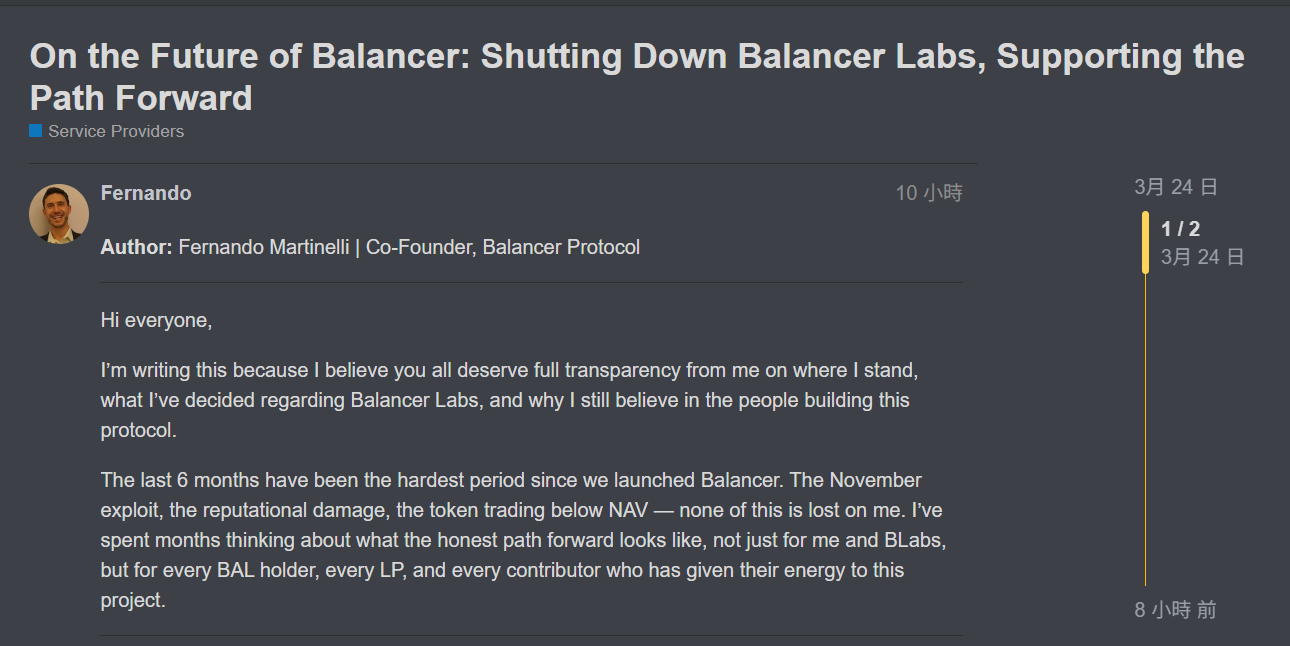
Image Source: Statement by Balancer Co-founder Fernando Martinelli: Balancer Has No Income After Hack, Announces Gradual Shutdown
Recap of the Balancer Hacker Incident: Rounding Function Vulnerability Caused the Damage
Looking back at last year’s Balancer hack, attackers exploited a logical flaw in the smart contract’s upscale rounding function, combined with BatchSwap batch transactions and flash loan mechanisms, to perform multiple complex operations within a single transaction, repeatedly draining assets from the liquidity pools.
The Balancer attack affected multiple blockchains, including Ethereum, Base, Avalanche, Arbitrum, Optimism, Polygon, Gnosis, Berachain, and Sonic, serving as a stark reminder that even in trust-minimized architectures, hot wallets and liquidity pools remain prime targets for hackers.
Although Balancer’s transparent handling of the incident and cross-chain cooperation received praise, the attack highlighted long-standing structural issues in DeFi. While complex composable designs accelerate innovation, they also expand attack surfaces.
The rounding error was a minor mathematical oversight, yet it triggered a chain reaction across cross-chain liquidity pools, revealing the industry’s ongoing lack of unified auditing standards and risk firewalls.
- Related article: Balancer Hacker Incident Report Released! How a Single Vulnerability Crippled the Entire DeFi Industry?
Balancer Governance and Security as Future Challenges
Zeus Research analyst Dominick John pointed out that Balancer exposed a structural failure, describing the protocol as having succumbed to a broken model characterized by token emission disappearance, weakened governance, and shallow value capture.
He believes that streamlining operations might be the right move, but this is only a patch for the later stages, and added that the old DeFi model driven by token rewards is being phased out.
Senior analyst Ryan Yoon of Tiger Research told Decrypt that shutting down the company may also be a way for Balancer to quickly escape legal risks, and the next challenge will be whether the reduced team can truly fix governance issues.
Yoon emphasized that the team must maintain governance consistency, ensure security integrity, and keep the treasury stable to promote protocol development.
Further Reading:
Stream Losses, xUSD Depegging Domino Effect: Over a Dozen DeFi Platforms at Risk, Exposure Near $300 Million
Disclaimer: The information on this page may come from third parties and does not represent the views or opinions of Gate. The content displayed on this page is for reference only and does not constitute any financial, investment, or legal advice. Gate does not guarantee the accuracy or completeness of the information and shall not be liable for any losses arising from the use of this information. Virtual asset investments carry high risks and are subject to significant price volatility. You may lose all of your invested principal. Please fully understand the relevant risks and make prudent decisions based on your own financial situation and risk tolerance. For details, please refer to
Disclaimer.


