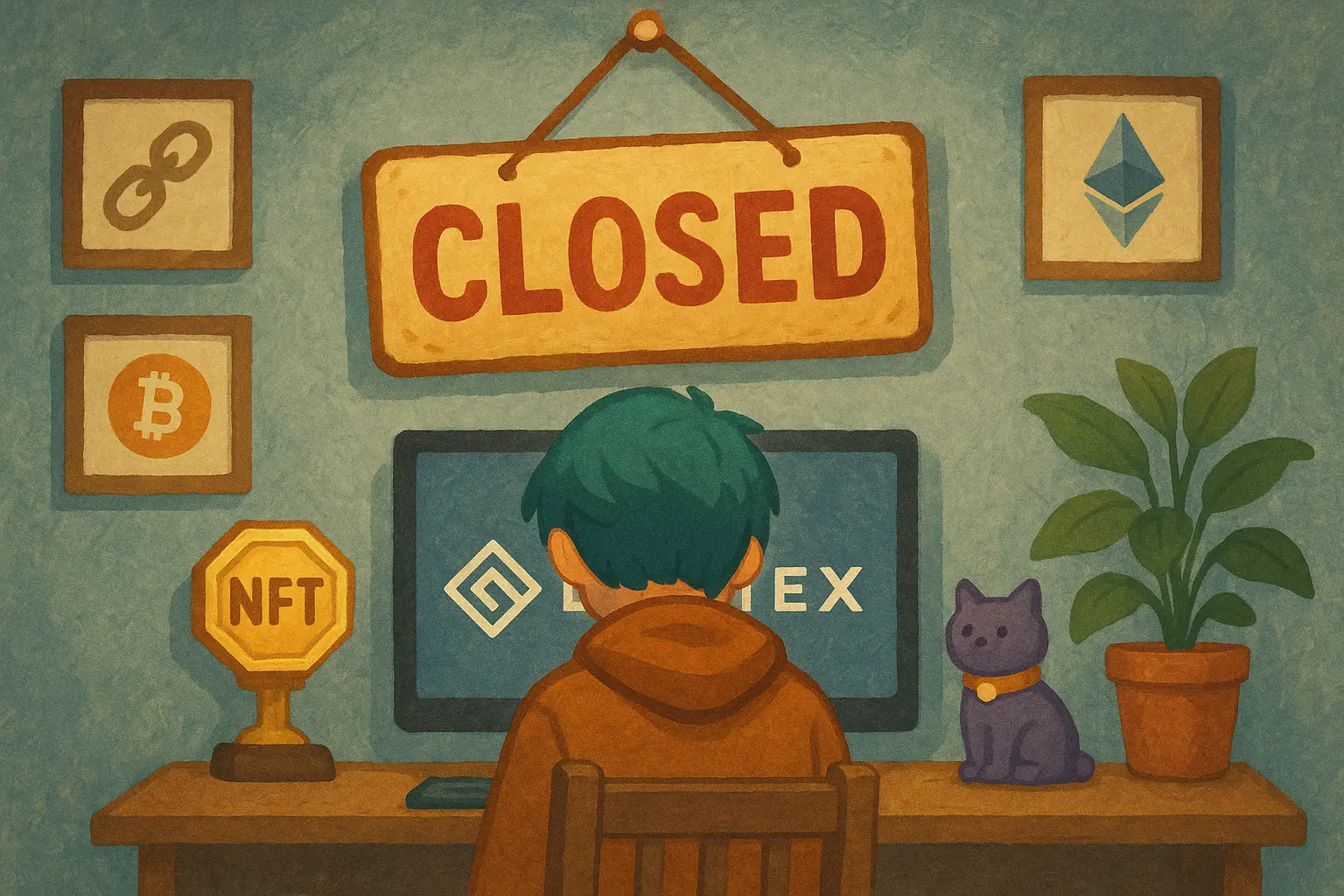
Taiwan multi-chain NFT trading platform Lootex officially announced on March 23rd that it will cease all services on April 4th. The platform was founded in Taiwan in 2018 by Justine Lu and David Tseng with the vision of allowing players to truly own their gaming assets. Over 8 years, it supported more than 7 blockchains and established over 50 global blockchain gaming partnerships.
Service Closure Schedule and User Asset Safety Guidelines
Lootex has always adhered to a non-custodial mechanism, never holding users’ private keys or assets. All control of NFTs remains in users’ own wallets. NFTs deployed on Ethereum, Polygon, BNB Chain, Arbitrum, Avalanche, Mantle, Base, and Soneium are completely independent of Lootex’s operations, and users do not need to perform any emergency asset transfers.
Key Timeline for Lootex Service Closure (UTC+8)
March 27: Stop allowing new listings and minting
March 31: All trading functions (buying, selling, bidding) cease; the system automatically cancels all active orders within validity
April 4: Lootex official website goes offline, only static FAQ page remains for inquiries
April 11: Officially stops monitoring community channels
Lootex recommends users revoke token approvals granted to the platform’s smart contracts via Revoke.cash or Etherscan as a precaution. Alternative marketplaces for users on each chain: Ethereum and Polygon can switch to OpenSea, Blur, or Magic Eden; BNB Chain can use Element Market or OKX NFT; Soneium assets are recommended to be transferred to OpenSea.
Farewell from the Founders: Thanks for Eight Years of Partnership
Justine Lu wrote in her farewell message: “Time flies, and I guess this is how it feels. Looking back, we’ve been on this journey together for a long time. Thank you to every supporter, user, listener, and fan. Your presence is what gives this product its true meaning.” David Tseng added: “To everyone who has minted, listed, collected, or simply believed in what we are building: thank you.”
The official statement notes that the NFT market environment has undergone dramatic changes over the past two years. After careful evaluation, the team chose to withdraw proactively rather than continue under unsatisfactory conditions.
Lootex’s Technological Legacy: A Trailblazer in Taiwan’s Web3 Scene
Over 8 years, Lootex has left many notable technological and cultural achievements: it was selected by Google Cloud as a case study for auto-scaling infrastructure; it pioneered the promotion of ERC-4337 account abstraction technology in Taiwan, enabling login via email or social accounts; collaborated with the Palace Museum on Ethereum to digitize ancient artworks into NFTs; became the first NFT marketplace on the Mantle blockchain; and developed its own NFT hub Biru on Sony-supported Soneium chain.
Supporting over 29,000 NFT collections and operating across the US, Latin America, and Asia—these milestones have become significant markers in Taiwan’s blockchain industry history. The platform’s native token $LOOT will continue to operate independently on-chain and is still tradable on Gate Exchange.
Frequently Asked Questions
Are my NFT assets safe after Lootex closes?
Absolutely safe. Lootex uses a non-custodial mechanism, never holding users’ private keys. All NFTs are stored in users’ own wallets and remain on the respective blockchains. After closure, these NFTs can still be traded normally on major marketplaces like OpenSea and Blur.
Can $LOOT tokens still be traded after the platform closes?
Yes. The on-chain functions of $LOOT will continue to operate independently. It is still tradable on Gate Exchange, and holders’ rights are not directly affected by the platform’s shutdown.
What actions should users take now?
It is recommended to revoke token approvals granted to Lootex’s smart contracts via Revoke.cash or Etherscan. Users with active orders should handle them before March 31st to avoid automatic cancellation by the system.
Disclaimer: The information on this page may come from third parties and does not represent the views or opinions of Gate. The content displayed on this page is for reference only and does not constitute any financial, investment, or legal advice. Gate does not guarantee the accuracy or completeness of the information and shall not be liable for any losses arising from the use of this information. Virtual asset investments carry high risks and are subject to significant price volatility. You may lose all of your invested principal. Please fully understand the relevant risks and make prudent decisions based on your own financial situation and risk tolerance. For details, please refer to
Disclaimer.


