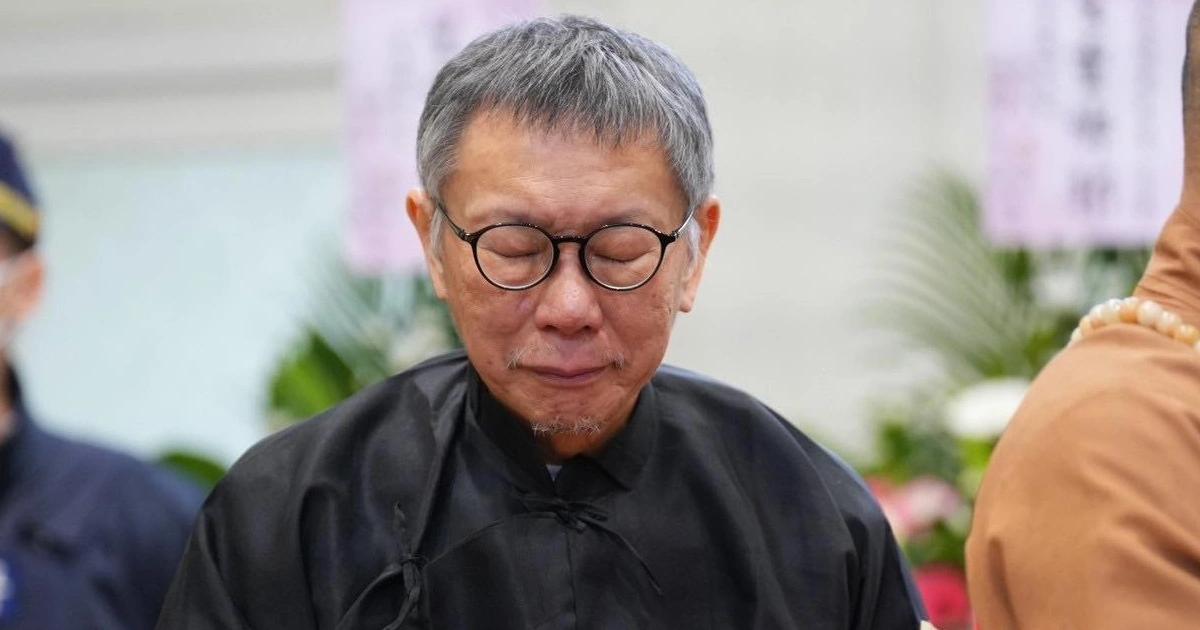
Ko Wen-je was sentenced to 17 years in the first trial for the Jinghua City case, making him unlikely to run in the 2028 presidential election. Previously, there was public speculation about 1,500 Bitcoins and USB cold wallets, but the indictment made no mention of Bitcoin or cold wallets, contradicting earlier rumors.
Ko Wen-je Jinghua City Case First Trial Results Announced
Former chairman of the Democratic Progressive Party Ko Wen-je is involved in the Jinghua City scandal and political donation case. The Taipei District Court announced the first trial verdict today. According to Public Television News, Ko Wen-je faces a combined sentence of 17 years in prison for 4 charges across 3 cases, along with a 6-year deprivation of civil rights. The case is still appealable.
The verdicts for other defendants are as follows:
- Shen Qingjing, Chairman of Weijing Group, sentenced to 10 years
- Taipei City Councilor Ying Hsiao-wei sentenced to 15 years and 6 months
- Former Deputy Mayor Peng Zhensheng sentenced to 2 years, with a 3-year probation
- Former Taipei City Urban Development Bureau Director Huang Jingmao sentenced to 6 years and 6 months
- Former Chief Engineer of the Urban Development Bureau Shao Xiuping sentenced to 1 year and 3 months, with a 3-year probation
In the political donation case, former CFO Li Wenzong was sentenced to 4 years and 6 months, Mokko Company manager Li Wenjuan received 2 years and 4 months, and accountant Duan Mu Zheng was sentenced to 1 year.
Current Democratic Progressive Party Chair Huang Kuo-chang responded to the verdict, saying:
“When I heard the first-instance verdict of Ko Wen-je, the party chairman, I was in disbelief and still cannot calm my emotions. I apologize for not being able to fully explain to everyone before seeing the reasons for the verdict.”
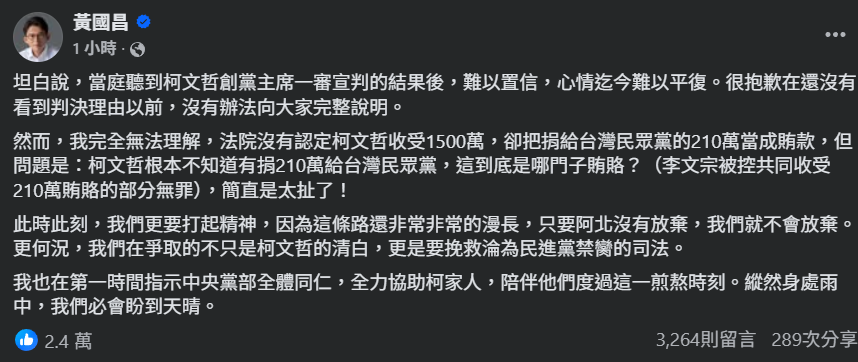
Image source: Huang Kuo-chang’s Facebook Jinghua City Case First Trial Results Announced, Huang Kuo-chang Responds
Review of Ko Wen-je’s Case Timeline: 2028 Presidential Election May Be Out of Reach
Reviewing the timeline of Ko Wen-je’s Jinghua City case, the Taipei District Prosecutors Office began investigating the Jinghua City case in May 2024, and searched Ko Wen-je’s residence in August of the same year. Ko Wen-je was ordered detention without bail in September 2024, and in December of the same year, he was indicted by the Taipei Prosecutor’s Office, facing a sentence of 28 years and 6 months. After about a year of detention, Ko Wen-je was released on bail in September 2025.
Prosecutors accused Ko Wen-je of crimes related to profiteering and bribery in the Jinghua City case, as well as public interest infringement and breach of trust in the political donations and the Hope Foundation cases, totaling four criminal charges.
According to the Presidential and Vice Presidential Election Recall Act, those with a final conviction of more than 10 years in prison are not eligible to register as presidential candidates.
With the first-instance sentence of 17 years announced, if the case is not overturned, Ko Wen-je may be unable to run in the 2028 presidential election.
Indictment Contradicts Rumors: No Mention of Bitcoin or Cold Wallets
During the investigation of Ko Wen-je’s case, there were frequent rumors that he had cryptocurrencies stored on USB drives.
Previous reports mentioned that some commentators and media speculated that Ko Wen-je’s USB drive might be a cold wallet, and even claimed that the record “Xiao Shen 1500” on Excel represented 1,500 Bitcoins. Some political talk shows even suggested that PowerPoint was a form of “virtual currency,” sparking online discussions and jokes.
However, according to the indictment and press releases published by the Taipei District Prosecutors Office, as summarized by Crypto City, there was no mention of virtual currencies, cold wallets, or Bitcoin.
The indictment states that the Excel files found on Ko Wen-je’s hard drive contained a record labeled “1500,” which was interpreted as a note of receiving NT$15 million in cash bribes from Shen Qingjing, with no relation to cryptocurrencies.
- Related article:** Ko Wen-je Indictment Summary: Is There 1500 Bitcoins or a USB Cold Wallet? Latest Developments in One Read**
Disclaimer: The information on this page may come from third parties and does not represent the views or opinions of Gate. The content displayed on this page is for reference only and does not constitute any financial, investment, or legal advice. Gate does not guarantee the accuracy or completeness of the information and shall not be liable for any losses arising from the use of this information. Virtual asset investments carry high risks and are subject to significant price volatility. You may lose all of your invested principal. Please fully understand the relevant risks and make prudent decisions based on your own financial situation and risk tolerance. For details, please refer to
Disclaimer.


