
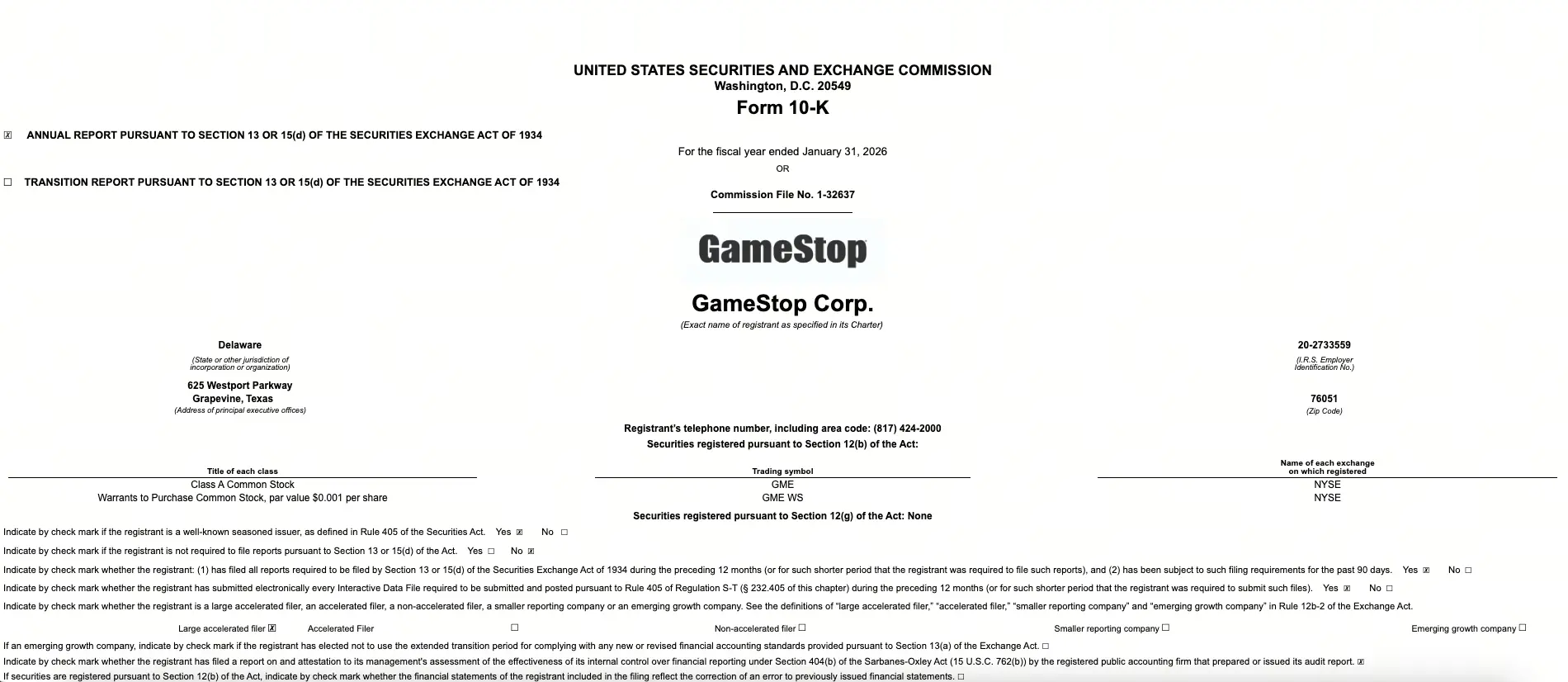
GameStop Corp. (NYSE: GME) filed its annual report for fiscal year 2025 on March 27, revealing the true purpose behind the market-focused Bitcoin transfer in January: of the 4,710 Bitcoins held by the company, 4,709 have been pledged as collateral to exchanges for over-the-counter covered call strategies, rather than being sold off.
Covered Call Strategy Structure: Earn Premiums While Limiting Upside Potential
 (Source: GameStop)
The core of GameStop’s Bitcoin options strategy involves pledging Bitcoin as collateral to sell short-term call options with strike prices ranging from $105,000 to $110,000, with expiration dates ending in March 2026. The logic behind this “covered call” approach is straightforward: selling call options allows the company to immediately earn option premiums. If Bitcoin does not surpass the strike price before expiration, the company keeps the premiums and recovers the pledged Bitcoin; if Bitcoin rises above the strike, the company is obligated to deliver Bitcoin at the agreed price, foregoing any gains above that level.
The financial details of the options strategy disclosed in the annual report are as follows:
Contract Strike Price: $105,000 to $110,000 (short-term)
Expiration Date: End of March 2026
Options-Related Liabilities: $700,000
Unrealized Gains: $2.3 million
Accounts Receivable (at fiscal year-end): $368.3 million
Unrealized Losses Related to Bitcoin Price Decline: $59.7 million
The report also notes that some covered call contracts expired unexercised after the fiscal year-end, with the related collateral still held by Coinbase Credit.
Accounting Nature Shift: From “Direct Holdings” to “Accounts Receivable”
This strategic arrangement results in a key change in accounting classification. Since Coinbase has the right to rehypothecate or redeploy the pledged Bitcoin under this arrangement, GameStop no longer classifies these Bitcoins as directly held assets but instead records them as “accounts receivable”—a claim to recover equivalent Bitcoin in the future.
GameStop emphasizes in its report that its “economic risk exposure” to Bitcoin remains similar to direct holdings, and overall market volatility has not been eliminated. However, structurally, this position has undergone a fundamental change: Bitcoin is now held by the counterparty Coinbase and linked to derivative contracts, no longer fully under GameStop’s independent control. This contrasts with the company’s earlier declared “long-term holding” strategy.
Frequently Asked Questions
Why did GameStop choose a covered call strategy instead of directly holding Bitcoin? The covered call strategy allows GameStop to retain exposure to Bitcoin’s price fluctuations while enhancing cash flow through premiums from selling call options. For example, with short-term contracts at strike prices of $105,000 to $110,000, the company can earn premiums if Bitcoin stays below these levels, at the cost of capping upside potential above the strike prices.
Does the covered call strategy mean GameStop’s Bitcoin might be forcibly sold? If Bitcoin rises above the strike prices before expiration (between $105,000 and $110,000), GameStop is obligated to deliver Bitcoin at the agreed price, which could result in forced delivery under certain conditions. If the price remains below the strike at expiration, the contracts expire worthless, and the company retains the premiums and collateral Bitcoin.
What are the specific figures for GameStop’s Bitcoin accounts receivable and unrealized losses? As of the end of fiscal year 2025 (January 31, 2026), the accounts receivable related to pledged Bitcoin totaled $368.3 million, with an unrealized loss of $59.7 million reflecting the decline in Bitcoin’s market price since the position was established.
Disclaimer: The information on this page may come from third parties and does not represent the views or opinions of Gate. The content displayed on this page is for reference only and does not constitute any financial, investment, or legal advice. Gate does not guarantee the accuracy or completeness of the information and shall not be liable for any losses arising from the use of this information. Virtual asset investments carry high risks and are subject to significant price volatility. You may lose all of your invested principal. Please fully understand the relevant risks and make prudent decisions based on your own financial situation and risk tolerance. For details, please refer to
Disclaimer.


