The long-term growth of a blockchain network is always linked to the scale of its developer ecosystem. As more developers join in building, the pace of infrastructure upgrades accelerates, attracting more users to layer 1 (L1), increasing on-chain activity, and enhancing the overall network value. In other words, the level of developer participation is the core driver of sustainable growth.
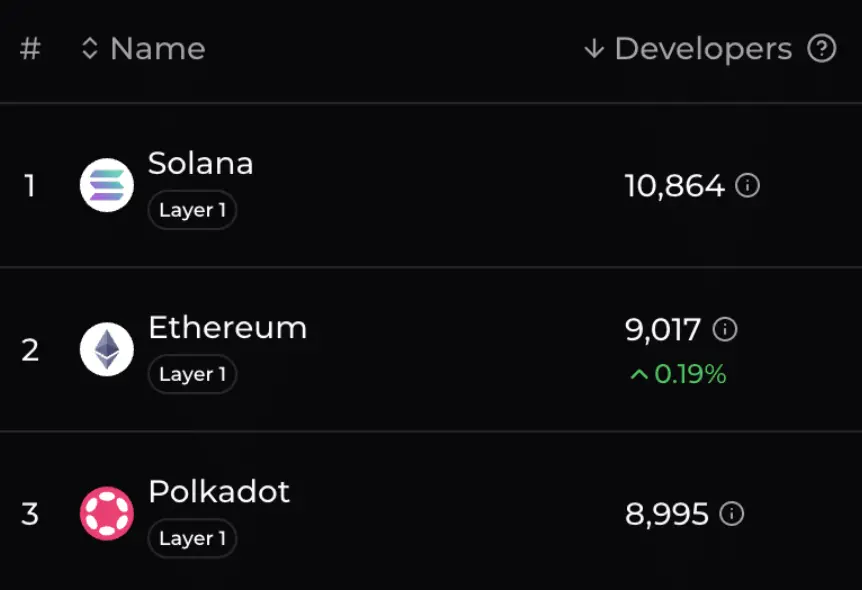
In this context, the recent milestone of Solana (SOL) is particularly noteworthy. Data shows that Solana has surpassed Ethereum (ETH) in terms of the total number of unique developers at any given time, leading all blockchains with 10,864 developers—nearly 20% higher than Ethereum. More importantly, the impact of this breakthrough is gradually reflecting clearly in the actual activity of the network.
A typical indicator is the trading volume on decentralized exchanges (DEX), a direct measure of on-chain activity levels. This metric reflects the transaction frequency of users, while also indicating the acceptance and liquidity of the network. The larger the volume, the higher the level of usage.
 Source: DeFiLlama According to DeFiLlama, Solana currently leads the entire market in DEX volume across all time frames. When placed alongside the strong growth of the developer community, it can be seen that this is not a random factor. The technical foundation bolstered by a large developer force is directly driving the demand for usage, creating a continuous and self-reinforcing growth loop.
At the same time, the expansion of the stablecoin ecosystem on Solana has also recorded significant progress. The supply of USD1 has increased from $160 million to $850 million in just 60 days, while the daily trading volume has remained stable at $200–300 million. USDC is also continuing to be issued strongly on the network, playing a role in supporting liquidity and contributing to the growth of on-chain activity alongside the boom of the developer ecosystem.
SOL/ETH in Focus
The abundant supply of stablecoins combined with strong DEX trading volume is reinforcing a solid foundation for Solana.
The operational mechanism is quite clear: high on-chain liquidity helps transactions to run more smoothly, enabling new applications to develop while attracting both developers and users. This forms a positive growth loop for the entire ecosystem. In this context, the fact that SOL is being undervalued compared to ETH is noteworthy.
Technically, price movements also reflect this. Since falling below the $0.05 mark after the crash in October last year, the SOL/ETH ratio has yet to recover. However, as network activity continues to expand, a breakout through the important resistance zone could open up room for Solana to demonstrate technical superiority.
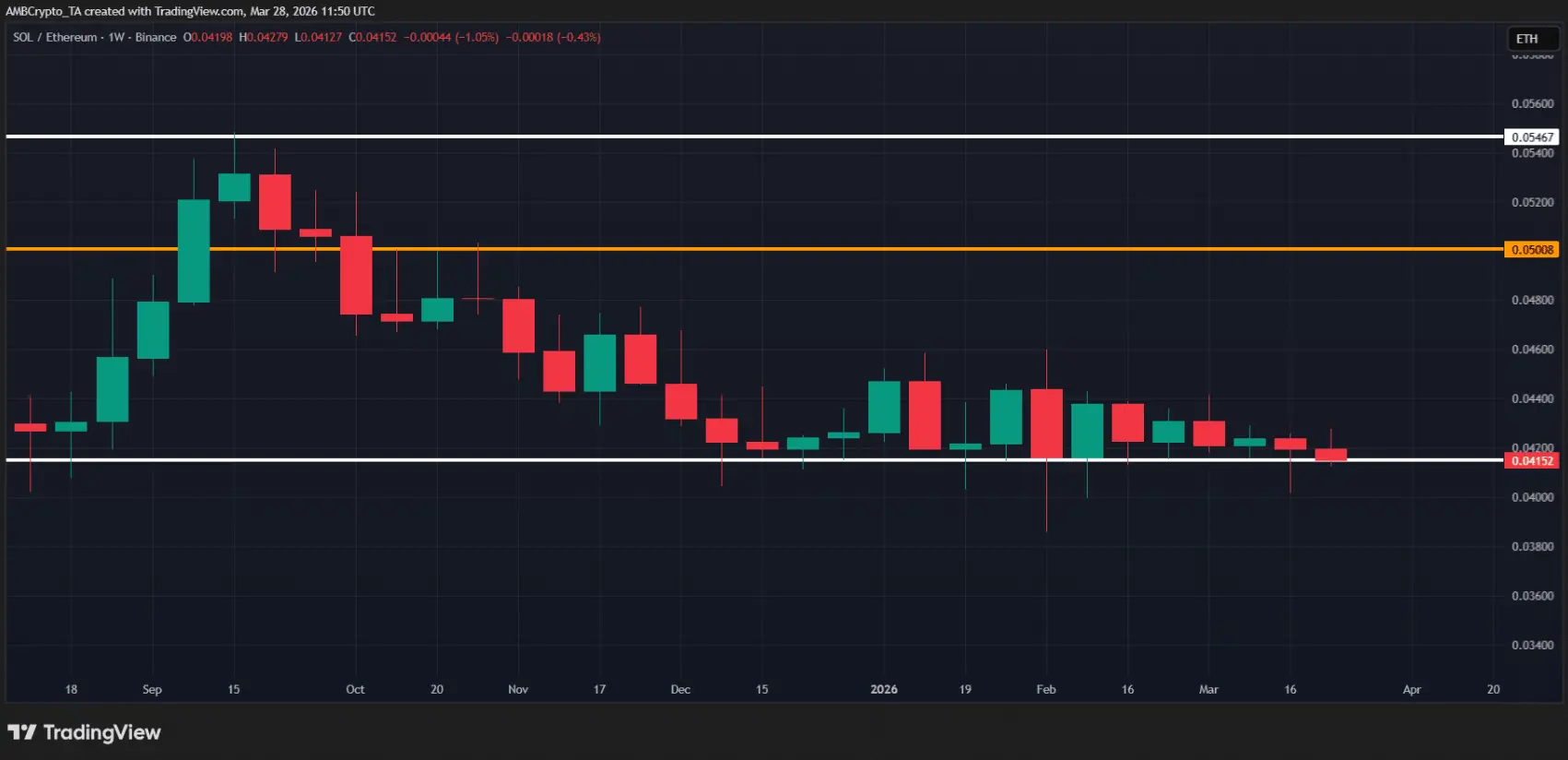 Daily SOL/USDT Chart | Source: TradingView From a more positive perspective, this ratio is currently accumulating around the $0.04 area—a region of key significance.
Notably, on the weekly timeframe, SOL/ETH has never closed below this area, indicating that it is a strong support level. According to Coin Photon, Solana’s advantage in the number of developers compared to Ethereum is directly reinforcing the network strength of SOL against ETH.
If this trend continues, it could become the foundation for a significant breakout, allowing SOL to outperform ETH in the second quarter.
Disclaimer: The information on this page may come from third parties and does not represent the views or opinions of Gate. The content displayed on this page is for reference only and does not constitute any financial, investment, or legal advice. Gate does not guarantee the accuracy or completeness of the information and shall not be liable for any losses arising from the use of this information. Virtual asset investments carry high risks and are subject to significant price volatility. You may lose all of your invested principal. Please fully understand the relevant risks and make prudent decisions based on your own financial situation and risk tolerance. For details, please refer to
Disclaimer.


