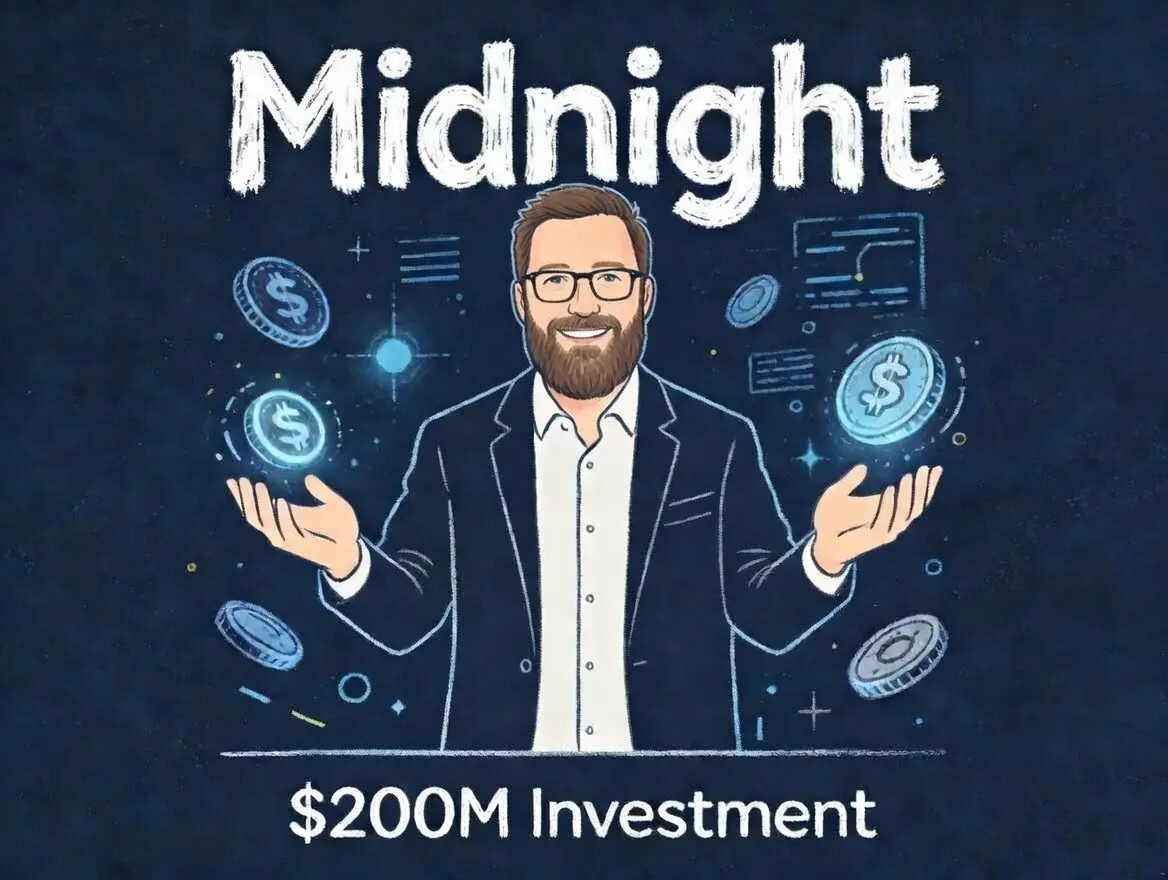
 Charles Hoskinson, founder of Cardano, launched the Midnight blockchain on March 31, 2026, a privacy-focused network designed to address what he described as crypto’s core design flaws in usability, data exposure, and complexity.
Hoskinson personally invested approximately $200 million in the project, which uses a hybrid ledger model and selective disclosure mechanisms to allow users and businesses to interact with blockchain without exposing sensitive personal data or managing complex wallet infrastructure.
Midnight Addresses Crypto Usability and Privacy Gaps with Selective Disclosure Model
Midnight is designed to solve what Hoskinson characterized as crypto’s failure to achieve mainstream adoption despite more than a decade of development. He cited complex wallet management, irreversible transaction risk, and fully transparent ledgers as structural barriers that have prevented blockchain from integrating with the real-world economy.
The network introduces selective disclosure, a system enabling users to prove specific facts about themselves—such as age, residency, or financial standing—without revealing underlying personal data. Users can answer cryptographic yes-or-no questions instead of handing over sensitive information, while transactions can maintain privacy without sacrificing verifiability where required.
Hoskinson described Midnight as a fourth-generation blockchain that removes the historical trade-off between privacy and transparency. Public blockchains have exposed too much data for enterprise use, while private systems sacrifice verifiability. The hybrid model allows some data to remain private while other elements can be verified when necessary, potentially enabling applications such as confidential payroll systems, financial institution fund transfers without position exposure, and identity systems without personal data storage.
Midnight Uses Dual-Token System with NIGHT for Governance and DUST for Transaction Fees
The network operates with a dual-token model designed to separate speculation from network utility. NIGHT serves as the governance and utility token, functioning as a store of value for the ecosystem while granting holders governance rights. Holding NIGHT generates DUST, a renewable gas token used for transaction fees.
Unlike traditional gas models where tokens are burned or paid out, DUST operates on a recharge model similar to a battery, with the amount earned proportional to the amount of NIGHT held. NIGHT holders can designate their DUST resources to others, allowing developers to cover transaction costs for users—a feature intended to reduce friction for application adoption.
The network uses zero-knowledge proofs to enable opt-in privacy and features a programming language called Compact designed for developers to build privacy-preserving applications without extensive ZK expertise. Midnight maintains its own ledger, consensus mechanism, and smart contract environment while remaining interoperable with Cardano through bidirectional asset movement without third-party bridges.
Midnight Achieves $776 Million Market Cap Following Largest Industry Airdrop
Hoskinson funded Midnight personally rather than through venture capital, distributing tokens through what the project describes as one of the largest airdrops in the industry. The distribution reached 37 million wallets across eight blockchains when tokens went live in December 2025.
Midnight briefly surpassed a $1 billion valuation and currently holds a market capitalization of approximately $776.2 million, with the token trading near $0.047. The network is built on Cardano, which ranks 12th globally with a market capitalization of approximately $9.2 billion.
At launch, Midnight operates under a federated validator model to maintain security and stability as the network matures. Early node operators include Worldpay, Bullish, MoneyGram, Pairpoint by Vodafone, eToro, AlphaTON Capital, Google Cloud, Blockdaemon, and Shielded Technologies. Cardano stake pool operators can also run Midnight validators to earn NIGHT tokens, allowing the network to inherit a degree of Cardano’s existing security and decentralized staking infrastructure.
Monument Bank Commits to Tokenize £250 Million in Deposits on Midnight
London-based Monument Bank announced plans to tokenize up to £250 million ($330 million) in retail deposits on Midnight, marking one of the first examples of a regulated bank bringing customer funds onto a public blockchain while maintaining regulatory protections. The institutional use case aligns with Midnight’s positioning for real-world asset tokenization and enterprise data workflows.
Hoskinson noted that Midnight aims to develop the DeFi and real-world asset ecosystem that has struggled to take root on Cardano by providing institutional privacy and security guarantees. Cardano’s entire DeFi ecosystem is estimated at $146 million in total value locked, according to DefiLlama.
The rollout will take place in phases, starting with infrastructure and expanding to applications and governance. Early use cases include confidential financial products, identity systems, and enterprise data workflows. The project is developed by Input Output Global, the research and development organization behind Cardano.
FAQ
What is Midnight and how does it differ from Cardano?
Midnight is a privacy-focused blockchain launched by Cardano founder Charles Hoskinson that operates as a complementary partner network to Cardano. While Midnight maintains its own ledger, consensus mechanism, and smart contract environment, it is interoperable with Cardano and allows Cardano stake pool operators to run Midnight validators.
How does Midnight’s dual-token system work?
Midnight uses NIGHT as its governance and utility token, which grants governance rights and generates DUST, a renewable gas token used for transaction fees. NIGHT holders can designate their DUST resources to developers, allowing applications to cover transaction costs for users.
What institutional adoption has Midnight secured?
Monument Bank, a UK-regulated bank, announced plans to tokenize up to £250 million ($330 million) in retail deposits on Midnight. Early node operators include Worldpay, MoneyGram, Vodafone’s Pairpoint, Google Cloud, and eToro.
Disclaimer: The information on this page may come from third parties and does not represent the views or opinions of Gate. The content displayed on this page is for reference only and does not constitute any financial, investment, or legal advice. Gate does not guarantee the accuracy or completeness of the information and shall not be liable for any losses arising from the use of this information. Virtual asset investments carry high risks and are subject to significant price volatility. You may lose all of your invested principal. Please fully understand the relevant risks and make prudent decisions based on your own financial situation and risk tolerance. For details, please refer to
Disclaimer.


