
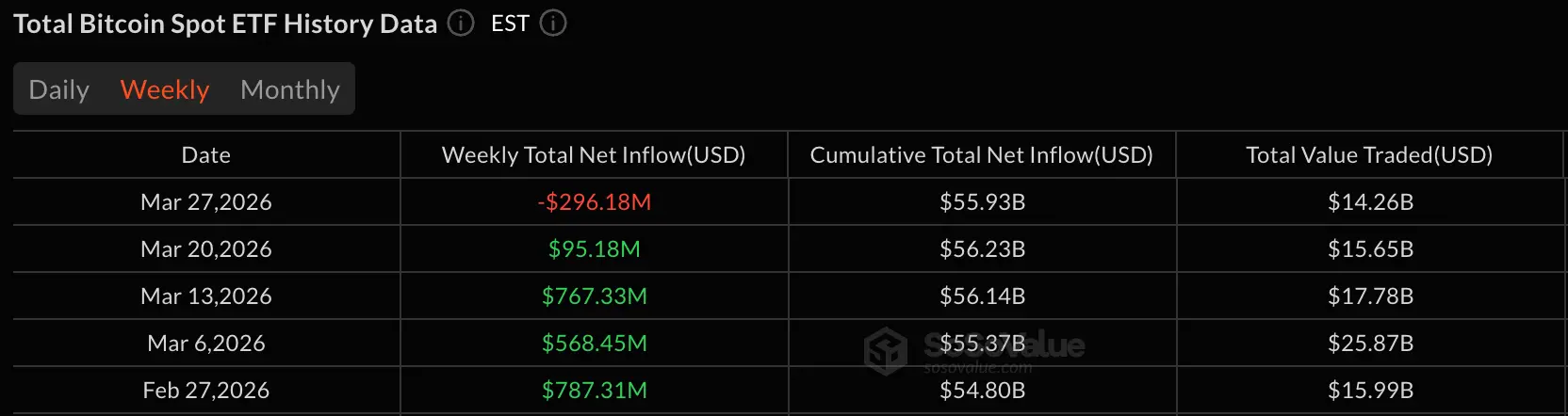
U.S. spot crypto exchange-traded funds (ETFs) faced notable funding pressure around the last full trading week of March. Bitcoin spot ETFs saw weekly net redemptions of $296 million, Ethereum ETFs saw net redemptions of $207 million, and the two combined saw outflows of about $503 million. This marked the first time weekly flows turned negative after four consecutive weeks of net inflows into Bitcoin ETFs; Ethereum ETFs, meanwhile, continued their daily outflow trend.
Bitcoin ETFs: An opening rebound that was short-lived—IBIT’s sharp Friday redemptions drove the reversal
 (Source: SoSoValue)
When trading opened on Monday last week (March 23), strong inflows into BlackRock’s IBIT and Fidelity’s FBTC injected a brief sense of hope into the market. But sentiment quickly reversed by midweek, and selling pressure dominated the trading days that followed. Friday (March 27) became the most destructive single day of the week: IBIT recorded single-day outflows of as much as $201 million, nearly wiping out the month’s gains accumulated from institutional positioning.
Overview of weekly fund flows for major Bitcoin ETFs:
IBIT (BlackRock): Primary driver of weekly outflows; sharp $201 million redemption on Friday; biggest drag
FBTC (Fidelity): Despite redemptions on multiple days, still finished the week with a net inflow of $46.88 million
GBTC (Grayscale): Continued steady outflows, with no clear improvement
BITB (Bitwise) / ARKB (Ark & 21Shares): Both recorded significant weekly net outflows
Ethereum ETFs: Broad outflows—ETHB staking breaks through against the tide
Ethereum ETFs not only performed worse in terms of outflow size, but also were more consistently tilted toward the negative side. The full week saw net redemptions of $207 million, with funds leaving in nearly every trading day. ETHA (BlackRock’s Ethereum ETF) led the downturn, while Fidelity’s FETH, Grayscale’s ETHE and its mini trust, Bitwise’s ETHW, 21Shares’ TETH, VanEck’s ETHV, and Invesco’s QETH all intensified overall outflow pressure.
However, BlackRock’s ETHB—which supports a staking feature—recorded a net inflow of $141 million for the entire week, making it the most convincing contrarian signal in the crypto ETF market. This figure suggests that, while large-scale capital was withdrawing from traditional Ethereum ETFs, ETFs with staking-related yield characteristics were attracting a batch of institutional capital with a preference for yield-oriented crypto products—reflecting a quiet shift in investor interest within the Ethereum ecosystem.
Altcoin ETFs diverge: XRP attracts inflows against the tide, Solana posts a slight outflow
In the altcoin ETF space, the market showed clear divergence this week. Solana (Solana) ETFs saw weekly net outflows of $4.2 million, mainly dragged by weak performance from Bitwise’s BSOL, Fidelity’s FSOL, and VanEck’s VSOL.
XRP ETFs became the only contrarian positive asset this week, with weekly net inflows of $2.66 million, driven mainly by Bitwise’s XRP products. Although the inflow size is relatively limited and unable to change the market’s overall negative tone, in a week when large-cap ETFs generally saw outflows, XRP’s directional choice in itself carries unique sentiment-reference significance.
Frequently Asked Questions
Why did Bitcoin ETFs show their first weekly outflow after four weeks of net inflows?
The main driver behind the week’s turn to negative flows was a broad deterioration in market sentiment, including continued geopolitical tensions in the U.S.-Iran region, expectations of Federal Reserve rate cuts cooling further, and certain institutional clients adjusting their positions at the end of the month. IBIT’s sharp $201 million redemption on Friday was the biggest contributor to the weekly turn negative, indicating that short-term defensive actions by institutional capital are currently driving the pricing pace.
What does contrarian inflow into the ETHB staking ETF mean?
ETHB’s net inflow of $141 million for the full week stands out especially against the backdrop of generally widespread outflows from traditional Ethereum ETFs. This data suggests institutional investors still have sustained demand for Ethereum products with staking-based yield characteristics. “Yield-enhanced” crypto ETFs may be forming a demand base that is independent of short-term market sentiment, making it a useful observation indicator for future directions of institutional capital.
Does the modest inflow into XRP ETFs mean institutions are starting to shift toward altcoins?
The $2.66 million inflow into XRP ETFs this week—compared with more than $500 million in combined outflows for BTC and ETH—is far too small to support a conclusion of a “systematic institutional shift toward altcoins.” This more likely reflects a diversification need for a small number of investors during the sell-off of large-cap assets, rather than a structural shift in demand for altcoin ETFs.
Disclaimer: The information on this page may come from third parties and does not represent the views or opinions of Gate. The content displayed on this page is for reference only and does not constitute any financial, investment, or legal advice. Gate does not guarantee the accuracy or completeness of the information and shall not be liable for any losses arising from the use of this information. Virtual asset investments carry high risks and are subject to significant price volatility. You may lose all of your invested principal. Please fully understand the relevant risks and make prudent decisions based on your own financial situation and risk tolerance. For details, please refer to
Disclaimer.


