
Bitcoin’s network hashrate in Q1 saw its first decline in six years. As the cost of mining a single coin nears $90,000—far above the current price of about $67,000—miners are taking severe losses. Large-scale mining firms have increasingly shifted their capital into AI computing infrastructure with higher profit potential, and the market may be headed toward further polarization.
Bitcoin’s hashrate first fell in Q1 in six years
The crypto mining market is undergoing a structural change. According to Glassnode data, Bitcoin’s total hashrate fell in Q1 for the first time in six years. Over the past five years, hashrate growth has increased by 10x; moreover, each year’s Q1 has shown an upward trend. But this year so far, hashrate is down by about 4%, hovering around 1 Zettahash (ZH/s) per second.
This decline reflects a change in the mining economy. The current cost of producing 1 Bitcoin is approaching $90,000, while the spot price is around $67,000, resulting in negative profits. Many publicly listed mining firms have redirected capital toward artificial intelligence and high-performance computing infrastructure to pursue higher returns.
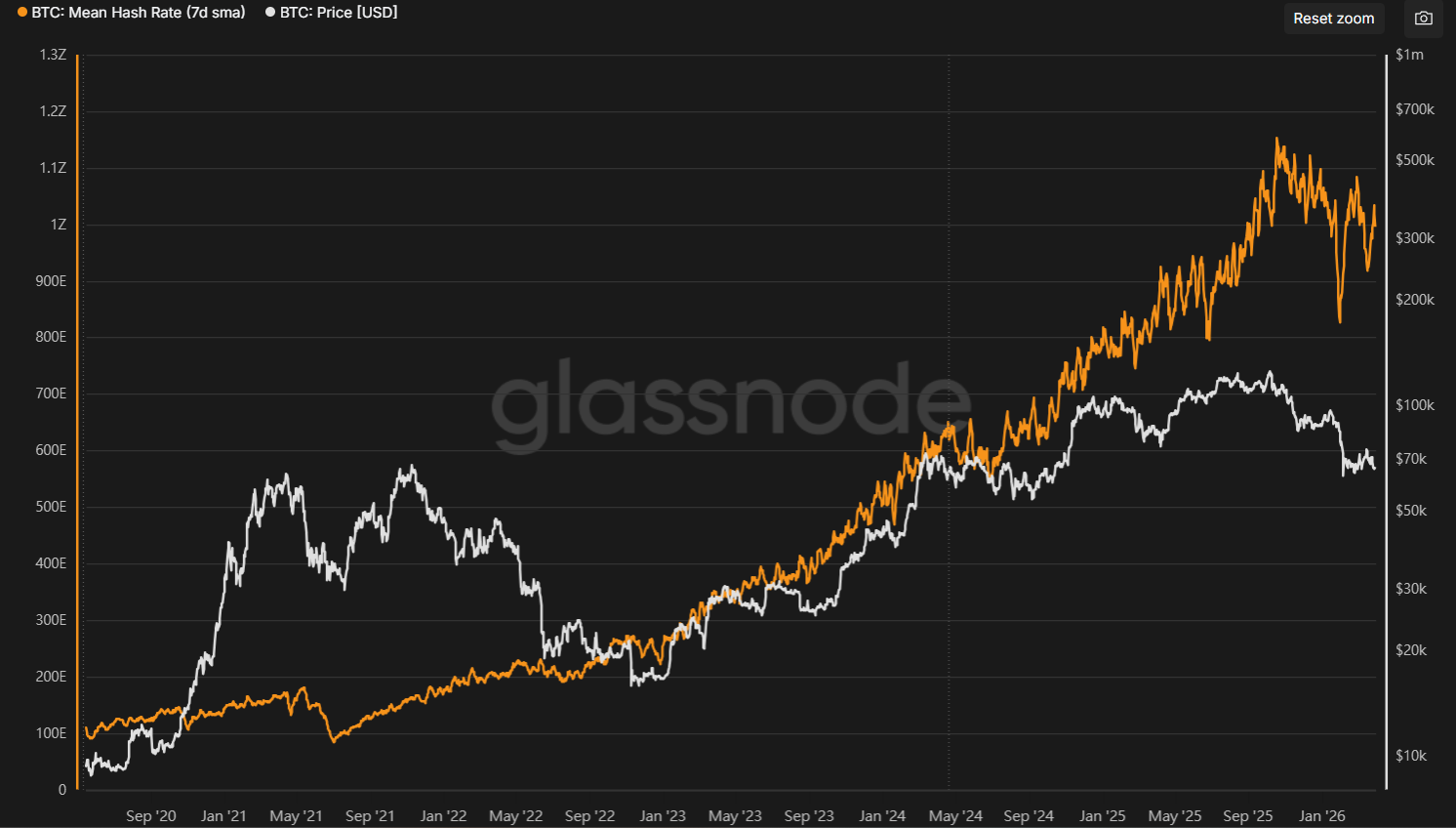
Image source: Glassnode Bitcoin network hashrate falls in Q1 for the first time in six years
Mining giants look to pivot to AI computing
According to a report by Block Tempo, the mining industry is facing severe challenges, as rising energy prices have pushed miners into losses.
Checkonchain’s model shows that as of March 13, the cost to mine 1 Bitcoin surged to $88,000. Compared with the spot price nearing $68,000, it means that for every Bitcoin mined, miners must absorb a massive loss of nearly $20,000; translated, every block mined would result in a 21% loss.
Public mining firms are pivoting one after another. Giants such as Marathon Digital and Cipher Mining have already started expanding data centers. CoinShares data shows that giants including TeraWulf, Core Scientific, and Hut 8 (Hut 8 Corp) have also announced AI and high-performance computing-related deals with a total value exceeding $70 billion.
CoinWarz predicts that Bitcoin’s next mining difficulty adjustment will take place in early April, and it may be adjusted downward further.
- **Related coverage:**Lose $20k for every 1 BTC mined! Bitcoin miners kick off a wave of departures as mining difficulty and total network hashrate retrace sharply
Mining capital gets reallocated, and the market faces a polarized structure
Regarding whether a decline in hashrate could raise concerns about Bitcoin network security—or instead increase decentralization — a report released by JPMorgan in January noted that U.S. publicly listed mining firms account for about 41% of the global hashrate. Some viewpoints believe that the dominance of these large companies is weakening, which could make the network more distributed.
However, blockchain analytics firm Nansen analyst Jake Kennis told The Street that there are many ways to measure decentralization, and a simple decline in hashrate will not directly improve decentralization. In the future, the level of decentralization will depend entirely on the breadth of hashrate distribution, rather than the absolute size of total hashrate.
He expects that the future of the mining market may move toward polarization: the top tier will be dominated by large AI and mining dual-purpose firms, the edge areas will be gradually built up by lower-cost miners, while mid-sized operators will face severe squeeze and difficulties.
Kennis noted that because large amounts of capital, electricity resources, and construction capacity are being redirected to AI infrastructure, it will inevitably reduce the space for future hashrate growth for publicly listed mining firms.
Will Bitcoin hit new highs this year? Traders are not optimistic
According to CoinShares’ forecast, if the price rebounds to $100,000, hashrate could still reach 1.8 ZH/s by the end of 2026. However, currently the price is still far from the October 2025 peak.
The probability that Polymarket Bitcoin will trade above $120,000 in 2026 is only 15%. Senior trader Peter Brandt expects that a new high price may only be seen in the second quarter of 2027.
Based on CoinGecko data, as of the time of publication, Bitcoin’s trading price was $67,865, up 1.13% over the past 24 hours.
Disclaimer: The information on this page may come from third parties and does not represent the views or opinions of Gate. The content displayed on this page is for reference only and does not constitute any financial, investment, or legal advice. Gate does not guarantee the accuracy or completeness of the information and shall not be liable for any losses arising from the use of this information. Virtual asset investments carry high risks and are subject to significant price volatility. You may lose all of your invested principal. Please fully understand the relevant risks and make prudent decisions based on your own financial situation and risk tolerance. For details, please refer to
Disclaimer.


