
Claude Code’s source code was leaked due to a human error, and the official statement confirmed it was a packaging oversight. A Korean developer quickly rewrote it into an open-source Python version, and in just two hours on GitHub it racked up 50,000 stars—a record for a “star burst.”
Claude Code source code leaked—what happened?
Within the last 24 hours, Anthropic’s popular AI coding tool, Claude Code, experienced an accidental source code leak. A Korean developer promptly “ported” and rewrote it into a Python version, open-sourcing it in the process—turning it into one of the fastest projects on GitHub to reach 50,000 stars.
Why did the Claude Code source code leak? According to a review by Fortune magazine and the developer Kuberwastaken, the root cause was a configuration error during the software release process. This leak exposed about 1,900 files of Claude Code, totaling as many as 500,000 lines of code.
The developers explained that when engineers publish a software package in JavaScript or TypeScript to the npm registry, build tools typically automatically generate source-mapping files (.map files). The main purpose of these files is to act as a bridge—so when the compressed production code crashes, developers can trace back to the correct line numbers in the original source files.
But Anthropic’s release process failed to exclude these mapping files, causing the complete Claude Code source to be treated as a string and embedded directly into JSON-format files. In simple terms, anyone can run a download command to easily obtain the full code—including internal constants, system prompt text, and all comments.
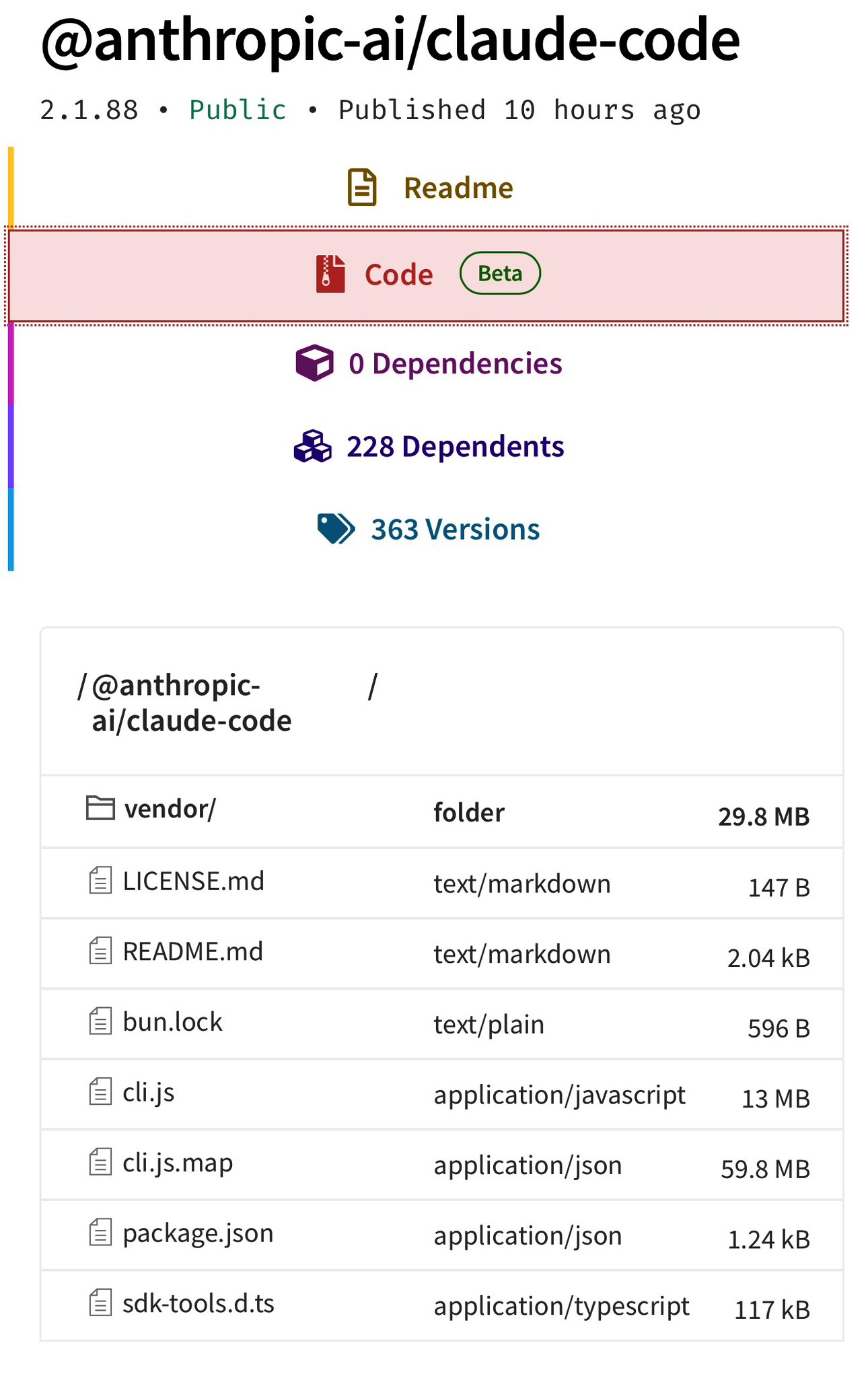
Image source: Kuberwastaken/GitHub Claude Code source code leaked
LayerX Security senior AI security researcher Roy Paz had initially pointed out that this appears to be a human error—suggesting someone may have bypassed standard security checks during the release. However, Anthropic later denied the claim that security mechanisms were bypassed.
Korean developer rapidly ports and rewrites it into “Claw Code”
Less than a day after the Claude Code source code leak hit the headlines, Korean developer Sigrid Jin (instructkr) launched a brand-new version “Claw Code” on GitHub, fully written in Python.
Sigrid Jin claimed that the rewritten “Claw Code” perfectly reproduced the architectural patterns of Claude Code’s agent framework, and said it used a clean-room implementation approach to ensure that no proprietary Anthropic source code was copied.
Once the project was released, it sparked a strong wave of interest in the global developer community. In just 2 hours, it surpassed 50,000 stars, becoming the open-source project in GitHub history to reach that milestone the fastest.
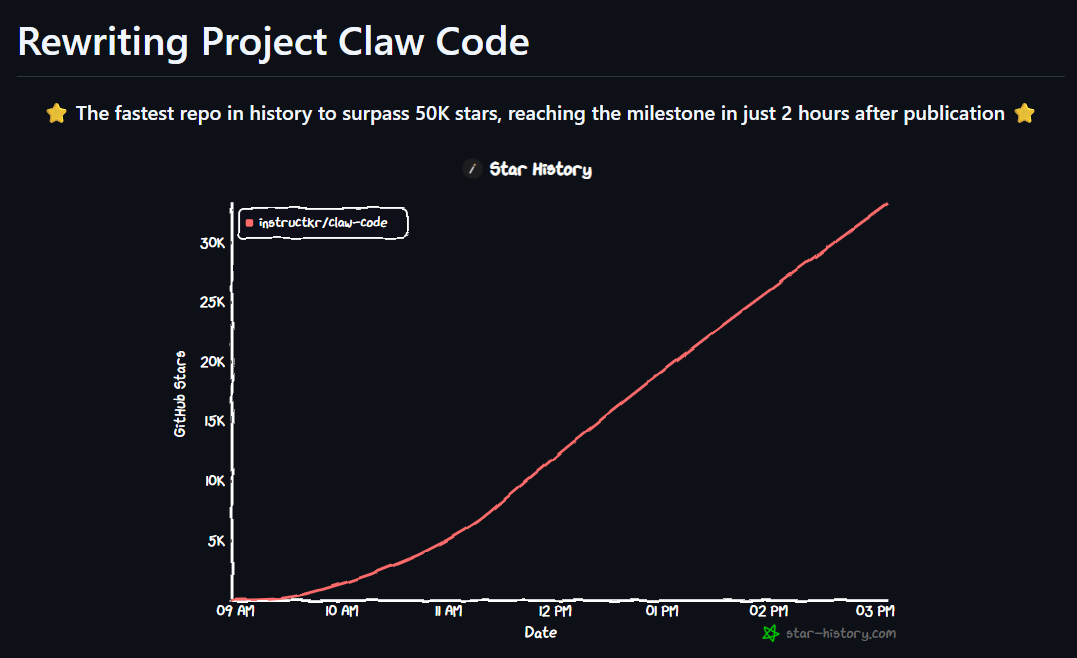
Image source: Sigrid Jin (instructkr) Korean developer quickly “ported” and rewrote it into the Python version “Claw Code,” open-sourcing it—making it the project on GitHub that got 50,000 stars the fastest.
In addition, Sigrid Jin further noted that a Rust-language port is already in progress on the dev/rust branch, and is expected to be merged into the main branch today.
He emphasized that the Rust implementation provides a faster-running framework execution environment with memory-safety characteristics, and that this will likely become the project’s final decision version.
The ported Claw Code uses workflow tools to assist development
Sigrid Jin also revisited the development process on the GitHub page. At the time Claude Code’s source was leaked, the whole developer community went into a frenzy. At the time, his Korean girlfriend was very worried that by downloading and saving the leaked source code on her computer, she might face legal action from Anthropic.
Under that kind of pressure, he decided to sit down right away—starting from scratch to port the core functionality to Python—and pushed the code before sunrise.
This rapid development process relied entirely on an end-to-end collaboration workflow tool, oh-my-codex, built by another developer, Yeachan Heo.
Sigrid Jin used the tool’s team mode to conduct parallel code reviews, and ran a continuous verification loop through specific patterns, ultimately producing a Python version with test foundations.
In a previous interview with The Wall Street Journal, Sigrid Jin revealed that he himself is a heavy user of AI tools—last year, he personally consumed as many as 25 billion Claude Code tokens.
Anthropic confirmed the leak, but didn’t respond on whether public behavior is unlawful
In response to the Claude Code source code leak, an Anthropic spokesperson confirmed to the tech media outlet The Register that a Claude Code release version indeed contained some internal source code. At the same time, the spokesperson emphasized that no customer data or credentials were involved or exposed in the incident.
The spokesperson said it was a packaging problem caused by human error and did not involve any security vulnerability being exploited by hackers. The company is currently deploying related measures to prevent similar incidents from happening again.
However, whether “backing up” Claude Code’s source code on GitHub, or rewriting it into other programming languages, would trigger intellectual property disputes is still an open question. When the media asked whether Anthropic would require the public to delete the relevant GitHub repositories, the company did not provide any further comments beyond its official statement.
Further reading:
Chinese drone maker’s users exposed to cybersecurity risks? He used Claude to reverse engineer and gained control of global devices
Disclaimer: The information on this page may come from third parties and does not represent the views or opinions of Gate. The content displayed on this page is for reference only and does not constitute any financial, investment, or legal advice. Gate does not guarantee the accuracy or completeness of the information and shall not be liable for any losses arising from the use of this information. Virtual asset investments carry high risks and are subject to significant price volatility. You may lose all of your invested principal. Please fully understand the relevant risks and make prudent decisions based on your own financial situation and risk tolerance. For details, please refer to
Disclaimer.


