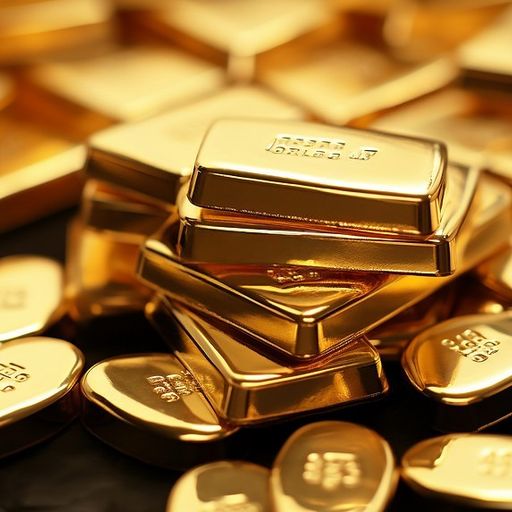
Global central banks are undergoing an invisible asset migration. In 2024, data shows that central banks worldwide net purchased 1,136 tons of gold — marking the third consecutive year surpassing the thousand-ton threshold. Countries like Poland, Brazil, Turkey, and Singapore have collectively entered the market, sending signals worth deep reflection.
Why are central banks around the world rushing to buy gold? The answer is straightforward. The proportion of US dollar reserves has fallen to a historic low of 44%, and the scale of US debt approaches $38 trillion. The US dollar credit system is facing unprecedented pressure. In this context, traditional hard currency gold has become the last "safety valve" for governments.
De-dollarization is moving from paper to reality. Geopolitical turbulence and repeated Federal Reserve policies are dismantling the dominance of the dollar. Gold, as an asset that transcends any single country's currency, is being repositioned as the best choice for "sovereign assets." Meanwhile, potential rate cuts by the Federal Reserve and inverse operations by the European and Japanese central banks further boost gold's appeal.
It is worth noting that China's central bank has taken a very prudent approach — steadily increasing holdings for 13 consecutive months, with gold reserves surpassing 2,300 tons. This long-term, systematic allocation contrasts sharply with the behavior of other central banks.
Gold prices have already broken through the $4,500 mark. Do ordinary investors still have a chance? Honestly, blindly following central banks and chasing high prices is not wise. But the trend itself is irreversible — the world is redefining its "value anchor." Gold, once considered an antique asset, is now being wildly revalued, reflecting a deep skepticism toward the existing monetary system.
The essence of this shift is a collective risk aversion among countries amid the loosening of the old order, and a revolutionary change in the concept of sovereign asset allocation. When central banks no longer fully trust paper money, this question is worth everyone’s consideration. Whether holding traditional assets or crypto assets, everyone should pay attention to how this trend is reshaping the global asset allocation landscape.
View Original
This page may contain third-party content, which is provided for information purposes only (not representations/warranties) and should not be considered as an endorsement of its views by Gate, nor as financial or professional advice. See Disclaimer for details.
17 Likes
Reward
17
6
Repost
Share
Comment
0/400
MetaMaskVictim
· 10h ago
Central banks are all stockpiling gold, while we retail investors are still flipping through paper money... outrageous
The dollar is cooling off, and gold is the real deal
This move by China's central bank is rock solid, learn from it
With gold prices at $4500, I can't afford to chase it haha
When paper currency's credit collapses, that's true liquidation
Hard assets are king, this is not a joke
De-dollarization is no longer just a slogan, it's really happening
Gold will still rise, but don't go all-in, brothers
Collective central bank risk aversion—what does it mean? Everyone's panicking
Once considered antique assets, now they're becoming hot commodities
Both crypto and gold should be held; diversification is smart
The Fed's latest move has directly sparked a gold rush
Stop trusting that paper money system, wake up everyone
View OriginalReply0
SorryRugPulled
· 10h ago
Central banks are hoarding gold, and retail investors should wake up too
This wave of de-dollarization is real, paper currency credit is failing
The Chinese central bank is steady, increasing for 13 months in a row, I’m envious
Breaks through 4500, still chasing high? Pure fool, but not participating isn’t an option either
From the financial crisis to now, gold has finally turned around and sung the song of the oppressed
$38 trillion in US debt is crushing, no wonder countries are stuffing their vaults with gold
Compared to this, I wonder if BTC can also share some of the spotlight
Sovereign asset reallocation? Basically, it means no longer trusting Uncle Sam
A real wealth transfer is quietly happening, most people are still sleeping
View OriginalReply0
BearMarketSunriser
· 10h ago
Central banks' recent moves are really like playing chess
Hard currency still has to be gold; you can't trust paper money anymore
$4500 is already so high; retail investors really need to be cautious and not get caught off guard
De-dollarization is inevitable; just look at how China's central bank is steadily accumulating gold to see that
View OriginalReply0
RektButSmiling
· 10h ago
Central banks are all stockpiling gold, what does that mean... Are paper currencies really going to fade away?
---
De-dollarization has long been overdue. Who can withstand the $38 trillion in US debt?
---
The Chinese central bank's recent moves are rock solid, playing a big chess game for 13 consecutive months.
---
Gold is now at $4,500 per ounce—still dare to challenge? Are you seeking death? Wait for the pullback.
---
Interesting, central banks around the world are all hoarding gold. Should we, the holders of currency, wake up?
---
The revaluation of gold reflects distrust in the US dollar. The signal is too obvious.
---
Why are some still stubbornly holding US debt? Just look at these data and you'll understand.
---
It has truly become a "collective safe haven." Is this an attempt to break the US dollar's dominance?
---
Fiat currency depreciates, gold prices soar—feeling like the next wave of wealth transfer is coming.
---
Sovereign asset allocation revolution—just hearing this phrase sounds extraordinary.
View OriginalReply0
GasFeeSurvivor
· 10h ago
Central banks are all stockpiling gold, and retail investors can only drink the soup...
Is the US dollar really going to end? Feels like we've been saying that for many years.
Gold has already reached 4500, still dare to chase? Isn't this just the final baton?
China's move is truly stable, continuously increasing positions for 13 months, just not in a hurry.
Paper currency credit collapse? What about our crypto assets? They’re not doing much better either.
This time, a new order has truly arrived, and asset allocation needs to be reconsidered.
When the central banks are cashing out, we’re still in FOMO, a classic reverse indicator haha.
Sovereign asset allocation revolution? Sounds big, but for ordinary people, it just means not making money.
De-dollarization is no longer just a slogan, it’s really happening.
Gold prices are so high, it feels like they've been overextended. Let’s wait for the dip, everyone.
View OriginalReply0
MemeKingNFT
· 10h ago
The central bank is rushing to buy gold, basically meaning they no longer trust paper currency... Hey, I saw this move coming a long time ago.
All the on-chain data is right here: the collapse of the US dollar credit system, the revaluation of gold, and next, it should be digital assets' turn, right?
44% of US dollar reserves, oh my... This wave of de-dollarization really feels like it has been brewing since the Book of Songs era, "the rise and fall of the mainland," brother.
You're still chasing high gold prices, but I've already been thinking about the revolution in blockchain asset allocation. The era of making quick money is over.
Honestly, the central bank's approach is basically an advanced version of the retail investor mindset—everyone's bottom-fishing, but where's the bottom?
This is true on-chain analysis, even if not on the chain, the logic is clearer than 99% of blockchain game projects.
The Chinese central bank has steadily increased holdings over 13 months, which is going with the trend, unlike some blue-chip projects that fluctuate wildly.
Gold at $4,500? Just like the digital collectibles I bought in 2018, high-level oscillations—everyone wants to escape, but you can't.
The old order is really loosening up; the bottoming phase is still ongoing. Don't rush to go all-in on gold.
This market sentiment shift toward sovereign assets—what does it mean? The asset allocation concept has been completely reshuffled.
What the central banks are doing, retail investors, don't blindly follow—lesson learned from my crash record.
Global central banks are undergoing an invisible asset migration. In 2024, data shows that central banks worldwide net purchased 1,136 tons of gold — marking the third consecutive year surpassing the thousand-ton threshold. Countries like Poland, Brazil, Turkey, and Singapore have collectively entered the market, sending signals worth deep reflection.
Why are central banks around the world rushing to buy gold? The answer is straightforward. The proportion of US dollar reserves has fallen to a historic low of 44%, and the scale of US debt approaches $38 trillion. The US dollar credit system is facing unprecedented pressure. In this context, traditional hard currency gold has become the last "safety valve" for governments.
De-dollarization is moving from paper to reality. Geopolitical turbulence and repeated Federal Reserve policies are dismantling the dominance of the dollar. Gold, as an asset that transcends any single country's currency, is being repositioned as the best choice for "sovereign assets." Meanwhile, potential rate cuts by the Federal Reserve and inverse operations by the European and Japanese central banks further boost gold's appeal.
It is worth noting that China's central bank has taken a very prudent approach — steadily increasing holdings for 13 consecutive months, with gold reserves surpassing 2,300 tons. This long-term, systematic allocation contrasts sharply with the behavior of other central banks.
Gold prices have already broken through the $4,500 mark. Do ordinary investors still have a chance? Honestly, blindly following central banks and chasing high prices is not wise. But the trend itself is irreversible — the world is redefining its "value anchor." Gold, once considered an antique asset, is now being wildly revalued, reflecting a deep skepticism toward the existing monetary system.
The essence of this shift is a collective risk aversion among countries amid the loosening of the old order, and a revolutionary change in the concept of sovereign asset allocation. When central banks no longer fully trust paper money, this question is worth everyone’s consideration. Whether holding traditional assets or crypto assets, everyone should pay attention to how this trend is reshaping the global asset allocation landscape.