

Trade
Basic
Futures
Futures
Hundreds of contracts settled in USDT or BTC
TradFi
Gold
Trade global traditional assets with USDT in one place
Options
Hot
Trade European-style vanilla options
Unified Account
Maximize your capital efficiency
Demo Trading
Futures Kickoff
Get prepared for your futures trading
Futures Events
Participate in events to win generous rewards
Demo Trading
Use virtual funds to experience risk-free trading
Earn
Launch
CandyDrop
Collect candies to earn airdrops
Launchpool
Quick staking, earn potential new tokens
HODLer Airdrop
Hold GT and get massive airdrops for free
Launchpad
Be early to the next big token project
Alpha Points
New
Trade on-chain assets and enjoy airdrop rewards!
Futures Points
New
Earn futures points and claim airdrop rewards
Investment
Simple Earn
Earn interests with idle tokens
Auto-Invest
Auto-invest on a regular basis
Dual Investment
Buy low and sell high to take profits from price fluctuations
Soft Staking
Earn rewards with flexible staking
Crypto Loan
0 Fees
Pledge one crypto to borrow another
Lending Center
One-stop lending hub
VIP Wealth Hub
Customized wealth management empowers your assets growth
Private Wealth Management
Customized asset management to grow your digital assets
Quant Fund
Top asset management team helps you profit without hassle
Staking
Stake cryptos to earn in PoS products
Smart Leverage
New
No forced liquidation before maturity, worry-free leveraged gains
GUSD Minting
Use USDT/USDC to mint GUSD for treasury-level yields

More






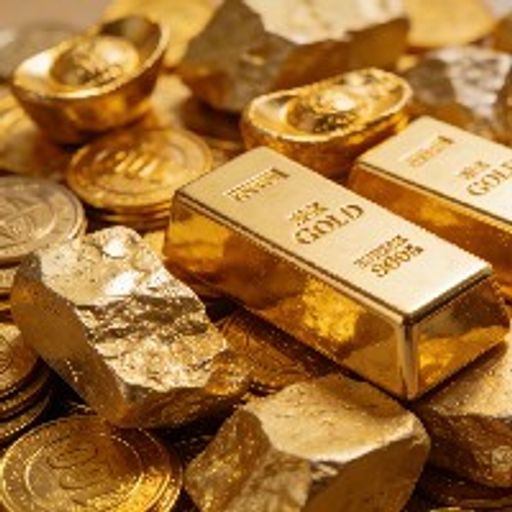
Gold predictions 10 years from now: $5,000 scenario by 2030
Gold forecasts in 10 years are one of the most relevant debates in global financial markets. With multiple economic and geopolitical factors converging, gold is positioned as a critical defensive asset. Professional analysis of the world’s leading financial institutions converges towards bullish scenarios, with estimates that see the precious metal reaching significant levels within the next decade.
Based on extensive studies combined with the latest market data, the most likely forecasts place gold around $5,000 per ounce at the end of this decade. This represents a structural growth trend rather than speculative volatility.
The institutional consensus: where experts predict gold
The world’s leading financial institutions have published a broad spectrum of forecasts for 2025 and 2026. Bloomberg estimates a range of $1,709 to $2,727 in 2025, reflecting macroeconomic uncertainty. Goldman Sachs projects gold to $2,700 in early 2025, based on a stable market view.
Further estimates come from important institutions:
A notable consensus emerges around the $2,700-$2,800 range for 2025, signaling broad agreement on the near-term trajectory. For 2026, projections suggest further appreciation, with the range of $2,800 to $3,800 per ounce.
Structural drivers: from monetary policy to inflation
Gold remains fundamentally a monetary asset, driven by the dynamics of the monetary base. The M2 aggregate, after the strong expansion of 2021, began to stabilize in 2022. Historically, gold and the monetary base have moved in positive correlation, although the price of the metal tends to precede monetary changes.
The time divergence between M2 and the spot price, observed in 2023-2024, was not sustainable. As predicted by professional analyses, this discrepancy has corrected during 2024, confirming the bullish thesis. Money growth continues to put positive pressure on the price of gold.
The Consumer Price Index (CPI) is the most critical fundamental factor in predicting gold movements. Gold tends to shine in inflationary environments. The historical correlation between inflation expectations (as measured by the TIP ETF) and the price of gold is statistically strong, with rare short-lived divergences.
Interestingly, gold shows positive correlation not only with inflation expectations, but also with the S&P 500. This invalidates the narrative that gold thrives only during recessions: the reality is that the metal responds to inflationary dynamics and global risk appetite.
Technical analysis: long-term chart formations
The multi-decade chart analysis of gold reveals significant bullish patterns. On the 50-year charts, gold completed a ten-year consolidation between 2013-2023, forming a cup and handle configuration. This is one of the most reliable technical formations to predict continuation of sustained trends.
Previously, in the 1980s and 1990s, gold had formed a long falling wedge. The length of this consolidation had then generated an unusually prolonged bull market. The current formation, which is equally long, suggests pronounced bullish potential for the coming years.
On the 20-year charts, it is clear that previous gold bull markets developed in multiple phases, accelerating towards their conclusions. The present reversal, which was completed in 2023, aligns with this historical pattern.
Leading indicators: currency markets and derivatives markets
The EURUSD is a significant leading indicator. The euro-dollar pair maintains a bullish configuration over the long term, creating a favorable environment for gold. When the euro strengthens, gold tends to appreciate. Conversely, a rising U.S. dollar historically compresses gold prices.
The 20-year US Treasuries show a long-term bullish stance. Since bond yields are inversely correlated with the price of gold (effect on real discount rates), prospects of stable or diminishing returns remain supportive for the metal.
In the COMEX futures market, the net short positions of commercial traders remain elevated. This metric, interpreted as an indicator of “extension,” suggests that the potential for further price compression is limited. When short trade positions are particularly high, the price of gold has a downside “safety cushion”.
Crucial Decade: How Past Predictions Came True
Examining the historical trace of professional estimates on gold prices, a pattern of remarkable accuracy emerges. For five consecutive years, projections have hit targets with constructive precision. The forecast for 2024 of $2,200-$2,555 was actually achieved by August 2024, confirming the methodological rigor of the analysis.
This historical reliability provides significant foundation for current projections. The estimates for 2030 of $5,000 represent the natural evolution of the observed trends, not an arbitrary speculative target. They are based on cross-sectoral correlation models, multi-decade graphical analysis, and objectively measurable monetary dynamics.
Gold versus silver: complementary dynamics in the long term
Over the next decade, both gold and silver play specific roles. Silver tends to react to the upside in later stages of the gold bull cycle. The chart of the 50-year gold/silver ratio confirms this dynamic: the gray metal accelerates its appreciation after gold has already completed significant portions of its rise.
Silver has strong fundamentals and growing industrial applications. A target of $50 per ounce of silver by the end of the decade would naturally emerge from the normalization of the gold/silver ratio.
Extreme scenarios and forecast limits
While $5,000 per ounce is the base case by 2030, extreme volatility scenarios could assume $10,000. This would lead to abnormal market conditions: out-of-control inflation as in the 1970s, or acute geopolitical crises that would lead to massive flight to safe-haven assets.
Forecasts beyond 2030 remain speculative by nature. Macroeconomic conditions tend to renew themselves every decade, making it impossible to credibly shape scenarios twenty years later. For this reason, gold forecasts 10 years from now are the maximum time horizon for reliable fundamental analysis.
Conclusion: The Gold Decade Remains Open
Gold forecasts 10 years from now converge to around $5,000 by 2030 under ordinary market conditions. This path does not represent a vertical acceleration, but rather a structural positive trend, driven by continued monetary expansion, the outlook for persistent inflation, and an upward revision of institutional demand.
The historical reliability of professional estimates, combined with technical support from decades-long chart formations, provides reasonable foundation for these projections. Investors structuring portfolios over the next decade may view gold as a critical defensive component, with expectations of structural appreciation consistent with the evolving global macroeconomic cycle.