Is Radix (XRD) a good investment?: A Comprehensive Analysis of Market Potential, Technology, and Risk Factors


Introduction: Radix (XRD) Investment Position and Market Prospects
XRD is an important asset in the cryptocurrency field. Since its launch in August 2021, it has been developed as a Layer 1 protocol specifically designed to serve the decentralized finance (DeFi) industry. As of December 2025, XRD has a market capitalization of approximately $20.34 million USD, with a circulating supply of approximately 13.32 billion tokens. The current price is trading around $0.001527, representing a significant decline from its historical high of $0.651264 reached in November 2021. Positioned as "a Layer 1 protocol built for the rapidly growing DeFi industry," XRD has gradually become a focal point when investors discuss whether Radix represents a viable investment opportunity. This article will provide a comprehensive analysis of XRD's investment value, historical price trends, future price projections, and associated investment risks to serve as a reference for investors.
Radix (XRD) Crypto Asset Research Report
I. Price History Review and Current Investment Value of XRD
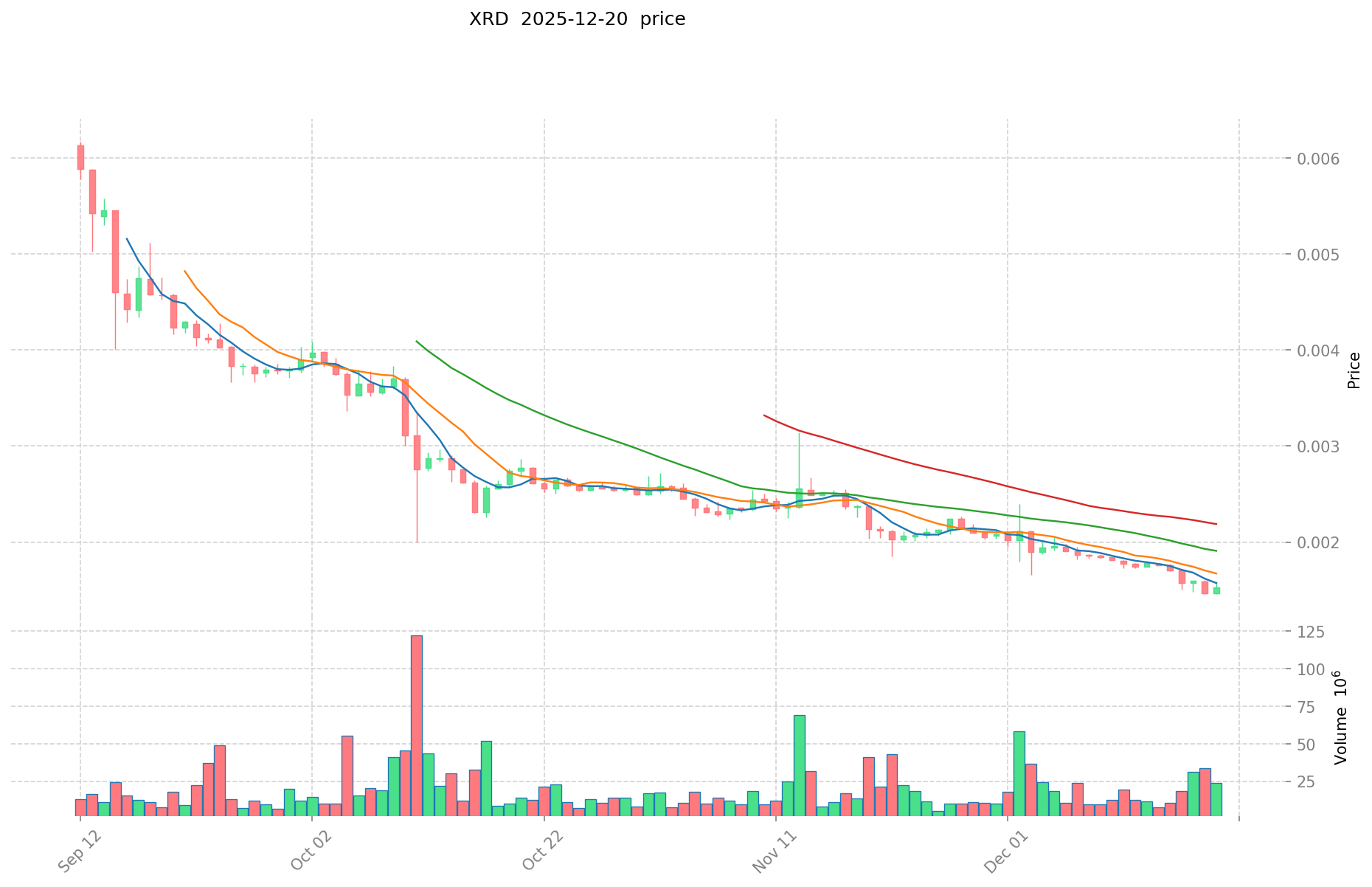
XRD Historical Price Trends and Investment Performance
All-Time High (ATH): $0.651264 (November 15, 2021)
All-Time Low (ATL): $0.00146366 (December 19, 2025)
The XRD token has experienced a significant decline from its peak valuation in 2021. The substantial drop from ATH to current levels represents a depreciation of approximately 99.77% over the period, indicating a highly volatile and challenging investment trajectory.
Current XRD Market Status (December 20, 2025)
| Metric | Value |
|---|---|
| Current Price | $0.001527 |
| 24-Hour Change | +3.39% |
| 7-Day Change | -14.45% |
| 30-Day Change | -29.27% |
| 1-Year Change | -94.14% |
| Market Cap | $20,336,796.53 |
| Fully Diluted Valuation | $20,336,796.55 |
| 24-Hour Trading Volume | $27,267.50 |
| Circulating Supply | 13,318,137,870.54 XRD |
| Total Supply | 13,318,137,884.08 XRD |
| Max Supply | 24,000,000,000 XRD |
| Market Dominance | 0.00063% |
| Number of Holders | 13,772 |
Market Emotion: Neutral to Negative (Score: 1)
Access real-time XRD market prices at: https://www.gate.com/price/radix-xrd
II. Project Overview
Project Name: Radix
Ticker: XRD
Blockchain Network: Ethereum (ERC-20)
Contract Address: 0x6468e79a80c0eab0f9a2b574c8d5bc374af59414
Project Description
Decentralized finance applications are currently being built on protocols that were not designed to meet the needs and requirements of DeFi services. Radix is using significant technology innovations to be a Layer 1 protocol specifically built to serve the rapidly growing DeFi industry.
The project aims to address fundamental limitations in existing blockchain protocols that were not initially designed with DeFi-specific requirements in mind, positioning itself as a purpose-built infrastructure for decentralized finance applications.
III. Tokenomics Overview
| Parameter | Value |
|---|---|
| Circulating Supply | 13,318,137,870.54 XRD (55.49% of max) |
| Total Supply | 13,318,137,884.08 XRD |
| Maximum Supply | 24,000,000,000 XRD |
| Current Market Cap | $20,336,796.53 |
| Launch Date | August 21, 2021 |
| Initial Launch Price | $0.039 |
| Trading Exchanges | 4 exchanges |
IV. Price Performance Analysis
Short-Term Price Movement
| Timeframe | Change | Absolute Movement |
|---|---|---|
| 1 Hour | +0.26% | +$0.000003959904 |
| 24 Hours | +3.39% | +$0.000050067995 |
| 7 Days | -14.45% | -$0.000257921099 |
| 30 Days | -29.27% | -$0.000631914181 |
| 1 Year | -94.14% | -$0.024531020478 |
24-Hour Trading Range
- High: $0.001591
- Low: $0.001459
- Current Price: $0.001527
V. Resources and Community
Official Website: https://www.radixdlt.com/
Blockchain Explorers:
- Radix Dashboard: https://dashboard.radixdlt.com/
- Etherscan Token Page: https://etherscan.io/token/0x6468e79a80c0eab0f9a2b574c8d5bc374af59414
Community Channels:
- Twitter: https://twitter.com/radixdlt
- Reddit: https://www.reddit.com/r/Radix/
- GitHub: https://github.com/radixdlt
- Podcast: https://www.radixdlt.com/podcast
Documentation:
- Whitepapers: https://www.radixdlt.com/#white-papers
VI. Risk Considerations
-
Extreme Price Volatility: XRD has experienced over 99% decline from its ATH, indicating significant price instability.
-
Limited Trading Volume: Daily trading volume of approximately $27,267 reflects relatively low liquidity, which may impact trade execution at desired price levels.
-
Competitive DeFi Landscape: The project operates in a highly competitive Layer 1 blockchain market with established competitors.
-
Token Distribution: With 24 billion maximum tokens and current circulating supply representing only 55.49% of the maximum, significant dilution from future token releases is possible.
-
Market Dominance: Market share of 0.00063% indicates minimal presence in the overall cryptocurrency market.
Disclaimer: This report is for informational purposes only and does not constitute investment advice. Cryptocurrency investments carry substantial risk, including potential loss of principal. Investors should conduct thorough due diligence and consult with financial advisors before making investment decisions.
Radix (XRD) Cryptocurrency Research Report
I. Executive Summary
Radix (XRD) is a Layer 1 protocol specifically designed to serve the decentralized finance (DeFi) industry. As of December 20, 2025, XRD is trading at $0.001527 with a market capitalization of approximately $20.34 million, ranking 865th by market cap. The token has experienced significant price depreciation, declining 94.14% over the past year from its all-time high of $0.651264 reached on November 15, 2021.
II. Core Factors Influencing XRD as an Investment
Supply Mechanism and Scarcity
XRD operates with a defined tokenomic structure designed to support long-term value proposition:
- Circulating Supply: 13,318,137,870.54 XRD
- Total Supply: 13,318,137,884.08 XRD
- Maximum Supply: 24,000,000,000 XRD
- Circulation Ratio: 55.49% of maximum supply currently in circulation
The token's scarcity mechanism is structured around a maximum supply cap of 24 billion tokens, with over half already distributed. This predetermined supply schedule creates a known inflationary trajectory that investors can evaluate.
Technology and Ecosystem Development
Radix's core technological proposition addresses fundamental DeFi infrastructure challenges:
Key Technical Features:
- Unlimited Linear Scalability: Designed to overcome transaction throughput limitations that constrain competing DeFi protocols
- Atomic Composability: Enables seamless interaction between DeFi applications and smart contracts
- Cerberus Consensus: The underlying consensus mechanism supporting the network's scalability claims
Ecosystem Application: The protocol targets rapid DeFi industry growth by providing infrastructure specifically engineered for decentralized finance applications, rather than general-purpose smart contract platforms that were not originally designed for DeFi requirements.
Market Performance and Price Trends
Current market metrics reveal significant volatility and downward pressure:
| Time Period | Price Change | Change Amount |
|---|---|---|
| 1 Hour | +0.26% | +$0.000003960 |
| 24 Hours | +3.39% | +$0.000050068 |
| 7 Days | -14.45% | -$0.000257921 |
| 30 Days | -29.27% | -$0.000631914 |
| 1 Year | -94.14% | -$0.024531020 |
Trading Range (24H): $0.001459 - $0.001591
Market Position and Adoption Metrics
- Current Holders: 13,772 token holders
- Exchange Listings: Available on 4 exchanges
- 24H Trading Volume: $27,267.50
- Market Dominance: 0.00063% of total cryptocurrency market cap
The limited number of exchange listings and holders suggests constrained adoption compared to more established Layer 1 protocols.
III. Market Sentiment and Analyst Perspectives
Analyst forecasts for XRD present divergent views:
Bearish Outlook: Multiple technical quantitative indicators suggest a bearish forecast for 2025, indicating continued downward pressure.
Bullish Scenarios: Some analysts project potential recovery with price targets ranging from $10-$15, positioning Radix as a potential leading DeFi infrastructure player.
Conservative Expectations: Additional forecasts suggest modest recovery, with cautious optimism about gradual appreciation from current depressed levels.
IV. Risk Factors and Considerations
- Extreme Price Volatility: 94% depreciation from all-time high indicates substantial downside risk exposure
- Limited Market Liquidity: Relatively low 24-hour trading volume suggests potential liquidity constraints
- Competition from Established Protocols: Multiple Layer 1 chains already capture significant DeFi market share
- Execution Risk: Protocol must successfully deliver on scalability and composability promises to justify valuation
V. Supporting Resources
Official Channels:
- Website: https://www.radixdlt.com/
- Twitter: https://twitter.com/radixdlt
- GitHub: https://github.com/radixdlt
- Dashboard: https://dashboard.radixdlt.com/
Contract Information:
- Ethereum Token Address: 0x6468e79a80c0eab0f9a2b574c8d5bc374af59414
Conclusion
Radix presents a technically sophisticated approach to DeFi infrastructure with clear design innovations targeting scalability and composability challenges. However, the token faces significant headwinds including substantial historical price depreciation, limited market adoption metrics, and a competitive Layer 1 landscape. Investment considerations should carefully weigh the protocol's technical merits against current market positioning and near-term recovery prospects.
III. XRD Future Investment Prediction and Price Outlook (Is Radix(XRD) worth investing in 2025-2030)
Short-term Investment Prediction (2025, short-term XRD investment outlook)
- Conservative forecast: $0.0009296 - $0.0013071
- Neutral forecast: $0.0013071 - $0.0016307
- Optimistic forecast: $0.0016307 - $0.0023029
Mid-term Investment Outlook (2026-2028, mid-term Radix(XRD) investment forecast)
-
Market phase expectation: XRD is projected to enter a consolidation and recovery phase as DeFi infrastructure developments progress. The network is expected to mature through technology upgrades and ecosystem expansion initiatives.
-
Investment return forecast:
- 2026: $0.0010568 - $0.0023029 (projected growth range: 3% - 51%)
- 2027: $0.0012611 - $0.0021147 (projected growth range: 27% - 38%)
- 2028: $0.0012165 - $0.0024735 (projected growth range: 32% - 62%)
-
Key catalysts: DeFi adoption acceleration, layer-1 protocol competitive positioning, smart contract upgrades, ecosystem partnership announcements, and overall cryptocurrency market sentiment recovery.
Long-term Investment Outlook (Is Radix a good long-term investment?)
-
Base case scenario: $0.0016132 - $0.0027343 USD (corresponding to steady progress in DeFi adoption and mainstream application improvements)
-
Optimistic scenario: $0.0032181 - $0.0032538 USD (corresponding to large-scale adoption and favorable market conditions)
-
Risk scenario: $0.0008000 - $0.0012000 USD (under extreme market downturn and competitive pressure from other layer-1 protocols)
View XRD long-term investment and price prediction: Price Prediction
2025-12-20 to 2030-12-31 Long-term Outlook
-
Base case: $0.0016132 - $0.0027343 USD (corresponds to steady DeFi infrastructure maturation and mainstream adoption progress)
-
Optimistic case: $0.0032181 - $0.0035000 USD (corresponds to accelerated ecosystem development and favorable regulatory environment)
-
Transformative case: $0.0050000 USD and above (if the project achieves breakthrough progress in ecosystem adoption and reaches mainstream popularity)
-
2030-12-31 projected high: $0.0032538 USD (based on optimistic development assumptions)
Disclaimer
This analysis is based on available market data and historical trends as of December 20, 2025. Price forecasts are subject to significant market volatility and various risk factors. Cryptocurrency markets remain highly speculative, and actual results may differ materially from projections. This content is for informational purposes only and should not be construed as investment advice or a recommendation to buy or sell.
| 年份 | 预测最高价 | 预测平均价格 | 预测最低价 | 涨跌幅 |
|---|---|---|---|---|
| 2025 | 0.00163068 | 0.001524 | 0.00092964 | 0 |
| 2026 | 0.0023029164 | 0.00157734 | 0.0010568178 | 3 |
| 2027 | 0.002114739738 | 0.0019401282 | 0.00126108333 | 27 |
| 2028 | 0.00247346944218 | 0.002027433969 | 0.0012164603814 | 32 |
| 2029 | 0.003218145938993 | 0.00225045170559 | 0.001620325228024 | 47 |
| 2030 | 0.003253815598527 | 0.002734298822291 | 0.001613236305152 | 79 |
Radix (XRD) Market Analysis Report
Report Date: December 20, 2025 Data Source: Gate Market Data Language: English
I. Overview of Radix (XRD)
Project Introduction
Radix is a Layer 1 protocol specifically designed to serve the rapidly growing decentralized finance (DeFi) industry. Unlike existing blockchain protocols built without DeFi-specific requirements in mind, Radix leverages significant technological innovations to address the specialized needs of DeFi applications.
Basic Information
| Metric | Value |
|---|---|
| Token Name | Radix |
| Token Symbol | XRD |
| Current Price | $0.001527 |
| Market Cap Ranking | 865 |
| Total Market Capitalization | $20,336,796.55 |
| Circulating Supply | 13,318,137,870.54 XRD |
| Maximum Supply | 24,000,000,000 XRD |
| Circulating Supply Ratio | 55.49% |
| Current Holders | 13,772 |
| Listed on Exchanges | 4 |
II. Market Performance Analysis
Current Price Metrics
| Time Period | Change Percentage | Price Change |
|---|---|---|
| 1 Hour | +0.26% | +$0.000003959904 |
| 24 Hours | +3.39% | +$0.000050067995 |
| 7 Days | -14.45% | -$0.000257921099 |
| 30 Days | -29.27% | -$0.000631914181 |
| 1 Year | -94.14% | -$0.024531020478 |
Historical Price Extremes
- All-Time High: $0.651264 (November 15, 2021)
- All-Time Low: $0.00146366 (December 19, 2025)
- 24-Hour High: $0.001591
- 24-Hour Low: $0.001459
Trading Volume and Liquidity
- 24-Hour Trading Volume: $27,267.50
- Fully Diluted Valuation (FDV): $20,336,796.55
- Market Share: 0.00063%
- Market Cap to FDV Ratio: 55.49%
III. Radix Network and Technical Characteristics
Ecosystem Resources
- Official Website: https://www.radixdlt.com/
- Blockchain Explorer: https://dashboard.radixdlt.com/
- GitHub Repository: https://github.com/radixdlt
- White Papers: Available at https://www.radixdlt.com/#white-papers
- Podcast/Forum: https://www.radixdlt.com/podcast
- Community Channels:
- Twitter: https://twitter.com/radixdlt
- Reddit: https://www.reddit.com/r/Radix/
Token Contract Details
Ethereum Network (ERC-20)
- Contract Address: 0x6468e79a80c0eab0f9a2b574c8d5bc374af59414
- Explorer Link: https://etherscan.io/token/0x6468e79a80c0eab0f9a2b574c8d5bc374af59414
IV. Investment Strategy and Risk Management
Investment Methodology
Long-Term Holding (HODL XRD)
- Suitable for conservative investors seeking long-term exposure to DeFi infrastructure development
- Requires conviction in Radix's technical roadmap and DeFi market growth
Active Trading
- Dependent on technical analysis given historical volatility
- Wave trading opportunities exist within significant price ranges
Risk Management
Asset Allocation Recommendations
| Investor Type | XRD Allocation |
|---|---|
| Conservative Investors | 1-3% of crypto portfolio |
| Aggressive Investors | 3-7% of crypto portfolio |
| Professional Investors | Strategic allocation based on DeFi exposure thesis |
Hedging Strategies
- Multi-asset portfolio diversification across different DeFi protocols
- Risk management through position sizing given current market volatility
Secure Storage
- Hot wallets (exchanges) for active trading liquidity
- Cold storage solutions for long-term holdings
- Hardware wallets recommended for significant positions
V. Investment Risks and Challenges
Market Risks
- Extreme Price Volatility: 94.14% year-over-year decline indicates significant downside pressure and market sentiment challenges
- Low Liquidity: 24-hour trading volume of $27,267 is relatively low compared to market capitalization, creating potential slippage risks
- Price Manipulation Risk: Low trading volume environment increases susceptibility to market manipulation
Regulatory Risks
- Policy Uncertainty: Different jurisdictions maintain varying approaches to DeFi protocol regulation
- Compliance Challenges: Future regulatory frameworks may impact protocol operations and token utility
Technical Risks
- Protocol Execution Risk: Ability to maintain competitive DeFi-specific advantages against established competitors
- Network Security: Ongoing security audit requirements and vulnerability management
- Upgrade Implementation: Successful deployment of planned technological improvements
Market Position Risk
- Competitive Pressure: Operating in highly competitive DeFi infrastructure market
- Market Adoption: Dependency on developer adoption and ecosystem growth
VI. Conclusion: Is Radix (XRD) a Good Investment?
Investment Value Summary
Radix represents a specialized DeFi infrastructure play with clear technical differentiation. However, the token faces significant headwinds with a 94.14% year-over-year decline and current price near historical lows. The project's long-term potential depends on successful protocol adoption and DeFi market expansion, but near-term price recovery remains uncertain.
Investor Recommendations
✅ Beginner Investors: Dollar-cost averaging strategy with dedicated secure wallet storage; start with minimal allocation to manage downside risk
✅ Experienced Investors: Wave trading opportunities may exist given current volatility; consider portfolio allocation based on DeFi infrastructure thesis
✅ Institutional Investors: Strategic long-term positioning in DeFi infrastructure space; conduct comprehensive technical and business model due diligence
Important Disclaimer
⚠️ Risk Warning: Cryptocurrency investments carry substantial risk, including potential total loss of capital. XRD demonstrates extreme volatility and low liquidity. This report is provided solely for informational purposes and does not constitute investment advice, financial recommendation, or solicitation to purchase or sell securities. Investors must conduct independent research and consult with qualified financial advisors before making investment decisions.
Last Updated: December 20, 2025, 16:24:21 UTC
Radix (XRD) Cryptocurrency Research Report - FAQ Section
VII. FAQ
Q1: What is Radix (XRD) and how does it differ from other Layer 1 protocols?
A: Radix is a Layer 1 blockchain protocol specifically designed to serve the decentralized finance (DeFi) industry. Unlike general-purpose smart contract platforms that were not originally built with DeFi requirements in mind, Radix incorporates technological innovations such as unlimited linear scalability, atomic composability, and the Cerberus consensus mechanism. These features are engineered to address fundamental DeFi infrastructure challenges and provide specialized infrastructure for decentralized finance applications.
Q2: What is the current price and market performance of XRD?
A: As of December 20, 2025, XRD is trading at $0.001527 with a market capitalization of approximately $20.34 million. The token has experienced significant depreciation, declining 94.14% over the past year and 99.77% from its all-time high of $0.651264 reached in November 2021. Current 24-hour trading volume is approximately $27,267.50, with 13,772 token holders across 4 exchange listings.
Q3: What are the tokenomics and supply structure of XRD?
A: XRD operates with a defined maximum supply of 24 billion tokens, of which 13.32 billion tokens (55.49%) are currently in circulation. This predetermined supply schedule creates a known inflationary trajectory. The token's scarcity mechanism is structured around the maximum cap, with over half already distributed. Future token releases from the remaining 44.51% of maximum supply represent potential dilution that investors should consider.
Q4: What are the price predictions for XRD in 2025-2030?
A: Price forecasts vary by scenario. For 2025, the neutral outlook ranges from $0.0013071 to $0.0016307. For 2026-2028, projections suggest a consolidation and recovery phase with growth ranging from 3-62%. By 2030, base case scenarios project $0.0016132-$0.0027343, while optimistic scenarios suggest $0.0032181-$0.0035000. These forecasts depend on DeFi adoption acceleration and successful protocol development execution.
Q5: What are the primary investment risks associated with XRD?
A: Key risks include extreme price volatility (94% year-over-year decline), limited trading liquidity ($27,267 daily volume), competitive pressure from established Layer 1 protocols, regulatory uncertainty surrounding DeFi, protocol execution risk, and significant dilution potential from unreleased tokens. Additionally, XRD holds only 0.00063% of total cryptocurrency market dominance, indicating minimal market adoption compared to established competitors.
Q6: Is XRD suitable for long-term investment?
A: XRD presents a specialized long-term investment thesis for investors convinced of Radix's technical roadmap and DeFi market growth. However, significant risks exist including current depressed valuation near all-time lows and competitive market pressures. Conservative investors should allocate 1-3% of their crypto portfolio, while aggressive investors may consider 3-7% allocation. Long-term success depends on successful protocol adoption and ecosystem expansion, which remains uncertain.
Q7: What liquidity and trading considerations should investors understand about XRD?
A: XRD exhibits relatively low trading liquidity with only $27,267 in 24-hour volume and limited exchange listings (4 exchanges). This low liquidity environment creates potential slippage risks during trading execution and increases susceptibility to price manipulation. Investors should use limit orders rather than market orders and consider position sizing carefully. The low volume-to-market cap ratio suggests significant execution challenges for larger trades.
Q8: What resources are available for investors to research Radix further?
A: Investors can access comprehensive information through official channels including the Radix website (https://www.radixdlt.com/), blockchain explorer dashboard (https://dashboard.radixdlt.com/), GitHub repository (https://github.com/radixdlt), published whitepapers, and community channels including Twitter (@radixdlt), Reddit (/r/Radix), and podcast resources. The Ethereum contract address (0x6468e79a80c0eab0f9a2b574c8d5bc374af59414) provides access to on-chain data via Etherscan for technical analysis.
Disclaimer: This FAQ is for informational purposes only and does not constitute investment advice. Cryptocurrency investments carry substantial risk, including potential loss of principal. XRD demonstrates extreme volatility and market concentration challenges. Investors should conduct thorough independent research and consult with qualified financial advisors before making investment decisions.
Share
How to Buy Cryptocurrency


Trending Cryptocurrencies



2025 NEAR Price Prediction: A Comprehensive Analysis of Factors Driving the Next Bull Run in the NEAR Protocol Ecosystem

2025 INJ Price Prediction: A Comprehensive Analysis of Market Trends and Growth Potential for Injective Protocol

2025 MNTPrice Prediction: Market Analysis and Potential Growth Factors for Mantle Network Token

2025 AURORA Price Prediction: Analyzing Future Trends and Market Potential for the Layer-2 Solution
2025 CELR Price Prediction: Analyzing Growth Potential and Market Factors for Celer Network Token
Is Celestia (TIA) a good investment?: Analyzing the potential and risks of this layer-1 blockchain project
How do MACD, RSI, and Bollinger Bands predict XLM price movements with volume divergence signals?

What is token economy model: A complete guide to distribution, inflation, and governance mechanisms

MoMA Adds CryptoPunks and Chromie Squiggles to Permanent Collection: What It Means for NFT Art

What Arthur Hayes Means When He Says 'Altcoin Season Never Ended'
How does ZBCN holdings concentration and exchange capital flow affect token price movement?