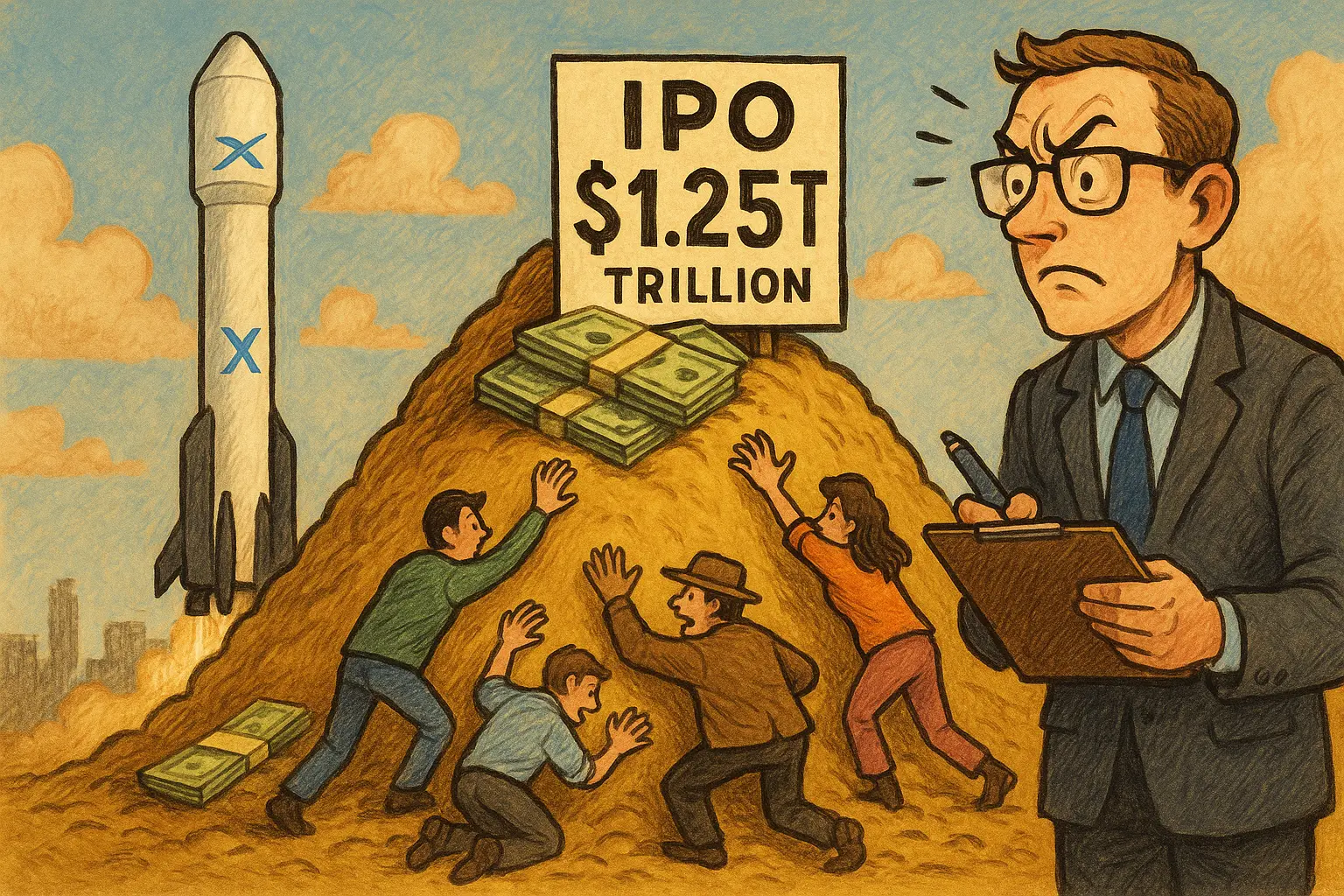
SpaceX plant, earliest this week, an initial public offering (IPO) application with U.S. regulators, aiming for a formal listing in June, with an expected fundraising of over 75 billion USD. According to Renaissance Capital data, this amount will surpass the total funding of all 2025 U.S. IPO companies (440 billion USD). Analysts warn that retail investors face very high risks on the first day of trading.
Business Scale and Valuation Composition of SpaceX IPO
SpaceX currently operates a highly vertically integrated business system. Its core business, Starlink satellite broadband, has 9.2 million active users, generating over 10 billion USD in revenue last year. Analysts forecast full-year 2026 revenue between 15.9 billion and 24 billion USD. In February 2026, SpaceX completed a full stock merger with Elon Musk’s AI company xAI, acquiring the Grok AI model-related business, significantly expanding the company’s AI footprint.
However, the $1.25 trillion valuation implies far more than current verifiable business earnings. Goals such as the large-scale commercialization of Starship heavy-lift rockets, orbital AI data centers, and lunar bases have not yet been realized, constituting a significant portion of the “future expectations premium” in the valuation, resulting in a current price-to-sales ratio of about 80 to 100 times the revenue of the past 12 months.
Three Structural Disadvantages for Retail Investors on the First Day
Motley Fool analyst Brett Schafer explicitly advises investors not to chase this IPO, pointing out that based on the current valuation targets, SpaceX stock is priced high, and first-day buyers will face clear structural disadvantages:
Inability to obtain the offering price: Most retail investors cannot subscribe at the institutional allocation price and can only buy on the open market at a premium, starting at a disadvantage.
Selling pressure after the lock-up period ends: Early investors entered when the company’s valuation was between $200 billion and $800 billion. After the 180-day lock-up period post-listing, large-scale profit-taking will create significant downward pressure.
Historical patterns of high-profile IPOs: Highly anticipated IPOs often surge on opening day but fall back within weeks as institutional investors sell their allocated shares.
Alternative Strategies and Three Key Validation Indicators Recommended by Analysts
Motley Fool states: “SpaceX is one of the most attractive long-term companies in the tech sector, but that doesn’t mean you need to rush in on IPO day.” Several analysts suggest that, compared to rushing in on the first day, waiting for a price correction and gradually building positions (DCA strategy) may offer a better risk-reward ratio. The first-day stock price already reflects many years of market optimism and Musk’s personal brand premium. For most investors, waiting for secondary market opportunities may have a higher chance of success than chasing the IPO.
Analysts believe that the following three developments are key indicators for assessing whether SpaceX’s long-term valuation will materialize: the large-scale reusability of Starship, significant expansion of Starlink’s profit potential, and substantial progress in orbital computing infrastructure prototypes. Until these validation points become clearer, a considerable part of the current valuation remains based on forward-looking assumptions.
Frequently Asked Questions
What is the target fundraising amount and listing time for SpaceX IPO?
SpaceX plans to submit its IPO application as early as this week, aiming for a formal listing in June 2026, with a target fundraising of over 75 billion USD. According to Renaissance Capital data, this amount will surpass the total funding of all U.S. IPOs in 2025, potentially setting a record for the largest IPO in history.
How does the merger with xAI affect the IPO valuation?
In February 2026, SpaceX completed a full stock merger with xAI. Post-merger, the company’s valuation is approximately $1.25 trillion. The addition of Grok AI model business significantly expanded its AI footprint. However, the merger also increased the proportion of “unverified future assets” in the valuation, with an overall price-to-sales ratio of about 80 to 100 times.
Why do analysts advise against buying SpaceX on the IPO first day?
The main risks are concentrated in three areas: retail investors cannot access institutional allocation prices and can only buy at a premium; large holdings by early investors will create structural selling pressure after the 180-day lock-up period; and high-profile IPOs tend to surge on opening day but fall back within weeks, with first-day buyers often serving as liquidity providers for early insiders’ exits.
Disclaimer: The information on this page may come from third parties and does not represent the views or opinions of Gate. The content displayed on this page is for reference only and does not constitute any financial, investment, or legal advice. Gate does not guarantee the accuracy or completeness of the information and shall not be liable for any losses arising from the use of this information. Virtual asset investments carry high risks and are subject to significant price volatility. You may lose all of your invested principal. Please fully understand the relevant risks and make prudent decisions based on your own financial situation and risk tolerance. For details, please refer to
Disclaimer.


