 :
:
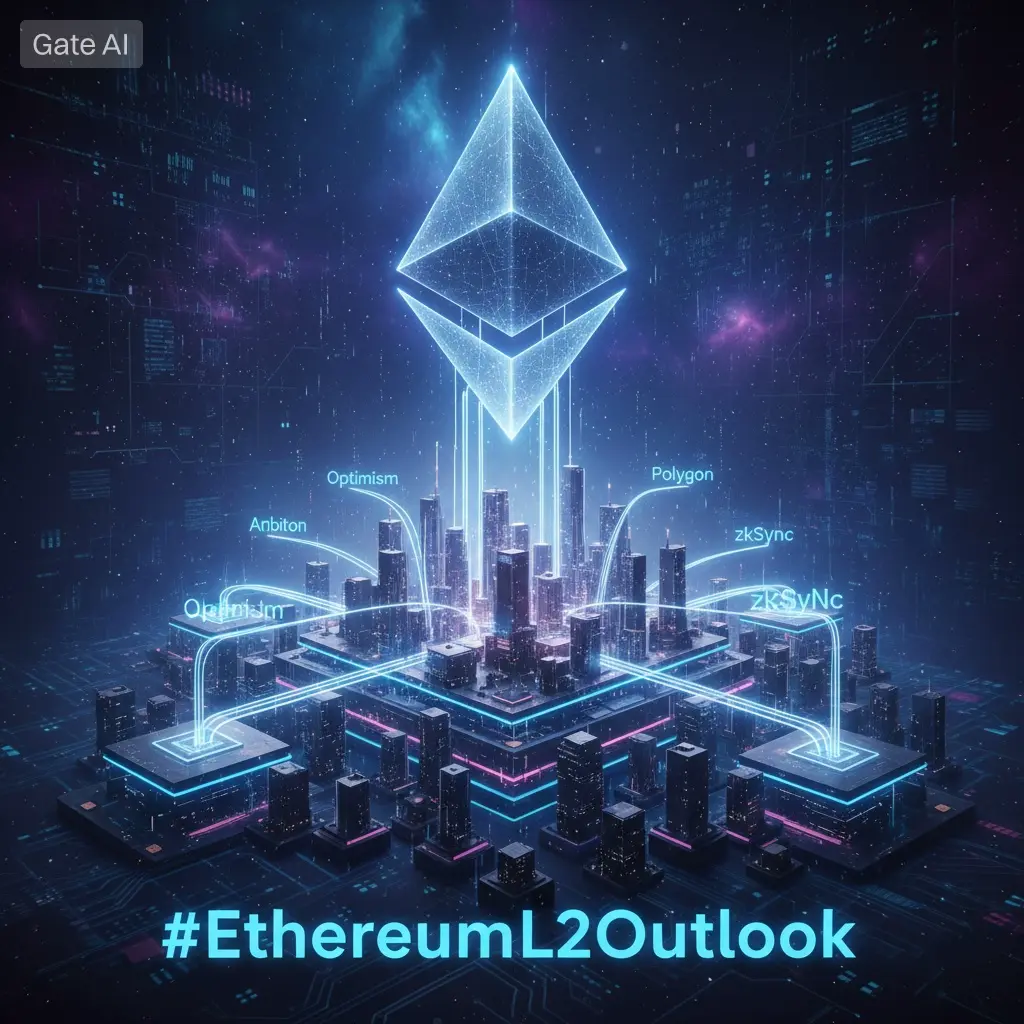
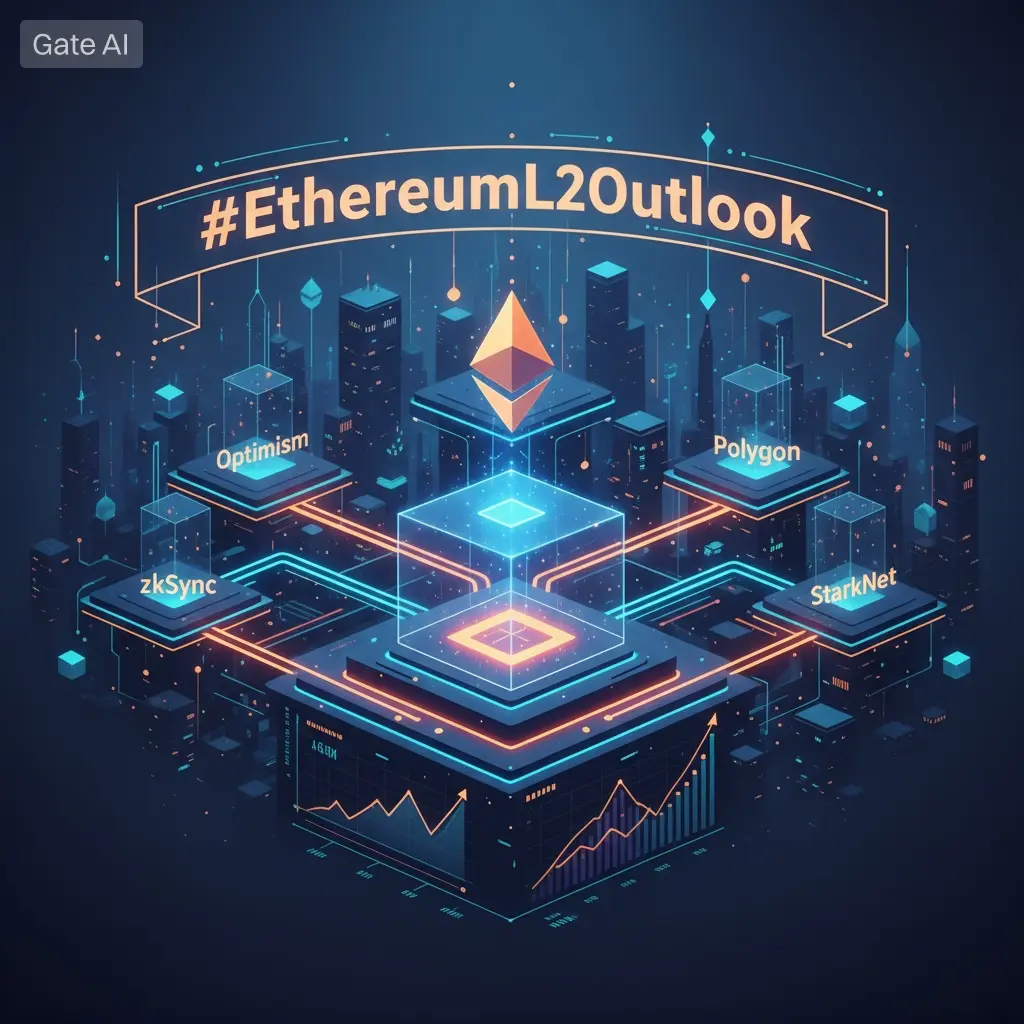
#EthereumL2Outlook 🔥 Ethereum L2 Outlook – Early 2026 Reality Check: Scaling Evolution, Consolidation & the New Reality 🔥
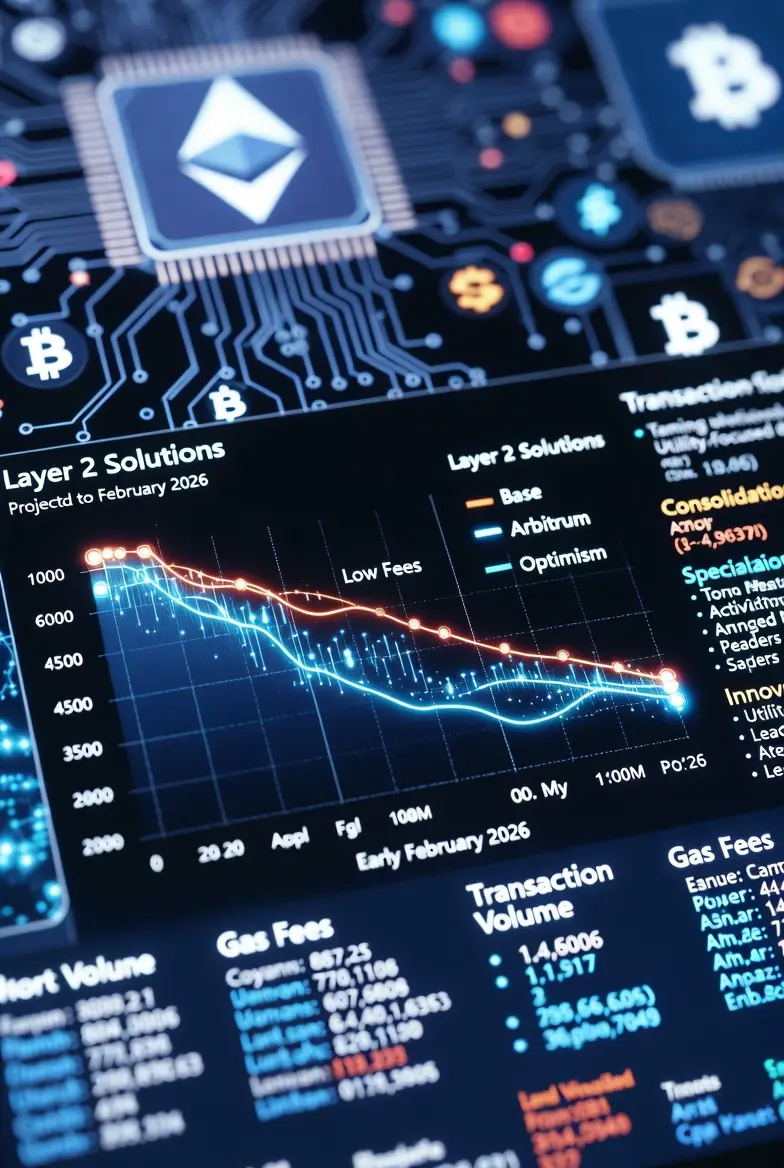
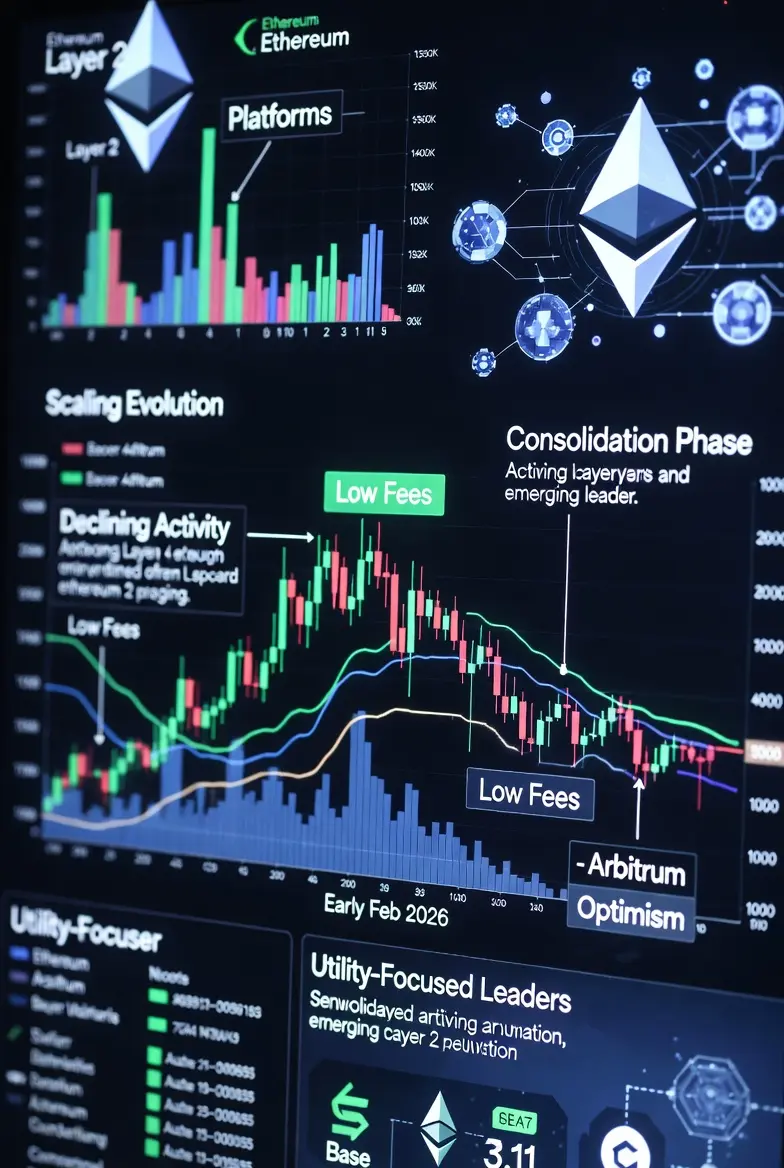
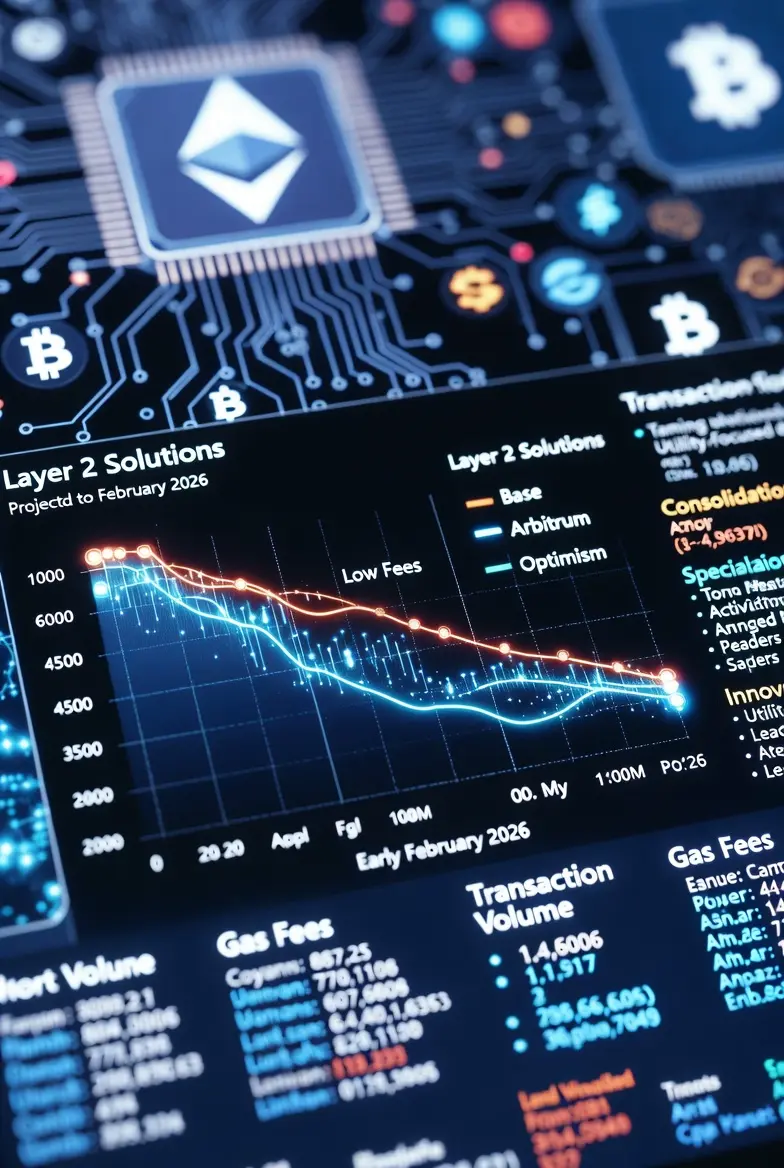
Ethereum’s Layer 2 ecosystem in February 2026 is at a pivotal juncture. Mainnet scaling has improved significantly — gas fees are near-zero, throughput is surging, and L1 activity is up over 41% year-over-year. Meanwhile, L2 activity has dropped roughly 50% from mid-2025 peaks, with monthly addresses falling from 58M to ~30M. L2s still process 95–99% of all Ethereum transactions, but their role as pure “scaling solutions” is under scrutiny. The community now demands real value creation beyond cheaper gas, forcing L2s to evolve from hype-driven rollups to utility-driven ecosystems.
📊 Current State Snapshot (Feb 2026)
Total L2 TVL ranges between $38–43B, down from all-time highs but resilient among top performers. Network throughput exceeds 300 TPS system-wide, handling millions of transactions daily. While L2 fees are extremely low, Ethereum mainnet fees have also collapsed, leading to reduced ETH burn and shifting revenue capture toward the L2s themselves. Consolidation is accelerating — a few leaders dominate users, revenue, and TVL, while many copycat L2s struggle post-incentives.
🚀 Top Performers & Leaders
Base (Coinbase-backed, OP Stack): TVL leader (~$4B+), strong stablecoin and DeFi ecosystem, dominating on-chain revenue flywheel.
Arbitrum: Backbone for DeFi ($16B+ historical TVL), trusted by protocols like Aave, Uniswap, and GMX. Mature retention and activity metrics.
Optimism / Superchain: Focused on governance innovation and interoperability (34+ chains), though TVL is volatile ($200–$300M recently).
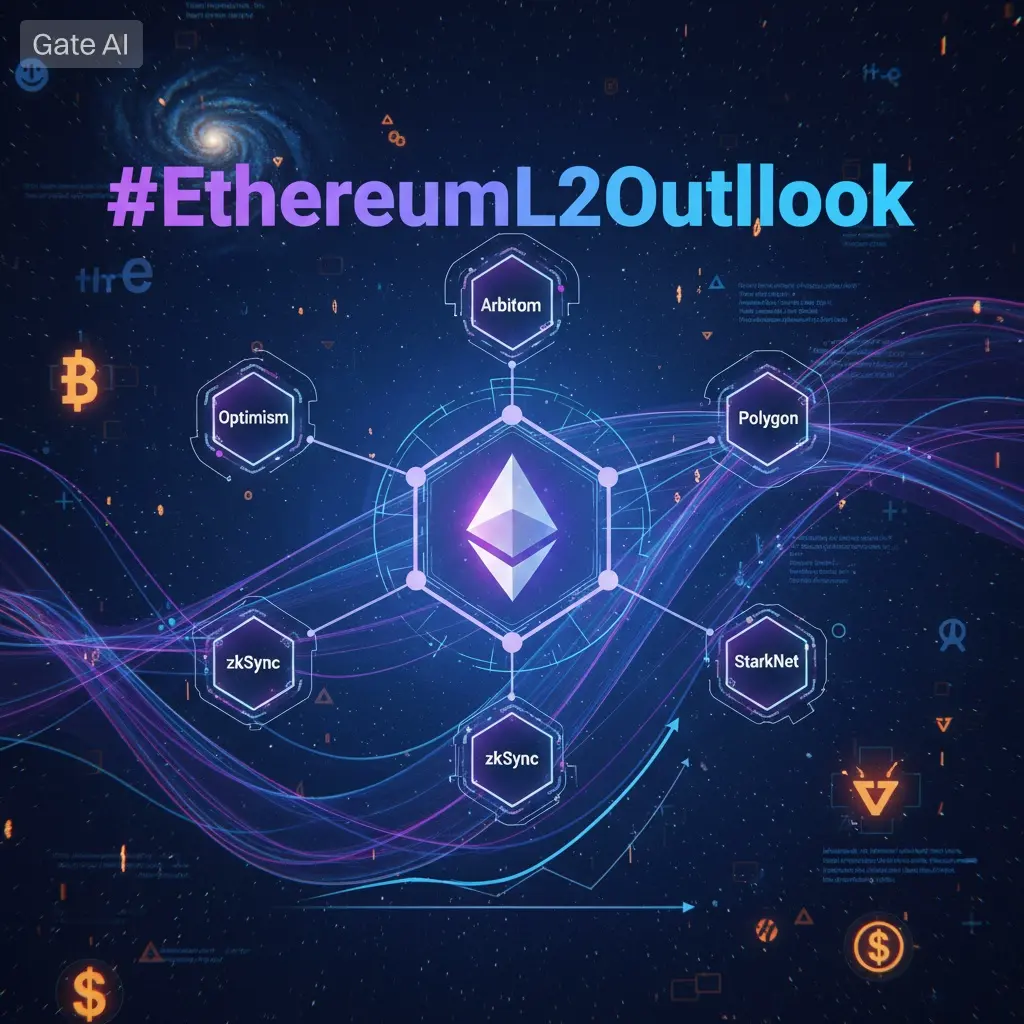
Polygon zkEVM / zkSync / Starknet / Mantle: Specialized high-throughput or privacy-focused chains gaining selective traction.
Emerging contenders (MegaETH): Parallel execution and ultra-high-performance designs could disrupt incumbents.
⚠️ Key Challenges & Shifts
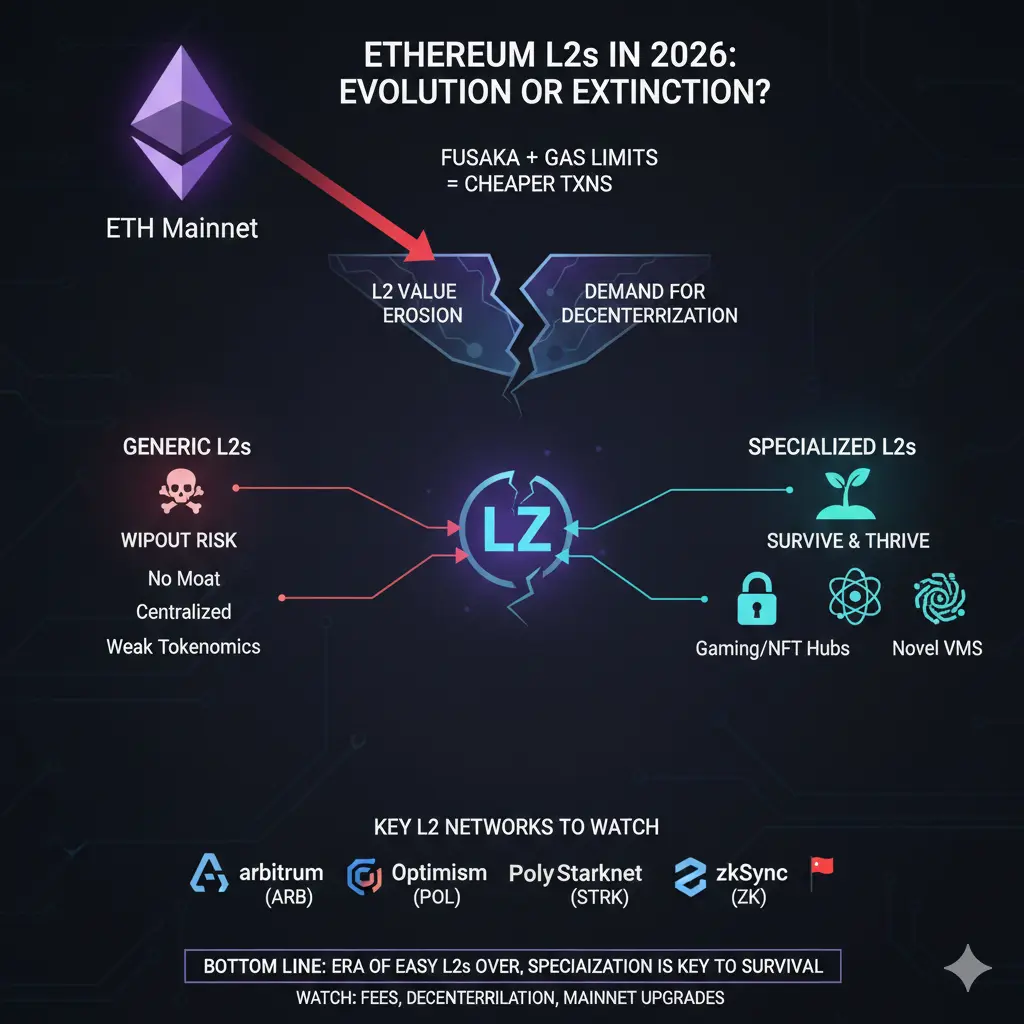
Vitalik Buterin’s recent commentary underscores a critical pivot: L2s must deliver unique value beyond scaling. Generic optimistic rollups risk irrelevance as L1 itself scales. Value leakage is apparent — low mainnet fees reduce ETH burn while revenue increasingly shifts to L2s, especially Base. Analysts foresee a Darwinian shakeout of generic L2 tokens by late 2026, leaving only profitable, utility-driven projects.
📈 2026 Outlook & Catalysts
Successful L2s will evolve into “profitable on-chain businesses”, focusing on real revenue, enterprise integration, and durable usage. Specialization matters: application-specific chains, modular architectures, and exchange-backed platforms (like Base) will outperform generic rollups. ETH remains the settlement layer of record, with staking at 28–30% and issuance moderate. L2 activity in stablecoins, DeFi, and tokenized real-world assets underpins the bullish ETH thesis.
💡 Trader & Investor Takeaways
Rotate exposure toward leaders with clear utility, such as Base and Arbitrum. Avoid high-beta L2 altcoins unless unique features or Stage 2 advancements indicate potential. Track metrics including TVL, on-chain activity (L2BEAT), ETH burn rates, and upcoming upgrades like Glamsterdam (enhancing fees and throughput). A bias of cautious optimism is prudent: scaling works, but the era of promise-driven speculation is over; proof-of-value has begun.
🔍 Innovation Signals to Watch
Successful L2s are increasingly judged on metrics beyond raw throughput: enterprise adoption, DeFi usage, cross-chain bridges, modularity, and governance participation. Projects like Optimism’s Superchain demonstrate the value of interoperability and governance incentives. MegaETH and zk-focused L2s highlight the potential for privacy, speed, and non-EVM experimentation to capture niche demand.
⚖️ Risks & Constraints
Fee compression remains a key challenge — low L2 fees threaten tokenomics if not offset by revenue from real usage. L2 token dilution, regulatory scrutiny on decentralization claims, and competition from specialized chains are ongoing concerns. L1 scaling improvements may also siphon activity back from L2s, making differentiation essential.
📌 Long-Term Perspective
Ethereum L2s are maturing from a scaling experiment into consolidated, utility-driven ecosystems. The winners will be those that can sustain revenue, attract long-term users, and integrate into the broader DeFi and enterprise landscape. ETH remains central, while top L2s act as value amplifiers. Investors who focus on durable leaders amid the shakeout are likely to benefit as weaker L2 tokens fail or consolidate.
💎 Bottom Line
The L2 era has entered “proof over promise.” Scaling alone no longer commands adoption; measurable utility, enterprise relevance, and real revenue streams are decisive. Ethereum’s L1 continues to scale efficiently, but top L2s amplify ETH’s value and remain critical infrastructure for high-frequency, low-cost, and specialized applications. The shakeout will be brutal for generic L2s, but for investors and developers, this phase marks the transition to a mature, utility-first Ethereum ecosystem.
Ethereum’s Layer 2 ecosystem in February 2026 is at a pivotal juncture. Mainnet scaling has improved significantly — gas fees are near-zero, throughput is surging, and L1 activity is up over 41% year-over-year. Meanwhile, L2 activity has dropped roughly 50% from mid-2025 peaks, with monthly addresses falling from 58M to ~30M. L2s still process 95–99% of all Ethereum transactions, but their role as pure “scaling solutions” is under scrutiny. The community now demands real value creation beyond cheaper gas, forcing L2s to evolve from hype-driven rollups to utility-driven ecosystems.
📊 Current State Snapshot (Feb 2026)
Total L2 TVL ranges between $38–43B, down from all-time highs but resilient among top performers. Network throughput exceeds 300 TPS system-wide, handling millions of transactions daily. While L2 fees are extremely low, Ethereum mainnet fees have also collapsed, leading to reduced ETH burn and shifting revenue capture toward the L2s themselves. Consolidation is accelerating — a few leaders dominate users, revenue, and TVL, while many copycat L2s struggle post-incentives.
🚀 Top Performers & Leaders
Base (Coinbase-backed, OP Stack): TVL leader (~$4B+), strong stablecoin and DeFi ecosystem, dominating on-chain revenue flywheel.
Arbitrum: Backbone for DeFi ($16B+ historical TVL), trusted by protocols like Aave, Uniswap, and GMX. Mature retention and activity metrics.
Optimism / Superchain: Focused on governance innovation and interoperability (34+ chains), though TVL is volatile ($200–$300M recently).
Polygon zkEVM / zkSync / Starknet / Mantle: Specialized high-throughput or privacy-focused chains gaining selective traction.
Emerging contenders (MegaETH): Parallel execution and ultra-high-performance designs could disrupt incumbents.
⚠️ Key Challenges & Shifts
Vitalik Buterin’s recent commentary underscores a critical pivot: L2s must deliver unique value beyond scaling. Generic optimistic rollups risk irrelevance as L1 itself scales. Value leakage is apparent — low mainnet fees reduce ETH burn while revenue increasingly shifts to L2s, especially Base. Analysts foresee a Darwinian shakeout of generic L2 tokens by late 2026, leaving only profitable, utility-driven projects.
📈 2026 Outlook & Catalysts
Successful L2s will evolve into “profitable on-chain businesses”, focusing on real revenue, enterprise integration, and durable usage. Specialization matters: application-specific chains, modular architectures, and exchange-backed platforms (like Base) will outperform generic rollups. ETH remains the settlement layer of record, with staking at 28–30% and issuance moderate. L2 activity in stablecoins, DeFi, and tokenized real-world assets underpins the bullish ETH thesis.
💡 Trader & Investor Takeaways
Rotate exposure toward leaders with clear utility, such as Base and Arbitrum. Avoid high-beta L2 altcoins unless unique features or Stage 2 advancements indicate potential. Track metrics including TVL, on-chain activity (L2BEAT), ETH burn rates, and upcoming upgrades like Glamsterdam (enhancing fees and throughput). A bias of cautious optimism is prudent: scaling works, but the era of promise-driven speculation is over; proof-of-value has begun.
🔍 Innovation Signals to Watch
Successful L2s are increasingly judged on metrics beyond raw throughput: enterprise adoption, DeFi usage, cross-chain bridges, modularity, and governance participation. Projects like Optimism’s Superchain demonstrate the value of interoperability and governance incentives. MegaETH and zk-focused L2s highlight the potential for privacy, speed, and non-EVM experimentation to capture niche demand.
⚖️ Risks & Constraints
Fee compression remains a key challenge — low L2 fees threaten tokenomics if not offset by revenue from real usage. L2 token dilution, regulatory scrutiny on decentralization claims, and competition from specialized chains are ongoing concerns. L1 scaling improvements may also siphon activity back from L2s, making differentiation essential.
📌 Long-Term Perspective
Ethereum L2s are maturing from a scaling experiment into consolidated, utility-driven ecosystems. The winners will be those that can sustain revenue, attract long-term users, and integrate into the broader DeFi and enterprise landscape. ETH remains central, while top L2s act as value amplifiers. Investors who focus on durable leaders amid the shakeout are likely to benefit as weaker L2 tokens fail or consolidate.
💎 Bottom Line
The L2 era has entered “proof over promise.” Scaling alone no longer commands adoption; measurable utility, enterprise relevance, and real revenue streams are decisive. Ethereum’s L1 continues to scale efficiently, but top L2s amplify ETH’s value and remain critical infrastructure for high-frequency, low-cost, and specialized applications. The shakeout will be brutal for generic L2s, but for investors and developers, this phase marks the transition to a mature, utility-first Ethereum ecosystem.