As major participants from TradFi enter the stablecoin space, many are still unsure how to seize this opportunity.
Written by: Abdul
Compiled by: Block unicorn
In the past year, the issuance of stablecoins has increased by $100 billion, and it is expected to grow tenfold in the coming years. With major participants from TradFi entering this space, many are still unsure how to seize this opportunity.
As demand grows, various types of stablecoins will expand—whether they are centralized issuers like Tether and Circle, or decentralized protocols like Ethena and MakerDAO.
Historically, Tether has been the biggest winner, accounting for 60% of all stablecoin issuance (through USDT). In 2024 alone, it made a profit of $13 billion. However, since Tether is a private company, there is no direct investment avenue. Fortunately, many other issuers have tradable tokens.
At the same time, some of the world’s largest financial institutions and governments are also betting on stablecoins. Trump’s stablecoin strategy could provide a significant boost to the industry this year. If this momentum continues, 2025 could become the most important year for stablecoins in history.
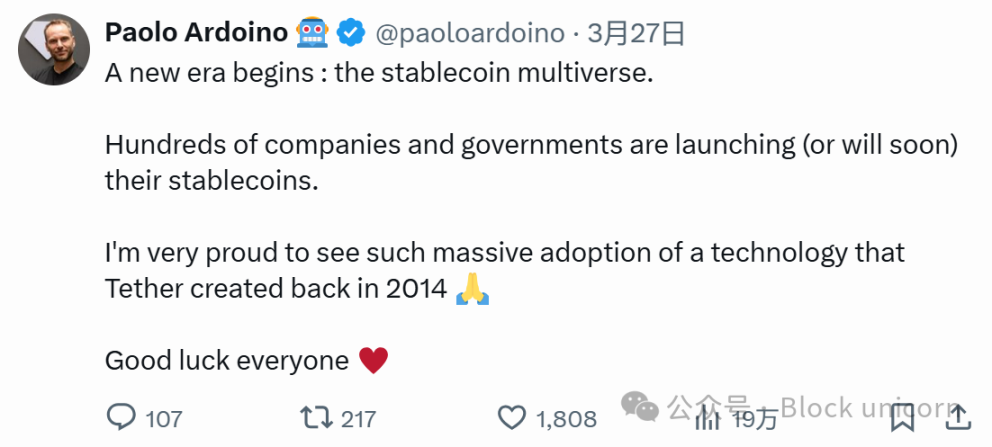
Even Tether’s CEO (Paolo) is looking forward to the stablecoin wars of 2025. Now is the time to position accordingly.
Increase focus on the growth of stablecoins
You can directly gain growth in stablecoin by owning the issuer of tradable tokens, or you can indirectly gain growth by benefiting from the adoption of stablecoin through protocols.
Direct Contact
The most obvious way to engage with the growth of stablecoins is through some issuers that have active tokens. Below, I will review some key participants.
Ethena
Ethena issues USDe, which is the largest synthetic yield-bearing stablecoin. It mints USDe by constructing delta-neutral positions on assets such as Bitcoin and Ethereum, generating yields from staking rewards and perpetual funding rates.
The circulation of USDe is approximately 7 billion US dollars, with a year-on-year growth of 350%. Ethena has become an important player in the stablecoin space. Its native token $ENA serves as both a utility token and a governance token in the ecosystem.
Sky (formerly Maker)
Sky (formerly known as Maker) is one of the oldest protocols in DeFi and the issuer of USDS (formerly DAI), which is the largest CDP-based stablecoin. Although the supply of DAI is migrating to USDS, the current total issuance of the protocol is $8.5 billion. Its governance token $MKR is used for protocol governance.
Ondo
Ondo Finance is a leading real-world asset (RWA) tokenization platform focused on bringing traditional financial assets on-chain. Its stablecoin product USDY is a tokenized representation of U.S. Treasuries, designed to provide a yield-bearing and fully backed digital dollar.
USDY has experienced rapid growth, with a circulation of approximately 600 million USD and a year-on-year growth of 1000%. Ondo is positioned at the intersection of TradFi and DeFi, making it one of the key players in the RWA space.
Ondo’s native token $ONDO plays a role in governance and protocol incentives, aligning token holders with the long-term growth of the platform.
Frax
Frax Finance is the issuer of the FRAX stablecoin, which was initially partially algorithmic but later transitioned to being backed by RWA and crypto assets.
The protocol expands its stablecoin product through sFRAX, a yield-bearing version of FRAX backed by government bonds, making it an important player in the on-chain RWA space. Frax has issued over 1 billion dollars and remains one of the most innovative decentralized stablecoin issuers.
Its governance token $FXS accumulates value through protocol revenue and governance rights, aligning holders with the long-term growth of Frax.
Indirect contact
As the stablecoin wars intensify later this year, the competition for establishing base liquidity will drive more activities towards the largest stablecoin use cases in DeFi. Here are some less obvious projects that benefit from the growth of stablecoins.
Aave
Aave is the largest lending protocol in DeFi, and it will benefit significantly from the increasing adoption of stablecoins, as stablecoins are the backbone of the lending market. A higher issuance of stablecoins means more liquidity flowing into Aave’s pools, which reduces borrowing costs, increases deposit yields, and enhances protocol revenue through interest rate spreads.
In addition, as competition among stablecoin issuers intensifies, many issuers will offer incentives to deepen liquidity, further promoting the usage of Aave. With its multi-chain presence and dominant position in DeFi lending, Aave has the ability to capture the surge in lending activity driven by the expansion of stablecoins.
$AAVE is the native governance coin of the Aave protocol.
Additional benefits: Aave also directly benefits from the demand for stablecoins through its stablecoin GHO, which has a circulation of 200 million dollars and has grown by 50% since the beginning of the year.
Curve
Curve is also a key player in DeFi, and its success is closely related to the rise of stablecoins. As the preferred decentralized exchange for stablecoin swaps, Curve will benefit significantly from the surge in stablecoin adoption. Since stablecoins make up a large portion of its liquidity pools, an increase in issuance will directly boost Curve’s TVL (Total Value Locked), while also enhancing the platform’s efficiency and reducing trade slippage. This leads to more trading volume, more fees, and thus increases the protocol’s revenue.
$CRV is the native governance token of Curve, and its value benefits from the increase in platform usage.
Additional benefits: Curve has also launched its own native stablecoin crvUSD, which provides additional exposure to the growing demand for stablecoins while offering extra incentives to liquidity providers.
Pendle
Pendle is a DeFi protocol for tokenized yield-bearing assets that allows users to separate principal and yield for more efficient trading and optimization. With the growth of stablecoin adoption, Pendle benefits by unlocking more liquidity for stablecoins, driving more trading volume and higher protocol revenue.
As the demand for stablecoins increases, Pendle’s model will capture a larger share of the DeFi market, providing users with the ability to maximize stablecoin returns. $PENDLE is its native governance token, benefiting from this expansion.
Morpho
Morpho is a protocol that enhances decentralized lending by optimizing interest rates and liquidity. With the growth of stablecoin adoption, Morpho will benefit from the increased demand for lending, as stablecoins bring liquidity into its pools, providing better rates for borrowers and lenders.
As more stablecoin liquidity flows into the DeFi space, Morpho’s unique model will become more attractive. $MORPHO is Morpho’s governance coin.
Fluid
Fluid (formerly known as Instadapp) is a DeFi platform that integrates lending and trading functions to enhance capital efficiency. Its innovative “smart collateral” and “smart debt” features allow users to simultaneously use assets as collateral for borrowing and trading liquidity, while earning fees from both lending and trading.
By providing a seamless integration between lending and trading, Fluid attracts more stablecoin liquidity, thereby reducing borrowing costs and increasing user returns. The Fluid protocol is governed by its native token $FLUID.
Special Mention: Tron
If we don’t mention Tron ($TRX), we can’t conclude this section. The Tron blockchain holds 50% of the USDT supply. Last month, Tron generated over $50 million in fees through stablecoin transfer activities.
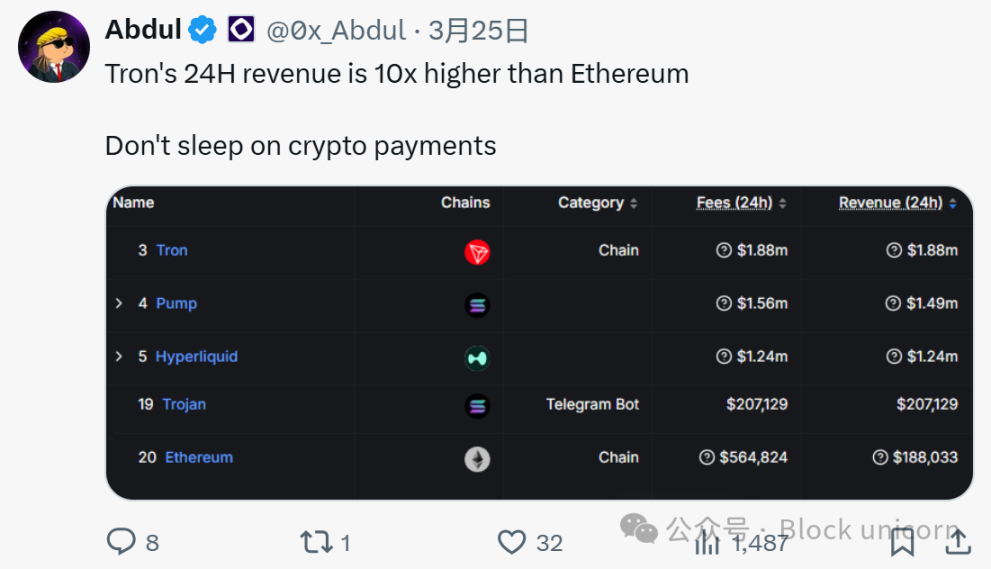
Stablecoins are considered a killer use case for cryptocurrencies, but most people have not ventured into the field because the largest stablecoin issuer (Tether) is a private company. I hope this article provides you with some ideas on how to position yourself in the explosive growth of stablecoins in the future.


