Original Title: How Trump’s Tariffs Will Affect Bitcoin Mining
Original author: Jaran Mellerud
Original text compiled by: Deep Tide TechFlow
Trump’s tariff policy will have a significant impact on the Bitcoin mining industry. Below is an analysis of the effects of this policy on the industry.
On April 2, Trump announced the implementation of comprehensive new tariffs on imported goods, aimed at strengthening the U.S. trade balance. Southeast Asia has been hit the hardest, which has far-reaching effects on the Bitcoin mining machine supply chain. This region is home to most of the mining machine manufacturers, including major producers like Bitmain, MicroBT, and Canaan.
In addition, since the United States accounts for 36% of the global hashing power, these tariffs could significantly impact miners’ economic benefits, hardware prices both domestically and internationally, as well as the global distribution of hashing power.
Before delving into the various impacts of these tariffs on the Bitcoin mining industry, let us briefly explain the mechanism by which tariffs operate.
How do tariffs work?
Tariffs are taxes imposed by the government on imported goods, usually with the aim of protecting domestic industries by raising the prices of foreign products to achieve this goal. When tariffs are implemented, importers must pay a certain percentage of the declared value of the goods to customs upon the goods’ entry.
For example, if an American company imports electronic products worth 1,000 dollars from China, and the tariff rate is 54%, the importer must pay an additional 540 dollars in duties, bringing the total import cost to 1,540 dollars. This increased cost is often passed on to consumers or reduces the profit margin for the importer.
Tariff History: The Sino-US Trade War and Its Ripple Effects
Bitcoin mining is a global industry, and the United States is an important player in it. The trade war and the tariffs it has triggered have already impacted the industry. However, historically, companies within the industry have found ways to circumvent these tariffs. In the following sections, we will explore how tariffs have historically affected the Bitcoin mining supply chain and what strategies companies have adopted to avoid these tariffs.
In 2018, the U.S. government imposed a 25% tariff on a range of Chinese goods, including electronics, as part of the China-U.S. trade war.
In response, companies like Bitmain have begun to look for ways to evade these high tariffs. They are shifting production from mainland China to Southeast Asian countries such as Indonesia, Thailand, and Malaysia, where goods exported to the U.S. are either duty-free or subject to lower tariffs—typically between 1% and 3% for electronics.
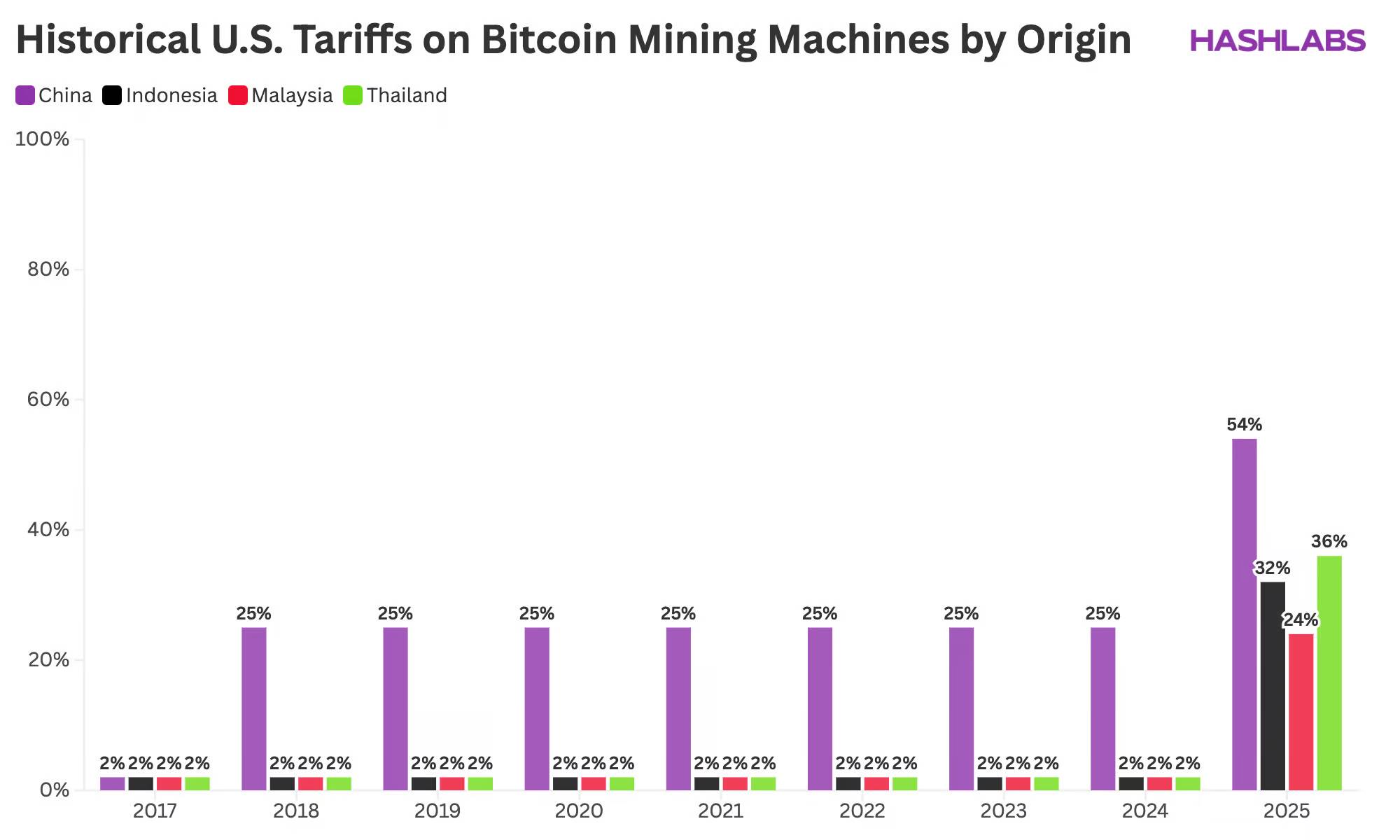
This strategy has been effective until earlier this month when Trump raised tariffs on goods imported from Indonesia, Malaysia, and Thailand to 32%, 24%, and 36%, respectively. As a result, companies like Bitmain and MicroBT can no longer fully evade these high tariffs, which were initially only aimed at goods imported from China.
In the following section, we will explain in detail how these newly implemented tariffs will affect the Bitcoin mining industry.
The price of mining machines in the United States will increase significantly.
The most direct and obvious impact of tariffs is that the prices of mining machines in the United States will rise significantly.
As Ethan Vera pointed out in The Mining Pod: “…any company operating in the U.S. that wishes to purchase mining machines will need to pay an additional 22% to 36% for these machines.” This is consistent with our data.
However, the 22% price increase only applies to imported mining rigs. At present, there is still a large inventory of mining machines in the United States. According to Bitmars’ pricing data, there is currently a 13% to 25% price difference between mining rigs in the US and those in Hong Kong. As U.S. inventory dwindles, this spread could narrow to 22%, plus a small amount of shipping costs.
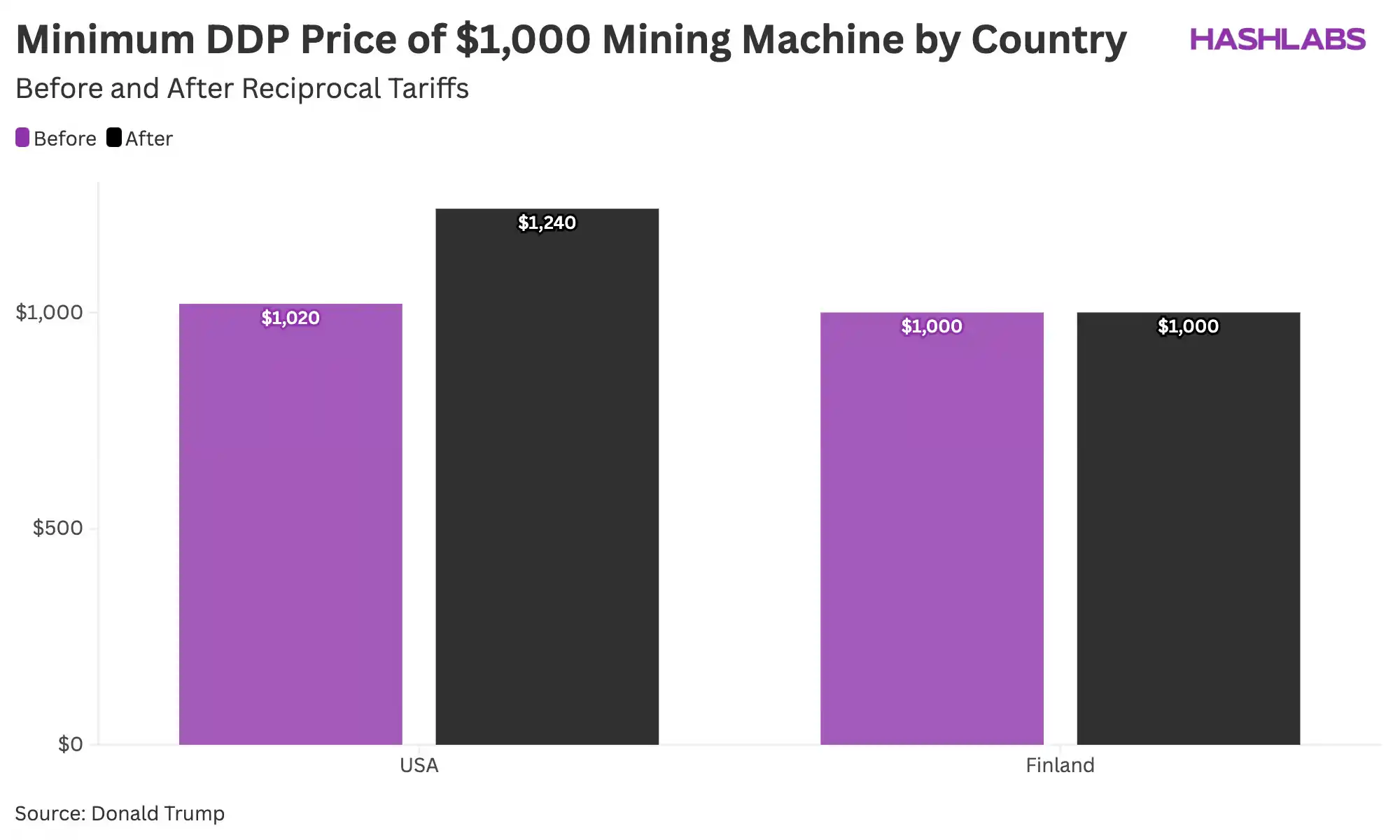
The above figure shows the final cost of importing a Bitcoin mining device worth $1000 into the United States and Finland before and after the introduction of countervailing duties. Finland, like most other countries, does not impose tariffs on electronic products imported from Asia—we use this country as an example because we mine there.
As shown in the figure, due to approximately 2% tariffs, the initial cost of importing mining machines to the United States is slightly higher. However, after the introduction of the new tariffs, the minimum cost of a mining machine that originally cost $1000 has risen to $1240 in the United States. This is a significant increase. Meanwhile, in Finland and most other countries, due to the absence of tariffs, the cost of a $1000 mining machine remains unchanged.
In an industry like Bitcoin mining that is highly sensitive to costs, a 22% increase in mining machine prices could render operations financially unsustainable. In the subsequent sections of this article, we will explore how these changes affect mining profitability in the United States compared to other regions.
Mining machines outside the United States may become cheaper
As the price of mining machines rises in the United States, the price of mining machines in other parts of the world may show a contrary downward trend.
The demand for mining machines shipped to the United States is expected to decline significantly, possibly approaching zero. Considering that the U.S. has always been the dominant player in the ASIC (Application-Specific Integrated Circuit) market, accounting for nearly 40% of the global computing power, the sharp decline in U.S. purchases will lead to a significant decrease in global demand.
Due to the decrease in demand from American miners, manufacturers will face surplus inventory that was originally planned to supply the U.S. market. To clear this inventory, they may need to lower prices to attract buyers from other regions.
Although it is difficult to accurately predict how much the price of mining machines will drop—because mining profitability also affects prices—we can conclude based on basic economic principles that a decrease in demand for a certain asset usually leads to a decrease in its price.
This price drop will make it easier for miners outside the United States to continue expanding, which may also lead to a decline in the share of the United States in global hash power that we will discuss next.
The share of the United States in the global Bitcoin mining industry will decline
Since China banned Bitcoin mining in 2021, the United States has been the dominant force in Bitcoin mining. According to data from Hashrate Index, the U.S. currently accounts for 36% of the global hash rate.
Like any business activity, the core of Bitcoin mining lies in balancing risk and return. Over the past four years, the United States has attracted significant mining investment as it is viewed as one of the lowest risk environments in the world, boasting political stability, abundant energy, and a liberalized electricity market. Furthermore, miners have so far avoided major import tariffs, which has helped them manage capital expenditures. These factors together create an unparalleled risk-return balance.
To understand how the new tariffs are reshaping the United States’ share in global mining, we first analyze from the perspective of returns.
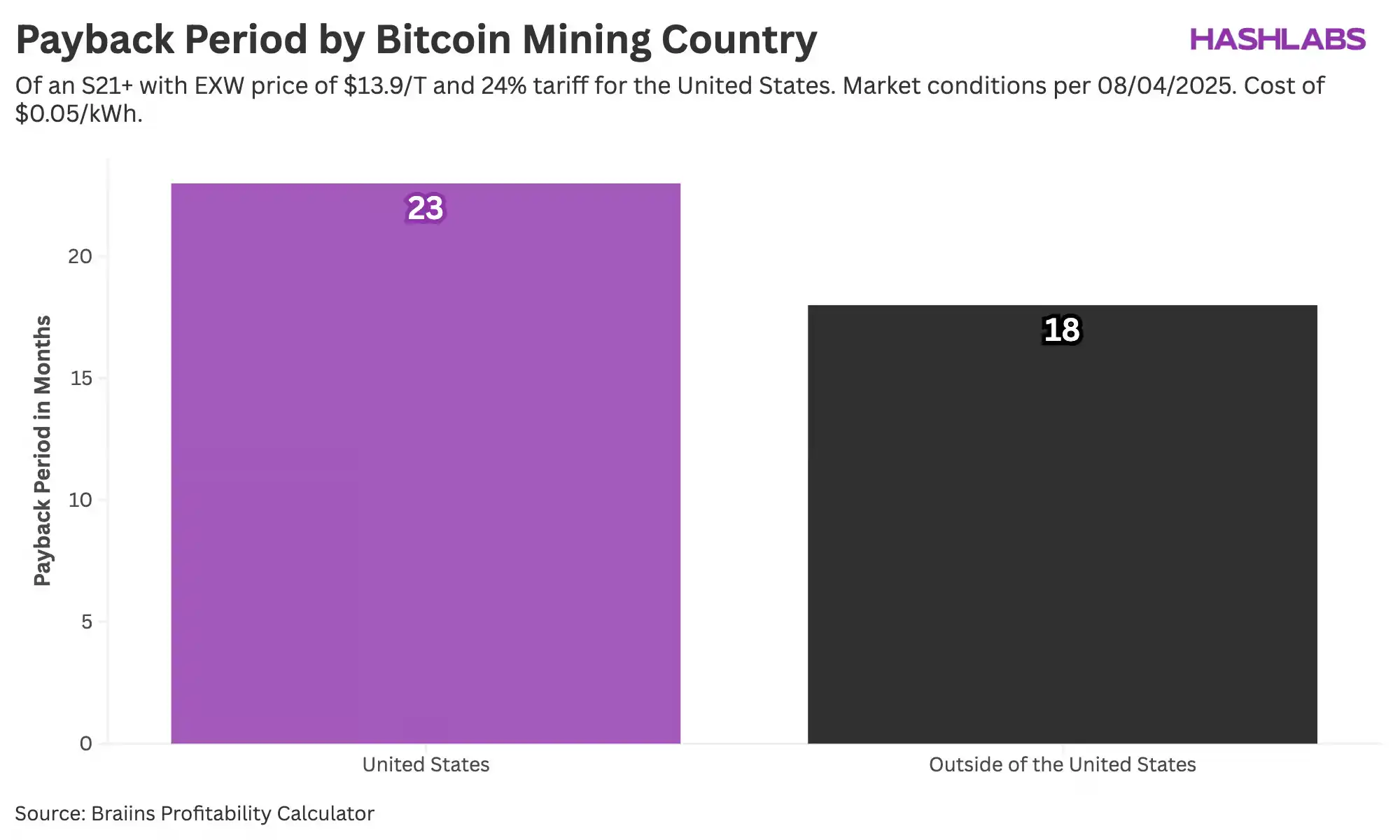
The chart below shows the expected payback period for deploying the Antminer S21+ in the United States and a country not affected by tariffs. As the data indicates, paying 24% more for the same mining machine in the United States will significantly extend the payback period—this undermines the core economic rationale for mining in the U.S.
In addition to the higher costs of mining rigs, risks have also been impacted. Many American miners felt reassured when Trump regained power, anticipating a stable regulatory environment. However, they are now experiencing the other side of his unpredictable policies. Even if these tariffs are revoked within a few months, the damage has been done—confidence in long-term planning has been shaken. With key variables potentially changing overnight, few are willing to make significant investments.
In conclusion, the once unparalleled risk-return balance of Bitcoin mining in the United States has significantly deteriorated. This change may lead to a gradual decline in the U.S. share of the global mining industry compared to other countries.
Of course, existing mining machines that have already been imported into the United States will not be affected—miners have no reason to shut them down. But the path to expansion has now become steep and full of uncertainty.
At the same time, miners in tax-free jurisdictions will continue to scale up, consolidating their competitive advantage. Therefore, it is expected that the global hash rate share of the United States will decline—not because miners are exiting, but because they are no longer growing.
From a more macro perspective, this could lead to a geographical distribution of Bitcoin mining that is more diverse than ever before. While the United States will still be a major player, its dominance will weaken, and the global hash rate distribution will become more balanced. This aligns with the predictions of Kristian Csepcar from Braiins and Summer Meng from Bitmars.
The growth of network computing power will slow down
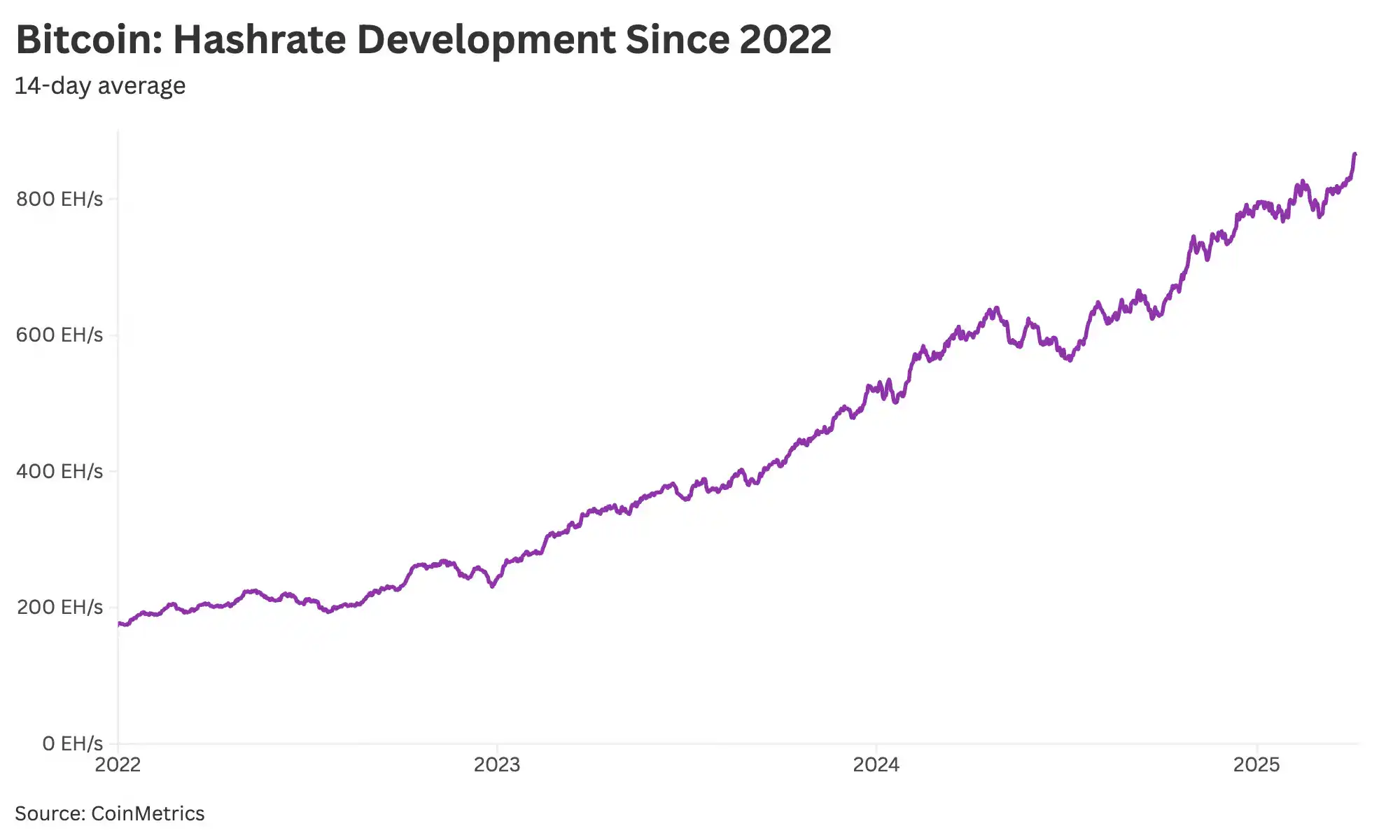
In the previous section, we explained how the new tariffs will lead to a decline in the United States’ share of the global Bitcoin mining industry. Given the important role of the United States in global hashing power, its slowdown in growth—or even complete halt—will inevitably lead to an overall deceleration in the growth of global hashing power.
According to data from the Hashrate Index, as of the second quarter of 2025, the United States accounts for about 36% of the global hash rate. In contrast, CBECI data shows that in January 2022, the hash rate share of the United States was approximately 38%. This indicates that the growth rate of the U.S. mining industry over the past three years has been roughly comparable to that of other regions in the world.
If this growth trajectory were to continue, the United States would contribute about 36% of future global hash rate growth. Therefore, if the mining industry in the United States stagnates due to the impact of tariffs, it could lead to a reduction of up to 36% in global hash rate growth.
However, the likelihood of the US mining industry completely stopping its growth is extremely low. As we will explain in the next section, these tariffs may be temporary, and there may be ways to circumvent them in the future. Therefore, a more realistic expectation is that the US mining industry will continue to expand, but at a much slower pace than before. The assumption of a 36% reduction in global hash rate growth should be viewed as an absolute upper limit—the actual impact may be slightly lower.
In the long run, if the growth in the United States slows down or stagnates, miners from other countries may accelerate their expansion to gradually fill this gap.
Nevertheless, in the short to medium term—over the next year or two—we may see global hash rate growth slower than previously expected. In an industry where slower hash rate growth means higher income, this will be a welcome development for miners around the world.
Is this temporary or permanent?
So far, this article has taken a rather pessimistic view on how these tariffs affect the Bitcoin mining industry in the United States—this is reasonable, considering the immediate and severe impact they may bring. However, the situation is more complex, and there are some important issues worth exploring.
In the following section, we will address these questions and assess how the long-term prospects of the U.S. mining industry can cope with current challenges.
Will Trump revoke the tariffs a few months after their implementation?
It is entirely possible—especially considering the unpredictability and reactiveness of Trump’s policy-making style. If tariffs are lifted, American miners will be able to import mining machines at competitive prices again, alleviating many of the immediate pressures they face.
However, the damage to the confidence of long-term investors may have already been done. Even if the tariffs are lifted, the fact that they were suddenly introduced makes large-scale, long-term investment in the U.S. mining industry much more difficult. In a capital-intensive industry like Bitcoin mining, policy stability is crucial—and that is precisely what is now in short supply.
Can mining machine manufacturers circumvent tariffs by importing chips from Taiwan and assembling mining machines in the United States?
Mining machine manufacturers may indeed circumvent tariffs by importing chips from Taiwan and assembling mining machines locally in the United States. According to the official statement from the White House, semiconductors are not subject to reciprocal tariffs. This means that chips can be imported into the U.S. duty-free. However, producing mining machines locally in the U.S. still requires other components, many of which have become more expensive due to tariffs, leading to overall inflation in the U.S. economy.
Currently, manufacturers like MicroBT have established assembly lines in the United States, but Bitmain has not followed suit. Even with MicroBT’s assembly capabilities, its production capacity will be far from sufficient to meet the demand for mining machines in the U.S. in the next 1-2 years.
Therefore, although this option is technically feasible, it does not address the immediate issues faced by American miners. However, in the long run, we expect more mining machine assembly to gradually shift to the United States, as manufacturers adapt to the new tariff environment and expand local production capacity. This shift may help reduce dependence on international imports and lower the impact of tariffs over time.
Is it realistic to establish a complete Bitcoin mining hardware supply chain in the United States, from chip manufacturing to final assembly?
Establishing a complete Bitcoin mining hardware supply chain in the United States, from chip manufacturing to final assembly, is a complex challenge, despite strong pushes for localizing chip production from both the Bitcoin mining industry and political leaders. Currently, the most advanced chips used in Bitcoin mining are produced in Taiwan and South Korea, regions with decades of expertise and finely tuned supply chains. The United States’ reliance on critical components from Asian countries is a significant geopolitical risk not only for the Bitcoin mining industry but for the entire high-tech sector.
Although localizing the assembly of mining machines in the United States is feasible, the continued reliance on imported chips is a major obstacle. Companies like Bitmain, MicroBT, and Canaan can establish assembly lines in the U.S., and new entrants like Auradine are also looking at this market. However, without locally produced cutting-edge chips, these manufacturers will still depend on imports for the foreseeable future.
Kristian Csepcsar from Braiins further emphasized this challenge, stating: “Chip foundries have established manufacturing facilities in the U.S., but they start from high nanometer levels. Cultivating the talent and expertise to transition to lower nanometer levels takes years. This process is gradual – companies start with high nanometer chips to ensure investment profitability, and then strive to expand into more advanced technologies. Even if the U.S. moves forward, establishing a fully localized Bitcoin mining hardware supply chain is almost impossible, and the costs would be extremely high. The real question is whether it is still cheaper to manufacture in China and pay tariffs if demand is high. After all, launching end-to-end manufacturing in the U.S. takes time and significant investment, just like what Bitmain recently attempted in China to set up an assembly line – although there hasn’t been much news after that.”
In short, although the United States has great potential in assembly and chip manufacturing, a fully localized Bitcoin mining hardware supply chain remains a long-term goal rather than a short-term reality. The costs, time, and complexity of this shift make it unlikely that this goal can be achieved on a large scale in the coming years.
Conclusion
In summary, the newly implemented import tariffs on goods will significantly impact the Bitcoin mining industry in the United States—leading to an increase in hardware prices, a decline in market share in the U.S., and a slowdown in global hash rate growth—but the long-term effects are more complex.
As the situation develops, miners and industry stakeholders need to closely monitor the political and economic landscape to respond to potential tariff and policy changes. The U.S. mining industry may face challenges in the short term, but there are still opportunities for growth and adaptation within the global mining ecosystem.
Original link
:


