The Pi Network's Crypto Assets PI have been integrated into the SWIFT system through the CEX exchange, realizing internal cross-border banking business functions. This significant breakthrough has pushed the price of PI to pump over 20% within 24 hours, soaring from $0.2100 to $0.2512, with a volume surge to 107 million PI.
CEX has completed the KYB review, and the SWIFT integration has officially started
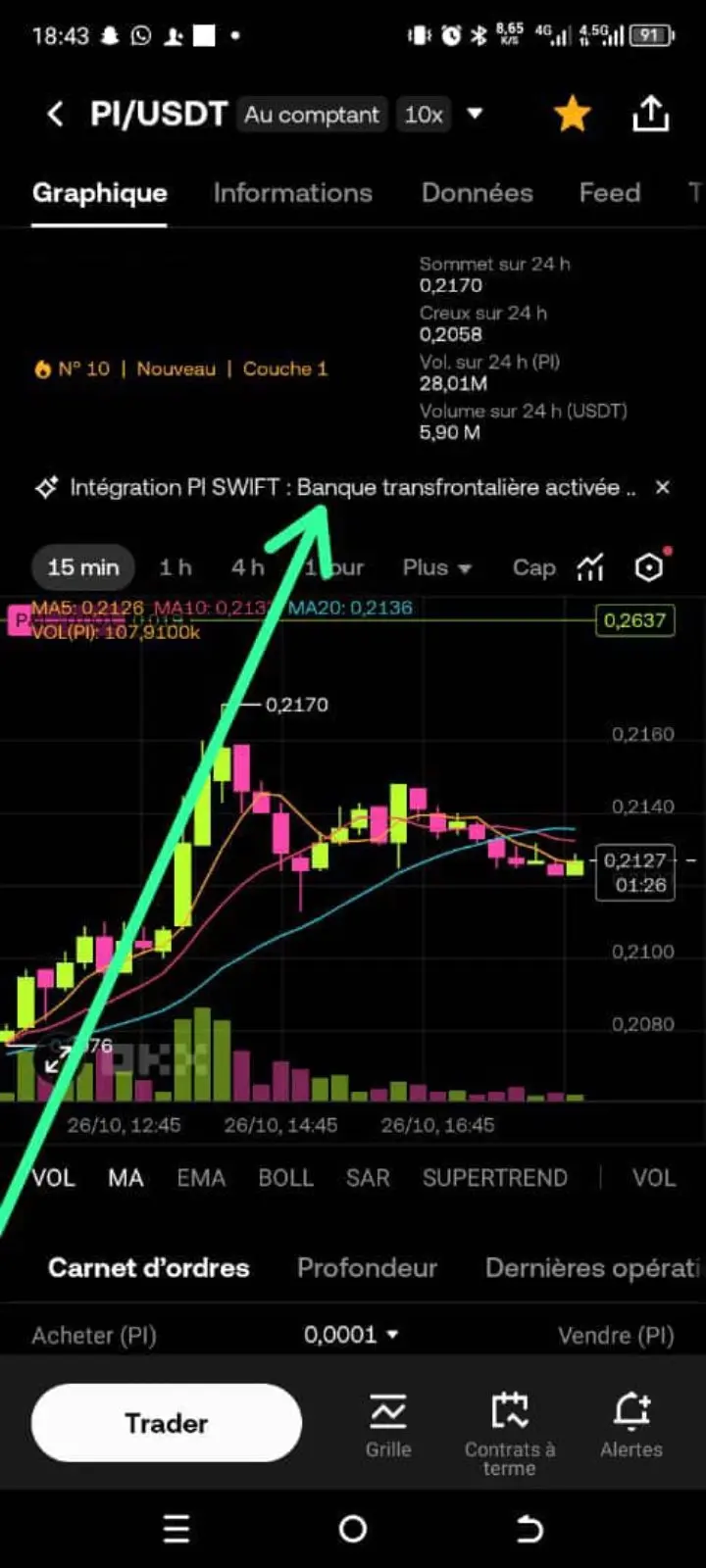
According to reports, the Pi Network's crypto asset PI has joined the SWIFT system, which allows companies to use cross-border banking functions internally. CEX has passed the Pi Network's “Know Your Business” (KYB) audit and confirmed on the social media platform X that it has launched the Pi SWIFT integration for cross-border banking functions. This news was first published by user @RaphaelNta239333 and subsequently sparked heated discussions in the Pi Network community.
SWIFT (Society for Worldwide Interbank Financial Telecommunication) has over 11,000 institutions across more than 200 countries, providing secure cross-border payment services. This is the core infrastructure of the global financial system, processing trillions of dollars in international transfers daily. After joining SWIFT, PI is expected to achieve low-cost, instant international transfers, making Pi Network a potential competitor to existing crypto payment networks like XRP or Stellar.
The completion of the KYB review is of great significance. “Know Your Business” is the process through which financial institutions conduct due diligence on corporate clients, covering various aspects such as company structure, sources of funds, business model, and compliance status. The KYB review by CEX through the Pi Network means that the project has met institutional-level standards in terms of compliance and business reliability.
However, it is important to note that this announcement indicates that the internal launch is still in the pilot stage. Its full public implementation depends on the release of the mainnet and regulatory authorization. Pi Network is currently still in the pre-mainnet stage, which means that the full functionality and free circulation of PI tokens have not yet been fully realized. The initial applications of the SWIFT integration may be limited to internal testing and specific partners, rather than being open to all users.
Price pumps over 20%, technical indicators show bullish trend
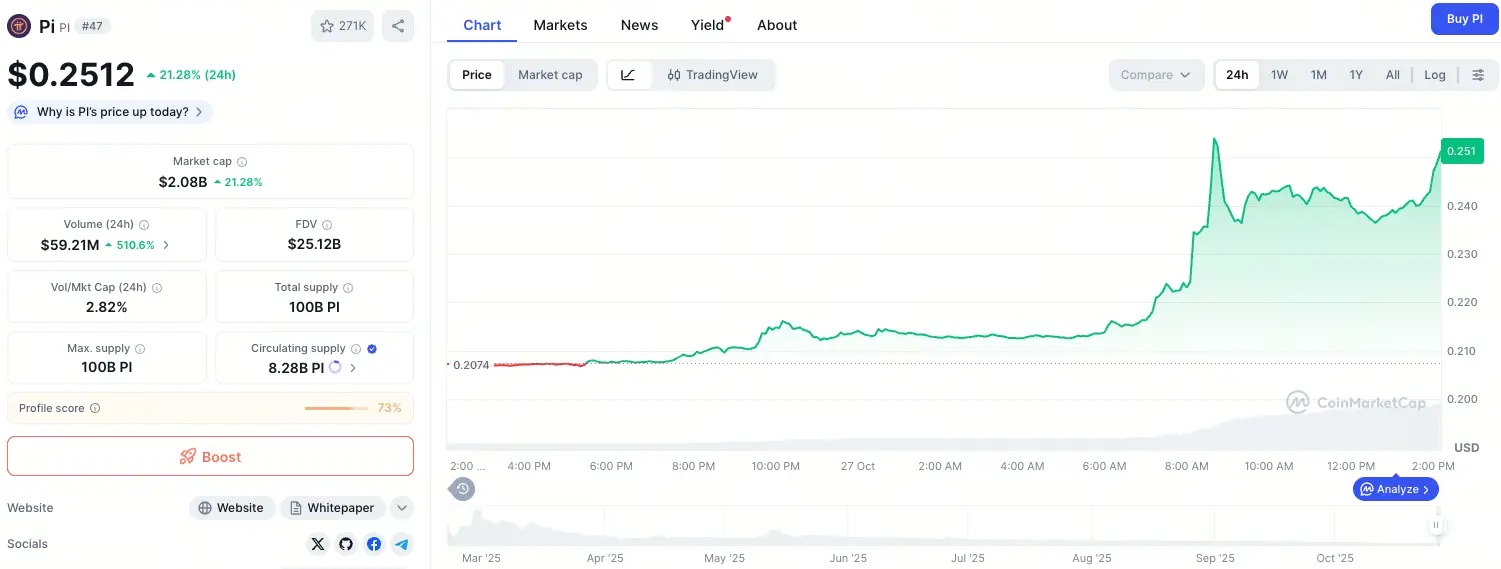
(Source: CoinMarketCap)
After the release of this news, the PI price surged significantly. It rose more than 20% within 24 hours, with the trading volume of PI tokens peaking at over 107 million. The price skyrocketed from $0.2100 to $0.2512 within an hour, indicating a strong market reaction to this news. Technical indicators such as moving averages (MA5: $0.2128, MA10: $0.2138, MA20: $0.2136) and the Bollinger Bands show that this news has triggered a bullish trend.
From a technical analysis perspective, the short-term moving average (MA5) is below the mid-term and long-term moving averages (MA10, MA20), but the price is breaking upward, which is a typical reversal signal. The Bollinger Bands indicate that the price is moving towards the upper band, showing increased volatility and strengthened upward momentum. The trading volume has surged from the usual millions of coins to 107 million coins, and this significant increase in volume usually means a higher validity of the breakout.
This news has led to a significant increase in prices and volume, and investors are optimistic about it. A volume of 107 million PI corresponds to a trading amount of approximately 23 million USD, which is quite a considerable figure for a project that is still in the pre-mainnet stage. However, investors also need to remain cautious, as the cross-border compliance of Pi and the pre-mainnet stage may affect the full functionality of SWIFT.
Pi Network ecosystem and 50 million user base
Pi Network was founded in 2019 by Stanford University PhD students Dr. Nicolas Kokkalis and Dr. Chengdiao Fan, based on a mobile-friendly crypto assets mining and user acquisition model. The core innovation of this project lies in allowing users to “mine” through a mobile application without consuming large amounts of electricity or purchasing expensive hardware. This low-threshold participation method has enabled Pi Network to rapidly accumulate a large user base.
The project claims to have over 50 million users by October 2025. If this number is true, it will make Pi Network one of the largest Crypto Assets projects in terms of user scale globally. In comparison, the estimated global user base of Bitcoin is around 200 million to 300 million, while Ethereum has about 100 million. Pi Network's ability to reach such scale in just a few years is largely due to its mobile-first strategy and referral reward mechanism.
Key Components of the Pi Network Ecosystem:
Mobile Mining Application: Users can “mine” by clicking daily, reducing the participation threshold.
E-commerce Integration: Some merchants have started accepting PI as a payment method.
Peer-to-peer payment: Users can conduct PI transfers and transactions.
Bank Cooperation Network: Has established partnerships with over 40 banks.
The total supply of PI is approximately 100 billion coins, with limited supply during the pre-mainnet phase. This supply control mechanism aims to prevent inflation from rising too quickly, maintaining the scarcity and value of the tokens. Ecosystem applications such as e-commerce and peer-to-peer payment solutions are also part of this ecosystem, and Pi has partnered with over 40 banks, indicating that its financial infrastructure is continuously expanding.
The establishment of partnerships with over 40 banks shows that Pi Network is actively laying out traditional financial integration. Although the specific list of partner banks has not been fully disclosed, such a scale of collaboration with financial institutions lays a foundation for Pi Network's future cross-border payments and banking applications. The integration with SWIFT is a natural extension of this strategic layout.
Challenge the cross-border payment market of XRP and Stellar
After integrating SWIFT, Pi Network will directly enter the cross-border payment encryption market dominated by XRP and Stellar in the long term. XRP is developed by Ripple and focuses on providing instant, low-cost cross-border transfer solutions for banks and financial institutions. Stellar focuses on inclusive finance, providing low-cost remittance services for developing countries.
The potential advantage of Pi Network lies in its large user base and mobile-first strategy. If 50 million users are converted into active cross-border payment users, it will create a significant network effect. Additionally, Pi's mobile app offers a relatively user-friendly experience, which may attract ordinary users who are not familiar with traditional Crypto Assets wallets.
However, Pi Network also faces significant challenges. First, the mainnet has not yet fully launched, and the free circulation and complete functionality of the PI token have not been realized. Second, there is regulatory uncertainty; although CEX has completed the KYB review, the regulatory status of Pi Network itself is still unclear in multiple jurisdictions. Third, there is the issue of technological maturity; XRP and Stellar have undergone years of practical testing, while Pi Network's cross-border payment functionality is still in the pilot stage.
Comparison of Pi Network and Competitors:
User Base: Pi claims 50 million users, far exceeding the direct user numbers of XRP and Stellar.
Technology Maturity: XRP and Stellar have been running for many years, while Pi is still in the pre-mainnet phase.
Bank Adoption: XRP has partnerships with hundreds of banks, and Pi currently has over 40.
Transaction Speed: All three claim to achieve settlement in seconds.
The integration with SWIFT will be a huge milestone for Pi Network, enabling it to engage in cross-border banking and go global. A 10.7% price pump and volume increase within 24 hours have heightened market enthusiasm. Although the conditions before the mainnet and pending regulatory approvals have triggered cautious sentiment in the market, this development makes Pi an emerging force in the international financial sector based on blockchain.


