Key Notes
- Tom Lee says the crypto bottom is in and expects a rapid bullish reversal.
- Ethereum could surge toward $62,000 if the ETH/BTC ratio reaches 0.25.
- Traders watch $4,800, $6,800, and $8,800 as critical resistance levels.
Tom Lee, the chairman of ETH
ETH
$3 118
24h volatility:
2.8%
Market cap:
$376.76 B
Vol. 24h:
$24.82 B
holding company BitMine Immersion Technologies, believes that the crypto market has already survived its harshest correction phase.
Speaking at Blockchain Week in Dubai, he argued that the pullback that began in October is over. Lee talked about previous cycles where similar drops resolved within six to eight weeks and added that the market is entering its reversal window.
No 4-Year Cycles
According to Lee, fears tied to quantum threats, liquidation cascades, and concerns around Tether and MicroStrategy contributed to the recent market anxiety.
Related article: Robert Kiyosaki Backs Bitcoin, Ethereum as “People’s Money” Despite VolatilityWhen discussing Ethereum, Lee remained exceptionally optimistic and said that major financial institutions like JPMorgan, BlackRock, and others are building real-world asset tokenization rails on Ethereum.
From his perspective, Ethereum is evolving into the core financial settlement layer of the global economy. He said that if Ethereum returns to its historical average ratio versus Bitcoin, ETH could trade near $12,000. A return to the 2021 peak ratio places ETH close to $22,000.
But Lee’s most ambitious forecast assumes ETH grows into the backbone of worldwide settlement which could lift the ETH/BTC ratio toward 0.25 and push Ethereum to roughly $62,000.
According to a recent release, the firm now holds more than $12 billion worth of Ether. Earlier today, Lookonchain revealed that BitMine had accumulated 41,946 ETH, worth about $130.78 million, at a price near $3,100.
Traders Turn to Key Resistance Levels
Analyst Ali Martinez took a more practical approach while sharing Lee’s words. While he acknowledged the possibility of a $62,000 ETH, the analyst argued that the market must first clear critical resistance levels.
According to Martinez, Ethereum needs to break above $4,800 to unlock momentum. Beyond that, the next major targets lie at $6,800 and $8,800. Clearing these levels will make ETH the next crypto to explode in the next cycle.
Meanwhile, according to CryptoQuant analysts, Ethereum’s Taker Buy/Sell Ratio on Binance climbed to 0.998 immediately following the Fusaka network upgrade. This was the highest reading since early August.
 ETH taker buy sell ratio | Source: CryptoQuant
A breakout above 1.0 would confirm the end of November’s correction and open the path toward the $3,500 and $4,000 zones.
CryptoQuant also noted that Ethereum’s cumulative volume delta (CVD) on Binance has shown sharp spikes of buying interest, and the indicator is now in positive territory.
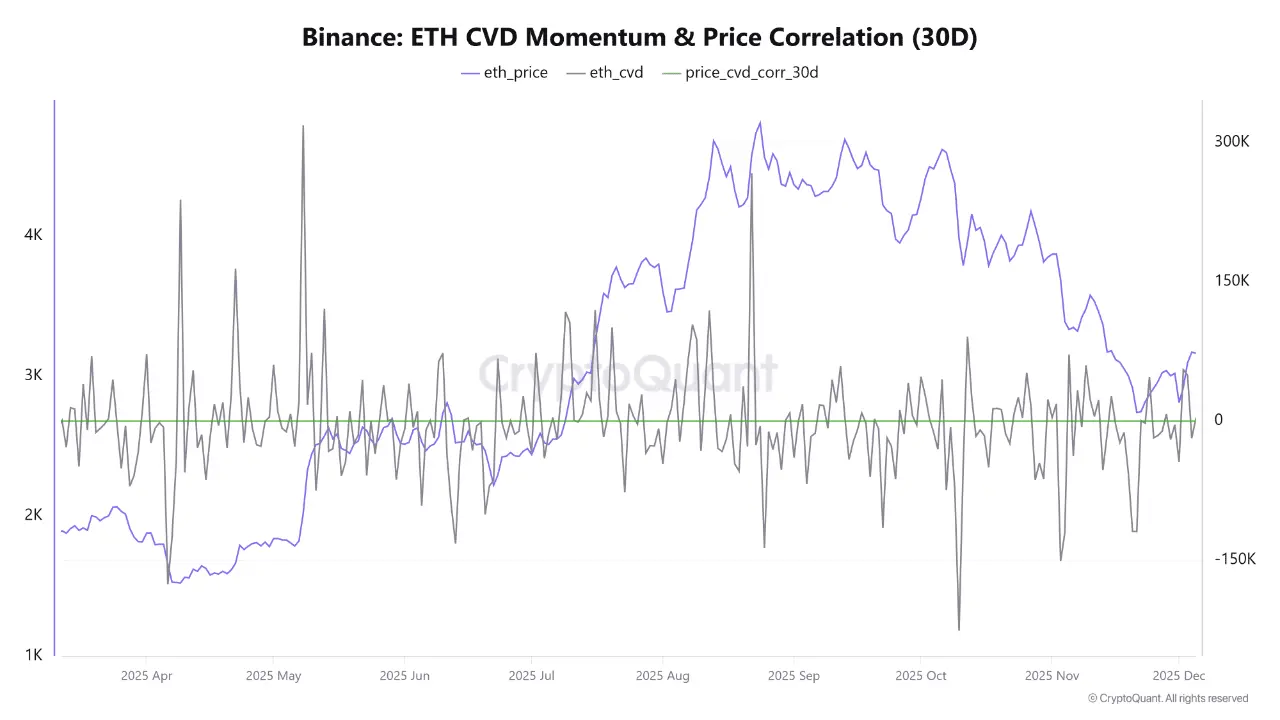 Binance ETH CVD momentum and price correlation 30D | Source: CryptoQuant
The 30-day correlation between price and CVD remains at a relatively high 0.6. According to analysts, this pattern confirms that traders are accumulating dips in anticipation of increased liquidity as future upgrades approach.
nextDisclaimer: Coinspeaker is committed to providing unbiased and transparent reporting. This article aims to deliver accurate and timely information but should not be taken as financial or investment advice. Since market conditions can change rapidly, we encourage you to verify information on your own and consult with a professional before making any decisions based on this content.
Disclaimer: The information on this page may come from third parties and does not represent the views or opinions of Gate. The content displayed on this page is for reference only and does not constitute any financial, investment, or legal advice. Gate does not guarantee the accuracy or completeness of the information and shall not be liable for any losses arising from the use of this information. Virtual asset investments carry high risks and are subject to significant price volatility. You may lose all of your invested principal. Please fully understand the relevant risks and make prudent decisions based on your own financial situation and risk tolerance. For details, please refer to
Disclaimer.
Related Articles
A judge ruled that the JENNER meme coin issued by socialite Jenners from the Kardashian family is not a security, dismissing the lawsuit.
The U.S. District Court for the Central District of California ruled that the $JENNER meme coin issued by socialite Jenna, of the Kardashian family, does not meet the definition of a security, dismissing investors’ lawsuit. The judge said the plaintiffs failed to prove the features of a common enterprise and can bring other claims in state court.
ChainNewsAbmedia1h ago
ETH breaks through 2350 USDT
Gate News bot message, Gate quotes show that ETH has broken through 2350 USDT, with the current price at 2350 USDT.
CryptoRadar3h ago
KelpDAO Exploiter Borrows $195M ETH from Aave, TVL Drops $6.28B as Whales Withdraw
Gate News message, the KelpDAO exploiter borrowed over 82,600 ETH ($195M) from Aave using RSETH as collateral, resulting in bad debt appearing on Aave. Following this incident, numerous whales withdrew funds from Aave, causing its TVL to decline from $26.396B to $20.114B, a decrease of $6.28B.
GateNews5h ago
Vitalik and Ethereum Foundation Chair Aya Miyaguchi Confirmed to Speak at Hong Kong Ethereum Community Hub Launch
Vitalik Buterin and Aya Miyaguchi will speak at the Hong Kong Ethereum Community Hub opening on April 21. The hub, Asia's first Ethereum-backed space, aims to connect Eastern and Western ecosystems with discussions on key topics like zero-knowledge proofs and AI.
GateNews7h ago
Justin Sun Deposits 53,660 ETH Worth $125M Into Spark After Aave Withdrawal
Justin Sun deposited 53,660 ETH worth $125 million into Spark, after withdrawing the tokens from Aave. He now holds about $2.13 billion in assets across Sky and Spark, along with $380 million in Aave.
GateNews8h ago
ETH drops 0.76% in 15 minutes: Dual pressure from whales’ proactive deleveraging and ETF fund outflows
Between 07:15 and 07:30 (UTC) on 2026-04-19, the ETH spot price fluctuated in the 2298.13 to 2322.69 USDT range, with an amplitude of 1.06% and a return of -0.76%. During this period, market attention increased; the sharp drop in price triggered widespread user focus, along with a clear surge in trading volume within a short time, indicating a sudden escalation in liquidity pressure.
The main driver behind this deviation is that on-chain whale accounts actively sold ETH to repay DeFi platform borrowings in order to avoid forced liquidation. Based on on-chain tracking and fund-flow monitoring, from April 18 to 19, more than 42,000 ETH per-transaction large transfers were rapidly sent into a certain mainstream exchange, and at the same time there was a sharp spike in net inflows to the exchange. This concentrated sell pressure directly weakened spot market prices. Under proactive deleveraging behavior, selling pressure was released in the short term, creating a sudden market shock.
In addition, during the period of price deviation, the ETH derivatives market saw a significant rise in passive liquidation volume, especially as leveraged long positions encountered strong liquidations during the price decline, further increasing supply pressure in the spot market. Meanwhile, ETH spot ETF funds continued to see net outflows; in mid-April, there were multiple days with single-day outflows exceeding $40-50M, with the largest single day reaching $200M. This reflects a warming of short-term institutional risk-avoidance sentiment, which led to a deeper shift downward in buy-side liquidity depth. The launch of a new public chain ecosystem also attracted some ETH liquidity migration, further weakening the capital protection layer of the mainnet. Multiple structural feedback effects amplified the downside move.
At present, leverage risk in the ETH market remains prominent. Some whales still have large borrowings outstanding; if the price continues to move downward, potential liquidation risks may flare up again. ETF fund flows, on-chain large transfers, and capital-attraction moves tied to the new-chain ecosystem all need close monitoring. With increased short-term volatility risk, it is recommended to watch key support zones, exchange net inflow indicators, and DeFi on-chain liquidation dynamics in order to promptly grasp the latest market signals.
GateNews9h ago


