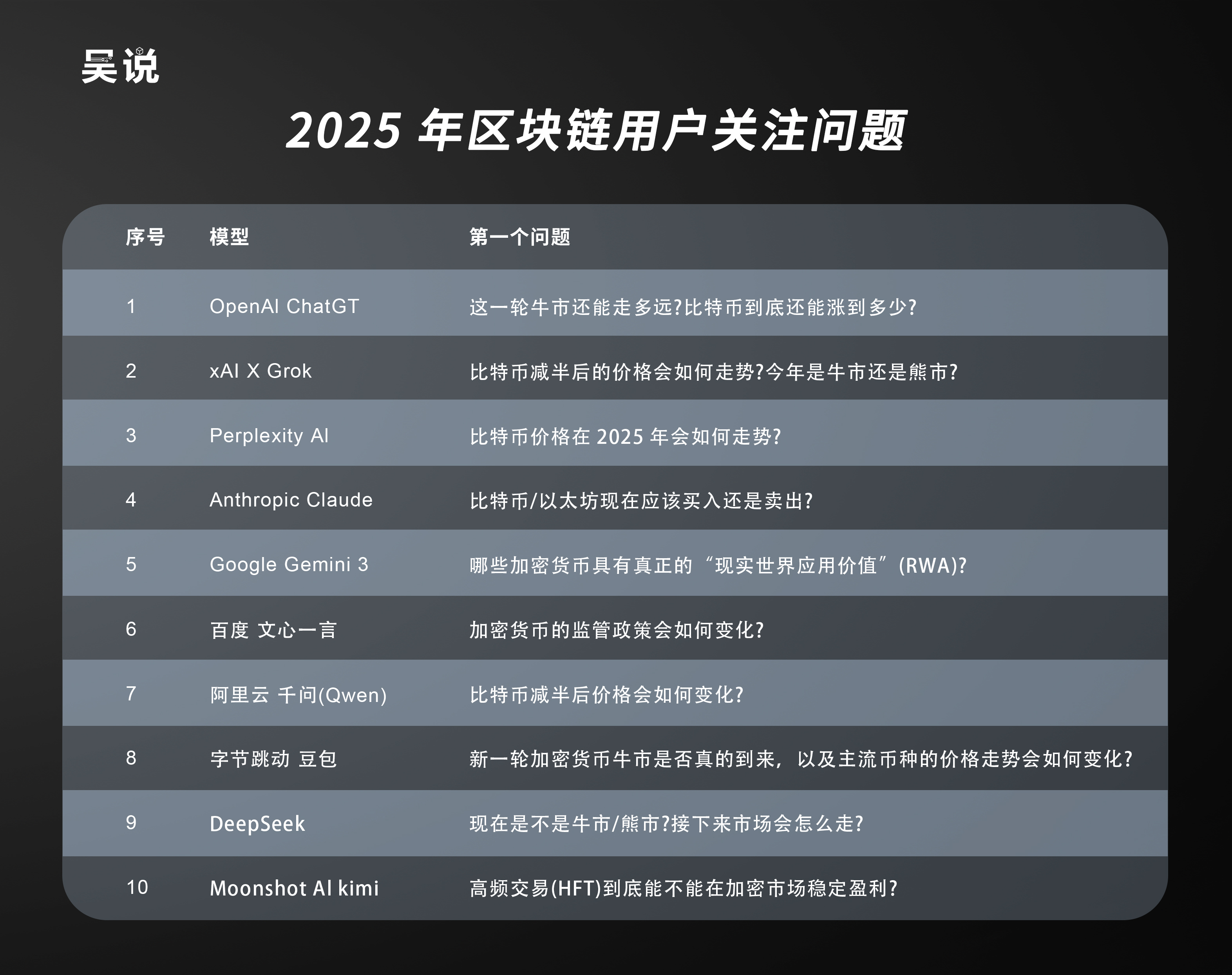
By asking 10 mainstream AI large models the question “What are the most concerned cryptocurrency issues for users in 2025,” we found that user anxiety centers around three main themes: bull-bear cycle judgment, profit path selection, and risk control boundaries. The responses from different models also reflect their respective positioning differences.
(Background summary: Bitcoin’s major transformation! Optech 2025 Annual Report: From passive defense to proactive evolution, systems combat quantum threats)
(Additional context: 2025 asset review: Why did Bitcoin significantly underperform compared to gold and US stocks?)
Table of Contents
- ChatGPT
- X Grok
- Perplexity AI
- Claude
- Gemini 3
- DeepSeek
- Doubao
- Qianwen
- Wenxin Yiyan
- Kimi
- Summary
What are crypto users most concerned about in 2025? We conducted a user survey through AI large models by asking the same question to different models: “What are the top three most asked questions about cryptocurrency in 2025?”
To minimize homogenized answers caused by models retrieving data online, and considering that large models usually cannot or are not allowed to provide verifiable statistics and disclosures from their training data, we added a clarification in the question: “Please do not perform real-time searches or cite specific articles; answer solely based on your understanding of long-term discussion patterns.”
ChatGPT
-
How far can this bull market go? Is Bitcoin already near the top?
-
Is there still genuine Alpha in this market cycle? How can ordinary users still make money?
-
Do current hot projects or sectors have long-term survival capabilities? Is there structural harvesting?
X Grok
-
Is the market in a bull or bear phase after Bitcoin halving?
-
What are the most worthwhile crypto assets or sectors to invest in 2025?
-
How is the performance of Ethereum spot ETFs and the inflow of institutional funds?
Perplexity AI
-
How might Bitcoin’s price evolve in 2025?
-
How to identify and avoid crypto-related scams?
-
How will ETF and regulatory developments impact the crypto market?
Claude
-
Is now a good time to buy or sell Bitcoin or Ethereum?
-
Is a certain crypto project a scam, and is it trustworthy?
-
How should new users start investing in cryptocurrencies and manage risks?
Gemini 3
-
Which crypto projects have real practical application value (RWA)?
-
How will current and future regulatory policies affect personal asset security?
-
Which technical route might become the ultimate winner: Ethereum L2, Solana, or AI + Crypto?
DeepSeek
-
Is the current market in a bull or bear phase?
-
Which crypto sectors or assets are most promising in 2025?
-
How will regulatory changes affect asset security and investment decisions?
Doubao
-
Has the new crypto bull market already arrived?
-
How will regulatory changes in various countries affect ordinary investors?
-
What does Bitcoin halving mean for retail investors’ strategies?
Qianwen
-
How will Bitcoin’s price trend evolve after halving?
-
Have Ethereum and mainstream public chains achieved substantial breakthroughs in practical applications?
-
How will regulatory policies in different countries influence the legitimate use of cryptocurrencies?
Wenxin Yiyan
-
How will global crypto regulatory policies change?
-
Do Bitcoin and mainstream crypto assets have long-term investment value?
-
Can real-world application scenarios of cryptocurrencies truly land?
Kimi
-
Can retail investors achieve stable profits through high-frequency trading in the crypto market?
-
How should private keys and wallet assets be stored to ensure maximum security?
-
In on-chain transactions, how to set slippage to avoid MEV losses?
Summary
The reason these models’ “top three questions” are not exactly the same may relate to their respective positioning and context. ChatGPT tends to view from a trader’s perspective, organizing discussions into a structured anxiety chain of “How far can the cycle go — Is Alpha still there — Is there structural harvesting”; Grok is more aligned with social platform hot topics, focusing on market narratives like halving, bull-bear, and ETF capital; Perplexity’s style resembles retrieval-based summaries, concentrating on price trends, scams, and ETF/regulatory progress; Claude is more cautious, emphasizing buy/sell timing, project trustworthiness, and risk management for beginners; Gemini leans toward industry and technical routes, concerned with RWA, regulatory impacts on asset security, and the “ultimate choice” among L2, Solana, and AI + Crypto. Overall, Chinese models focus more on the three “hardcore certainty variables”: cycle position, halving, and regulation, while Kimi is an exception, delving into on-chain execution details (wallet security, slippage / MEV, HFT), reflecting real friction from high-frequency on-chain users.
Another secondary but noteworthy possibility is that the capability differences among models also affect the sharpness of outputs. More capable models tend to ask more specific and systematic questions on the same topic; weaker models tend to revert to more general expressions like “price / regulation / scams,” making answers seem more similar and with less informational increment. While this may not be the main factor, in macro open-ended questions, it can indeed amplify the perception of homogenization.
In summary, these questions are highly concentrated on three main themes: cycle position, profit pathways, and risk boundaries. The prominent feature of the crypto market is high volatility and strong narrative-driven movements, so “which bull or bear phase we are in” almost determines all subsequent user actions (HODL, sell, rotate, leverage, or exit). As the market matures and becomes more crowded, users quickly shift from “Is there an opportunity” to “Where are the opportunities, can I still catch them,” making Alpha, sector choices, and institutional funds (ETF) high-frequency topics. Meanwhile, scams, project trustworthiness, asset security, and regulation reflect that crypto users are long-term in an environment of “high returns / high uncertainty”: chasing yields while fearing pitfalls, forming a typical behavioral pattern — first judging the trend, then seeking opportunities, and finally managing risks.

Disclaimer: The information on this page may come from third parties and does not represent the views or opinions of Gate. The content displayed on this page is for reference only and does not constitute any financial, investment, or legal advice. Gate does not guarantee the accuracy or completeness of the information and shall not be liable for any losses arising from the use of this information. Virtual asset investments carry high risks and are subject to significant price volatility. You may lose all of your invested principal. Please fully understand the relevant risks and make prudent decisions based on your own financial situation and risk tolerance. For details, please refer to
Disclaimer.


