Key Takeaways:
- Wyoming has launched $FRNT, the first fiat-backed, fully reserved stablecoin issued by a U.S. state, now live on Solana.
- $FRNT is available to the public via Kraken, with cross-chain access to Ethereum, Arbitrum, Avalanche, Base, Optimism, and Polygon.
- Interest earned on reserves flows back to Wyoming’s public schools, positioning the stablecoin as a revenue-generating public good.
Wyoming has taken a historic step in crypto adoption, bringing the first U.S. state-issued stablecoin into live public circulation. The launch places Wyoming at the center of the fast-growing stablecoin market while signaling a new model for government participation in onchain finance.
Read More: Wyoming Rolls Out First-Ever State-Issued $FRNT Stablecoin Live on 7 Major Blockchains
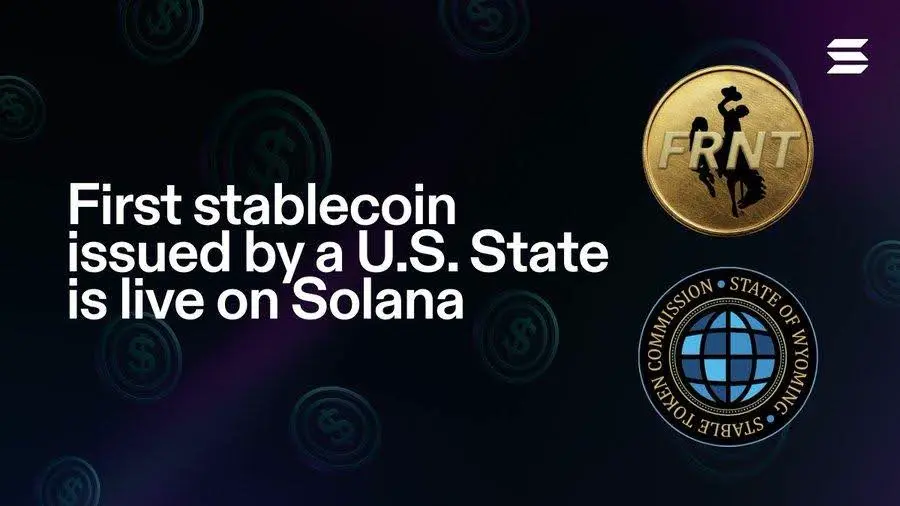
Table of Contents
- Wyoming Brings a State-Issued Stablecoin to Public Markets
- How $FRNT Works and What Makes It Different
- State-Managed Reserves and Public Transparency
- Planned Uses Beyond Trading
Wyoming Brings a State-Issued Stablecoin to Public Markets
Frontier Stable Token is now available on the Solana blockchain and it is referred to as, $FRNT. It is the original stablecoin ever issued by a governmental body in the history of the United States, fully supported by the U.S. dollar and short-term American Treasuries, and sold to the public.
It is also in contrast to privately issued stablecoins, as the Wyoming Stable Token Act regulates $FRNT under the statute. The Wyoming Stable Token Commission is in charge of oversight, and it should issue fully reserved digital dollars with transparency and accountability to the people.
The token is currently available to Kraken, a cryptocurrency exchange with its headquarters in Wyoming. Through the cross-chain infrastructure provided by Stargate, users are able to purchase $FRNT on Solana and transfer it to and from prominent Layer-1 and Layer-2 networks. The network supported includes Ethereum, Arbitrum, Avalanche, Base, Optimism, Polygon, and Solana, which will expand in 2026. It is the product of close to ten years of legislative preparation by the Wyoming legislature that has made the state one of the most crypto-friendly jurisdictions within the U.S.
How $FRNT Works and What Makes It Different
$FRNT is targeted at individuals and institutions that use retail. It allows peer-to-peer transactions in dollars, which are immediately settled in a matter of seconds, and transaction costs are less than a penny. The token is instantly auditable, globally accessible with an internet connection, and has less counterparty risk than the traditional payment rails…
State-Managed Reserves and Public Transparency
As opposed to those of corporate issuers, Wyoming has the reserves of the $FRNT held in trust and invests only in cash and short-term U.S. Treasuries. Shareholders do not receive interest generated on these reserves. Rather, net income will be reverted back to the state, and a part of it will be sent to the School Foundation Fund of Wyoming.
This design transforms stablecoin holdings into a social source of revenue instead of an enterprise. It also harmonizes the design of the token with the fiscal responsibility regulations that are already in place to control the state finances.
Decisions related to issuance, reserves, and expansion are made in public Commission meetings, allowing citizen oversight that does not exist with private stablecoin operators.
Read More: Morgan Stanley Files First-Ever Bitcoin and Solana ETFs, Opening Wall Street’s Gates to Crypto
Planned Uses Beyond Trading
In 2026, Wyoming plans to:
- Onboard new resale partners to broaden distribution
- Integrate $FRNT into state agencies to lower payment costs
- Partner with other public entities exploring similar stablecoin models
This strategy positions $FRNT not as a crypto asset, but as financial infrastructure. The stablecoins have come to symbolize a market worth over $300 billion around the world. Concurrently, foreign Treasury holders of the U.S. have been de-exposing on the U.S. Treasuries. Stablecoins issued by the state such as $FRNT produce a new audience of domestic buyers of short-term government debt.
Disclaimer: The information on this page may come from third parties and does not represent the views or opinions of Gate. The content displayed on this page is for reference only and does not constitute any financial, investment, or legal advice. Gate does not guarantee the accuracy or completeness of the information and shall not be liable for any losses arising from the use of this information. Virtual asset investments carry high risks and are subject to significant price volatility. You may lose all of your invested principal. Please fully understand the relevant risks and make prudent decisions based on your own financial situation and risk tolerance. For details, please refer to
Disclaimer.
Related Articles
SOL breaks through 90 USDT, 24-hour gain of 0.66%
Gate News reports that on March 20, a certain CEX showed SOL surpassing 90 USDT, currently trading at 90.03 USDT, with a 24-hour increase of 0.66%.
GateNews2h ago
Solana DApps Fall to 18-Month Low, SOL Faces Risk of Retesting 80 Dollar Level
Solana ecosystem DApps revenue has dropped to $22 million, marking an 18-month low, while the derivatives market is also showing bearish signals with funding rates near 0% and option skew surging, reflecting institutional lack of confidence in the future. The rise of competitor Hyperliquid has further intensified the pressure, leading to erosion of Solana's market share in the derivatives sector.
MarketWhisper4h ago
Solana DApp Revenue Drops to $22 Million, SOL Price Falls 11% in Three Days to $87
Solana ecosystem decentralized application revenue has dropped to an 18-month low, with SOL price recently declining 11% to $87, while long positions have been liquidated. Despite strong performance in DEX trading volume, it faces intense competition in the perpetual futures market.
GateNews6h ago
Solana on-chain revenue hits 18-month low, SOL may test $80 level
The Solana ecosystem has come under pressure recently, with SOL's price retreating from $97.70 to $87, representing a three-day decline of approximately 11%. Sentiment in the derivatives market is insufficient, with funding rates approaching historic lows, and on-chain DApp revenue has dropped to an 18-month low. Despite relatively solid performance on decentralized exchanges, new products and competition are putting pressure on capital flows. SOL is expected to remain range-bound and weak in the near term.
GateNews7h ago
Forward Industries Borrows $40 Million for Share Buyback, SOL Holdings Show Paper Loss Exceeding $1.1 Billion
Forward Industries announced the repurchase of over 6 million shares, reducing outstanding shares by approximately 7.4%. This repurchase was partially funded by a $40 million cryptocurrency loan, aimed at capitalizing on the current stock price trading below net asset value. The company faces over $1.1 billion in book losses while holding over 7 million SOL tokens, with a market value of approximately $614 million, indicating unusual financial circumstances. Management emphasized that the share repurchase strategy reflects confidence in the long-term value of SOL.
MarketWhisper7h ago
Morgan Stanley advances Bitcoin ETF application: S-1 amendment has been submitted, with the ticker symbol MSBT.
Morgan Stanley has recently submitted a revised S-1 filing for a Bitcoin ETF planned for listing in the United States under the ticker symbol MSBT, with an initial issuance of 10,000 shares and expected fundraising of approximately $1 million. The firm may become the first major bank to directly issue a spot Bitcoin ETF. Market demand is being driven by self-directed investors, and improvements in the regulatory environment will facilitate capital inflows, driving expansion of the Bitcoin ETF market.
GateNews8h ago


