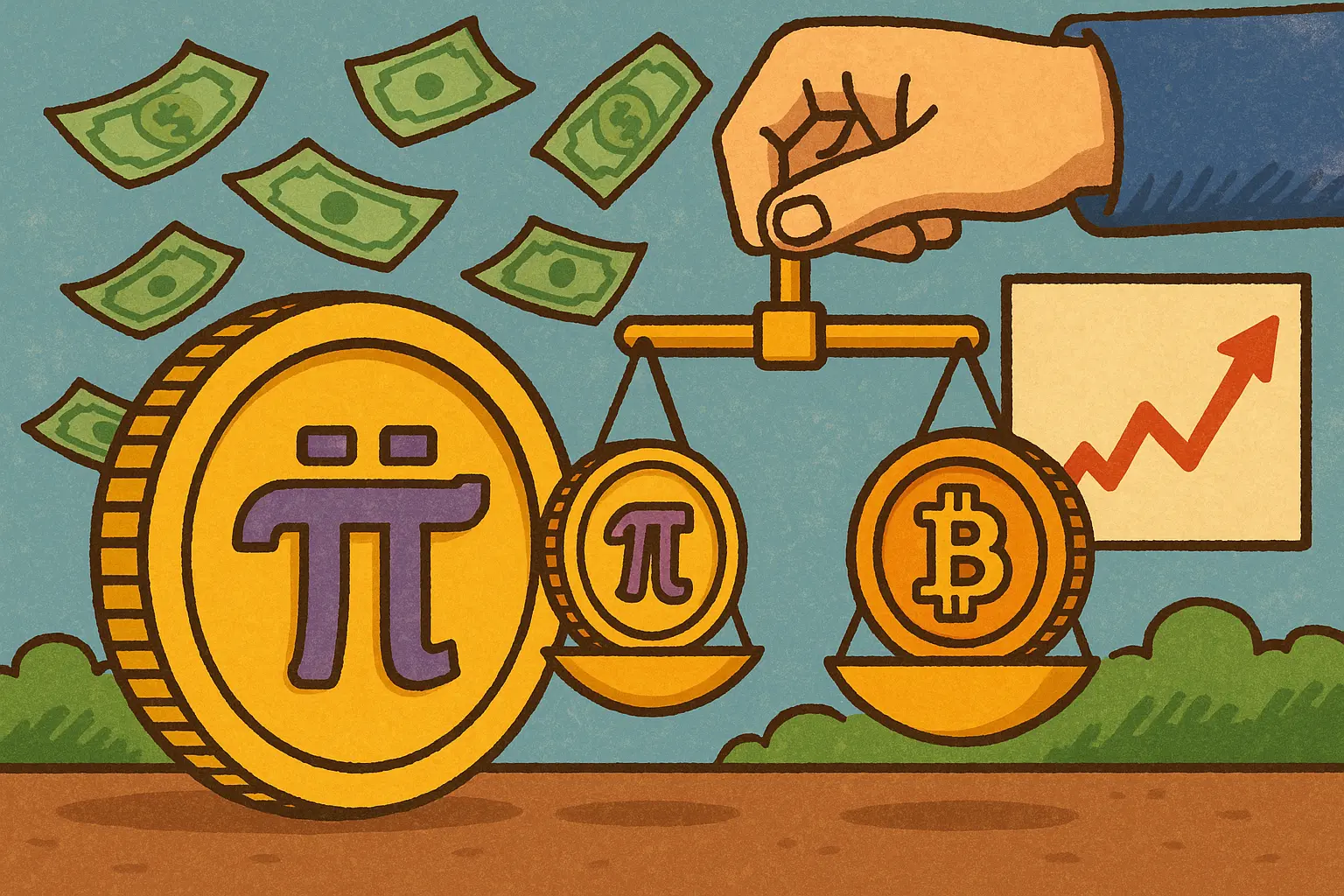
Pi Coin fundamentally challenges the assumption that cryptocurrencies must be valued in USD. Its core philosophy is “1π equals 1π,” aiming to become a native unit of value in Web3 rather than a speculative asset.
Why Pi Coin Rejects the USD Pricing Framework
Almost all discussions about cryptocurrencies revolve around a core assumption: value must be measured in USD. From Bitcoin to emerging altcoins, price charts, exchange rates, and market caps are all based on fiat currency standards. Pi Network fundamentally challenges this assumption. As emphasized in a recent statement by community leader @strong37022, Pi’s design intention is not to be measured in USD; instead, Pi aims to measure value itself.
This difference may seem subtle but actually represents a fundamental shift in how value is defined in the digital economy. The core is not how many USD π is worth, but how USD, gold, silver, and other assets are measured in terms of π. The key concept is a simple yet powerful principle: 1π equals 1π. Many critics view Pi Network through the same framework used for traditional crypto assets, questioning when Pi will be listed on exchanges, what its opening price will be, or what the highest USD price could reach.
According to the core team of Pi Network, this assumption is flawed. Pi is not an asset in the old system; it aims to define a new system. In this system, Pi is not an object to be measured but a measurement tool. This perspective challenges entrenched financial thinking—just as length is measured in meters and weight in kilograms, π is intended to become a unit of economic measurement in a decentralized digital environment.
“1π equals 1π” is not a slogan to evade currency valuation but a declaration of currency identity. Fiat currencies fluctuate relative to each other, but their internal valuation systems rely on stable units. Within the USD system itself, 1 dollar equals 1 dollar. Pi Network adheres to the same principle: Pi’s value is intended to remain stable within its ecosystem, driven by consensus, utility, and real economic activity, not external speculation. Therefore, the network emphasizes usage over trading, and ecosystem development over exchange listings.
Pi Coin as a Native Value Unit in Web3
Throughout history, societies have created value units to facilitate trade and economic coordination. Gold played this role for centuries, followed by government-backed fiat currencies. In the digital age, decentralized networks are exploring alternative models. Pi Network positions itself as a Web3 native value unit, not reliant on centralized institutions but validated through community participation and consensus.
When users accept Pi for exchanging goods, services, or digital resources, Pi becomes a functional accounting unit. This approach shifts focus from speculative price discovery to practical economic use, where value is created through circulation rather than volatility. The idea of measuring traditional assets with π is significant—if widely accepted, it could become a neutral, cross-national reference unit.
Unlike fiat currencies constrained by national policies, π operates within a decentralized framework accessible to anyone with a mobile device. Measuring value with π can also reduce dependence on currencies vulnerable to inflation. As fiat values fluctuate due to monetary expansion and geopolitical pressures, digital units based on consensus and practicality may offer an alternative way to preserve and compare value.
Three Preconditions for Pi Coin to Become an Independent Value Unit
Ecological Closed-Loop Formation: Users conduct transactions, pay for services, and interact with dApps within the Pi ecosystem without exchanging fiat currency.
Price Consensus Establishment: Merchants start pricing directly in Pi (e.g., “a cup of coffee = 5π”) instead of “0.85 USD = ?π.”
Network Effect Activation: When enough users and merchants join, Pi’s acceptance reaches a critical mass, creating a self-reinforcing cycle.
Within this framework, Pi 幣 is not a speculative token but an economic connector linking users, applications, and markets. Pi’s success will not be measured by charts or headlines but by user behavior. When users start pricing goods and services directly in Pi without referencing fiat exchange rates, the vision of the Pi network begins to materialize.
Historical Analogy of Currency Evolution
Every major monetary innovation has faced skepticism. Paper money was once considered less reliable than gold, and digital banking was initially seen as riskier than cash. Over time, convenience and practicality reshaped public perception. Pi Network represents another step in this evolution; it does not adapt to the old system but proposes a parallel one.
Gold, before becoming a globally recognized store of value, also took centuries to build trust. Initially accepted only in specific regions, it eventually became a cross-civilization standard through trade expansion and consensus. The rise of fiat currency also faced skepticism—when governments announced that paper money could be exchanged for gold, many doubted the value of “a piece of paper.” But through national credit backing and enforced circulation, fiat eventually replaced precious metals as the mainstream.
Pi Network is attempting a similar path, but its foundation is not national authority or scarcity but community consensus and network effects. This approach is inherently challenging but opens the door to redefining value in a way that reflects the realities of a globalized digital society.
Despite ambitious goals, Pi Coin still faces ongoing criticism. Skeptics argue that without external pricing mechanisms, its adoption may be limited. Others question whether users will accept a new unit of value and coexist with existing currencies and cryptocurrencies. These challenges are real but typical of early-stage systems. Pi’s success depends on whether its ecosystem can generate tangible utility, thereby encouraging natural adoption by users.
Disclaimer: The information on this page may come from third parties and does not represent the views or opinions of Gate. The content displayed on this page is for reference only and does not constitute any financial, investment, or legal advice. Gate does not guarantee the accuracy or completeness of the information and shall not be liable for any losses arising from the use of this information. Virtual asset investments carry high risks and are subject to significant price volatility. You may lose all of your invested principal. Please fully understand the relevant risks and make prudent decisions based on your own financial situation and risk tolerance. For details, please refer to
Disclaimer.
Related Articles
Pi Network Agreement 23 Targets the Institutional Market, Smart Contracts, and RWA Tokenization to Launch in Early May
Pi Network officially went live with Protocol 23 on May 18, bringing smart contracts, real-world asset tokenization, and the AI App Studio, enabling Pi to transform from a payment token into a programmable blockchain infrastructure. The protocol covers four major functions, similar to Ethereum, and is expected to attract institutional investors. The upgraded node milestones signal market confidence and may affect Pi’s price performance.
MarketWhisper13h ago
Pi Network 18 million users complete KYC, and 26.5 million PI are issued to verifiers
Pi Network distributes 26.5 million PI tokens to more than 1 million community members who have completed KYC verification, to accelerate user identity verification and strengthen the decentralized model. 18 million already-verified users have laid the groundwork for the ecosystem’s development, but the key lies in how to convert these users into active participants. With the protocol upgrade, Pi Network is moving toward the open network phase, and smart contract support signals richer application scenarios.
MarketWhisper04-14 05:07
Pi Network price hits a new 7-week low as a wave of 60 million token unlocks comes in
Pi Network's native token PI fell to $0.165 in April, hitting a 7-week low and leaving market sentiment weak. The unlock peak will release more than 60 million PI, adding downward pressure. Despite the core team recently publishing technical updates, it failed to improve market confidence and instead drew community criticism due to KYC access issues and the ongoing slide in price. Increased future supply could further drive prices lower.
MarketWhisper04-14 02:50
Pi Network Distributes 26.5M PI to 1M KYC Validators
Pi Network has taken another step forward in building its ecosystem. The project recently distributed 26.5 million PI tokens to more than 1 million KYC validators.
These rewards were given to users who helped verify identities on the network. This process is important. Because it ensures that
Coinfomania04-13 13:30
Pi Network PIRC baseline protection mechanism sparks controversy, implying a “quasi-stablecoin” logic
Pi Network member Daniel F raised a logical contradiction in the PIRC token design, noting that if it has a 23.8% floor protection, it would need to behave like a stablecoin, which conflicts with its high volatility on CEX. This floor is based on Pi’s price calculations; if Pi itself fluctuates significantly, it will be unable to effectively protect holders. Daniel emphasized the importance of transparency, but the project team did not respond to it, leading the community to continue speculating about the reasons for its silence.
MarketWhisper04-13 02:23


