
Ethereum RWA grows over 254% annually, reaching $14.52 billion, as Wall Street giants accelerate their entry, and the prospect of a trillion-dollar market gradually emerges this year.
Data reveals growth engine, with Ethereum firmly holding the top spot in RWA
According to data from RWA.xyz, the tokenized real-world assets (RWA) market on the Ethereum mainnet is experiencing unprecedented explosive growth. As of mid-February 2026, the total value of RWA issued on the Ethereum chain has reached $14.52 billion. Looking back a year, the industry’s market size was only $4.1 billion, meaning that in just 12 months, Ethereum’s RWA market achieved an astonishing 254.1% annual growth rate. Currently, Ethereum accounts for 34% of the total RWA value across the network, solidifying its position as the preferred blockchain for tokenized finance worldwide.
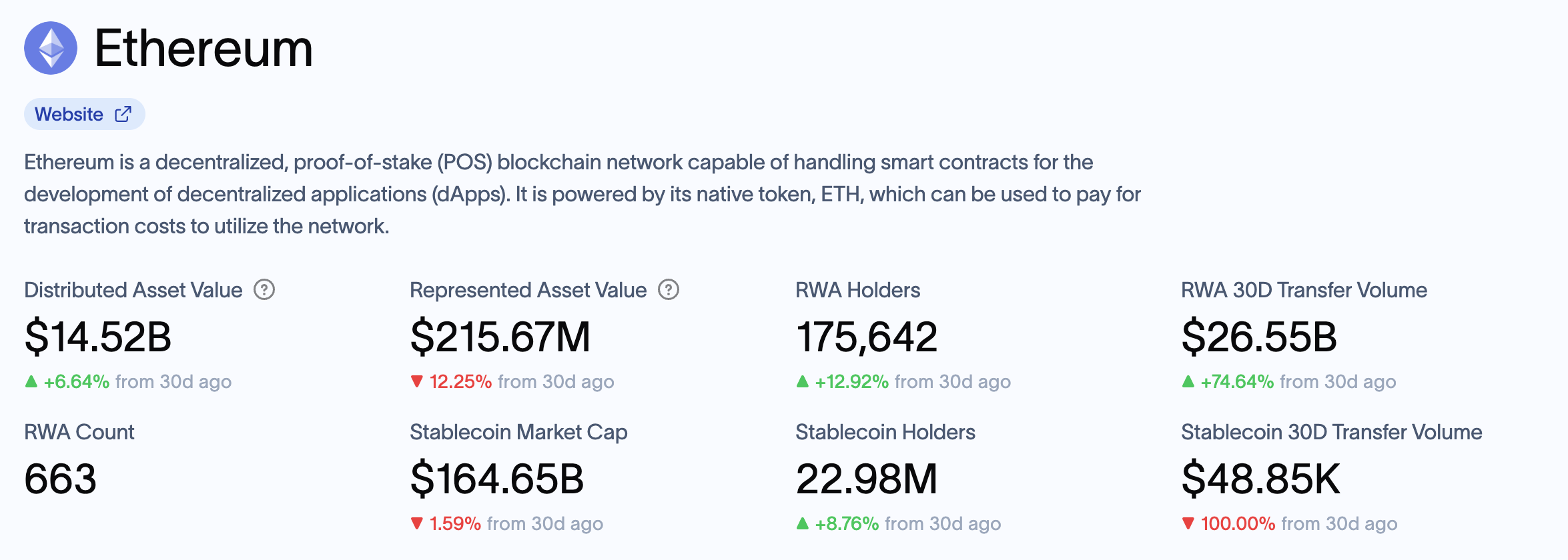
Image source: RWA.xyz As of mid-February 2026, the total value of RWA issued on the Ethereum chain has reached $14.52 billion
Supporting this massive ecosystem is the continuously expanding stablecoin market. Currently, the total market cap of stablecoins on the Ethereum mainnet exceeds $164.65 billion. These dollar-pegged digital assets provide excellent liquidity and settlement environments for tokenized assets.
Geoffrey Kendrick, Head of Digital Asset Research at Standard Chartered, pointed out that the widespread adoption of stablecoins creates ideal conditions for other asset classes to migrate onto the chain.
Data shows that Ethereum currently hosts about 661 different RWA tokens, with 175,642 holders. This reflects that traditional financial products are increasingly being adopted on blockchain, penetrating from institutional players to broader markets.
Wall Street giants deeply involved, BlackRock and JPMorgan’s on-chain strategies
The strong involvement of traditional financial giants is a key driver behind the continuous breakthroughs in the Ethereum RWA market. BlackRock, the world’s leading asset manager, launched the tokenized U.S. Treasury fund BUIDL in collaboration with Securitize in 2024, which has become a flagship product in this category. This fund, investing in short-term U.S. government securities, has grown into the largest tokenized money market instrument on a public blockchain infrastructure. Notably, BlackRock recently expanded BUIDL’s functionality by partnering with Uniswap Labs, allowing investors to trade directly on UniswapX, successfully integrating institutional capital with decentralized finance (DeFi) infrastructure.
Meanwhile, JPMorgan has also taken significant steps in the blockchain industry. In December 2025, the bank launched its first tokenized money market fund on Ethereum, initially targeting accredited investors with about $100 million. This move not only incorporates blockchain technology into JPMorgan’s core financial infrastructure but also sends a clear signal to the market: Yield-bearing tokenized products are gaining favor among mainstream finance. With the participation of these Wall Street gatekeepers, blockchain is gradually evolving into the new foundational layer supporting modern financial instruments.
Further reading
BlackRock partners with Uniswap! Opens on-chain trading of tokenized fund BUIDL, UNI surges 20%
JPMorgan accelerates RWA deployment, launches tokenized fund MONY, officially on Ethereum
From U.S. bonds to gold, diversified assets drive on-chain ecosystem transformation
Within the Ethereum RWA market, U.S. Treasury tokenization products occupy the core position, currently valued at about $5.3 billion. Following closely are commodities, mainly gold and oil, with a total value reaching $5.1 billion. Additionally, the private credit industry contributes approximately $2.4 billion in market share. These diversified asset classes together form the backbone of Ethereum’s tokenized finance ecosystem.
Recently, crypto trading giant Wintermute officially launched a tokenized gold trading service for institutional clients, offering algorithmic trading hedges for mainstream gold-backed tokens such as $PAXG and $XAUt, indicating a hot trend of on-chain commodities.
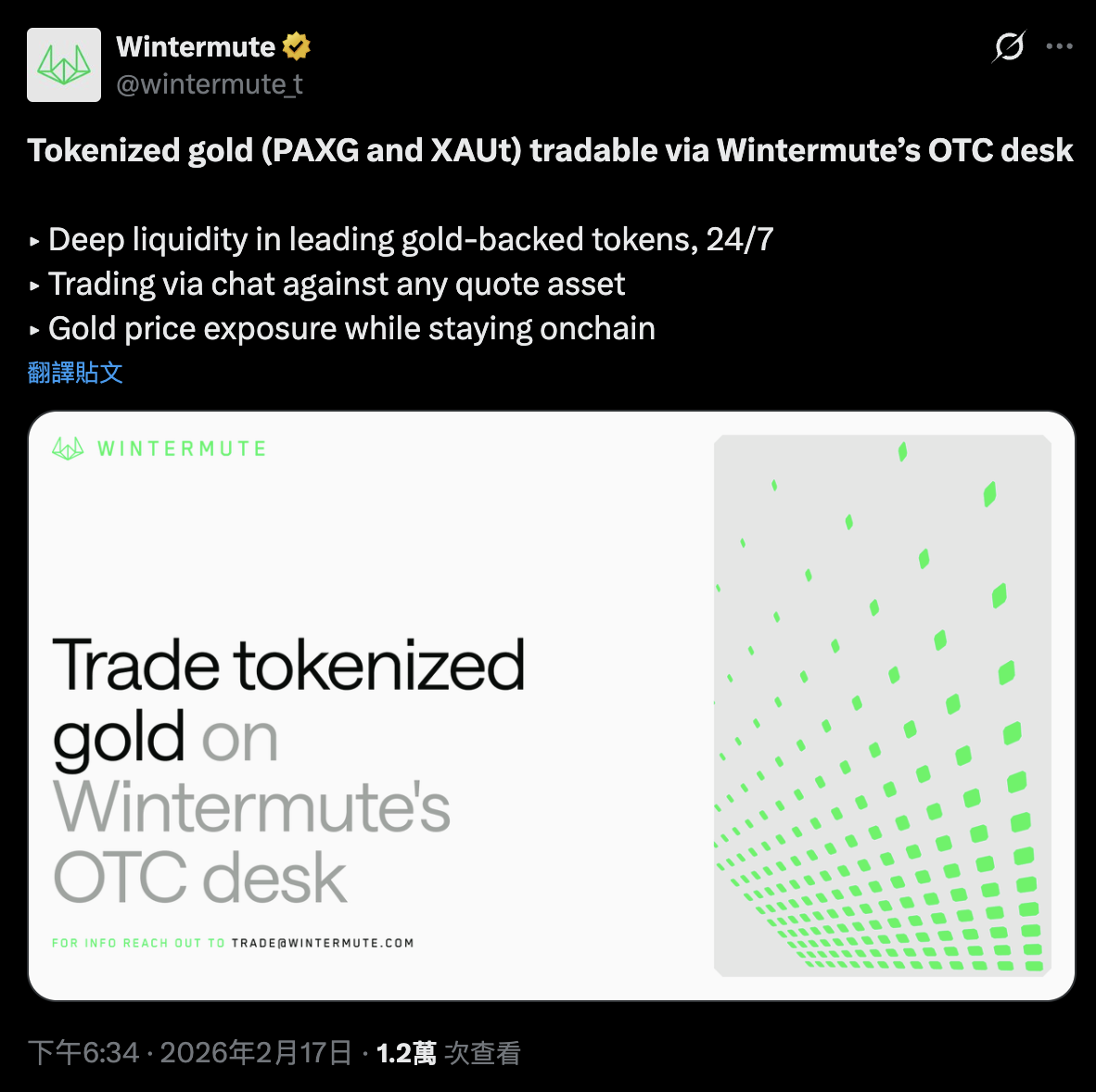
Image source: X/@wintermute_t Wintermute officially launched a tokenized gold trading service for institutional clients, providing algorithmic trading hedges for mainstream gold-backed tokens like $PAXG and $XAUt
Wintermute CEO Evgeny Gaevoy predicts that the tokenized commodities market could reach $15 billion by 2026 (about $5 billion in 2025). By converting physical assets into on-chain tokens, investors can enjoy 24/7 market access and use gold or bonds as collateral for on-chain lending, significantly reducing reliance on traditional intermediaries.
Looking ahead to 2028, trillion-dollar market transformation and opportunities
Faced with the rapid expansion of the RWA industry, major financial institutions are highly optimistic about the future prospects. Standard Chartered previously predicted that by 2028, the global tokenized real-world assets market could reach $2 trillion, with most issued on the Ethereum platform. The bank’s analysis suggests that tokenized money market funds and publicly listed stocks will lead the market, followed by real estate, private equity, and various derivatives. ARK Invest’s forecast is even more ambitious, estimating that by 2030, the total value of tokenized assets could rise to approximately $11 trillion.
This long-term trend indicates that traditional finance is accelerating its shift toward blockchain technology. With its robust ecosystem compatibility and security, Ethereum has become the preferred platform for enterprises to tokenize assets. The current market value of $14.5 billion is just the beginning. As regulatory environments become clearer and technological barriers lower, more traditional financial instruments will be transformed into transparent, traceable, and efficient digital assets. This revolutionary shift in financial infrastructure is expected to continue optimizing global asset liquidity and opening new avenues for investor profit in capital markets over the coming years.
Disclaimer: The information on this page may come from third parties and does not represent the views or opinions of Gate. The content displayed on this page is for reference only and does not constitute any financial, investment, or legal advice. Gate does not guarantee the accuracy or completeness of the information and shall not be liable for any losses arising from the use of this information. Virtual asset investments carry high risks and are subject to significant price volatility. You may lose all of your invested principal. Please fully understand the relevant risks and make prudent decisions based on your own financial situation and risk tolerance. For details, please refer to
Disclaimer.
Related Articles
The Ethereum Foundation uses it too! The CoW Swap frontend was hacked, and DeFi leaders advise revoking approvals
The Ethereum DeFi platform CoW Swap experienced DNS hijacking on April 14, which may put users at risk of phishing. Although the protocol itself was not compromised, the risk of frontend attacks remains high. The industry recommends that users revoke approvals before taking any future actions. CoW Swap offers batch transaction functionality and protects against MEV attacks, and its security incident may affect the entire DeFi ecosystem.
ChainNewsAbmedia2h ago
Bitmine promoted to the NYSE Main Board! Tom Lee: U.S. stocks may be at a bottom, and selling pressure on Ether could ease
Bitmine has officially moved from the NYSE American board to the main board in the U.S., marking an important milestone for the company. Despite a sharp drop in its share price, it has still increased its share repurchase program to $4 billion. The company holds a large amount of Ether (ETH), and expects that a rebound in the crypto market will help improve its assets and share price performance.
CryptoCity2h ago
ETH 15-minute drop of 0.72%: Large addresses transferring to and net outflows of funds from the main players triggered a sell-pressure resonance
2026-04-14 16:45 to 2026-04-14 17:00 (UTC), within the 15-minute window ETH’s return recorded -0.72%. The price range fluctuated from 2329.63 to 2351.42 USDT, with a swing of 0.93%. During this period, market capital outflows accelerated markedly, volatility intensified, market sentiment turned cautious, and attention rose rapidly.
The main driver of this anomaly is that on-chain large addresses (whales) centralized and transferred ETH to exchanges, releasing a large sell signal. The net outflow of funds from the main capital totaled as much as -61.80 million USD,
GateNews4h ago
ETH rose 1.06% in 15 minutes: global political stimulation and a coordinated boost to risk appetite and on-chain activity together drove the move
From 15:30 to 15:45 (UTC) on 2026-04-14, the ETH price range was 2340.75 to 2367.0 USDT. Within 15 minutes, the return rate reached +1.06%, and the amplitude was 1.12%. Market volatility intensified, and on-chain and social attention rose in tandem. Short-term trading activity increased significantly, and investor sentiment shifted to optimism.
The main driving force behind this market move is the direct impact of an international political event on risk appetite. The United States announced a blockade of the Strait of Hormuz in the Middle East region related to the White House, creating a stark contrast with peace signals reportedly coming from Iran, and it triggered uncertainty and panic sentiment in the market.
GateNews5h ago


