Bitcoin (BTC) has been stuck in a sideways range for two consecutive weeks, hovering between two key levels of $60,000 and $72,000. At the time of writing, BTC is trading around $68,000, with slight short-term recovery signals.
However, the overall market sentiment remains bleak as the fear index is at an extreme level. Despite major institutions continuing to adhere to a “buying” strategy despite temporary losses, the risk of sharp short-term volatility still exists and has not diminished.
Coin Photon warns that traders rushing to open long positions may fall into a “long squeeze” trap. This pressure comes from the increasing volume of highly leveraged long positions, amid a continued skew in the long/short ratio during the prolonged accumulation phase.
The ongoing developments could push the market into extreme tension — a familiar scenario often considered a necessary condition for forming a long-term bottom in the next cycle.
Bitcoin Has Not Yet Experienced a “Complete Purge”
For nearly three years, the Sales Pressure signal has almost disappeared from the on-chain picture, while Bitcoin’s price has remained steady above the realized price of $54,800. Notably, the number of days without strong network pressure has set a new record with 1,133 consecutive days, according to crypto analyst Axel Adler Jr.
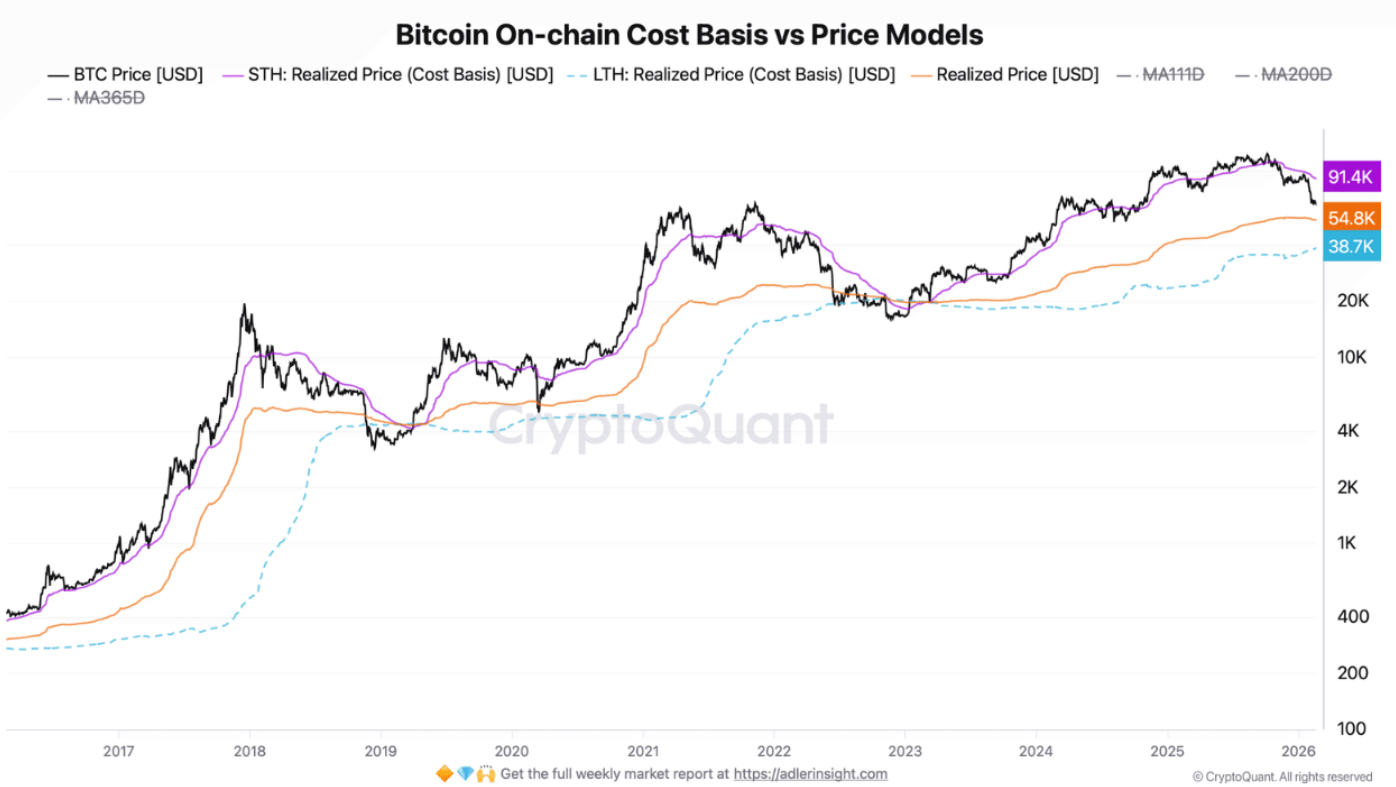 Source: Axel Adler Jr Insights He also points out three key on-chain cost thresholds that investors should pay close attention to:
- Short-term holder realized price: $91,400
- Network-wide realized price: $54,800
- Long-term holder realized price: $38,700
Among these, the $54,800 level acts as a “life or death” boundary for cycle risk assessment. If Bitcoin’s price decisively drops below this level, the market’s average position will turn into a loss, triggering the Sales Pressure indicator and signaling a phase of extreme network stress.
Currently, the market is still leaning toward a bearish trend. However, long-term holders are still in profit, and the extreme tension phase has not yet truly begun.
The $54,800 level thus becomes a high-risk but decisive zone — not only as a measure of network health but also as a region that has historically served as a crucial support in previous Bitcoin cycles.
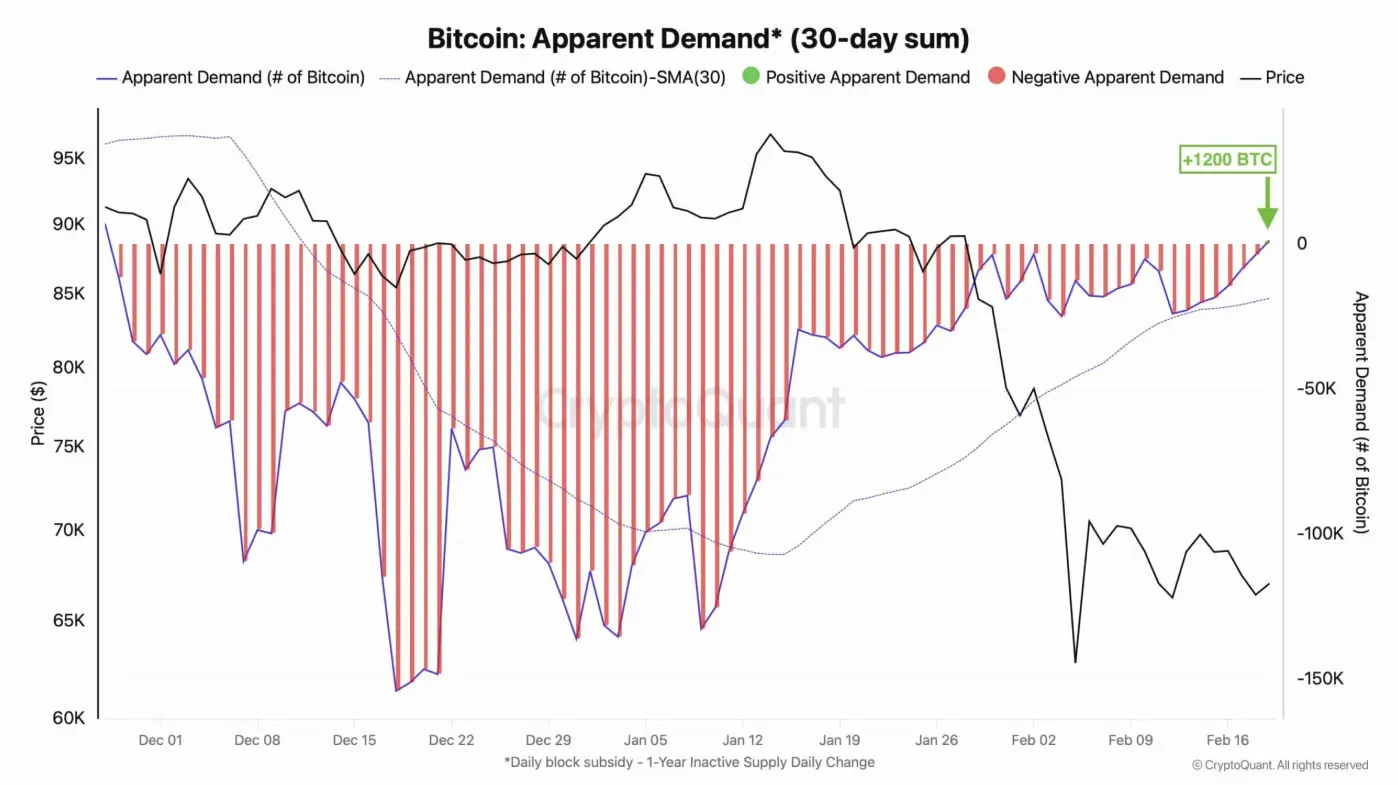 Source: Darkfost In another development, in a post on X, analyst Darkfost stated that monthly Bitcoin accumulation demand has returned to positive territory after nearly three months of weakness.
This is seen as an early signal that, despite long-term market challenges, structural accumulation forces have begun to strengthen enough to absorb new supply.
However, to confirm a sustainable recovery cycle for BTC, the market still needs several more weeks of positive monthly accumulation to reinforce the belief that a trend reversal has truly taken hold.
SN_Nour
Disclaimer: The information on this page may come from third parties and does not represent the views or opinions of Gate. The content displayed on this page is for reference only and does not constitute any financial, investment, or legal advice. Gate does not guarantee the accuracy or completeness of the information and shall not be liable for any losses arising from the use of this information. Virtual asset investments carry high risks and are subject to significant price volatility. You may lose all of your invested principal. Please fully understand the relevant risks and make prudent decisions based on your own financial situation and risk tolerance. For details, please refer to
Disclaimer.
Related Articles
Willy Woo: BTC's early decline was too rapid, and it is now creating conditions for a rebound to $85,000.
On March 8th, analyst Willy Woo pointed out that Bitcoin faced resistance near $75,000, but since mid-February, capital flows have been recovering, and market sentiment may shift toward risk appetite. Although there is a short-term rebound opportunity, in the long term, Bitcoin remains in the mid-stage of a bear market and may experience sideways consolidation and test resistance levels.
GateNews14m ago
Strategy: Purchased 48,000 BTC in the first two months of 2026, investing $4.3 billion
Bitcoin Treasury Company Strategy Director Chaitanya Jain revealed that in the first two months of 2026, approximately $4.3 billion was invested to purchase 48,000 Bitcoins, far exceeding the $300 million spent in all of 2022. Jain stated that this large-scale institutional buying will change the structure of the Bitcoin market.
GateNews15m ago
A newly created wallet deposits 2 million USDC into Hyperliquid to open short positions on BTC and ETH.
Gate News Report, March 8th: According to Onchain Lens monitoring, a newly created wallet deposited 2 million USDC into Hyperliquid, opened a 5x leveraged BTC short position and a 20x leveraged ETH short position, with the current position value approximately equivalent to 10 million USD.
GateNews47m ago
PI Network Price Jumps 15% as Volume Rises But $0.28 Holds the Real Answer - BTC Hunts
The post PI Network Price Jumps 15% as Volume Rises But $0.28 Holds the Real Answer appeared first on Coinpedia Fintech News
The PI Network price is suddenly back on traders’ radar this weekend. Not because it exploded into a massive rally but because something subtler is happening beneath the
BTCHUNTS1h ago
CryptoQuant Analyst: Bitcoin NUPL-MVRV indicator reaches 0.33, indicating that extreme selling conditions are moderating
Gate News Announcement, March 8 — CryptoQuant analyst Axel posted on X platform that Bitcoin may have entered the mid-stage of this bear market cycle. Data shows that the NUPL–MVRV harmonic composite indicator has reached 0.33, while historical cycle bottoms typically occur around the -0.5 level. The chart indicates that the start of the bear market cycle is trending upward, suggesting that extreme selling conditions are moderating. However, the indicator remains well above historical bottom levels, indicating that a full-scale market sell-off has not yet been confirmed.
GateNews1h ago
Bitcoin Investment: Data Shows No Profit for 3+ Years
Bitcoin (CRYPTO: BTC) has long carried a reputation for punishing late entrants, with double-digit drawdowns that test even patient investors. Yet a closer look at cycle-era history suggests that time, not timing, often determines whether red ink becomes green in the long run. Across
CryptoBreaking1h ago


