 Trusted Editorial content, reviewed by leading industry experts and seasoned editors. Ad Disclosure
Bitcoin core developer Matt Corallo used a fresh Blockstream announcement this week to push back on a familiar line in the quantum debate: that nobody serious is working on post-quantum cryptography for Bitcoin. The immediate trigger was Blockstream’s preview of OP_SHRINCSVERIFY, but the broader point was that the work did not appear out of nowhere; it sits on top of research that has already been published and debated in public.
Trusted Editorial content, reviewed by leading industry experts and seasoned editors. Ad Disclosure
Bitcoin core developer Matt Corallo used a fresh Blockstream announcement this week to push back on a familiar line in the quantum debate: that nobody serious is working on post-quantum cryptography for Bitcoin. The immediate trigger was Blockstream’s preview of OP_SHRINCSVERIFY, but the broader point was that the work did not appear out of nowhere; it sits on top of research that has already been published and debated in public.
Bitcoin’s Post-Quantum Critics Are Wrong
Corallo’s post was blunt: “And the Bitcoin fudsters keep trying to claim no one is working on PQC in Bitcoin…” Blockstream, in turn, framed Jonas Nick’s upcoming talk at OPNEXT 2026 (on April 16, 2026) around a specific technical artifact rather than a vague promise, saying, “He’ll be presenting on OP_SHRINCSVERIFY.” It described the proposal as “a new opcode enabling SHRINCS,” a construction aimed at 324-byte stateful post-quantum signatures with static backups.
Related Reading: Morgan Stanley Confirms Bitcoin Push: Trading, Yield, CustodyThe event lineup itself also reinforces Corallo’s point. Quantum is not a one-off mention tied only to Jonas Nick’s OP_SHRINCSVERIFY session. The main stage schedule also includes Alex Pruden of Project 11 speaking on “Quantum Bitcoin,” and later a “Quantum/Investor fireside” featuring Robert Mitchnick of BlackRock and David Duong of Coinbase.
In other words, post-quantum risk and the response to it are showing up repeatedly across both the technical and institutional sides of the program.
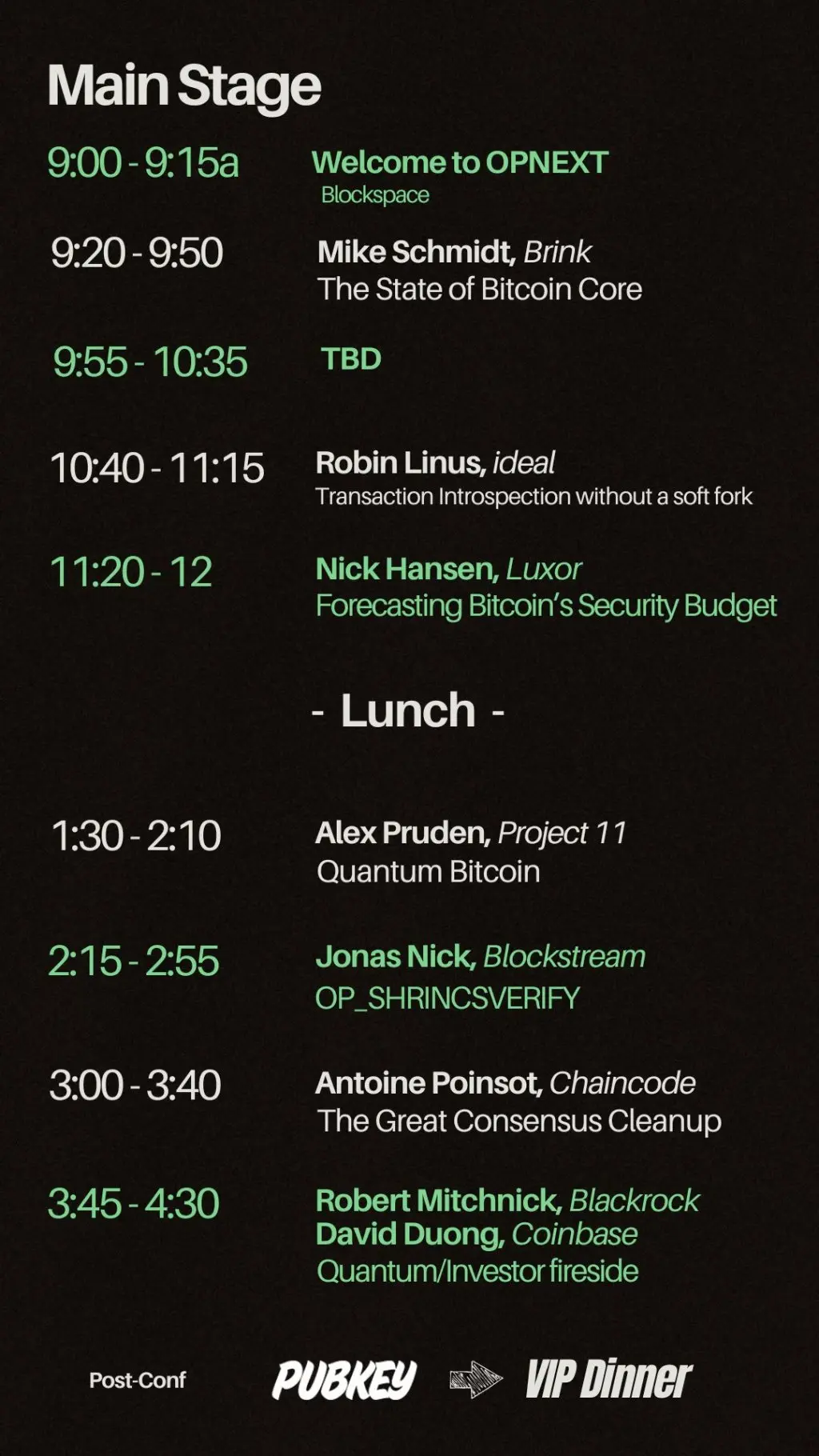 OPNEXT 2026 | Source: X @blockspaceThe subtext was hard to miss: whatever one thinks about Bitcoin’s quantum timetable, the claim that the problem is being ignored is increasingly difficult to sustain.
What SHRINCS Actually Is
Nick laid out SHRINCS in a December post on Delving Bitcoin as a hybrid hash-based signature design that combines a stateless scheme such as SPHINCS+ with a stateful scheme based on unbalanced XMSS. The design goal is to get the efficiency benefits of stateful signing when wallet state is intact, while keeping a stateless fallback available if that state is lost or a backup has to be restored.
In Nick’s words, the scheme is “extremely efficient when only a few signatures are required” and “can be backed up with a static seed.” Bitcoin Optech later summarized the same trade-off more plainly: cheaper normal-path signing, heavier fallback signing when state integrity is in doubt.
That efficiency claim is where the proposal gets interesting for BTC. Nick wrote that the normal-path SHRINCS signature size is min(292 + q·16, s_l) + 16, where q is the number of signatures already produced through the stateful path. For q = 1, that yields the now-circulating 324-byte figure, which he said is more than 11x smaller than the smallest NIST-standardized alternative, ML-DSA, in that setting.
Related Reading: Bitcoin’s Price Is Down 50% — Yet Adoption Has Never Been StrongerThe earlier paper by Nick and Mikhail Kudinov made the broader case for hash-based signatures in Bitcoin, arguing that they are attractive post-quantum candidates because their security reduces to hash assumptions, while keeping public keys small and verification cost per byte within a workable range.
None of that means Bitcoin suddenly has a settled post-quantum roadmap. Nick’s Delving post explicitly invited feedback, and the December mailing-list discussion raised unresolved questions about hardware performance, signature limits, wallet design, and whether Bitcoin should standardize stateful schemes alongside stateless ones. Bitcoin Optech also covered SHRINCS as part of ongoing consensus-change discussion, not as an adopted upgrade.
That is why Corallo’s jab matters. The more precise framing is not that BTC has solved post-quantum cryptography, but that the engineering work is already underway in public view, with concrete proposals, concrete trade-offs, and increasingly concrete opcodes attached to them.
For a debate that often swings between complacency and panic, OP_SHRINCSVERIFY is evidence of something more grounded: Bitcoin’s post-quantum discussion is no longer theoretical hand-waving, even if it is still very much a research problem.
At press time, BTC traded at $66,630.
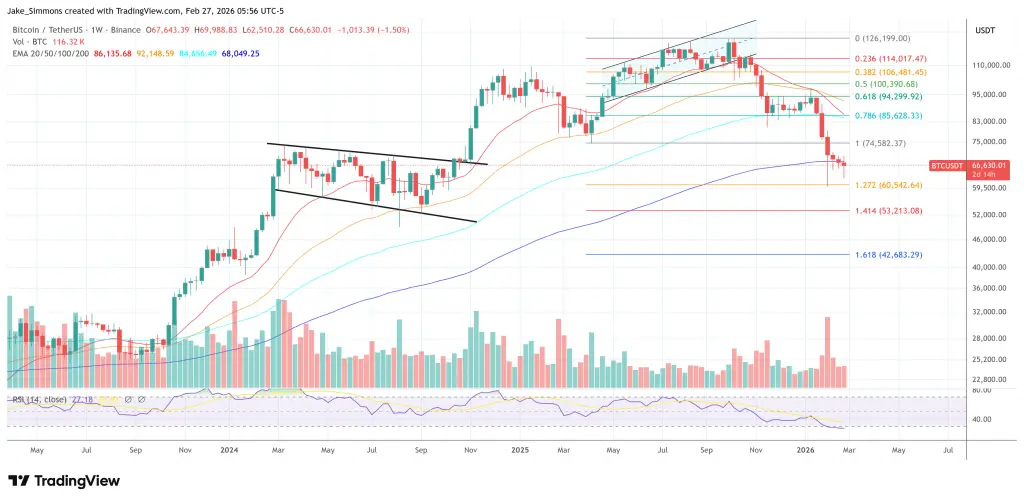 BTC must reclaim the 200-week EMA, 1-week chart | Source: BTCUSDT on TradingView.comFeatured image created with DALL.E, chart from TradingView.com
![]() Editorial Process for bitcoinist is centered on delivering thoroughly researched, accurate, and unbiased content. We uphold strict sourcing standards, and each page undergoes diligent review by our team of top technology experts and seasoned editors. This process ensures the integrity, relevance, and value of our content for our readers.
Editorial Process for bitcoinist is centered on delivering thoroughly researched, accurate, and unbiased content. We uphold strict sourcing standards, and each page undergoes diligent review by our team of top technology experts and seasoned editors. This process ensures the integrity, relevance, and value of our content for our readers.
Disclaimer: The information on this page may come from third parties and does not represent the views or opinions of Gate. The content displayed on this page is for reference only and does not constitute any financial, investment, or legal advice. Gate does not guarantee the accuracy or completeness of the information and shall not be liable for any losses arising from the use of this information. Virtual asset investments carry high risks and are subject to significant price volatility. You may lose all of your invested principal. Please fully understand the relevant risks and make prudent decisions based on your own financial situation and risk tolerance. For details, please refer to
Disclaimer.
Related Articles
Cango sells 2,000 BTC to repay debt, and a wave of miner liquidations accelerates, sweeping through the industry
Cango sold 2,000 bitcoins in March to repay a collateralized loan, reducing its holdings to 1,025.69 BTC, with debt of $30.6 million. This move is part of a comprehensive financial restructuring and strengthens the balance sheet through a $65 million equity investment and a $10 million convertible bond. Multiple miners in the industry are facing liquidation pressure, and are re-evaluating their strategies due to competition for AI resources, with expectations that by the end of 2026 AI revenue will account for 70% of miners’ revenue.
MarketWhisper10m ago
“Strategy” opposing order book: flattening and increasing BTC short positions by over $5.2 million; total open positions rise to $75.2 million
On April 9, Hyperinsight detected that address 0x94d3 increased its holdings by 81.06 BTC short positions. Its total position size is $75.2048 million, with an unrealized loss of approximately $1.8229 million, and it is currently the largest BTC short position on Hyperliquid. The address previously established a large BTC short position in reverse back in December of last year.
GateNews29m ago
In the past 24 hours, liquidations across the entire network totaled $232 million, with long liquidations accounting for over 60%.
Gate News, April 9, according to CoinAnk data, the total liquidation amount across the entire network over the past 24 hours reached $232 million. Of that, long liquidations totaled about $144 million, accounting for more than 60%; short liquidations totaled about $88.17 million. From the distribution by asset, the liquidation amount for Bitcoin was about $68.95 million, and the liquidation amount for Ethereum was about $35.32 million.
GateNews57m ago
Adam Back Denies Being Bitcoin Creator Satoshi Nakamoto After New York Times Investigation
British Bitcoin developer and Blockstream CEO Adam Back publicly denied on April 8, 2026 that he is Satoshi Nakamoto, the pseudonymous creator of Bitcoin, after a New York Times investigation by journalist John Carreyrou identified him as the strongest candidate to be the inventor of the digital currency.
CryptopulseElite1h ago
Bitcoin is hovering around the $700,000 level; if oil prices fall below $100 or push toward $80,000
Bitcoin has recently been trading in a high-level range. The price rebounded from $67,000 to $70,900, driven by a U.S.-Iran ceasefire agreement. Market analysis suggests that weakness in oil prices—or easing inflation pressure—may support Bitcoin’s upside. If it breaks above $72,500, it could trigger short liquidations and push the price up to $80,000. However, instability in the Middle East and a rebound in oil prices could act as a drag. Volatility in the energy market will be a key factor influencing Bitcoin’s direction.
GateNews1h ago
Chainalysis: By 2035, stablecoin transaction volume may reach 1.5 quadrillion USD, exceeding the scale of global cross-border payments
Blockchain analytics firm Chainalysis predicts that by 2035, stablecoin transaction volume will reach $71.9 trillion. If there are two major macro catalysts, it could double to $150 trillion, surpassing the current global cross-border payments market size. Analysts note that institutional participation will significantly increase activity.
GateNews1h ago


