Ethereum continues to maintain its position as the largest blockchain for stablecoin concentration and decentralized finance (DeFi) capital, despite the rise of faster networks.
In recent years, many new blockchains have promoted their superior transaction processing capabilities and low costs, raising questions about whether institutional funds might move away from Ethereum in the future.
Kevin Lepsoe, founder of ETHGas and former derivatives director at Morgan Stanley in Asia, believes Ethereum’s advantage will persist because financial institutions tend to prioritize capital depth over performance metrics.
He notes that while transactions per second (TPS) can excite engineers, they are not the decisive factor in where capital flows. According to Lepsoe, liquidity and stablecoin supply are mainly concentrated on Ethereum, and traditional finance (TradFi) always seeks the highest liquidity.
Institutional capital provides scale and stability to the blockchain ecosystem. Major asset managers and tokenized fund issuers deploy capital at a scale that increases liquidity and strengthens stablecoin supply. Their presence helps a network sustain a long-term position rather than relying on retail speculative waves that often surge during bull markets and decline when conditions worsen.
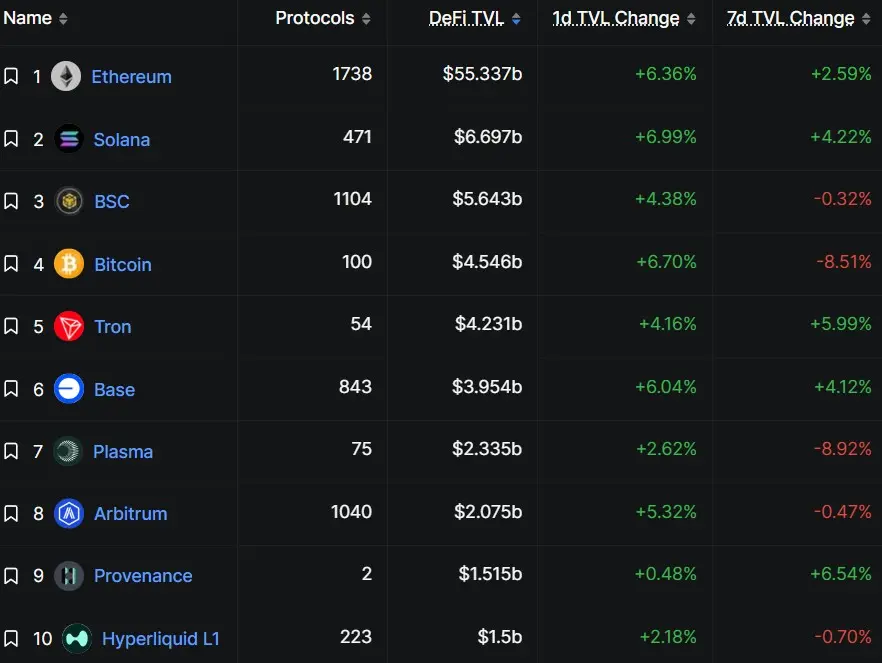
Liquidity Keeps Ethereum Ahead
If institutions prioritize operating in areas with existing large capital pools, building a faster blockchain alone isn’t enough to pull funds away from Ethereum.
In many previous cycles, performance became a key tool for attracting users. Solana emerged as a high-speed alternative to Ethereum and was dubbed the “Ethereum killer.” The network attracted many retail investors through NFT waves and memecoin fever, but that vibrancy was not sustainable.
Today, Solana also faces new “Solana killers” claiming even higher theoretical TPS. However, Ethereum’s liquidity advantage results in narrower spreads, lower slippage for large transactions, and the ability to absorb institutional-scale transactions without significant price volatility.
Lepsoe compares Ethereum to a city’s financial district. There may be markets in the suburbs with different prices or experiences, but if you need the deepest liquidity, the money will go to the center—and in today’s blockchain ecosystem, that’s Ethereum.
While previous cycles were mainly driven by retail speculation, the next phase is increasingly shaped by institutional capital. Financial institutions are paying more attention to practical applications like stablecoins and real-world assets (RWA) tokenization.
Even the world’s largest asset manager, BlackRock, is pushing RWA strategies. The USD Liquidity Fund (BUIDL)—a tokenized US government bond fund—initially launched on Ethereum before expanding to other blockchains. Currently, Ethereum accounts for over 30% of BUIDL’s market capitalization.
Ethereum is also the largest network by stablecoin market cap, with $160.4 billion according to DefiLlama. Samara Cohen, BlackRock’s global head of market development, states that stablecoins are becoming a bridge between traditional finance and digital liquidity.
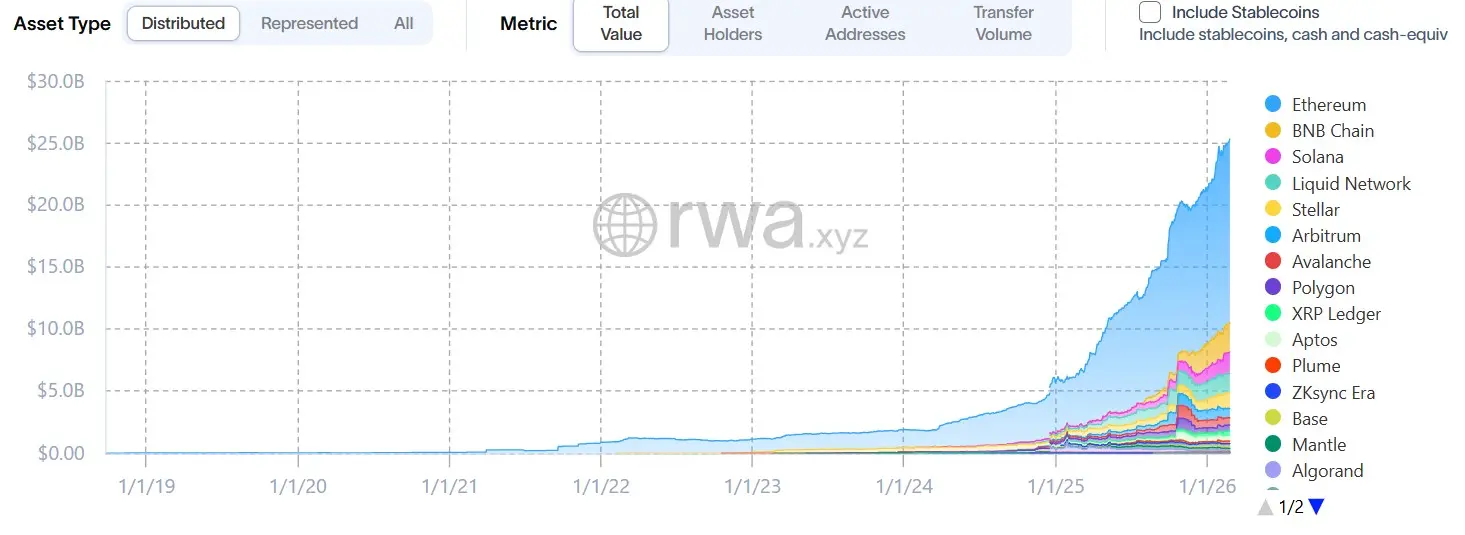 Ethereum is increasingly consolidating its leading position as the distribution layer for real-world assets (RWA), excluding stablecoins | Source: RWA.xyz## Restructuring to Strengthen Position
While liquidity is fundamental, technical performance cannot be overlooked. Ethereum has restructured to improve scalability. Transaction fees, which once soared to levels that made usage difficult, have been significantly reduced thanks to the development of layer 2 (L2) solutions. However, L2 also creates liquidity fragmentation across different environments.
According to Lepsoe, this fragmentation can be seen as “risk mitigation.” If L2s do not retain some liquidity within the Ethereum ecosystem, capital might flow to competing layer 1 blockchains and struggle to return.
Recently, Ethereum has shifted focus back to expanding layer 1. Co-founder Vitalik Buterin believes many L2s have not achieved the expected level of decentralization, while the main chain now has enough infrastructure to expand directly.
Ethereum plans to implement the Glamsterdam upgrade in 2026, increasing the gas limit per block from 60 million to 200 million, aiming for 10,000 TPS over time.
Alongside protocol upgrades, infrastructure providers are testing efficiency solutions. Lepsoe’s ETHGas focuses on improving block construction through off-chain processing mechanisms, while Psy Protocol uses zero-knowledge technology to bundle multiple transactions.
Marcin Kaźmierczak, co-founder of RedStone—an oracle data provider for tokenized assets and blockchain applications—believes Ethereum still holds an advantage due to its long operational history and proven reliability. Although institutions are expanding heavily into Ethereum, they also consider alternatives like Solana or Canton, especially when privacy is a priority.
However, Lepsoe emphasizes that he does not see significant threats from competitors, as Ethereum still has the deepest liquidity pool—an essential factor for large capital allocators.
In the blockchain market, speed can attract users during boom periods, but long-term capital tends to stay where the market is deep and liquidity is solid. Currently, that advantage still belongs to Ethereum.
Vương Tiễn
Disclaimer: The information on this page may come from third parties and does not represent the views or opinions of Gate. The content displayed on this page is for reference only and does not constitute any financial, investment, or legal advice. Gate does not guarantee the accuracy or completeness of the information and shall not be liable for any losses arising from the use of this information. Virtual asset investments carry high risks and are subject to significant price volatility. You may lose all of your invested principal. Please fully understand the relevant risks and make prudent decisions based on your own financial situation and risk tolerance. For details, please refer to
Disclaimer.
Related Articles
ETH 15-minute drop of 0.62%: Large funds withdrawing in size and ETF net outflows converging to amplify volatility
From 2026-04-05 12:30 to 12:45 (UTC), the ETH price range is 2022.11 to 2037.82 USDT. The 15-minute K-line return is -0.62%, and the amplitude is 0.77%. Against the backdrop of elevated on-chain activity, market attention has increased, volatility has picked up, and this reflects stronger short-term risk-averse sentiment.
The main driver behind this unusual move is that large funds have continued flowing out of exchanges. Data shows that in the past 24 hours, ETH net outflows were as high as -11,970.54 coins, and in the $1M-$10M range, large net outflows were -5
GateNews1h ago
10x Research: Tether’s USDT issuance on Ethereum surpasses Tron—ETH could become the main beneficiary of stablecoin growth
10x Research noted that over the past five years, Ethereum (ETH) has performed lackluster, with its price trading around $2,000, mainly due to weak on-chain activity leading to insufficient demand. After falling 57% from its 2025 peak, ETH’s current valuation remains low, while capital accumulation is still ongoing; USDT’s issuance has surpassed Tron, sparking discussion that ETH could become a leading beneficiary of stablecoin growth. Analysts are now re-evaluating ETH’s potential turning point.
GateNews2h ago
A certain address deposited 1,856 ETH to a certain CEX; if it sells, it will lose $1.89 million.
Gate News message, April 5, on-chain data shows that an address deposited 1,856 ETH into a certain CEX about 45 minutes ago, worth approximately $3.78 million. The address has held ETH for two months, including 1,450 ETH that was withdrawn from an exchange on January 18 when the price was $3,339.38. If sold, it would incur a loss of $1.89 million, with assets shrinking by 39%.
GateNews4h ago
Price predictions 4/3: BTC, ETH, BNB, XRP, SOL, DOGE, HYPE, ADA, BCH, LINK
Key points:
Buyers are attempting to maintain BTC above the $66,500 level, but several analysts believe that the $60,000 level may crack.
Some major altcoins risk breaking below their immediate support levels, signaling that bears remain in control.
Buyers are attempting to push an
Cointelegraph5h ago


