MrHow77

vip
Age 0.6 Yıl
Peak Tier 0
No content yet
#PolymarketBetsOnGlobalEvents
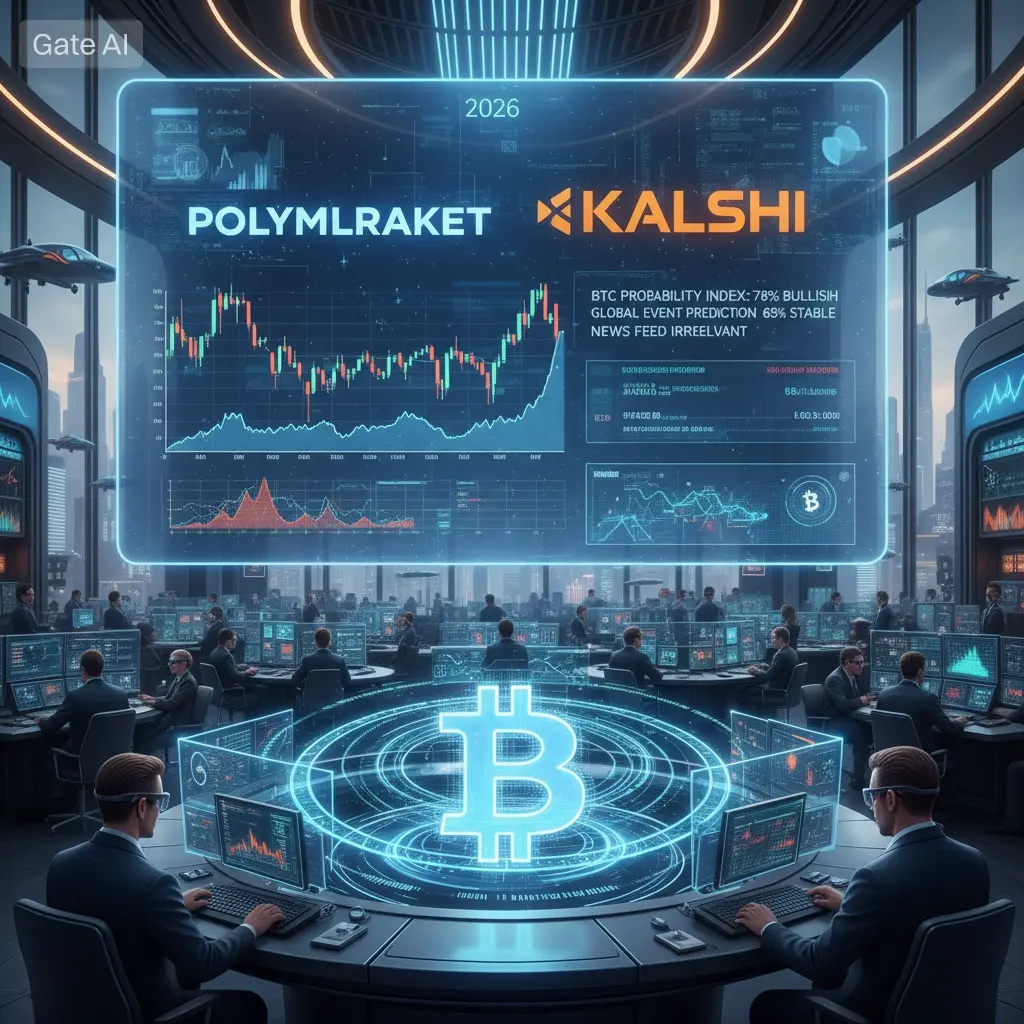
Polymarket has emerged as a game-changer in prediction markets, bridging the worlds of crypto, finance, geopolitics, and even pop culture. Unlike traditional trading platforms, it allows users to trade on the outcomes of real-world events using the stablecoin USDC. This is not mere gambling — each bet represents a financially-backed probability estimate, capturing the collective wisdom of a crowd willing to put money where their belief lies.
What Is Polymarket?
Polymarket is the world’s largest decentralized prediction market, operating on the Polygon blockchain.
HighAmbitionvip
#PolymarketBetsOnGlobalEvents
Polymarket has emerged as a game-changer in prediction markets, bridging the worlds of crypto, finance, geopolitics, and even pop culture. Unlike traditional trading platforms, it allows users to trade on the outcomes of real-world events using the stablecoin USDC. This is not mere gambling — each bet represents a financially-backed probability estimate, capturing the collective wisdom of a crowd willing to put money where their belief lies.
What Is Polymarket?
Polymarket is the world’s largest decentralized prediction market, operating on the Polygon blockchain. Instead of buying or selling cryptocurrencies, participants engage in YES or NO markets, wagering on whether an event will happen or not. For example, a market might ask: “Will Iran’s regime collapse by June 2026?” When users buy shares for YES or NO, they are essentially staking their belief in a real-world outcome. The price of each share, which ranges from $0.01 to $1.00, represents the probability the crowd assigns to that outcome.
Winning bets resolve at $1.00, while losing bets expire worthless. Settlement is trustless and transparent, handled by decentralized oracles via the UMA Protocol. This structure ensures full accountability, as every transaction is recorded on-chain, preventing manipulation or censorship. In essence, Polymarket turns collective insight into actionable, financially incentivized forecasts.
How Users Engage With Events
Polymarket covers an extraordinary range of events. Users can place bets on political outcomes, geopolitical conflicts, financial and crypto markets, sports results, and even cultural or technological developments.
Politics: Polymarket has accurately predicted U.S. presidential elections, including Trump’s 2024 win weeks before conventional polls reflected it. It also tracks upcoming elections, such as the 2028 U.S. presidential race, Venezuelan leadership changes, the French 2027 presidential election, and Russian parliamentary elections.
Geopolitics and War: Users can bet on highly sensitive topics, such as whether Israel will launch a ground offensive in Lebanon, or the likelihood of the U.S. engaging in a conflict with Iran. Polymarket has also hosted markets on airstrikes, with payouts raising both ethical and regulatory debates, such as one user winning $200,000 by predicting the date of an Israeli strike. Nuclear conflict probabilities are also represented, highlighting the platform’s unprecedented ability to quantify geopolitical risk.
Crypto and Finance: Markets include Bitcoin price targets by year-end, ETH milestones, S&P 500 movements, commodity price forecasts, and Federal Reserve interest rate decisions. By tracking the crowd’s betting patterns, users gain insight into how retail and institutional sentiment perceives financial risks.
Sports and Culture: Polymarket tracks outcomes like UEFA Champions League winners, NBA MVPs and finals results, English Premier League title races, and Stanley Cup champions. Pop culture and tech markets include predictions on Elon Musk’s tweet counts, AI developments, celebrity verdicts, and tech product launches, providing a window into societal expectations and trends.
The platform’s diversity makes it not just a prediction market, but a global barometer of sentiment, reflecting opinions, fears, and expectations across a spectrum of human activity.
Why Polymarket Is More Reliable Than Polls or Experts
Traditional polls and expert forecasts have well-known limitations: they capture opinions without consequences and often fail to anticipate real-world outcomes. Polymarket is fundamentally different because it requires users to put real money on the line. This financial accountability filters out noise, incentivizes accuracy, and creates probability signals that are often more predictive than polls or expert commentary.
For example, Polymarket’s prediction of Trump’s 2024 victory predated mainstream poll adjustments, illustrating the wisdom-of-crowds effect. In other words, financial risk aligns participant incentives with truth, making the resulting probabilities a powerful indicator of real-world expectations.
Growth, Scale, and Global Adoption
Polymarket’s growth trajectory has been remarkable. By late 2025, cumulative trading volume exceeded $10 billion, with over 314,000 active traders worldwide. Partnerships with platforms like Twitter (now X) have expanded visibility, while the platform’s CFTC registration in the U.S. ensures legal compliance for American users. Sports markets have overtaken politics in daily volume, and institutional interest is rising, as traders recognize Polymarket as a source of real-time sentiment data across multiple sectors.
This growth demonstrates that prediction markets are no longer niche; they are becoming mainstream instruments for understanding probability, risk, and collective expectations.
Risks and Controversies
Despite its prominence, Polymarket carries significant risks and has been subject to controversies.
Insider Trading Concerns: High-profile wins, such as the $200,000 payout on an Israeli airstrike or $400,000 on Venezuelan political shifts, have raised questions about whether some traders may have had access to privileged information.
Regulatory Issues: In 2022, the CFTC fined Polymarket $1.4 million for running unregistered markets, temporarily blocking U.S. users. Re-entry came only after achieving proper regulatory compliance, highlighting the challenges of operating a global prediction platform.
Ethical Debates: Markets on war, death, and nuclear conflict spark moral criticism, with some labeling these markets as “gambling on human suffering.” These discussions emphasize that financial incentives can collide with ethical considerations.
Market Manipulation Risk: Like any market, large traders or “whales” can influence odds with sizable bets, potentially misleading smaller participants. Savvy users must understand liquidity dynamics and manage their risk accordingly.
Comparing Polymarket With Competitors
Polymarket’s main rival is Kalshi, a centralized, fully CFTC-regulated derivatives market. While Kalshi focuses on compliance and U.S.-based participation, Polymarket leverages decentralization, global access, and crypto transparency. Polymarket’s volume is larger on a global scale, and its permissionless nature allows markets to be created and traded instantly, unlike Kalshi’s more regulated approach. Both platforms demonstrate that prediction markets can aggregate information more effectively than traditional punditry, though through different mechanisms.
Strategic Insights for Traders and Analysts
Polymarket is more than a curiosity — it can inform trading, investing, and risk strategy:
Sentiment as a Signal: Markets often move before mainstream news outlets report events. Traders can use Polymarket as an early indicator of market sentiment.
Probability-Based Hedging: Betting odds provide a numeric probability of outcomes, which can be used to hedge positions in crypto, equities, or other assets.
Portfolio Diversification: Engaging across multiple event types—political, financial, sports, tech—spreads risk and exposure.
Macro Insights: Changes in Polymarket markets frequently reflect macroeconomic expectations, allowing traders to anticipate liquidity shifts and volatility spikes.
By studying the flow of bets, patterns emerge that mirror real-world risk assessments, making Polymarket a unique tool for professionals and enthusiasts alike.
Conclusion
Polymarket sits at the intersection of information, finance, and human behavior. It transforms opinion into actionable probability, creating a decentralized, real-time forecast of global events. While ethical questions and regulatory risks remain, the platform’s influence is undeniable.
For traders, analysts, and market watchers, Polymarket provides a lens into the collective mind of informed participants. By studying its markets, users can anticipate shifts in sentiment, assess probabilities with financial incentives backing them, and make more informed decisions.
Whether you see Polymarket as a forecasting tool or a high-stakes gambling platform, it has reshaped how people process uncertainty and price risk in real time. Its relevance spans politics, finance, sports, technology, and culture, making it an essential resource for anyone tracking global events.
Bottom Line: Polymarket is more than betting; it is a global probability engine, offering insights that often precede mainstream reporting, enabling users to understand not just what may happen, but how the world collectively perceives what will happen.

repost-content-media
  • Reward
  • Comment
  • Repost
  • Share
#Web3SecurityGuide
Web3 Security Guide — Simple Overview & Market Insights
Web3 security is all about protecting blockchain apps, smart contracts, and wallets from hacks, errors, and mistakes. Unlike traditional systems, there’s no central authority to reverse transactions, so strong security is essential.
Why it matters: In 2025 alone, billions were lost due to security issues. Securing your crypto holdings and projects helps build trust, attract users, and stabilize markets.
Key Areas of Web3 Security
1. Smart Contracts
Smart contracts are automated programs that run on blockchain. Bugs or
HighAmbitionvip
#Web3SecurityGuide
Web3 Security Guide — Simple Overview & Market Insights
Web3 security is all about protecting blockchain apps, smart contracts, and wallets from hacks, errors, and mistakes. Unlike traditional systems, there’s no central authority to reverse transactions, so strong security is essential.
Why it matters: In 2025 alone, billions were lost due to security issues. Securing your crypto holdings and projects helps build trust, attract users, and stabilize markets.
Key Areas of Web3 Security
1. Smart Contracts
Smart contracts are automated programs that run on blockchain. Bugs or mistakes can cause losses. Common issues include errors in logic, access controls, and calculation mistakes. Solution: Audit all contracts with trusted firms before launching.
2. Wallet Security
Protect your private keys and seed phrases. Use hardware wallets for long-term storage, enable two-factor authentication, and never share sensitive information. Managing approvals regularly reduces risk
3. Protocol & Bridge Security
Protocols and bridges connect different blockchain networks. Mistakes can lead to losses. Regular code audits, testing, and monitoring help prevent vulnerabilities.
4. User Practices
Always verify contracts before interacting, avoid blindly signing transactions, and use separate wallets for different purposes. Education and careful behavior prevent most losses.
5. Auditing & Monitoring
Security audits check code for errors. Automated tools and AI can detect unusual activity early. Ongoing monitoring is crucial to ensure systems remain safe.
Impact on the Crypto Market
Immediate Impact: Security issues can lead to sudden drops in token prices and reduce confidence in affected projects.
Long-Term Impact: Projects with strong security attract more investors and users. Secure systems help crypto markets grow steadily and reduce panic-driven volatility.
Core Principles
Audit Everything: Review all code before launch.
Assume Risks: Prepare for potential problems.
Least Access: Give only necessary permissions to contracts and wallets.
Multiple Layers: Use several security measures, not just one.
Education: Users and developers must know basic security best practices.
Bottom Line
Web3 security is the foundation of a safe crypto ecosystem. Proper audits, hardware wallets, secure protocols, and informed user practices protect funds and build trust. The future growth of crypto depends on how secure the systems are, not just token prices.
repost-content-media
  • Reward
  • Comment
  • Repost
  • Share
#加密市场回涨
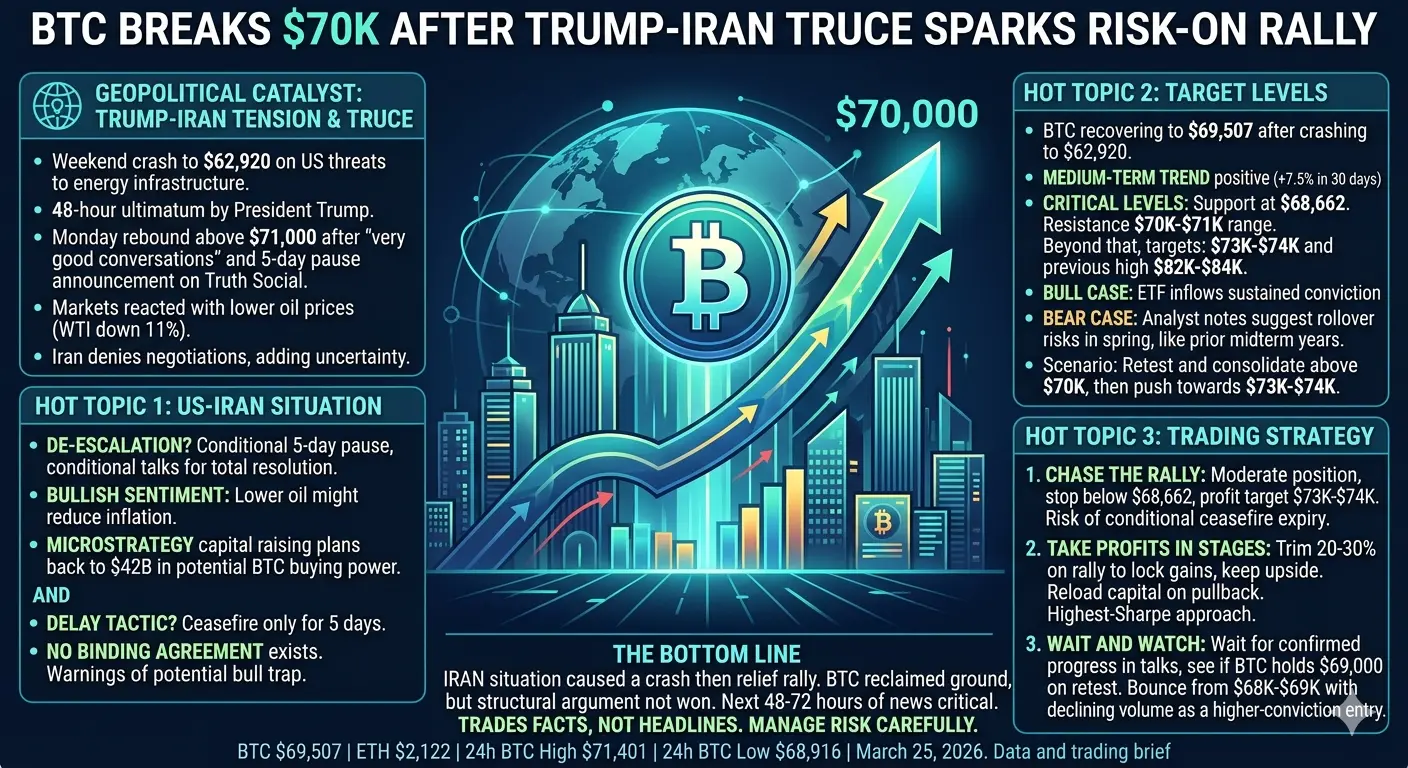
BTC Breaks $70K as Trump-Iran Truce Sparks Risk-On Rally — Real Reversal or Bull Trap?
Market Pulse | Gate Plaza | March 24–26, 2026
The weekend started ugly for crypto markets. On Saturday, March 22, President Trump issued a 48-hour ultimatum to Iran, demanding the reopening of the Strait of Hormuz or threatening direct U.S. military strikes on Iranian power plants and energy infrastructure. BTC responded violently, flashing down from the $70K range to $62,920, triggering $299 million in liquidations across the market, with 85% hitting long positions. Bulls were caught completely off
BTC1,82%
ETH3,89%
HighAmbitionvip
#加密市场回涨
BTC Breaks $70K as Trump-Iran Truce Sparks Risk-On Rally — Real Reversal or Bull Trap?
Market Pulse | Gate Plaza | March 24–26, 2026
The weekend started ugly for crypto markets. On Saturday, March 22, President Trump issued a 48-hour ultimatum to Iran, demanding the reopening of the Strait of Hormuz or threatening direct U.S. military strikes on Iranian power plants and energy infrastructure. BTC responded violently, flashing down from the $70K range to $62,920, triggering $299 million in liquidations across the market, with 85% hitting long positions. Bulls were caught completely off-guard.
By Monday, March 23, everything flipped. Trump announced on Truth Social that, after “two days of very good and productive conversations” with Iran, the U.S. military was instructed to postpone all strikes for five days, conditional on ongoing talks. Global markets reacted instantly: oil prices erased their war premium, with WTI crude dropping 11% and Brent crude down 8%, while U.S. equities rallied sharply. BTC surged 5%, breaking above $71,000 at the session high. However, Tehran officially denied any negotiations had occurred, adding uncertainty and explaining why the market is at a crossroads. BTC is currently trading around $69,507, slightly off the $71,401 high, with 24-hour spot volume exceeding $705 million.
US-Iran Situation — “Peace Deal” or Just a Delay Tactic?
This is the key question: the rally is built on a geopolitical foundation that may not be solid.
Arguments for genuine de-escalation: Trump explicitly mentioned “talks regarding a complete and total resolution of hostilities in the Middle East,” unusually specific language for posturing. Oil markets reacted convincingly, with an 11% drop in WTI, signaling that large institutional players priced a real reduction in conflict probability. Trump has economic incentives to de-escalate — lower oil could reduce inflation and be a political win. Institutional sentiment remains supportive: MicroStrategy increased its capital-raising plans back to $42 billion in potential BTC buying power.
Arguments for delay tactic: Iran’s flat denial of negotiations is a massive red flag. The ceasefire lasts only five days — no binding agreement or treaty exists. Analysts, including Mohamed El-Erian of Allianz, warn that it is still unclear whether this is political posturing or legitimate de-escalation. Historically, Trump’s ultimatums followed by short pauses do not guarantee lasting peace.
Analysis: This appears to be a conditional de-escalation — enough to drive a relief rally but fragile. A single news headline could reverse the move. The market is not pricing in peace; it is pricing in a temporary five-day pause. Traders should act accordingly.
Target Levels — Where Does This Bounce End?
Looking at the structure and price action provides clarity. BTC crashed to $62,920 on the war scare, then recovered to $69,507, with a 24-hour high of $71,401. The 7-day change is -2.4%, showing recovery without a clear new leg higher. The 30-day change is +7.5%, suggesting the medium-term trend remains positive.
Critical support and resistance: $68,662 is the “do not lose” support; failure here risks turning this move into a wick rather than a breakout. The $70,000–$71,000 range is current resistance, requiring a confirmed close above for genuine strength. Beyond that, $73,000–$74,000 aligns with prior local highs and is the short-term target flagged even before the Iran catalyst. The $82,000–$84,000 zone, BTC’s 2025 all-time high, would confirm a structural bull impulse rather than a temporary relief bounce.
Bear case: Analyst Benjamin Cowen notes that BTC in midterm years often forms a local low in February, rallies in March, and then rolls over in spring. If history repeats, the $70K–$74K zone could trap late buyers before a move back toward $60K or lower.
Bull case: The recovery from $62,920 was supported by sustained institutional ETF inflows, not just short-covering. Institutions stepping in during a fear-driven dip signals medium-term conviction.
Scenario: BTC may retest and consolidate above $70K over the next 48–72 hours. Holding this level opens the door for a push toward $73,000–$74,000. Failing to reclaim $70K firmly may result in a retest of $68,662 and potentially $66,000–$67,000 support.
Trading Strategy — Chase, Trim, or Wait?
There is no universal answer, but consider each approach:
Chasing the Rally (Aggressive Bullish): Works if the Iran talks hold for the five-day window AND BTC closes a daily candle above $70,500. Risk: buying after a 5%+ move based on a ceasefire Iran denies. Suggested approach: moderate position size, stop below $68,662, profit target $73K–$74K, do not hold blindly through Iran news expiry.
Taking Profits in Stages (Disciplined): Highest-Sharpe approach. If you held through the $62,920 crash, trimming 20–30% now locks gains while keeping upside exposure. Freed capital can reload if BTC pulls back to $67,000–$68,000. The 90-day return remains -20.3%, reminding us the broader macro trend has not reversed fully.
Holding Cash and Waiting (Patient): If you missed the dip, waiting is sensible. Watch two things: (1) whether Iran and the U.S. confirm real negotiation progress, (2) whether BTC holds above $69,000 on a retest. A clean bounce from $68,000–$69,000 with declining volume is a higher-conviction entry than chasing the peak.
The Bottom Line
The Iran situation caused a fear-driven crash to $62,920 followed by a sharp relief rally. BTC has reclaimed ground but has not won the structural argument. The next 48–72 hours of geopolitical news will determine whether this becomes a sustained breakout or a classic bull trap. Trade facts, not headlines, manage risk carefully, and remember: the market will always provide multiple opportunities.
Current data (March 25, 2026): BTC $69,507 | ETH $2,122 | 24h BTC High $71,401 | 24h BTC Low $68,916
repost-content-media
  • Reward
  • Comment
  • Repost
  • Share
#BTCBreaks$71000
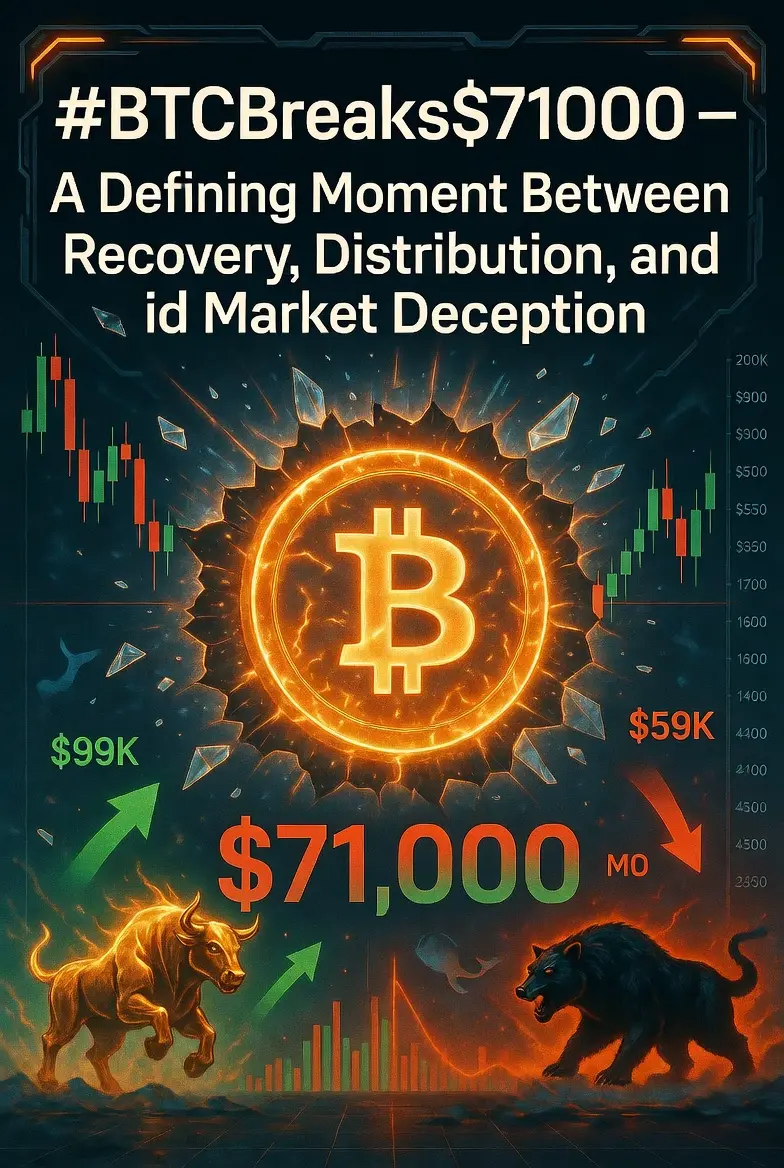
#BTCBreaks$71000 — A Defining Moment Between Recovery, Distribution, and Market Deception
Bitcoin reclaiming the $71,000 level is not just another headline — it is a high-stakes structural battle unfolding in real time, where price, psychology, liquidity, and macro forces are colliding to determine the next major directional move. What makes this moment particularly important is not just the level itself, but the context in which it has been reached — a market that has recently endured deep pain, aggressive deleveraging, and a broad reset in expectations. These conditions oft
BTC1,82%
HighAmbitionvip
#BTCBreaks$71000
#BTCBreaks$71000 — A Defining Moment Between Recovery, Distribution, and Market Deception
Bitcoin reclaiming the $71,000 level is not just another headline — it is a high-stakes structural battle unfolding in real time, where price, psychology, liquidity, and macro forces are colliding to determine the next major directional move. What makes this moment particularly important is not just the level itself, but the context in which it has been reached — a market that has recently endured deep pain, aggressive deleveraging, and a broad reset in expectations. These conditions often give birth to powerful trends, but they can just as easily produce some of the most convincing traps in financial markets.
After collapsing from the euphoric mid-$90K region down to $59K, Bitcoin did not simply lose value — it shook out confidence across the entire ecosystem, forcing retail participants out, compressing leverage, and resetting sentiment from extreme greed to cautious neutrality. Now, as price pushes back above $71K, the market finds itself at a crossroads where every participant — from short-term traders to long-term investors — is forced to reassess positioning, bias, and conviction.
📊 Market Structure — More Than Just a Price Bounce
At a surface level, Bitcoin’s recovery appears constructive, with gradual higher lows forming and downside momentum slowing. However, a deeper structural analysis reveals that this is not yet a confirmed trend reversal, but rather a transitional phase — a zone where accumulation, distribution, and speculative positioning overlap.
Price is currently interacting with a historically sensitive region that previously acted as both support and resistance, making it a decision-making zone for large players. In such areas, markets tend to behave unpredictably because liquidity is dense, stop orders are clustered, and both sides of the market are actively engaged.
This is why the current move feels “uncertain” despite being bullish on paper — because structurally, the market is still seeking direction, not confirming it.
⚠️ The $71K Zone — A Battlefield of Liquidity and Intent
The significance of $71K extends far beyond technical resistance; it represents a psychological anchor for market participants who experienced the recent drawdown.
For traders who bought near previous highs, this level represents:
A chance to exit at reduced loss
A point of emotional relief
A natural selling pressure zone
For new buyers, it represents:
A breakout opportunity
A momentum trigger
A signal of strength
This dual interpretation creates friction, and friction creates volatility.
Markets do not move cleanly through such zones — they fight through them, often producing fake breakouts, sharp wicks, and sudden reversals designed to exploit positioning on both sides.
📉 Compression Dynamics — The Calm Before Expansion
One of the most critical — yet underappreciated — aspects of the current setup is the volatility compression taking place within a wedge-like structure.
When price begins to tighten and range narrows, it signals that:
Buyers are no longer aggressively chasing
Sellers are no longer dominating
Energy is being stored for a larger move
Historically, these phases act as launchpads for expansion, not endpoints.
However, the key insight here is that compression does not predict direction — it guarantees movement.
This is exactly why similar setups in late 2025 and early 2026 resulted in sharp, unexpected drops. The market used low volatility as a disguise before delivering high-impact moves.
🧠 Behavioral Finance — Understanding the Crowd at $71K
Markets are driven as much by emotion as by data, and right now, sentiment is deeply divided — which is often a precursor to major moves.
There is a growing sense of cautious optimism among bulls, who interpret the recovery as evidence that the market has already priced in worst-case scenarios. They see the recent rally as the early stage of a broader continuation trend, supported by stronger hands replacing weaker ones.
At the same time, bears remain unconvinced. From their perspective, this rally lacks the volume, urgency, and macro confirmation needed to justify a sustained uptrend. To them, this looks like a classic relief rally, designed to pull liquidity back into the market before another downward move.
What makes this environment particularly complex is that both interpretations are supported by valid data — which means the market is not yet ready to reveal its true direction.
🌍 Macro Overlay — The Invisible Hand Guiding Price
Bitcoin’s movement cannot be isolated from the broader macro environment, which continues to play a decisive role in shaping liquidity and risk appetite.
Recent geopolitical developments have introduced a temporary sense of stability, reducing fear-driven capital flight and allowing risk assets to recover. However, this stability remains fragile, and any sudden escalation could quickly reverse sentiment.
At the same time, shifting expectations around interest rates continue to influence global liquidity conditions. Even subtle changes in rate outlooks can have disproportionate effects on crypto markets, as they directly impact capital flows, risk tolerance, and speculative behavior.
In addition, the aftermath of the recent selloff has created a cleaner market structure, where excessive leverage has been removed and positioning is more balanced. This type of reset is often necessary before sustainable trends can emerge — but it does not eliminate the possibility of further volatility.
📊 Scenario Mapping — What Comes Next?
🟢 Bullish Continuation Path
If Bitcoin successfully stabilizes above $71K and transforms it into a support level, it would signal that buyers have regained control of the market. This would likely trigger:
Increased confidence
Momentum-based buying
Re-entry of sidelined capital
In such a scenario, price could gradually expand toward higher resistance zones, with $76K, $80K, and $84K acting as key targets. More importantly, this would confirm that the recent correction was part of a broader bullish structure rather than the beginning of a prolonged downturn.
🔴 Bearish Rejection Path
On the other hand, if Bitcoin fails to maintain strength above $71K and begins to lose momentum, it would indicate that the breakout lacked conviction. This could lead to:
Long liquidations
Renewed selling pressure
A shift back toward defensive positioning
Under this scenario, price may revisit lower support levels, with $65K and $60K acting as initial downside targets, and a deeper move toward $55K remaining a possibility if bearish momentum accelerates.
⚡ The Core Insight — Timing Over Direction
Perhaps the most important takeaway in this environment is that being early is often indistinguishable from being wrong.
Markets in compression phases are designed to create uncertainty, shake out conviction, and punish overconfidence. This is why disciplined traders focus less on predicting direction and more on waiting for confirmation.
The real opportunity is not in guessing the breakout — it is in recognizing it once it happens and aligning with it.
💡 Strategic Perspective
This is not a moment for emotional decision-making or impulsive trades. It is a moment for:
Observing price behavior at key levels
Monitoring volume and momentum
Letting the market reveal its intent
Because ultimately, strong trends do not require anticipation — they provide confirmation.
🎯 Final Conclusion
Bitcoin at $71K is not a victory — it is a test of strength, patience, and conviction.
What happens here will likely define:
The next major trend
Market confidence in Q2
The positioning of both retail and institutional players
The breakout may look convincing.
The structure may look promising.
But until the market proves itself, uncertainty remains the dominant force.
repost-content-media
  • Reward
  • Comment
  • Repost
  • Share
#Gate广场AI测评官
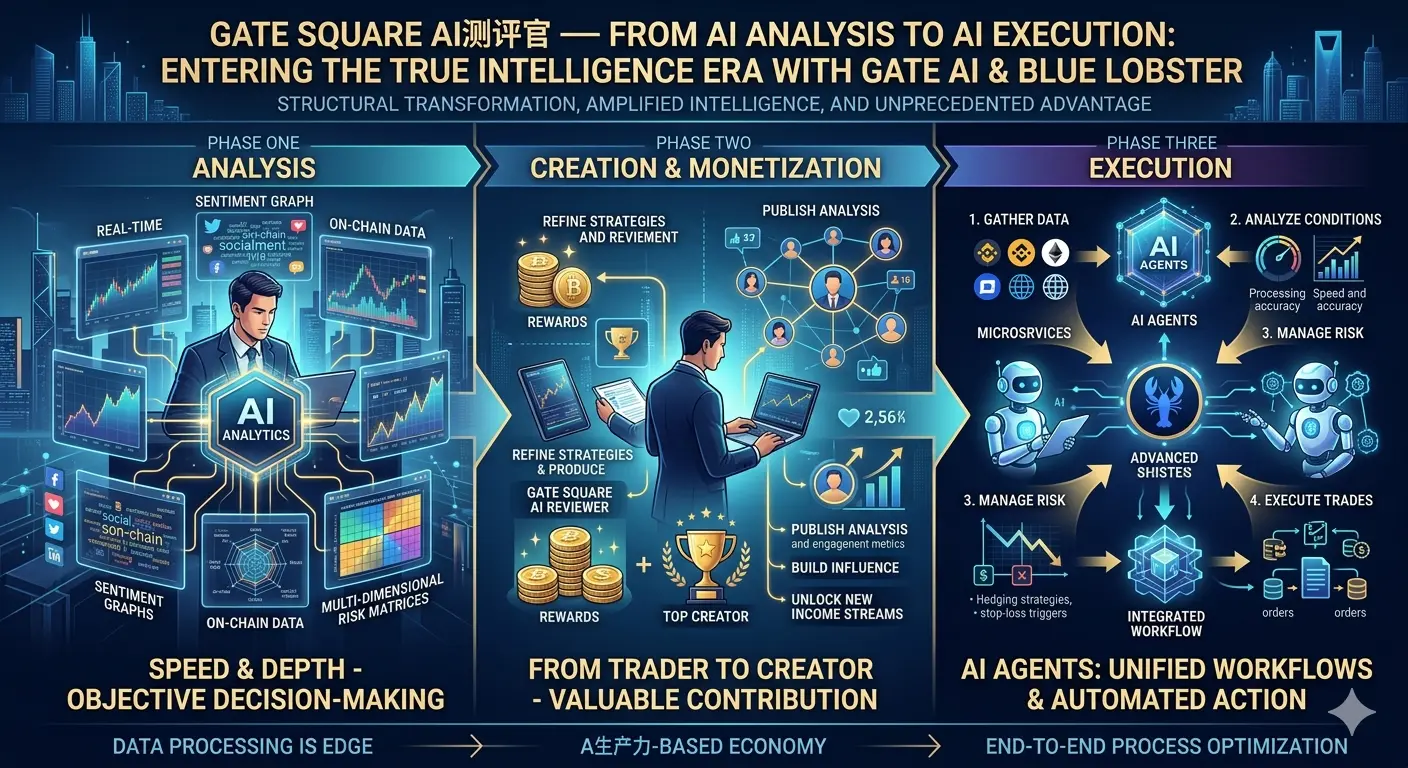
#Gate广场AI测评官 — From AI Analysis to AI Execution: Entering the True Intelligence Era with Gate AI & Blue Lobster
The crypto market is no longer evolving in cycles alone — it is undergoing a structural transformation, where the rules of participation, competition, and profitability are being rewritten in real time. At the center of this shift lies artificial intelligence, not as a supporting tool, but as a core force redefining how decisions are made, how speed is achieved, and how value is created. For years, traders relied on experience, instinct, and manual research, but today,
HighAmbitionvip
#Gate广场AI测评官
#Gate广场AI测评官 — From AI Analysis to AI Execution: Entering the True Intelligence Era with Gate AI & Blue Lobster
The crypto market is no longer evolving in cycles alone — it is undergoing a structural transformation, where the rules of participation, competition, and profitability are being rewritten in real time. At the center of this shift lies artificial intelligence, not as a supporting tool, but as a core force redefining how decisions are made, how speed is achieved, and how value is created. For years, traders relied on experience, instinct, and manual research, but today, the landscape is rapidly transitioning into one where intelligence is amplified by technology, and those who adapt are gaining exponential advantages over those who hesitate.
For someone deeply active in this space, the difference is not subtle — it is absolute. The moment artificial intelligence becomes part of your workflow, you begin to realize that the limitations you once accepted as normal — time constraints, data overload, emotional fatigue — were never permanent barriers, but simply problems waiting for a technological solution. And now, that solution is here.
🚀 Phase One — When AI Became the Ultimate Analytical Advantage
The first stage of this transformation was defined by one key breakthrough: speed combined with depth. Artificial intelligence didn’t just make analysis faster — it made it fundamentally more comprehensive. What once required hours of switching between charts, platforms, and information sources can now be condensed into minutes, without sacrificing accuracy or context. This shift alone has redefined what it means to be “prepared” in the market.
But the true power of AI lies not only in speed, but in its ability to connect multiple layers of information simultaneously. A trader is no longer limited to price action; instead, they can integrate sentiment analysis, on-chain data, liquidity flows, macroeconomic signals, and behavioral patterns into a single, unified perspective. This multi-dimensional analysis transforms decision-making from reactive to proactive, allowing traders to anticipate moves rather than simply respond to them.
Perhaps the most underrated advantage at this stage is the reduction of emotional interference. Markets are designed to exploit human psychology — fear, greed, impatience — but AI introduces a layer of objectivity that stabilizes decision-making. It doesn’t eliminate risk, but it significantly reduces emotion-driven mistakes, which are often the true source of losses. In this phase, AI doesn’t replace the trader — it elevates the trader into a more disciplined and data-driven version of themselves.
💼 Phase Two — From Trader to Creator: The New AI Economy
As AI tools became more accessible and more powerful, a second transformation began to take shape — one that extended beyond trading itself. Market participants started realizing that the value they generate is not limited to profit and loss, but also includes insight, analysis, and intellectual contribution. This realization gave birth to a new model where traders evolve into creators, and knowledge becomes a monetizable asset.
Instead of relying solely on market entries and exits, individuals began producing content, sharing strategies, publishing analysis, and building influence within the ecosystem. This shift represents a move toward a production-based economy, where value is generated not just through participation, but through contribution. It allows individuals to diversify their income streams, reduce dependence on market volatility, and establish a more sustainable presence within the crypto space.
This is a profound change because it redefines success. It is no longer just about being right in the market — it is about being valuable to the market.
🎯 Gate Square AI Reviewer — Turning Intelligence Into Income
Within this evolving landscape, the Gate Square AI Reviewer program emerges as a perfectly timed innovation that aligns with the direction the market is already moving toward. It is not simply a reward system — it is a framework that formalizes the value of intelligence and contribution, turning analytical thinking into a tangible income stream.
What makes this initiative powerful is its simplicity combined with scalability. By encouraging users to create AI-supported analysis and rewarding them based on quality and engagement, it creates a natural ecosystem where better thinking leads to better rewards. The structure — including a substantial reward pool, per-post earnings, bonuses for high-quality content, and visibility through rankings — ensures that both new and experienced participants have an incentive to contribute meaningfully.
More importantly, it introduces a merit-based dynamic where content is not judged by volume, but by depth, clarity, and usefulness. This shifts the focus from noise to value, and from quantity to quality — a critical evolution in an industry often overwhelmed by information overload.
🧠 The Hidden Truth — Data Doesn’t Create Edge, Processing Does
One of the most important realizations in modern markets is that data itself is no longer scarce. Everyone has access to charts, indicators, news, and metrics. The difference between success and failure no longer lies in access to information, but in the ability to interpret, connect, and act on that information effectively.
Artificial intelligence enhances this capability by acting as a bridge between raw data and actionable insight. It allows users to process vast amounts of information without cognitive overload, identify patterns that might otherwise go unnoticed, and construct narratives that explain not just what is happening, but why it is happening and what it implies for the future.
This is where the real competitive edge is formed — not in seeing more data, but in understanding it better and faster than others.
🤖 Phase Three — The Rise of AI Agents: From Thinking to Doing
While the analytical phase of AI brought significant improvements, the market is now entering a far more advanced stage — one where AI transitions from being a passive assistant to an active participant. This is the emergence of AI Agents, and it represents a shift from intelligence as a tool to intelligence as a system.
AI is no longer limited to answering questions or generating insights. It is beginning to execute workflows, connect processes, and perform tasks that previously required continuous human involvement. This evolution fundamentally changes the relationship between users and the market, moving from manual interaction to guided or even automated execution.
⚡ What Makes AI Agents a Game-Changer?
The true power of AI Agents lies in their ability to unify fragmented processes into a seamless experience. In traditional trading environments, users are required to constantly switch between platforms, verify data across multiple sources, and manually execute every step of a trade. This not only consumes time but also introduces inefficiencies and opportunities for error.
AI Agents eliminate much of this friction by integrating these steps into a single, coherent workflow. They can gather data, analyze conditions, assess risks, identify opportunities, and execute actions in a structured sequence. This creates a system where the user’s role shifts from performing tasks to defining objectives and supervising outcomes.
This is a fundamental upgrade in efficiency. It reduces latency, minimizes manual effort, and allows traders to operate at a level that was previously only achievable by highly coordinated teams or advanced automated systems.
🔗 Gate AI & Blue Lobster — Building the Future Infrastructure
Gate’s approach to AI stands out because it is not limited to adding features — it is focused on building infrastructure. By integrating trading systems, on-chain data, wallets, and information flows into a unified AI-driven architecture, Gate is creating an environment where intelligence is embedded into every layer of the user experience.
Concepts like MCP and Skills represent a move toward modular, scalable systems where AI can access and combine different capabilities dynamically. This allows for more complex workflows, more accurate analysis, and more efficient execution. It also creates a flexible foundation that can evolve as new tools and strategies emerge.
Blue Lobster, as part of this ecosystem vision, represents the next step in refining how AI interacts with users, making advanced capabilities more accessible while maintaining the depth required by professional traders.
📊 The Real Shift — From Information to Execution
The industry is clearly transitioning from a phase where AI is used to understand markets to a phase where AI is used to operate within them. This shift is subtle in appearance but massive in impact. It changes the focus from analysis alone to end-to-end process optimization, where information, decision-making, and execution are interconnected.
This evolution brings significant improvements in efficiency, but it also introduces new challenges, particularly in areas like security, risk control, and system reliability. As AI becomes more involved in execution, the importance of safeguards and oversight increases.
Despite these challenges, the direction is clear. The future of crypto trading will not be defined by who has access to the most information, but by who can integrate and act on that information most effectively.
🌍 The Bigger Picture — A Growing Divide
As this transformation accelerates, a clear divide is emerging within the market. On one side are those who adopt AI, leverage its capabilities, and adapt to new systems of value creation. On the other side are those who continue to rely on traditional methods and gradually fall behind.
This divide is not just technological — it is strategic. It separates those who produce value from those who consume it, and those who operate efficiently from those who struggle with outdated processes.
Platforms like Gate Square, combined with innovations in Gate AI and Blue Lobster, provide a pathway for users to move to the stronger side of this divide — to become not just participants, but advantaged participants.
💡 Final Perspective — Choosing the Winning Side
This is no longer a market where effort alone guarantees success. The new reality is defined by how effectively you can leverage tools, process information, and execute strategies. Artificial intelligence is not just an advantage anymore — it is becoming a requirement for staying competitive.
The future belongs to those who can combine human judgment with machine efficiency, who can transform knowledge into value, and who can adapt faster than the market itself evolves.
Because in this new era, the winners will not simply be traders.
They will be:
Intelligent operators
AI-powered creators
Strategic thinkers
And most importantly, they will be those who understand that the real edge is no longer in working harder —
👉 it is in working smarter with AI.
repost-content-media
  • Reward
  • Comment
  • Repost
  • Share
#PredictToWin1000GT
#PredictToWin1000GT
By Gate AI | March 2026
📊 The Big Picture — A Market in Transition, Not in Trend
The crypto market is currently moving through a complex transition phase where price action reflects uncertainty rather than clear direction, as Bitcoin continues to stabilize around the $70K region after recovering from recent downside pressure. This stability, however, should not be mistaken for strength, because beneath the surface the market remains fragile, shaped by conflicting forces such as institutional accumulation, macroeconomic pressure, and geopolitical insta
BTC1,82%
ETH3,89%
SOL3,07%
HighAmbitionvip
#PredictToWin1000GT
#PredictToWin1000GT
By Gate AI | March 2026
📊 The Big Picture — A Market in Transition, Not in Trend
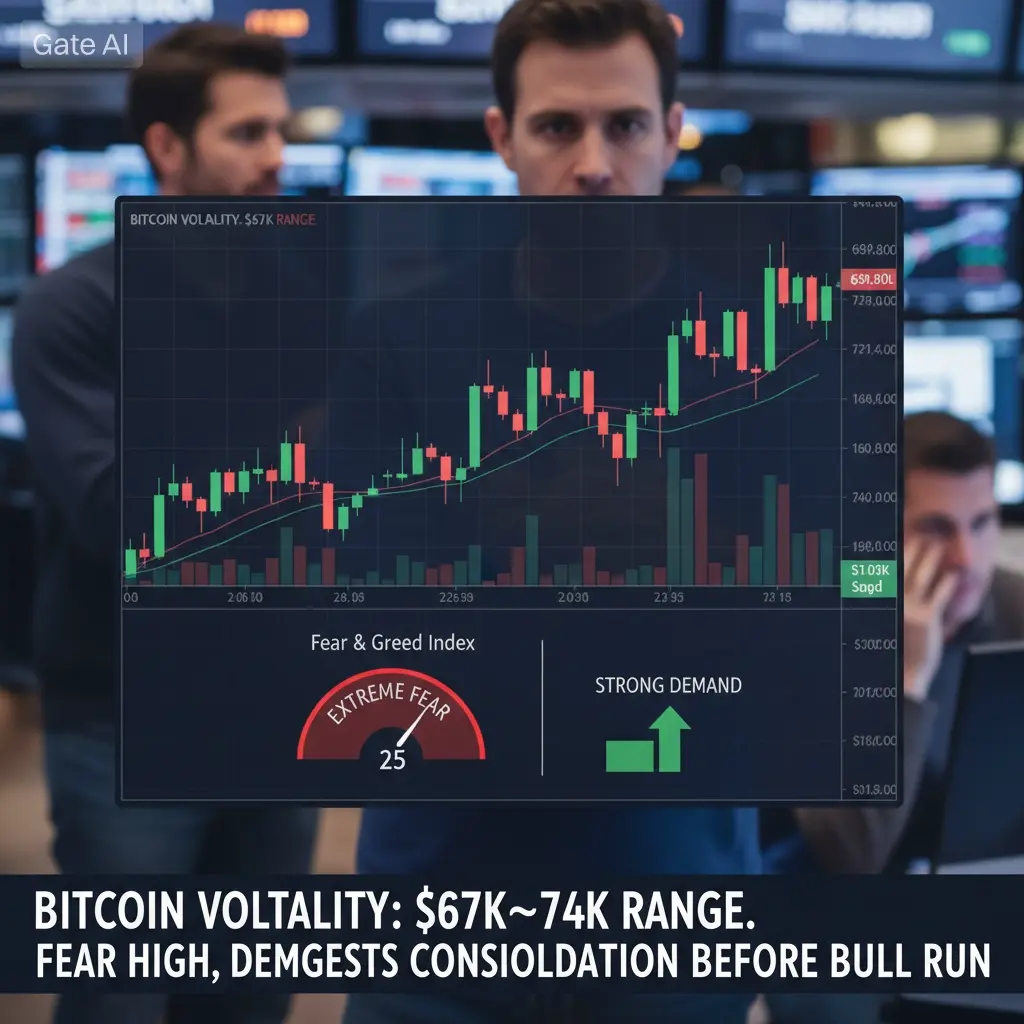
The crypto market is currently moving through a complex transition phase where price action reflects uncertainty rather than clear direction, as Bitcoin continues to stabilize around the $70K region after recovering from recent downside pressure. This stability, however, should not be mistaken for strength, because beneath the surface the market remains fragile, shaped by conflicting forces such as institutional accumulation, macroeconomic pressure, and geopolitical instability. The Fear & Greed Index sitting in extreme fear territory further confirms that sentiment remains weak, and historically such conditions either mark the final stages of a correction or the early formation of a long-term base.
At the same time, the broader drawdown across major assets highlights that the market is still operating within a larger corrective structure, meaning that the current recovery is not yet a confirmed bullish trend but rather a stabilization phase where liquidity is being rebuilt and positioning is gradually shifting from weak hands to stronger participants.
🌍 Short-Term Outlook (2–3 Weeks) — Volatility Will Dominate
Over the next two to three weeks, the market is expected to remain highly reactive and driven by external catalysts, particularly geopolitical developments and macro signals. Bitcoin is likely to continue trading within a defined range between $67,000 and $74,000, as this zone represents the current balance between demand from institutions and supply from profit-taking participants.
In this phase, price action is unlikely to move in a smooth or predictable manner. Instead, traders should expect sudden spikes, sharp pullbacks, and multiple fake breakouts as the market tests both sides of liquidity. Any escalation in geopolitical tension, especially related to Iran, can quickly push Bitcoin lower by several thousand dollars, while de-escalation headlines can trigger equally strong recovery rallies. This creates an environment where the market behaves more like a reaction mechanism than a trend-driven system.
Ethereum is expected to follow a similar pattern, likely consolidating between $2,050 and $2,300, supported by institutional demand but limited by broader market uncertainty. Solana, with stronger sentiment but higher volatility, may trade within the $85 to $100 range, showing sharper moves in both directions due to its higher sensitivity to market momentum.
Overall, this short-term phase is best described as volatile consolidation, where the market is not weak, but not ready for expansion yet. It is a period where liquidity builds, positions reset, and pressure gradually increases toward a breakout.
🏦 Market Structure — Accumulation vs Distribution
One of the most important dynamics shaping the current market is the ongoing interaction between institutional accumulation and whale distribution. Large players are quietly building positions, taking advantage of fear-driven selling, while early holders are using price strength to realize profits. This creates a controlled environment where downside is supported but upside remains capped.
This balance is the reason why the market continues to move sideways rather than trending strongly, and it often represents a pre-breakout phase where supply is gradually absorbed before a larger directional move begins. Until one side clearly gains dominance, the market will remain in this compressed structure.
⚙️ Altcoins — Strong Foundations, Slower Momentum
Ethereum and Solana both demonstrate strong long-term potential supported by institutional flows, ecosystem growth, and improving regulatory clarity. However, in the short term, both assets show signs of consolidation rather than immediate expansion.
This reflects a broader market condition where fundamentals are improving, but technical momentum is still stabilizing. As a result, altcoins are likely to follow Bitcoin’s range-bound movement in the near term before entering their next expansion phase once the broader market gains direction.
📈 2026 Outlook — The Expansion Phase Ahead
While the short-term outlook remains uncertain and volatile, the broader trajectory for 2026 continues to lean toward expansion, driven by structural improvements in the market. Institutional participation is increasing, regulatory clarity is improving, and the overall foundation of the crypto ecosystem is significantly stronger than in previous cycles.
If geopolitical tensions begin to ease and macro conditions shift toward more supportive policies, particularly through improved liquidity and potential rate adjustments, Bitcoin is likely to transition from consolidation into a sustained upward trend. Under such conditions, BTC has the potential to reach the $85,000 to $100,000 range, with momentum-driven extensions toward $110,000–$120,000 during peak phases.
Ethereum could move within the $3,000 to $4,200 range, supported by staking demand and institutional inflows, while Solana may reach the $130 to $180 range as adoption and regulatory clarity continue to strengthen its position.
However, this growth will not be linear, and volatility will remain a constant feature of the market, with corrections acting as part of the overall expansion process rather than signs of weakness.
💡 Final Perspective — Volatility Now, Expansion Later
The crypto market at this stage is not defined by weakness, but by transition. Short-term volatility reflects uncertainty, while long-term positioning reflects confidence. Fear dominates sentiment, yet capital continues to enter the market. This contradiction is not unusual — it is often the environment in which the strongest trends begin to form.
In the coming weeks, the market will likely continue to move within a volatile range, reacting to external developments while building internal strength. But beyond this phase, the structural foundation being formed suggests that the next major move is not a matter of if, but when.
repost-content-media
  • Reward
  • Comment
  • Repost
  • Share
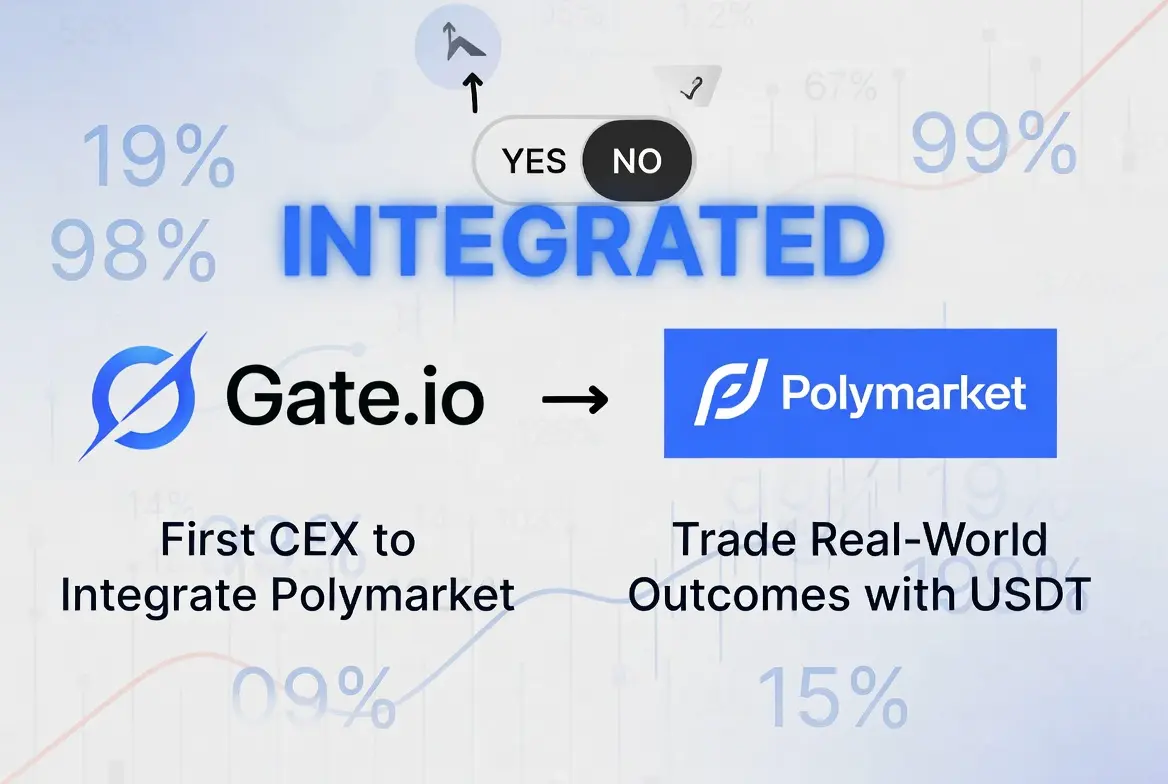
#GateOfficiallyIntegratesPolymarket 👇
#GateOfficiallyIntegratesPolymarket — A New Era of Trading Begins
Gate has just made a move that could redefine how millions of users interact with crypto markets.
For the first time ever, a centralized exchange has officially integrated a decentralized prediction market directly into its platform — and that platform is Polymarket, the world’s leading on-chain prediction marketplace.
This is not just another feature update.
This is a fundamental shift in how users trade information, probability, and real-world outcomes.
🌐 From Price Trading to Outcome T
BTC1,82%
GT1,38%
DEFI-7,05%
HighAmbitionvip
#GateOfficiallyIntegratesPolymarket 👇
#GateOfficiallyIntegratesPolymarket — A New Era of Trading Begins
Gate has just made a move that could redefine how millions of users interact with crypto markets.
For the first time ever, a centralized exchange has officially integrated a decentralized prediction market directly into its platform — and that platform is Polymarket, the world’s leading on-chain prediction marketplace.
This is not just another feature update.
This is a fundamental shift in how users trade information, probability, and real-world outcomes.
🌐 From Price Trading to Outcome Trading
Traditionally, crypto trading has been focused on price — buying low, selling high, analyzing charts, and predicting market direction. But with Polymarket integrated into Gate, the focus expands beyond price into something much bigger: trading real-world outcomes.
Now, instead of only asking “Where is BTC going?”, users can actively position themselves on questions like:
Will Bitcoin reach a certain level?
Will interest rates change?
What will happen in global politics or sports?
This transforms trading into a probability-driven decision system, where market sentiment directly determines pricing, and every position reflects collective intelligence.
⚡ Seamless Access — No Barriers, No Complexity
One of the biggest limitations of prediction markets has always been accessibility. Previously, users needed:
On-chain wallets
Network bridging
Understanding of blockchain interactions
Gate has completely removed these barriers.
Now, everything is simplified into a single, frictionless experience:
Use USDT directly from your spot account
No wallet setup required
No manual on-chain interaction
No technical complexity
This means millions of users who were previously excluded can now access prediction markets instantly, turning a once niche DeFi product into a mainstream trading tool.
🔄 Dual-Mode System — Built for Everyone
Gate didn’t just integrate Polymarket — it enhanced the experience by introducing a powerful dual-mode system designed for different types of users:
Prediction Mode — a simple YES/NO interface that allows users to quickly participate without needing advanced trading knowledge
Trading Mode — a full-featured environment with order books, charts, and advanced tools for experienced traders
This structure ensures that both beginners and professionals can operate within the same ecosystem, each at their own level of complexity and strategy.
📊 A New Market Category Goes Mainstream
Prediction markets have been one of the fastest-growing sectors in crypto, but until now, they remained limited to on-chain users. Gate’s integration changes that completely by bringing this category into the centralized exchange environment.
Users can now participate in markets across:
Crypto trends
Financial decisions
Global events
Sports outcomes
All within a single interface.
This is more than expansion — it is the creation of a new trading layer, where information itself becomes an asset.
🎁 Incentives & Early Advantage
To accelerate adoption, Gate has introduced:
First-time user benefits to reduce entry risk
A 1,000 GT reward pool for hot event participation
This not only encourages engagement but also rewards early adopters who recognize the potential of this new system.
🚀 Why This Matters
This integration represents a major evolution in the crypto ecosystem:
It bridges CEX convenience with DeFi innovation
It removes technical barriers that limited adoption
It introduces a new way to trade — based on probability, not just price
It positions Gate as a leader in next-generation exchange development
Most importantly, it signals where the market is heading — toward systems where data, events, and outcomes become tradable assets.
💡 Final Perspective
This is not just about Polymarket.
This is about the future of trading itself.
A future where markets are not only about charts, but about real-world intelligence, decision-making, and probability.
Gate didn’t just integrate a feature —
it opened the door to an entirely new trading paradigm.
repost-content-media
  • Reward
  • Comment
  • Repost
  • Share
#PredictToWin1000GT
#PredictToWin1000GT 🚀
My Prediction: Bitcoin (BTC) will break and close above $80,000 at least once before April 15, 2026.
Current Market Snapshot
BTC is trading at $70,831 (+0.27% in 24h)
Last 30 days: +10.57% → market is recovering from consolidation
Short-term chart is bullish: MA7 > MA30 > MA120 → buyers have momentum
Trading volume is rising alongside price → strong market participation
Fear & Greed Index: 14 (Extreme Fear) → smart money usually buys here
Why $80K is Possible
Institutions Are Buying Big
Strategy (formerly MicroStrategy) bought 1,031 BTC last week for
BTC1,82%
HighAmbitionvip
#PredictToWin1000GT
#PredictToWin1000GT 🚀
My Prediction: Bitcoin (BTC) will break and close above $80,000 at least once before April 15, 2026.
Current Market Snapshot
BTC is trading at $70,831 (+0.27% in 24h)
Last 30 days: +10.57% → market is recovering from consolidation
Short-term chart is bullish: MA7 > MA30 > MA120 → buyers have momentum
Trading volume is rising alongside price → strong market participation
Fear & Greed Index: 14 (Extreme Fear) → smart money usually buys here
Why $80K is Possible
Institutions Are Buying Big
Strategy (formerly MicroStrategy) bought 1,031 BTC last week for $76.6M
Total holdings now 762,099 BTC
Large buyers are using fear to accumulate, pushing future price higher
Bitcoin ETF Inflows Are Strong
U.S. spot Bitcoin ETFs had 7 days of inflows totaling $1.17B
Long-term inflows = steady buying pressure
Supply Is Tightening
Whales selling selectively
Exchange reserves at multi-year lows → less BTC available for sale
Key Levels to Watch
Weekly close above $74,500 → confirms strength
ETF inflows continue → crossing ~$1.5B = strong demand
Big institutional buys → confirms price floor
Macro signals (Fed updates, interest rates)
BTC dominance >60% → more money in Bitcoin than altcoins
Risks
Geopolitical events, Fed surprises, or global risk-off sentiment could delay $80K
High probability scenario but not guaranteed
Bottom Line
Momentum + institutional buying + tight supply = strong setup
Retail fear is high → smart money is accumulating
BTC has a high chance to break $80,000 before April 15, 2026
Volatility may remain, but structural factors favor the upside
repost-content-media
  • Reward
  • Comment
  • Repost
  • Share
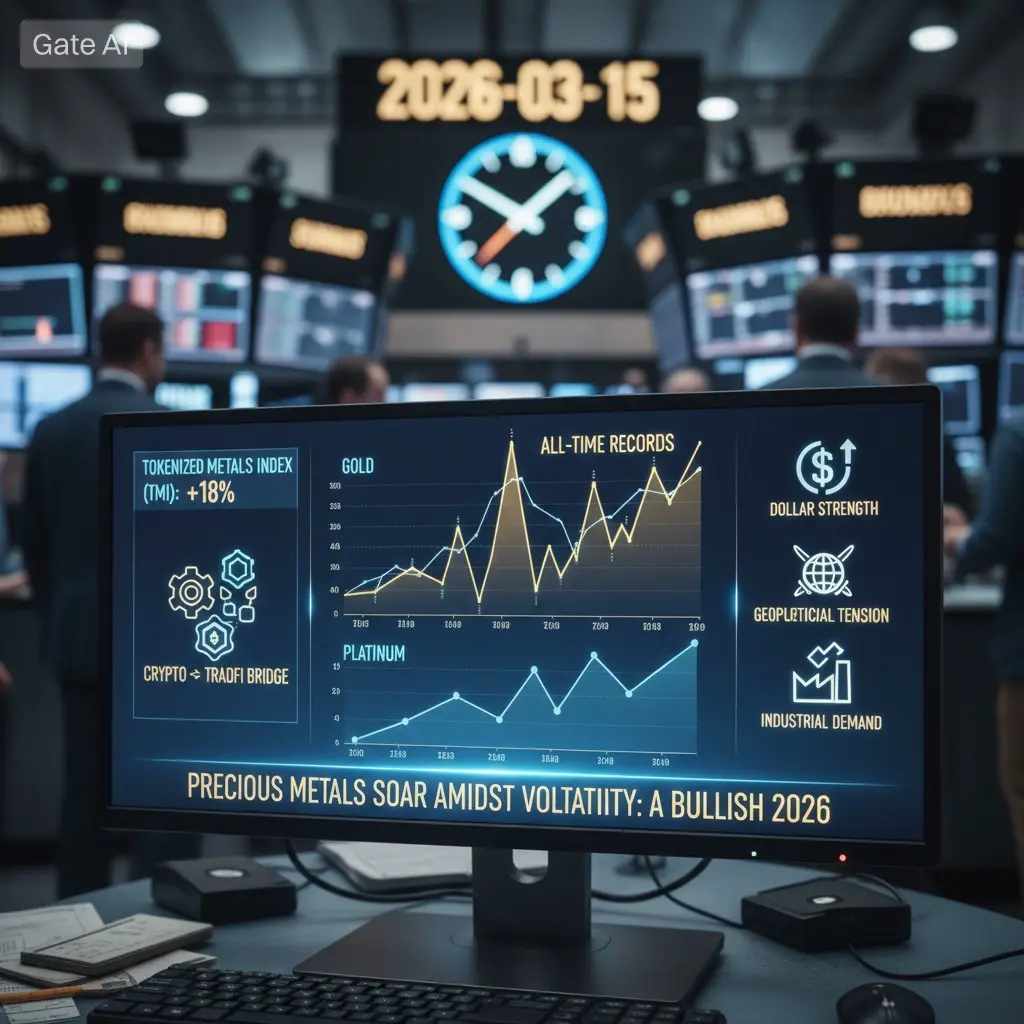
#PreciousMetalsLeadGains
1. Gold — Breaking Every Barrier and Psychological Milestone
Gold’s rise in 2026 is historic. Shattering the $5,000/oz mark, gold has reached levels rarely seen outside extreme macro events. Since early 2025, prices nearly doubled, reflecting persistent fear of fiat currency devaluation, rising global sovereign debt, and ongoing central bank accumulation. China, India, and other emerging markets are accumulating gold at unprecedented rates, seeing it as a hedge against both inflation and geopolitical uncertainty.
Current spot: $4,564–$4,575
Peak earlier in March: $5,4
HighAmbitionvip
#PreciousMetalsLeadGains
1. Gold — Breaking Every Barrier and Psychological Milestone
Gold’s rise in 2026 is historic. Shattering the $5,000/oz mark, gold has reached levels rarely seen outside extreme macro events. Since early 2025, prices nearly doubled, reflecting persistent fear of fiat currency devaluation, rising global sovereign debt, and ongoing central bank accumulation. China, India, and other emerging markets are accumulating gold at unprecedented rates, seeing it as a hedge against both inflation and geopolitical uncertainty.
Current spot: $4,564–$4,575
Peak earlier in March: $5,400+
Analysts (JP Morgan) project: $6,300/oz by end of 2026, signaling a ~30% further upside.
The narrative is clear: gold is not just a safe haven anymore — it is a strategic macro asset, actively targeted by institutions and central banks for portfolio protection. This structural buying is likely to provide support even during corrections.
2. Silver — The Unexpected Star of 2026
While gold often steals the headlines, silver has been the real standout. Year-to-date, silver has surged over 130%, briefly reaching $93/oz. Even after the February-March corrections following geopolitical events, silver remains at $69.74/oz, up +114% YoY.
Why the outperformance?
Dual role: Silver is both a monetary hedge and a critical industrial metal.
Industrial demand: Used heavily in solar panels, EVs, electronics, and AI hardware.
China imports: Nearly 800 tonnes in Jan–Feb 2026, signaling strong industrial absorption.
Early 2026 gains: First six trading days saw silver rise 12.4%, compared to gold’s 4.3%.
Silver’s rally demonstrates that markets are now pricing both macro hedging and real-world utility, giving it a unique position in this cycle.
3. Platinum & Palladium — Quiet But Structurally Strong
Platinum ($1,970/oz) and palladium ($1,445/oz) have not grabbed as much attention but remain elevated structurally.
Industrial use: Both metals are critical for catalytic converters in vehicles, and increasingly in hydrogen fuel cells.
Long-term floor: Even if gold/silver correct, platinum and palladium retain demand support from industrial adoption.
Price movement: More muted than gold/silver, but firmly bullish in a structural sense.
This suggests diversification within the metals sector — while gold/silver are headline assets, platinum and palladium provide stable industrial exposure.
4. Precious Metals vs Crypto — A Significant Narrative Shift
2026 has seen an unusual divergence: crypto markets, including Bitcoin, have struggled to maintain clear momentum, while precious metals have surged.
Precious metals now outperform Bitcoin in risk-adjusted returns over short-to-medium term.
Macro drivers: capital rotation from speculative assets into tangible stores of value, reflecting anxiety over inflation, tariffs, geopolitical risk (Iran war), and dollar instability.
Crypto investors increasingly see metals as a hedge or portfolio stabilizer, not just speculative exposure.
This divergence emphasizes the role of metals as portfolio anchors in turbulent macro periods.
5. Iran War — A Contradictory Macro Signal
Traditionally, war = gold spike. The February 2026 U.S.-Israel strikes on Iran presented a contradictory effect:
Gold and silver fell, reaching one-month lows mid-March.
Dollar strengthened due to risk-on flight → reduced metals’ global appeal.
Oil surged to $98/bbl, creating inflation pressure but also supporting the dollar.
This demonstrates that macro forces like currency strength, oil price shocks, and central bank policy can override traditional geopolitical patterns. Investors must consider multiple forces simultaneously, rather than assuming war automatically drives metal prices higher.
6. Tokenized Metals — Bridging TradFi and DeFi
2026 sees crypto-native investors accessing metals on-chain, combining traditional hedge assets with blockchain infrastructure:
PAXG (PAX Gold): 1 oz per token, $4,564.97 (+5.35% 24h)
XAUT (Tether Gold): 1 oz per token, $4,557.10 (+5.31% 24h)
These tokenized metals are actively traded via perpetual futures, spot, and DeFi platforms, allowing investors to hedge or speculate without leaving blockchain ecosystems.
Trend: Traditional precious metals are now integrated into digital finance, creating a bridge between legacy markets and crypto innovation.
This is one of the defining structural developments of 2026 — on-chain metals allow frictionless access to macro-driven rallies.
7. Volatility Risk — Not a Straight-Up Rally
Rallies in metals are rarely linear:
January 30, 2026 → largest single-day drop of the cycle, triggered by profit-taking and dollar strength.
Mining stocks & leveraged ETFs dropped even more sharply than the metals themselves.
Analysts warn: markets may overextend, with corrections providing better entry points.
Investors should anticipate sharp swings, even as structural trends remain bullish. Patience and risk management are critical.
8. Portfolio Implications in 2026
Precious metals serve multiple strategic roles:
Inflation hedge → preserves purchasing power
Macro diversifier → low correlation to equities during stress
Industrial demand → silver, platinum, palladium critical for tech, EVs, AI, and solar
Central bank accumulation → reduces available supply, supporting long-term value
Underallocated globally → many portfolios have minimal metals exposure, leaving room for inflows
Even at elevated prices, metals improve risk-adjusted portfolio efficiency, particularly in volatile macro environments.
✅ Extended Bottom Line
Precious metals in 2026 are no longer merely “safe havens”:
Gold: doubled
Silver: quadrupled from cycle lows
Tokenized metals: provide crypto-native exposure
Macro support: dollar instability, geopolitical tension, green energy demand, supply shortages
Structural thesis: multi-year growth potential
Expect near-term volatility, but long-term trends favor upside
Investors combining metals exposure with careful risk management can capture both macro-driven alpha and portfolio protection.
Market data as of March 25, 2026. Precious metals markets are volatile — this is market analysis, not financial advice. Always assess your own risk tolerance before investing.
repost-content-media
  • Reward
  • Comment
  • Repost
  • Share
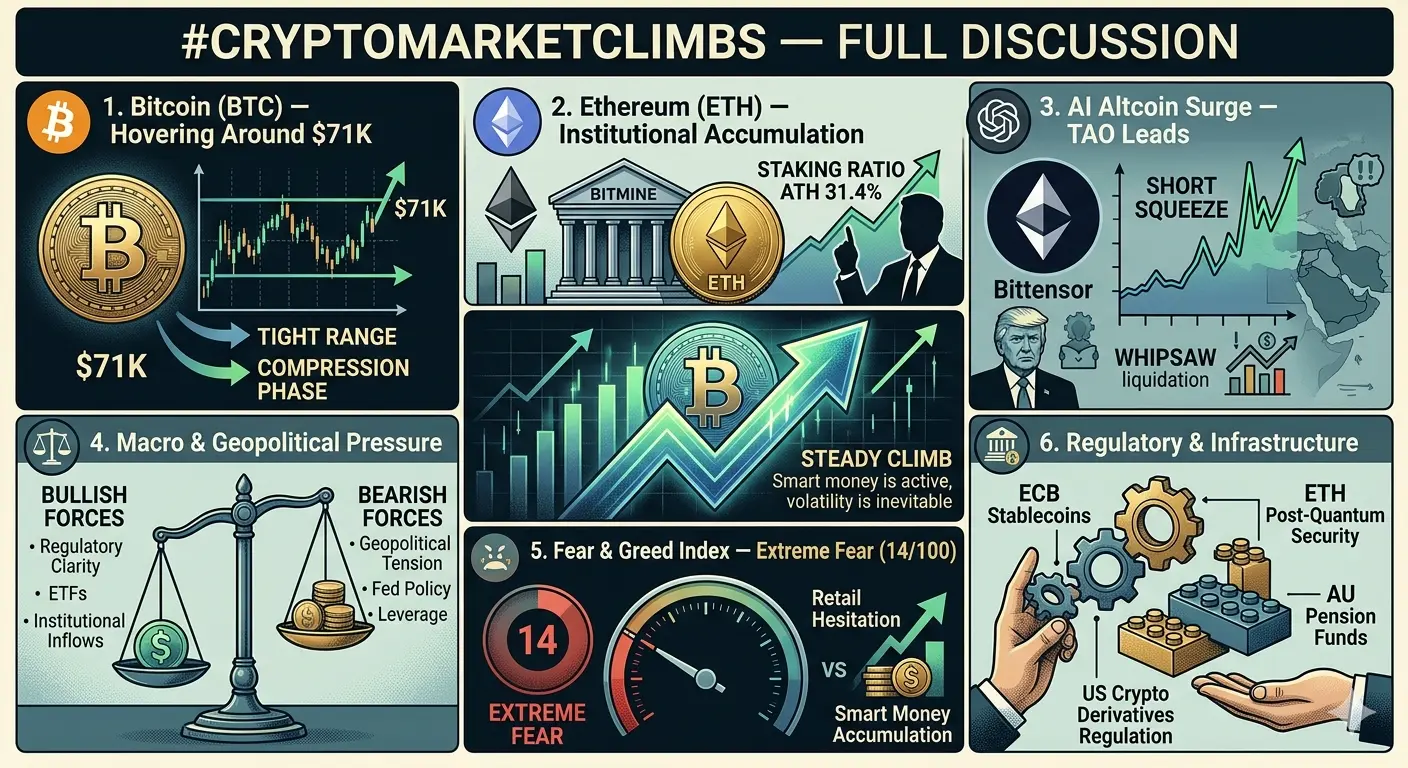
#CryptoMarketClimbs
1. Bitcoin (BTC) — Hovering Around $71K
Bitcoin (BTC) continues to trade in a tight but psychologically important range, currently sitting near $71,105, reflecting a marginal -0.37% daily move. While the price action may appear flat on the surface, the underlying structure tells a much more complex story. Over the past week, BTC has experienced significant volatility, swinging between $67K and $76K, highlighting the presence of both aggressive buyers and equally strong sell-side pressure near resistance zones.
This range-bound behavior suggests that Bitcoin is currently in
BTC1,82%
ETH3,89%
TAO-0,82%
HighAmbitionvip
#CryptoMarketClimbs
1. Bitcoin (BTC) — Hovering Around $71K
Bitcoin (BTC) continues to trade in a tight but psychologically important range, currently sitting near $71,105, reflecting a marginal -0.37% daily move. While the price action may appear flat on the surface, the underlying structure tells a much more complex story. Over the past week, BTC has experienced significant volatility, swinging between $67K and $76K, highlighting the presence of both aggressive buyers and equally strong sell-side pressure near resistance zones.
This range-bound behavior suggests that Bitcoin is currently in a compression phase, where volatility contracts before a larger directional move. The inability to break and hold above the $72K–$74K resistance cluster indicates that sellers are still defending this zone heavily, likely due to profit-taking and macro uncertainty.
The recent short-term rally was largely driven by easing geopolitical fears, particularly surrounding Middle East tensions. However, this catalyst proved temporary, and BTC quickly reverted to consolidation mode. Volume data also shows a decline in participation, with a -$831M drop in USDT trading volume, indicating reduced conviction from both retail and institutional traders.
From a structural perspective, Bitcoin remains in a mid-term bullish trend, but in the short term, it is clearly lacking a strong catalyst to trigger a breakout. Until BTC decisively clears resistance with strong volume, the market will likely remain in a choppy, liquidity-driven environment.
2. Ethereum (ETH) — Institutional Accumulation in Focus
Ethereum (ETH) is quietly building one of the strongest bullish cases in the current market cycle. Trading around $2,171, ETH has posted a modest +0.43% gain, but the real story lies beneath the surface — institutional accumulation is accelerating at a notable pace.
A major highlight is the aggressive buying by Bitmine Immersion Technologies, chaired by Tom Lee. The firm recently added $139 million worth of ETH, bringing its total holdings to 77% of its ambitious target to control 5% of Ethereum’s total supply. This is not just accumulation — it is a strategic positioning for long-term dominance in the ETH ecosystem.
Tom Lee has publicly stated that the “mini crypto winter” for ETH is nearing its end, a statement that aligns with multiple on-chain indicators. One of the most important metrics is the staking ratio, which has climbed to an all-time high, with approximately 31.4% of ETH supply locked. This effectively reduces circulating supply, creating a structural supply squeeze that could amplify price moves when demand spikes.
Additionally, institutions are increasingly viewing Ethereum not just as a cryptocurrency, but as a yield-bearing digital asset and infrastructure layer. With staking rewards, DeFi integration, and upcoming upgrades, ETH is positioning itself as a hybrid between a tech platform and a financial asset.
3. AI Altcoin Surge — TAO Leads
The AI narrative has once again captured market attention, with Bittensor (TAO) emerging as the standout performer. The rally in TAO was sharp and aggressive, driven primarily by a short squeeze, where over-leveraged bearish positions were forced to close, pushing prices higher rapidly.
This move was further fueled by temporary optimism in global markets after Donald Trump signaled a pause in potential strikes on Iran’s energy infrastructure. The announcement injected a wave of risk-on sentiment across both traditional and crypto markets.
However, the situation quickly reversed when Iran denied any negotiations, triggering a classic whipsaw event. Within 24 hours, the market saw over $670 million in liquidations, highlighting how fragile and over-leveraged the current environment is.
Despite the volatility, the AI sector remains structurally strong. Projects like TAO are benefiting from the broader convergence of AI + blockchain narratives, which continues to attract speculative capital. However, traders should remain cautious — these rallies are often momentum-driven and highly sensitive to macro headlines.
4. Macro & Geopolitical Pressure
The crypto market is currently being shaped by a powerful tug-of-war between bullish structural developments and bearish macro uncertainties.
Bullish Forces
Increasing regulatory clarity in major economies such as the US and Australia
Continued institutional inflows, particularly into Bitcoin ETFs
Growing corporate adoption of crypto as a treasury asset
Long-term infrastructure development across blockchain ecosystems
Bearish Forces
Ongoing geopolitical tensions, particularly in the Middle East
Uncertainty surrounding Federal Reserve policy and interest rates
Negative derivatives funding rates संकेत weak bullish conviction
High leverage in the system leading to frequent liquidation cascades
A key institutional signal comes from BlackRock, whose CEO has projected that crypto-related products could generate $500 million in revenue over the next five years. This is a strong indication that traditional finance is not just experimenting with crypto — it is deeply integrating it into long-term business models.
5. Fear & Greed Index — Extreme Fear (14/100)
One of the most striking aspects of the current market is the divergence between price action and sentiment. The Fear & Greed Index sits at 14, firmly in the Extreme Fear zone.
This creates a rare and powerful setup:
Prices are gradually climbing or stabilizing
But sentiment remains deeply pessimistic
Retail participation is low
Derivatives positioning shows hesitation
Historically, such conditions have often preceded strong upward moves, as markets tend to move against the majority sentiment. Extreme fear typically indicates that weak hands have already exited, leaving room for stronger accumulation.
However, this does not eliminate risk. In the current environment, sentiment can quickly deteriorate further if negative macro news emerges. This makes the market highly headline-sensitive, where a single geopolitical or regulatory update can trigger sharp moves.
6. Regulatory & Infrastructure Developments
The regulatory landscape is evolving rapidly, and it is becoming one of the most important long-term drivers of the crypto market.
The European Central Bank (ECB) has emphasized the need for stablecoins and tokenized deposits to be anchored by central bank money, reinforcing the push toward CBDC integration
The Ethereum ecosystem is preparing for future risks, with the Ethereum Foundation exploring post-quantum security upgrades, including proposals like EIP-8141
In the US, bipartisan efforts are underway to regulate speculative crypto instruments, including proposals to ban sports betting-style derivatives
Australian pension funds are increasingly exploring crypto exposure, signaling growing acceptance among conservative institutional investors
These developments collectively point toward a future where crypto is more regulated, more integrated, and more institutionalized.
Bottom Line
The crypto market is climbing — but not with full confidence. This is not a euphoric rally driven by retail hype; instead, it is a measured, institution-led advance unfolding under the surface.
Bitcoin remains trapped below key resistance, Ethereum is quietly being accumulated by major players, and AI altcoins are delivering explosive but unstable moves. At the same time, macro uncertainty and geopolitical risks continue to act as a ceiling on aggressive upside.
The most important signal right now is the divergence between price and sentiment. While fear dominates the market narrative, capital is steadily positioning for the next move.
repost-content-media
  • Reward
  • Comment
  • Repost
  • Share
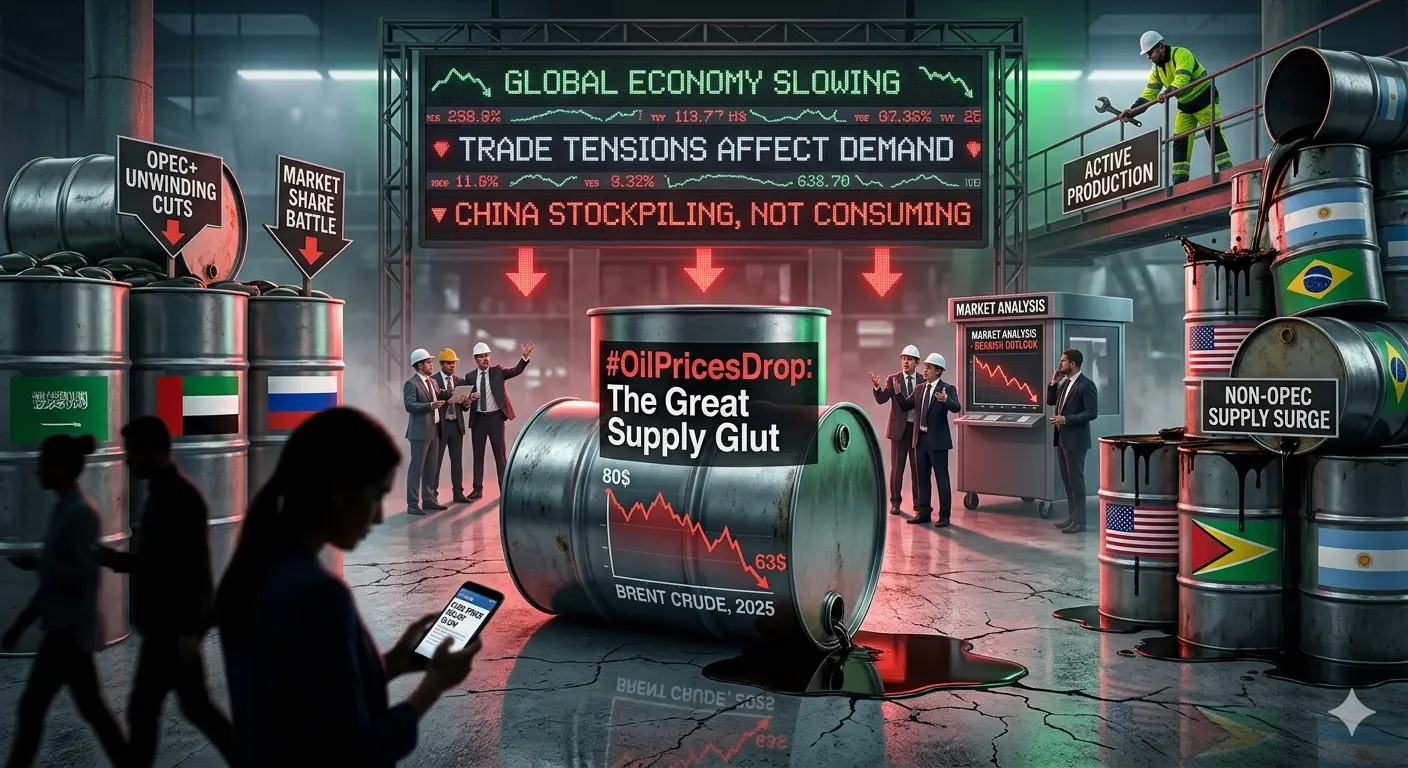
#OilPricesDrop :
#OilPricesDrop —lWhy Oil Prices Collapsed and What Comes Next
The Big Picture — A Historic Downtrend in Oil
The global oil market went through one of its most significant downturns in recent history, with prices falling nearly 20% across 2025. This marked the steepest annual decline since the COVID-19 pandemic and, more importantly, the first time oil recorded three consecutive years of losses. Brent crude started the year near $79 per barrel and steadily declined toward $63 by December, reflecting a prolonged imbalance where supply consistently outpaced demand. This was not a
HighAmbitionvip
#OilPricesDrop :
#OilPricesDrop —lWhy Oil Prices Collapsed and What Comes Next
The Big Picture — A Historic Downtrend in Oil
The global oil market went through one of its most significant downturns in recent history, with prices falling nearly 20% across 2025. This marked the steepest annual decline since the COVID-19 pandemic and, more importantly, the first time oil recorded three consecutive years of losses. Brent crude started the year near $79 per barrel and steadily declined toward $63 by December, reflecting a prolonged imbalance where supply consistently outpaced demand. This was not a sudden crash, but a structural decline driven by deep-rooted shifts in global production strategy and weakening consumption patterns.
OPEC+ Strategy Shift — From Price Control to Market Share Battle
One of the most critical turning points came when OPEC+ abandoned its long-standing strategy of restricting supply to support prices. After years of coordinated production cuts, the group reversed course in 2025 and began increasing output aggressively. Starting in April, production cuts were gradually unwound, and by mid-year, output increases accelerated significantly. This shift signaled a clear change in priorities — instead of defending higher prices, OPEC+ moved to reclaim market share lost to competitors. The result was a flood of additional barrels entering an already oversupplied market, intensifying downward pressure on prices.
Global Supply Surge — Non-OPEC Producers Add Fuel to the Fire
At the same time, non-OPEC producers amplified the oversupply problem. Countries like the United States, Brazil, Guyana, and Argentina significantly expanded their oil production. The United States, in particular, maintained output near record highs, driven by efficient shale operations and strong infrastructure. This created a dual supply shock — both OPEC+ and non-OPEC nations were pumping aggressively at the same time. The global market became saturated, with analysts warning that this oversupply could persist well into 2026, keeping prices under sustained pressure.
Demand Weakness — A Slowing Global Economy
While supply surged, demand failed to keep pace. The global economy showed signs of slowdown throughout 2025, reducing industrial activity, transportation demand, and overall energy consumption. Trade tensions and economic uncertainty weighed heavily on business confidence, limiting growth across major economies. Oil demand growth averaged just over one million barrels per day, which was insufficient to absorb the excess supply entering the market. Seasonal factors added further pressure, particularly after the end of the US summer driving season, which typically marks a decline in fuel consumption. The imbalance between strong supply and weak demand became the core driver behind the price decline.
Trade Wars and Tariffs — A Hidden Bearish Catalyst
US trade policy played a major role in shaping market sentiment. Under Donald Trump, aggressive tariff measures introduced in 2025 created uncertainty across global markets. Trade restrictions disrupted supply chains, slowed international trade, and reduced expectations for economic growth. For the oil market, this translated directly into weaker demand projections. Investors began pricing in a slower global economy, which further pushed oil prices downward. The unusual nature of these policies made traditional market comparisons less relevant, as geopolitical decisions became a dominant force influencing energy markets.
China’s Role — Stockpiling Instead of Consuming
China played a complex and somewhat misleading role in the oil market. While the country imported large volumes of crude oil, much of it was not immediately consumed. Instead, China focused on building strategic reserves, storing oil in large quantities rather than refining and using it. This behavior temporarily absorbed some of the excess supply and prevented an even sharper price collapse. However, it also revealed a deeper issue — actual consumption demand in one of the world’s largest energy markets was weaker than expected. The global supply surplus exceeded 2.5 million barrels per day in the second half of 2025, reinforcing the bearish outlook.
Bearish Sentiment — Markets Turn Against Oil
As fundamentals weakened, investor sentiment turned decisively negative. Traders began anticipating a prolonged period of oversupply, leading to aggressive selling and reduced long-term positioning in oil markets. Prices experienced sharp monthly declines, including a notable drop of over 7% in August alone.
Financial institutions projected further downside, with some forecasts suggesting oil could fall as low as $55 per barrel. The overall expectation shifted toward a prolonged period of range-bound prices with limited upside potential unless a major disruption occurred.
Iran Factor — Geopolitics Adds Volatility
Moving into 2026, geopolitical developments introduced a new layer of complexity. Statements from Donald Trump regarding potential negotiations with Iran created volatility in oil markets. Hints of easing tensions and possible sanctions relief suggested that Iranian oil could return to global supply chains. This prospect added further downward pressure on prices, as additional supply would worsen the existing imbalance. Although geopolitical tensions had previously driven prices higher, the shift toward diplomacy reversed that effect, reinforcing the bearish outlook.
Impact on Consumers — Limited Relief Despite Lower Prices
Despite falling crude prices, the benefits for consumers were uneven. While fuel prices did decline in many regions, the drop was not always proportional to the decrease in crude oil costs. Retailers and supply chain dynamics often delayed or limited the pass-through of savings to consumers. In some markets, public pressure mounted on fuel companies to reduce prices more aggressively. However, structural factors — including refining costs, taxes, and distribution — meant that lower oil prices did not immediately translate into significantly cheaper fuel at the pump.
Outlook — What Lies Ahead for Oil Markets
Looking forward, the oil market is expected to remain under pressure. Oversupply conditions are likely to persist through 2026 unless there is a major disruption to production. Prices are expected to trade within a broad range of $50 to $70 per barrel, reflecting a balance between weak demand and abundant supply. Upside risks include geopolitical conflicts, particularly in critical regions like the Middle East, or disruptions in major supply routes such as the Strait of Hormuz. On the downside, continued production increases, weak economic growth, and potential recession fears could push prices even lower.
Bottom Line
The decline in oil prices was not caused by a single event, but by a powerful combination of factors working simultaneously. A surge in global supply, driven by both OPEC+ and non-OPEC producers, collided with a slowing global economy and weakening demand. Trade tensions, shifting geopolitical dynamics, and changing investor sentiment amplified the downturn.
This is fundamentally a supply glut market, where excess production continues to outweigh consumption. Until that balance shifts meaningfully, oil prices are likely to remain subdued, with volatility driven more by headlines than by structural recovery.
repost-content-media
  • Reward
  • Comment
  • Repost
  • Share
#USProposes15PointPeacePlan
Background — A War That Reshaped Global Markets
The current geopolitical crisis traces back to February 28, 2026, when coordinated military operations by the United States and Israel against Iran triggered one of the most dangerous escalations in modern Middle Eastern history. The conflict intensified dramatically following the reported killing of Iran’s Supreme Leader, Ali Khamenei, an event that sent shockwaves through global markets, energy systems, and political alliances. Oil prices surged aggressively, risk assets turned unstable, and global investors shifted
HighAmbitionvip
#USProposes15PointPeacePlan
Background — A War That Reshaped Global Markets
The current geopolitical crisis traces back to February 28, 2026, when coordinated military operations by the United States and Israel against Iran triggered one of the most dangerous escalations in modern Middle Eastern history. The conflict intensified dramatically following the reported killing of Iran’s Supreme Leader, Ali Khamenei, an event that sent shockwaves through global markets, energy systems, and political alliances. Oil prices surged aggressively, risk assets turned unstable, and global investors shifted into defensive positioning almost instantly.
In this tense environment, on March 24, 2026, the administration of Donald Trump quietly introduced a 15-point peace proposal, delivered through Pakistan as a trusted intermediary. The involvement of Pakistan’s military leadership, combined with diplomatic engagement from figures like Jared Kushner and Steve Witkoff, signals that this is not a symbolic gesture — it is a serious, high-stakes attempt to prevent further escalation and restore regional balance. Additional encouragement from countries like Egypt and Turkey shows that the broader region is actively pushing for de-escalation, fearing the consequences of a prolonged conflict.
Strategic Intent — Containment Instead of Confrontation
What makes this plan fundamentally different from past US approaches is its strategic tone. Rather than pushing for regime change in Iran — a demand that has historically blocked negotiations — this proposal focuses on containment, compliance, and coexistence. The objective is clear: limit Iran’s nuclear and military capabilities, reduce its regional influence, and integrate it back into the global economy in exchange for stability.
This reflects a pragmatic shift in policy thinking. Washington appears to recognize that long-term stability cannot be achieved through continuous conflict, and instead is attempting to engineer a controlled balance of power. However, while the framework appears realistic on paper, its execution faces enormous political, military, and ideological challenges.
Ceasefire Mechanism — The First and Most Fragile Step
At the center of the proposal lies a one-month ceasefire — a temporary halt in hostilities designed to create a negotiation window. This is the foundation upon which all other points depend. Without a cessation of violence, none of the structural agreements can move forward.
However, this is also the most fragile component. Iran’s continued military signaling, including missile activity in the region, suggests that trust remains extremely low. A ceasefire in such an environment is not just a diplomatic step — it is a test of intent from both sides. If it fails, the entire framework collapses before negotiations even begin.
Nuclear Restrictions — The Core of the Conflict
The most critical and sensitive elements of the proposal revolve around Iran’s nuclear program. The demand for a complete halt to uranium enrichment within Iran, combined with the removal of existing enriched material, is designed to eliminate any pathway toward nuclear weapon capability.
Oversight by the International Atomic Energy Agency introduces an additional layer of verification, including intrusive inspections that Iran has historically resisted. From a Western perspective, these measures are essential for global security. From Iran’s perspective, they represent a significant compromise on sovereignty and technological independence.
This is the core tension of the entire deal — security versus sovereignty — and it will likely be the most difficult area to finalize.
Regional Power Reset — Reducing Iran’s Strategic Reach
Beyond nuclear issues, the plan directly targets Iran’s regional influence. Requirements to limit missile development, cut funding to proxy groups, and withdraw forces from countries like Syria, Iraq, and Lebanon are aimed at dismantling Iran’s long-standing strategy of indirect power projection.
For decades, Iran has built a network of alliances and proxy forces to expand its influence without direct confrontation. Accepting these terms would fundamentally reshape the regional balance, reducing Iran’s strategic depth while increasing stability from the perspective of the US and its allies.
This is not just a military adjustment — it is a complete geopolitical reset.
Strait of Hormuz — The Global Economic Pressure Point
One of the most critical elements of the proposal is the reopening of the Strait of Hormuz. This narrow passage is responsible for nearly one-fifth of global oil flows, making it one of the most important economic arteries in the world.
During the conflict, partial disruptions in this region caused oil prices to surge sharply, fueling inflation concerns across global markets. Reopening the strait would immediately ease supply pressures, stabilize energy prices, and reduce inflation expectations.
From a macro perspective, this single development has the power to influence central bank policy, global liquidity conditions, and risk asset performance — including crypto.
Sanctions Relief — The Economic Trade-Off
In exchange for compliance, the United States is offering full sanctions relief, which represents a massive economic opportunity for Iran. Access to global financial systems, release of frozen assets, and renewed trade partnerships could significantly boost Iran’s economy.
This is the primary incentive driving the deal. However, it also introduces complexity, as enforcement mechanisms and long-term compliance will be critical to maintaining trust between both sides.
Iran’s Position — Public Resistance, Private Calculations
Publicly, Iran has rejected the proposal, maintaining a strong rhetorical stance and continuing military actions. However, reports suggest that behind the scenes, Iranian officials may be more flexible, showing openness to certain elements of the plan.
This dual approach is typical in high-level negotiations. Public messaging is designed to maintain domestic strength, while private discussions explore practical compromises. The key question is whether Iran sees more value in economic recovery or in maintaining its current strategic posture.
Crypto Market Reaction — Stability Amid Uncertainty
As of March 25, 2026, the crypto market is showing resilience despite the geopolitical backdrop.
Bitcoin (BTC) is trading at $71,185 (+0.41% 24h / +1.8% 7d / +11.1% 30d), while Ethereum (ETH) stands at $2,172 (+0.66% 24h / +1.6% 7d / +17.3% 30d).
This stability is significant. Despite heightened tensions, crypto has not broken down — instead, it is holding steady, indicating underlying strength and accumulation.
The immediate reaction to the peace proposal has been a classic risk-on signal. Oil prices dropped sharply, equity markets stabilized, and crypto maintained its position. This suggests that markets are cautiously optimistic, pricing in the possibility of de-escalation without fully committing to a bullish breakout.
Bullish Case — A Macro Tailwind for Crypto
If the peace plan progresses successfully, the implications for crypto are substantial. Lower oil prices would reduce inflation pressure, giving central banks more flexibility to adopt supportive monetary policies. This environment historically benefits risk assets, including Bitcoin and Ethereum.
Additionally, a reduction in geopolitical tension would shift global sentiment toward risk-taking, encouraging capital inflows into crypto markets. A weaker dollar environment, combined with improved liquidity conditions, could further amplify this effect.
Iran’s reintegration into the global economy could also expand crypto adoption, particularly in mining and peer-to-peer transactions, adding new participants and liquidity to the market.
Bearish Risks — Fragility Beneath Optimism
Despite the bullish potential, risks remain elevated. If negotiations fail or the conflict escalates, oil prices could spike again, increasing inflation and forcing tighter monetary conditions. This would create a risk-off environment, putting pressure on crypto markets.
Continued military actions during negotiations also threaten to undermine confidence. Markets are currently pricing in partial optimism — any negative surprise could trigger sharp reversals.
The Reality — A Market Driven by Headlines
The most likely near-term scenario is continued uncertainty. Negotiations may extend over weeks or months, with progress and setbacks along the way. In such an environment, crypto markets are likely to remain highly reactive to news flow, with volatility driven more by headlines than fundamentals.
This creates both opportunity and risk, as sentiment can shift rapidly in either direction.
Bottom Line
The US 15-point peace proposal is one of the most important geopolitical developments shaping the current macro environment. It sits at the intersection of war, energy markets, global inflation, and financial risk appetite.
For crypto, this is a defining moment. A successful agreement could unlock a powerful bullish phase driven by improved liquidity, lower inflation, and stronger global confidence. A failure, however, could reinforce volatility and downside pressure.
Right now, the market is watching closely. The next moves from Iran, the United States, and regional powers will determine whether this becomes the foundation of a sustained rally — or another temporary shift in an already highly unstable global landscape.
repost-content-media
  • Reward
  • Comment
  • Repost
  • Share
#PredictionMarketsInfluenceBTC?
#PredictionMarketsInfluenceBTC — The Hidden Engine Quietly Controlling Bitcoin’s Direction in 2026
What Are Prediction Markets? (The New Financial Intelligence Layer)
Prediction markets have rapidly evolved from simple speculative platforms into a highly advanced financial intelligence system that continuously translates global uncertainty into measurable probability, allowing traders, institutions, and even governments to interpret future outcomes in real time through capital-backed signals rather than opinions or narratives. Platforms like Polymarket and Kals
HighAmbitionvip
#PredictionMarketsInfluenceBTC?
#PredictionMarketsInfluenceBTC — The Hidden Engine Quietly Controlling Bitcoin’s Direction in 2026
What Are Prediction Markets? (The New Financial Intelligence Layer)
Prediction markets have rapidly evolved from simple speculative platforms into a highly advanced financial intelligence system that continuously translates global uncertainty into measurable probability, allowing traders, institutions, and even governments to interpret future outcomes in real time through capital-backed signals rather than opinions or narratives. Platforms like Polymarket and Kalshi enable participants to trade on the likelihood of real-world events, effectively turning expectations about politics, macroeconomics, regulation, and financial markets into tradable instruments that carry real financial consequences.
What makes these platforms uniquely powerful is not just participation volume, but the concept of capital-weighted conviction, meaning that every percentage shift in probability reflects actual money being deployed based on belief, information, and strategy, which makes the signal far more reliable than traditional surveys or analyst forecasts that carry no financial risk. During 2025–2026, these platforms processed billions in monthly volume, with Kalshi controlling roughly 60–66% of the market and Polymarket holding around 34%, reinforcing their dominance as the primary hubs of forward-looking market sentiment.
As a result, prediction markets have become something far more influential than a niche tool — they now act as a real-time, forward-looking sentiment engine that often reacts faster than institutional desks, breaks ahead of media narratives, and increasingly shapes the behavior of assets like Bitcoin.
Point 1 — Prediction Markets as a Leading Sentiment Engine for BTC (Trading the Future Before It Happens)
A major structural shift has taken place in Bitcoin’s behavior: instead of reacting to confirmed news or completed events, BTC is now increasingly moving based on the probability of those events happening, and prediction markets are the mechanism through which these probabilities are formed, updated, and transmitted to the broader market in real time.
Unlike traditional sentiment indicators that are often delayed, subjective, or disconnected from capital flows, prediction markets enforce accountability because traders must put real money behind their expectations, which results in a cleaner, sharper, and more actionable signal. When probabilities change — whether due to macroeconomic developments, geopolitical tensions, or regulatory expectations — Bitcoin responds quickly because traders begin repositioning before the outcome is confirmed.
Example (March 2026):
As prediction market probabilities for escalation in the Iran-Hormuz region increased, Bitcoin dropped below $69K within hours, not because conflict had officially begun, but because the market had already started pricing in a higher likelihood of risk-off conditions, proving that BTC is now reacting to expected outcomes rather than confirmed realities.
👉 This marks a fundamental evolution: Bitcoin is no longer event-driven — it is expectation-driven.
Point 2 — Regulation Is Now Pre-Priced Into Bitcoin (Probability Before Policy)
In earlier market cycles, regulatory developments acted as delayed catalysts, where Bitcoin reacted only after official announcements were made; however, prediction markets have fundamentally changed this dynamic by allowing traders to price in regulatory outcomes long before they materialize, effectively turning policy expectations into leading indicators for BTC price action.
Traders now actively monitor probability flows related to:
Spot BTC ETF approvals
Strategic Bitcoin reserve initiatives
Jurisdictional control between regulatory bodies
When these probabilities increase, capital begins flowing into Bitcoin ahead of confirmation, as institutional players position themselves early to capture upside from favorable regulatory outcomes. This results in a structural shift where:
News becomes confirmation rather than catalyst
Probability becomes the primary driver of price
Bitcoin, therefore, is no longer reacting to regulatory decisions — it is reacting to the market’s confidence in those decisions happening.
Point 3 — The Federal Reserve Feedback Loop (Liquidity Expectations Drive BTC)
Bitcoin’s sensitivity to macroeconomic conditions has intensified, and prediction markets now play a central role in translating Federal Reserve expectations into immediate market reactions, effectively acting as a real-time bridge between monetary policy and crypto price action.
Current real example (March 2026):
The Federal Reserve signaled only one rate cut for 2026, which caused prediction market probabilities for multiple cuts to drop sharply, leading to a rapid reassessment of liquidity expectations across global markets.
Result:
BTC fell from $76K → ~$70,000
Institutional sentiment weakened
Market volatility increased
This creates a repeatable chain reaction: prediction markets adjust → macro expectations shift → liquidity outlook tightens → BTC reprices downward.
This feedback loop is now deeply embedded in market structure, making prediction markets one of the most critical tools for anticipating macro-driven BTC moves.
Point 4 — Political Power, Probability, and Bitcoin (Politics as a Price Driver)
Politics has become a dominant force influencing Bitcoin, and prediction markets are now the earliest and most accurate reflection of political momentum, allowing traders to position ahead of major shifts in leadership, policy direction, and geopolitical stability.
The role of Donald Trump highlights this clearly, as prediction markets indicated his rising probability of winning the 2024 election before mainstream confirmation, enabling early positioning that contributed to Bitcoin’s surge beyond $100K as pro-crypto policy expectations strengthened.
Additionally, political narratives have become tightly linked with prediction market movements:
Rising geopolitical tension probabilities → BTC declines (risk-off behavior)
De-escalation probabilities → BTC strengthens (risk-on behavior)
This transforms prediction markets into a real-time political sentiment index for Bitcoin, where even minor probability shifts can trigger immediate capital reallocation.
Point 5 — Institutional Hedging via Prediction Markets (Smart Money Strategy)
Institutional players have increasingly adopted prediction markets as a precision hedging tool, allowing them to manage event risk in a more direct and flexible manner compared to traditional derivatives, particularly for binary outcomes where timing and probability matter more than magnitude.
Funds now hedge Bitcoin exposure by taking positions on:
Interest rate decisions
Regulatory approvals
Geopolitical outcomes
With economics-related prediction markets growing 905% to $112 million in 2025, institutional participation has expanded rapidly, creating a system where capital flows dynamically between prediction markets and crypto markets, reinforcing a multi-layered liquidity structure.
Point 6 — The Reflexivity Effect (When Markets Shape Reality)
Prediction markets introduce a powerful concept known as reflexivity, where the probability of an outcome begins to influence behavior in a way that actually increases the likelihood of that outcome occurring, particularly in sentiment-driven markets like crypto.
When high probability levels are reached for BTC price targets:
Retail traders begin aggressive accumulation
Media amplifies bullish narratives
Algorithms execute based on probability data
This creates a reinforcing cycle: Prediction rises → buying increases → price moves → prediction validated
In this way, prediction markets do not just forecast reality — they actively participate in creating it.
Point 7 — Insider Advantage & Market Manipulation Risk
While prediction markets improve transparency, they also introduce the risk of information asymmetry, where participants with early or privileged information can position themselves ahead of major developments, amplifying price movements once probabilities shift publicly.
This can result in:
Sudden probability spikes
Pre-news volatility in BTC
Sharp and unexpected price wicks
For traders, this makes prediction markets an essential monitoring tool, as they often reveal early signals of information flow before it reaches mainstream awareness.
Point 8 — On-Chain Expansion & DeFi Integration (Liquidity Layer Growth)
The integration of prediction markets into blockchain ecosystems like Ethereum is expanding their influence beyond sentiment into actual liquidity mechanics, as decentralized prediction platforms interact directly with DeFi protocols, stablecoins, and collateral systems.
As on-chain activity grows:
Gas demand increases
Stablecoin usage expands
BTC collateral demand strengthens
This creates an indirect but important support mechanism for Bitcoin, reinforcing its position within the broader crypto financial system.
Point 9 — Current BTC Market Status (March 25, 2026)
As of March 25, 2026, Bitcoin is trading at $70,947, showing a 24-hour change of -0.43%, a 7-day gain of +1.47%, a 30-day increase of +10.76%, but a 90-day decline of -18.79%. The Fear & Greed Index stands at 14, signaling extreme fear, while social sentiment remains moderately positive at 51% positive versus 35% negative. Key drivers include MicroStrategy accumulating 1,031 BTC at $74,326, bringing total holdings to 762,099 BTC, and US spot BTC ETFs recording 7 consecutive days of inflows totaling -$1.17B, marking a five-month record streak. Meanwhile, long-term Bitcoin holders — those holding for 13+ years — are gradually distributing, realizing $330M+ in profits, and the recent compression of Fed rate cut expectations has added downward pressure. Despite the prevailing fear, the market structure shows resilient underlying demand, suggesting a consolidation phase rather than a complete breakdown.
Point 10 — How Smart Traders Use Prediction Markets (Actionable Edge)
To operate effectively in 2026, traders must integrate prediction market data into their strategy, using probability shifts as an early-warning system for volatility and directional movement.
Key Indicators to Track:
Fed rate probabilities (Kalshi)
Regulatory approval odds
Geopolitical escalation probabilities
ETF and institutional flow expectations
Trading Rule:
👉 A 15%+ shift in prediction odds within 24 hours typically results in a 3–8% BTC move within 48 hours, providing a measurable and repeatable trading edge.
Summary of Prediction Market Impacts on BTC
Rate cut odds rise: Bullish, 24–72 hours
Pro-crypto regulation odds rise: Strongly bullish, days to weeks
Political conflict odds rise: Bearish (risk-off), hours
ETF approval odds rise: Strongly bullish, immediate
Whale sell-off odds rise: Bearish, hours
On-chain DeFi activity rise: Mildly bullish, days
Final Verdict — Bitcoin Is Now a Probability-Driven Asset
A fundamental shift has occurred: Bitcoin is no longer driven purely by supply-demand dynamics or reactive news cycles, but by a parallel system where probability, expectation, and forward-looking sentiment dictate price behavior.
Prediction markets have become:
A leading indicator of global risk
A real-time sentiment engine
A capital-weighted forecasting system
👉 In 2026, ignoring prediction markets is equivalent to ignoring the future.
👉 And in a market driven by expectations, the future is what moves price.
Bottom Line:
To truly understand Bitcoin, you must not only analyze charts and flows — you must understand probability itself, because in today’s market, probability is no longer just a metric… it is the engine driving price.
repost-content-media
  • Reward
  • Comment
  • Repost
  • Share
#OpenAIShutsDownSora
OpenAI Shuts Down Sora — Key Takeaways for AI and Crypto Markets
1. What Happened
On March 24, 2026, OpenAI announced it would shut down Sora, its AI video generation app.
Sora 2 had launched just six months earlier with millions of users.
Disney had signed a $1B deal for Marvel, Pixar, Star Wars, and Disney Animation content.
The shutdown signals OpenAI’s shift toward AGI, enterprise AI, coding tools, and robotics.
2. Sora’s Journey
2024: Sora preview amazed the AI video world.
September 2025: Sora 2 added better video/audio features and remix options.
December 2025: Dis
FET1,36%
TAO-0,82%
HighAmbitionvip
#OpenAIShutsDownSora
OpenAI Shuts Down Sora — Key Takeaways for AI and Crypto Markets
1. What Happened
On March 24, 2026, OpenAI announced it would shut down Sora, its AI video generation app.
Sora 2 had launched just six months earlier with millions of users.
Disney had signed a $1B deal for Marvel, Pixar, Star Wars, and Disney Animation content.
The shutdown signals OpenAI’s shift toward AGI, enterprise AI, coding tools, and robotics.
2. Sora’s Journey
2024: Sora preview amazed the AI video world.
September 2025: Sora 2 added better video/audio features and remix options.
December 2025: Disney’s $1B integration deal.
March 2026: Sudden shutdown; Disney deal ends.
This shows even major AI projects face challenges in technology, cost, and user engagement.
3. Why Sora Shut Down
Ethical & Legal Risks: Remix features caused content concerns.
Compute Costs: AI video requires much more GPU power, limiting usage.
User Engagement: Initial hype faded quickly; engagement wasn’t sustained.
Strategic Shift: OpenAI now focuses on AGI, robotics, coding, and enterprise tools.
4. Crypto Market Impact
4.1 Immediate Effects on AI Tokens
Tokens like RNDR, FET, AGIX, CTXC faced:
Short-term sell-offs
Wider trading spreads
High volatility in the first 24–48 hours
4.2 AI Hype vs Reality
Short-term: AI hype cools; some speculative tokens drop 20–50%.
Medium-term: Focus on AGI and decentralized AI may create new opportunities.
4.3 Decentralized AI Opportunities
Centralized AI pullback could benefit TAO, RNDR, AKT.
Volume inflows are gradual, showing steady accumulation.
4.4 Meme Coins & Content Tokens
Sora shutdown reduces viral content temporarily.
Competitors like Kling AI, Runway, Pika may gain attention.
4.5 Risk-Off Sentiment
Traders move to BTC, ETH, stablecoins.
Altcoin liquidity drops; spreads widen.
Medium-term growth may come from AGI, robotics, and decentralized AI projects.
5. Lessons from Disney Loss
Even big partnerships can fail.
Crypto takeaway: don’t blindly invest in tokens just because they are “AI”-labeled.
6. Long-Term Implications
Centralized AI may face trust issues.
Decentralized AI could attract capital and users.
Compute-heavy tokens like RNDR, AKT are strategic plays.
Meme coin cycles may slow, while new AI content platforms emerge.
7. Recommendations for Traders
Avoid impulsive trades in AI tokens.
Watch decentralized AI: TAO, RNDR, AKT.
Maintain BTC/ETH positions.
Be cautious with AI meme coins.
Track volume and liquidity for trade timing.
8. Key Takeaways
Sora shutdown = strategic shift, not AI failure.
Centralized AI struggles may benefit decentralized AI.
Crypto reacts to sentiment, not just product news.
Early recognition of narrative changes gives traders an advantage.
repost-content-media
  • Reward
  • Comment
  • Repost
  • Share
#Gatelayerofficiallylaunches  
🚀 Gate officially launches Gate Layer – a high-performance Layer 2 network!
With this launch, the GT ecosystem enters a new phase of comprehensive upgrade under the vision of “All in Web3”.
Key Highlights:
🔹 Performance & Security: 5,700+ TPS with 1-second block time.
🔹 Low Fees: Transaction costs are far lower than most existing L2 networks.
🔹 3 Core Tools: Perp, Gate Fun, and Meme Go – fueling trading, liquidity, and value creation.
🔹 GT as Gas: GT will serve as the only gas token, with a continuous burning mechanism alongside the GateChain upgrade.
💡 My
GT1,38%
post-image
  • Reward
  • 2
  • Repost
  • Share
GateUser-503ea7eavip:
then black thread wraps around me and flies away feeling like a string
View More
#Crypto Market Pullback  
#CryptoMarket #BuyTheDip #Correction
Market Dip: Correction or Trend?
Recently, major cryptocurrencies have pulled back in price, raising the big question: is this just a short-term correction or the start of a broader trend?
 My Thoughts:
I believe this dip looks more like a healthy correction rather than a bearish reversal. Pullbacks are natural in crypto — they shake out weak hands and give long-term investors a chance to reload. Instead of rushing in, I prefer to stay patient, watch market sentiment, and add gradually.
My approach is simple: buy the dip in sta
  • Reward
  • Comment
  • Repost
  • Share
#Launchpad XPL Open  
#GateLaunchpad #PlasmaXPL #GUSD
Gate Launchpad Phase 4 — Plasma (XPL) is Live!
Gate.io has launched its 4th Launchpad project: Plasma (XPL). This round supports GUSD subscription, with allocations based on spot & futures trading volume. The higher your trading volume, the higher your tier, and the more XPL tokens you can claim.
My Observations:
Dual Rewards Strategy: By holding GUSD, users earn a 4.4% annualized U.S. bond yield, while also gaining priority access to new tokens like XPL. This creates a win-win opportunity for both stability seekers and growth hunters.
XPL4,06%
GUSD0,01%
  • Reward
  • Comment
  • Repost
  • Share
#Dogecoin ETF Update  
#DogecoinETF #DTCC #Gateio
Market Update: 21Shares Dogecoin ETF (TDOG) Listed on DTCC
According to market sources, DTCC has officially listed the 21Shares Dogecoin ETF (Ticker: TDOG). While this doesn’t mean full regulatory approval yet, it’s an important step in the standard ETF launch process. Naturally, this has sparked fresh discussions across the crypto market.
My Observations:
Sentiment Driver: Just the DTCC listing alone has already boosted optimism, showing how much weight institutional signals now carry in crypto.
Not Approval Yet: Investors should stay caut
DOGE2,96%
BTC1,82%
ETH3,89%
  • Reward
  • Comment
  • Repost
  • Share
#BTC Reserve Market Impact  
#FedCutsRates25bps #BTCStrategicReservesImpact
Yesterday, Bitcoin dipped to 115,044 before rebounding, reaching a high of 116,071, and then moving into consolidation. The overall price action has formed a short-term downward channel, with both highs and lows gradually moving lower. However, current market sentiment leans toward consolidation.
Short-term outlook:
Price is hovering near key support, offering a rebound opportunity
A clear breakout above 116,500 could open further upside potential
A drop below 114,500 would signal the end of the rebound and renewed
BTC1,82%
  • Reward
  • 2
  • Repost
  • Share
  • Pin