Bitcoin (BTC) is showing early signs of tension among long-term investors, as the LTH SOPR (Spent Output Profit Ratio) index recently dropped below the 1.0 threshold. This indicates that some holders are beginning to sell BTC at a loss.
Although still localized, this development reflects increasing cautious sentiment in the market as BTC fluctuates around the $90,000 level, accompanied by mixed technical signals.
This is a noteworthy signal, because BTC holders for over six months are generally considered a stable support during price corrections. The fact that this group is starting to sell, albeit cautiously, could imply short-term weakening risks or a shift in sentiment after months of accumulation.
The LTH SOPR indicator measures whether on-chain BTC transfers are being sold at a profit or loss. Values above 1.0 indicate profit-taking activity, while falling below 1.0 suggests a “surrender” phenomenon, where investors accept selling at a loss.
According to analysis shared by market observer Darkfost on January 13, Bitcoin’s LTH SOPR for coins held over six months has at times fallen below this threshold. Such behavior often appears during downtrend phases, reflecting selling pressure from a relatively “younger” long-term holder group—those who bought within the past 9 months and are currently at a loss.
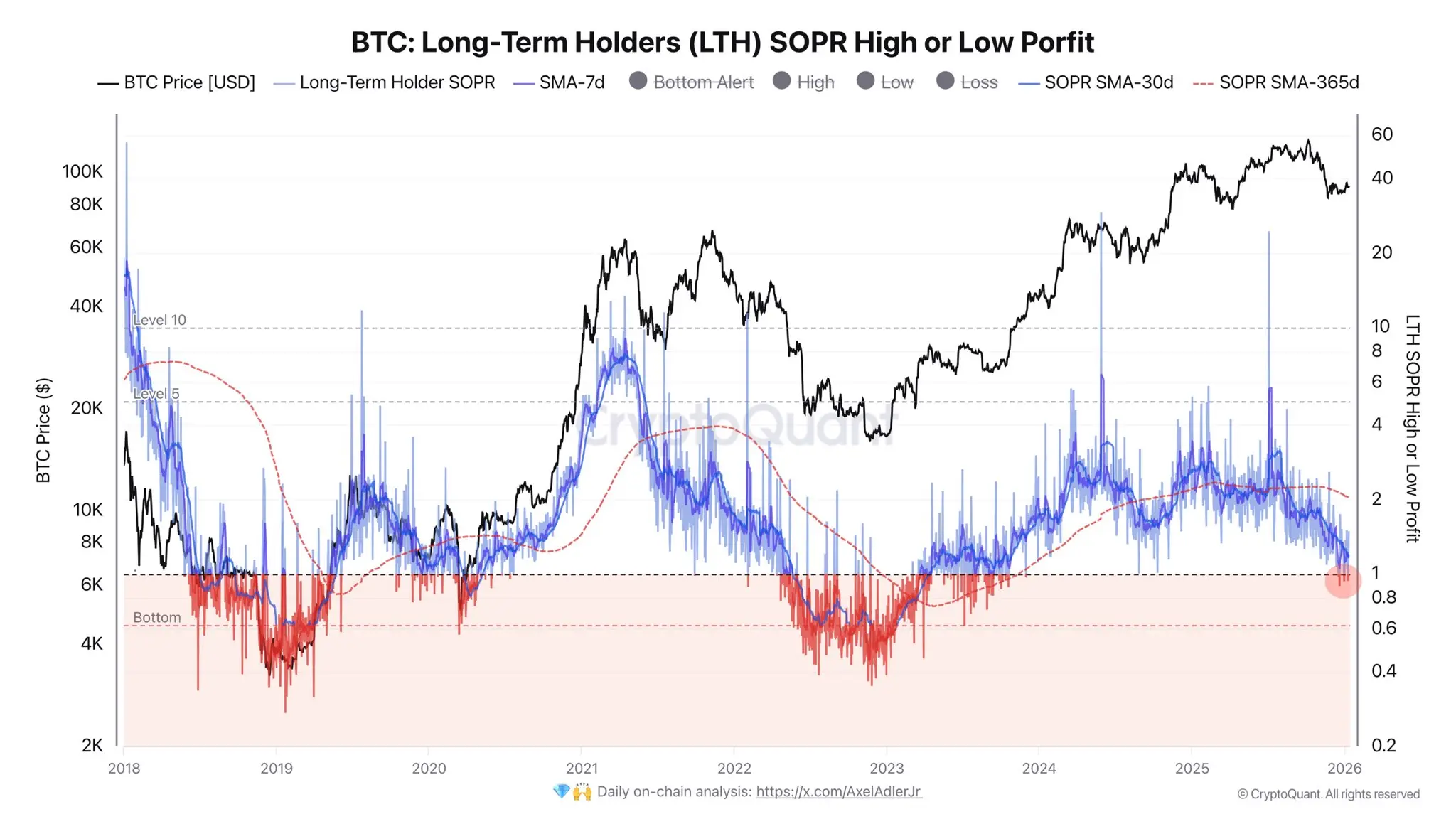 Source: Darkfost This development also coincides with large investors reducing their positions. As previously noted, addresses holding between 1,000 and 10,000 BTC have sold a total of approximately 220,000 BTC over the past year, the fastest decline rate since early 2023.
However, the 30-day moving average of LTH SOPR remains above breakeven at around 1.18, but significantly lower than the annual average near 2.0. This indicates that actual profits are shrinking across the market.
Currently, the market shows conflicting analytical viewpoints. On one hand, LTH SOPR indicates certain pressure and tension; on the other hand, some technical analysts see constructive signals. Egrag Crypto’s analyst points out the emergence of a “hidden bullish divergence” on Bitcoin’s weekly chart, where the price forms higher lows while the RSI indicator forms lower lows—a pattern often signaling a potential continuation of the upward trend.
Additionally, the Sell-Side Risk Ratio—measuring the scale of realized profits and losses—has returned to levels recorded in October 2023, suggesting that distribution is ongoing but at a less intense pace.
Looking ahead, Bitcoin’s outlook will likely depend on its ability to break out of the current accumulation range. Over the past week, the price mostly oscillated between $90,000 and $92,400 with relatively modest volatility. In the last 24 hours, BTC increased by about 1.7% to around $92,200, as short-term holders approach breakeven, according to investor CW.
Analysts suggest that reclaiming the $92,000–$95,000 zone could trigger new buying momentum. However, persistent resistance—possibly the eighth or ninth attempt in recent weeks, according to Ted Pillows—raises concerns that the upward drive may be weakening.
Disclaimer: The information on this page may come from third parties and does not represent the views or opinions of Gate. The content displayed on this page is for reference only and does not constitute any financial, investment, or legal advice. Gate does not guarantee the accuracy or completeness of the information and shall not be liable for any losses arising from the use of this information. Virtual asset investments carry high risks and are subject to significant price volatility. You may lose all of your invested principal. Please fully understand the relevant risks and make prudent decisions based on your own financial situation and risk tolerance. For details, please refer to
Disclaimer.
Related Articles
GameStop Used Bitcoin Holdings for Covered-Call Options Strategy, SEC Filing Reveals
GameStop (NYSE: GME) disclosed in its fiscal 2025 annual report filed on March 24, 2026, that it pledged 4,709 of its 4,710 bitcoin as collateral with Coinbase Credit to execute a covered-call options strategy, generating premium income while maintaining economic exposure to the asset, rather than selling its holdings as market speculation had suggested.
CryptopulseElite38m ago
MARA Sells $1.1B Bitcoin, Repurchases $913M Debt in AI-Focused Pivot
MARA Holdings (NASDAQ: MARA), the world’s largest Bitcoin miner by market capitalization, announced on March 26, 2026, that it sold 15,133 bitcoin for approximately $1.1 billion between March 4 and March 25, while simultaneously repurchasing $913 million of its convertible notes at a discount to reduce outstanding indebtedness by roughly 30%.
CryptopulseElite58m ago
BTC drops below $70,000, long positions wiped out with $300 million liquidated, $14.16 billion options expiring today test the market direction
Bitcoin drops below $70,000, reaching a low of $69,036, with 24-hour liquidation hitting $248 million. Ethereum experiences the highest liquidation. Today, $14.16 billion worth of Bitcoin options expire, with the key strike at $75,000. Market sentiment is extremely fearful, and traditional markets continue to be under pressure. The future trend depends on geopolitical risks and the performance of U.S. stocks.
動區BlockTempo58m ago
Bitcoin and Ethereum account for 80% of the crypto market capitalization.
Bitcoin and Ethereum dominate the cryptocurrency market, holding approximately 67% and 13% of total market capitalization, respectively. This concentration indicates a strong preference for relatively stable assets among investors. Bitcoin is considered "digital gold," while Ethereum leads in decentralized applications and smart contracts. Their price movements significantly influence the overall market trends.
TapChiBitcoin59m ago
Prevent foreign infiltration! The UK will ban encrypted political donations, and the Reform Party, which accepts Bitcoin, strongly protests.
UK Prime Minister Rishi Sunak announced a freeze on party cryptocurrency donations in response to money laundering and foreign interference risks mentioned in the Rycroft report. The report highlights that crypto assets are difficult to trace and could become channels for illegal funds. The ban has been incorporated into the Representation Bill, requiring parties to refund any received crypto donations within a specified period. This move mainly addresses the controversy over the UK Reform Party's $16 million donation, with the government emphasizing that protecting democracy takes precedence over financial innovation.
CryptoCity1h ago


