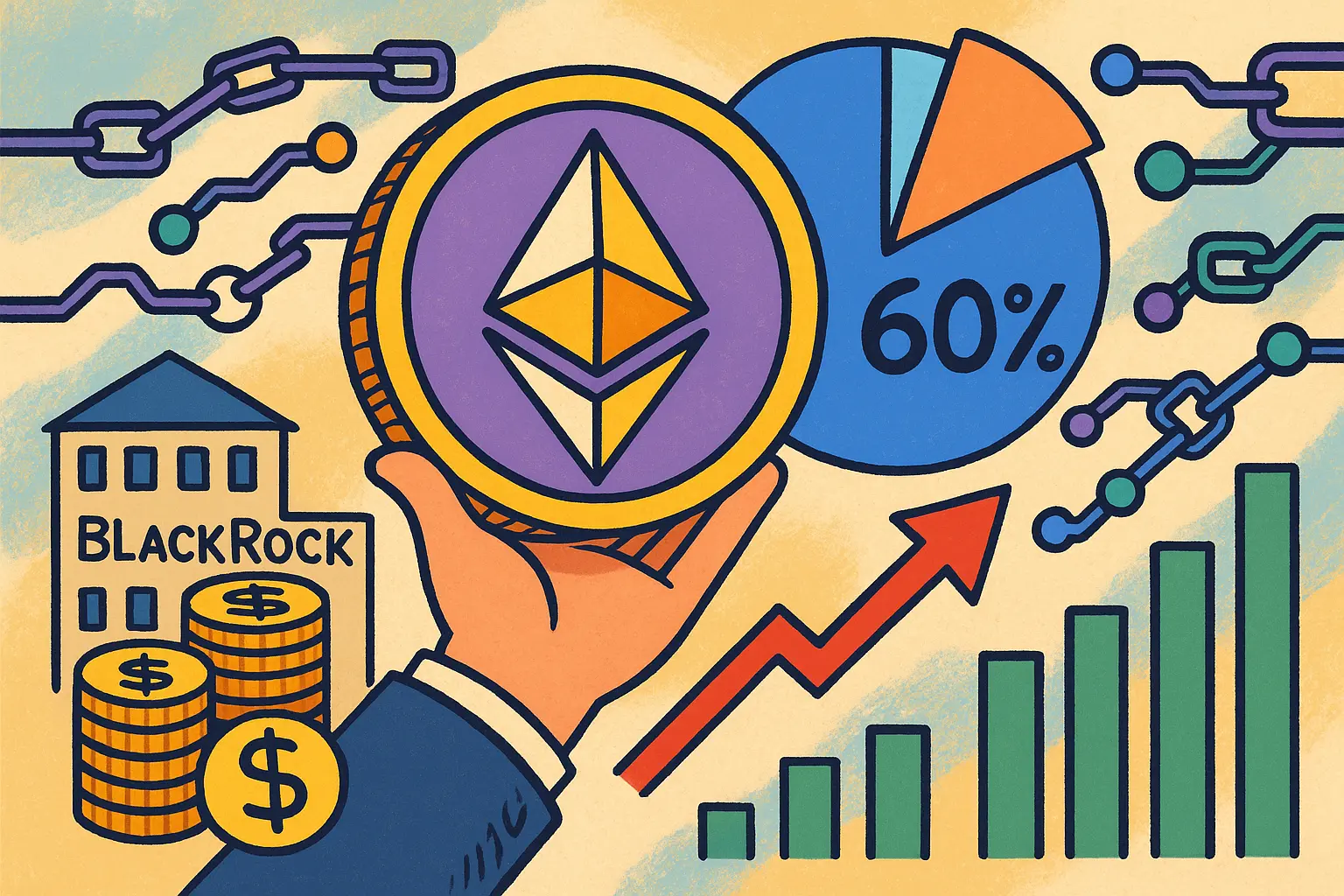
BlackRock’s “2026 Thematic Outlook” places Ethereum at the core of its tokenization theory, claiming that “more than 65% of tokenized assets are on Ethereum” and proposing a “toll road” model. However, the latest data shows that as of January 22, Ethereum’s market share is only 59.84%, with a total value of approximately $12.8 billion. Despite facing multi-chain challenges, BlackRock emphasizes Ethereum’s unshakable position as the foundational layer for issuance, settlement, and fee payments.
Discrepancy Between BlackRock’s 65% Market Share Claim and Reality
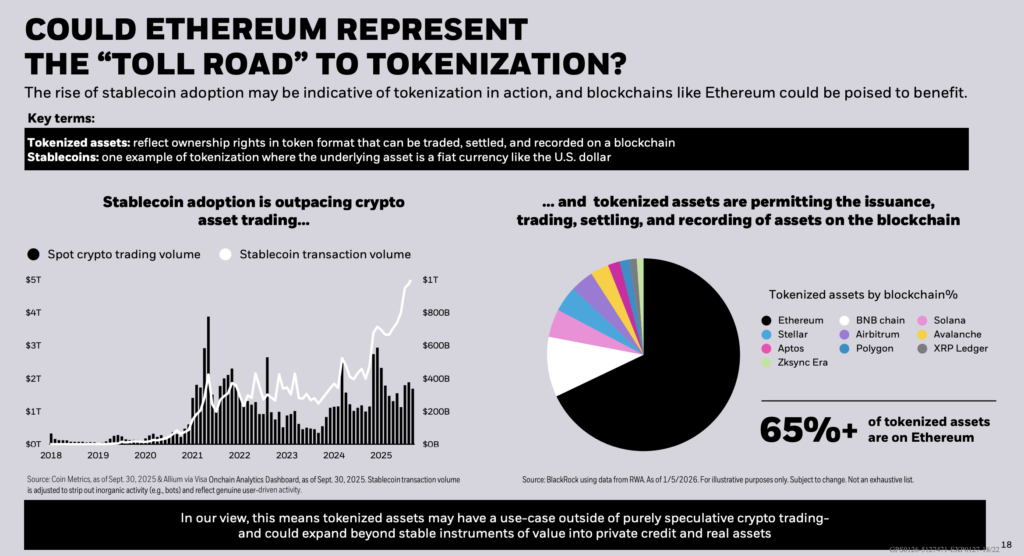
(Source: BlackRock)
BlackRock’s “2026 Thematic Outlook” centers Ethereum in its tokenization theory and questions whether the network can serve as a “toll road.” BlackRock states, “Over 65% of tokenized assets are on Ethereum.” This framework positions Ethereum as an infrastructure layer rather than providing directional guidance for ETH. The “toll road” model depends on where issuance, settlement, and fee payments occur when real-world assets and tokenized cash flow on-chain.
However, market surveys in late January show that the “65%+” figure should be viewed as a snapshot at a specific point in time. The RWA.xyz directory view indicates that as of January 22, the market share of Ethereum tokenized RWA is 59.84%, with a total value of about $12.8 billion. The network view from RWA.xyz also shows that Ether leads by value, with a total (excluding stablecoins) of $13,433,002,447.
These figures differ from the data BlackRock published on January 5, leaving room for share drift. As issuance expands to other blockchains and reporting windows change, such deviations may occur.
Key Data Comparison
BlackRock Data (January 5): Over 65% of tokenized assets on Ethereum
RWA.xyz Directory (January 22): Market share 59.84%, total value approximately $12.8 billion
RWA.xyz Network View (January 22): $13,433,002,447 (excluding stablecoins)
For ETH holders, the future issue is less about whether institutions will tokenize assets and more about whether tokenization will enable settlement of payment fees via ETH pathways. BlackRock leans toward positioning Ethereum as the base layer for tokenized assets. However, if execution shifts toward rollups or tokenized capital distributed across multiple L1s (where users do not need direct ETH interaction), Ethereum’s foundational role could be diminished.
Complexities of L2 Rollups and the Toll Road Theory
Summary from L2BEAT shows that leading Ethereum rollups have already “secured” large pools of value. Arbitrum One is valued at $17.52 billion, Base at $12.94 billion, and OP Mainnet at $2.33 billion, all marked as phase one. This architecture can preserve Ethereum’s settlement capabilities while changing how users pay transaction fees daily.
The economics and fee assets of rollups vary by design. Even if Ethereum remains the underlying security layer, these differences impact fee acquisition. Tokenized cash could become the main throughput driver in tokenized portfolios, with clearer scenario-based mathematical models.
Citi’s stablecoin report forecasts that by 2030, stablecoin issuance could reach $1.9 trillion in baseline scenarios and $4.0 trillion in optimistic ones. Combining these figures with a 50x velocity assumption, they simulate about $100 trillion and $200 trillion in transaction activity, respectively. Mechanistically, even moderate shifts in market share within settlement networks can have an impact if activity scales to these levels.
BlackRock notes that stablecoin transaction volumes are adjusted to “exclude non-natural activity (e.g., bots)” and cites data from Coin Metrics and Allium via the Visa Onchain Analytics dashboard. This limitation narrows the scope of indicators investors can rely on when translating tokenized “activity” into economic benefits.
Contradictions in BlackRock’s Multi-Chain Strategy and the Toll Road Narrative
Multi-chain distribution is already present in institutional product design, complicating any linear “tokenization equals ETH demand” argument. BlackRock’s BUIDL tokenization fund operates across seven blockchains and uses Wormhole for cross-chain interoperability. Even if Ethereum maintains a lead in issuance value or settlement reputation, this provides a pathway for non-Ethereum chains as distribution and practical layers.
This multi-chain approach contrasts interestingly with BlackRock’s public support for Ethereum. On one hand, the report depicts Ethereum as the core infrastructure for tokenization; on the other, its actual product design employs multi-chain distribution. This contradiction reflects a pragmatic stance: theoretically supporting the leading platform but practically maintaining flexibility to reduce platform concentration risks.
Visa considers stablecoin transfer volumes to contain “noise.” For example, Visa states that after removing non-natural growth activities, stablecoin transaction volume over the past 30 days dropped from $3.9 trillion to $817.5 billion. BlackRock’s tokenization slides mention the same concept of excluding bots, linking it to a narrower definition of economic utility. If the “toll road” aims to realize monetization through settlement, the investable variable is the natural settlement demand that cannot be cheaply replicated elsewhere, rather than headline transfer numbers.
Single Ledger Debate and Ethereum’s Decentralization Challenges
Another debate centers on whether institutional tokenization will ultimately form a shared ledger. During the Davos forum week, this topic was widely circulated on social media, including a speech by BlackRock CEO Larry Fink. The World Economic Forum’s recent materials support broader claims about tokenization benefits, including fragmentation and faster settlement. However, the WEF’s 2026 Digital Asset Outlook and tokenization explainer videos do not explicitly endorse a “single blockchain” narrative.
Regarding Ethereum’s decentralization, its investment value lies in whether, as tokenization links to large issuers and regulated venues, the base layer can remain neutral. The “transparency” claim depends on credible resistance to unilateral changes and the ultimate solutions inherited by downstream layers.
Today, data from L2BEAT’s phase framework and value guarantees show that under Ethereum’s security, rollup scale continues to grow; meanwhile, BlackRock’s multi-chain promotion indicates major issuers are reducing platform concentration risks. BlackRock’s “toll road” narrative sets market share at over 65%, but this is an outdated metric. Recent RWA dashboards and multi-chain product launches in late January highlight that the recent battleground is share, settlement location, and natural usage metrics.
The same dynamics could influence investors’ interpretations of growth in tokenized bonds and other on-chain issuance categories. Despite challenges like declining market share and multi-chain competition, BlackRock remains committed to Ethereum as the core for tokenized access, reflecting institutional confidence in the network’s long-term value proposition.
Disclaimer: The information on this page may come from third parties and does not represent the views or opinions of Gate. The content displayed on this page is for reference only and does not constitute any financial, investment, or legal advice. Gate does not guarantee the accuracy or completeness of the information and shall not be liable for any losses arising from the use of this information. Virtual asset investments carry high risks and are subject to significant price volatility. You may lose all of your invested principal. Please fully understand the relevant risks and make prudent decisions based on your own financial situation and risk tolerance. For details, please refer to
Disclaimer.
Related Articles
BTC is quoted at about $71,646, up about 6.1% from $76,000; ETH is quoted at about $2,215
Gate News update, April 12, BTC’s current price is about $71,646, up about 6.1% from $76,000; ETH’s current price is about $2,215, up about 8% from $2,400.
GateNews1h ago
NewsAlert: Trump Issues Iran Ultimatum – How BTC, ETH, And XRP is Reacting
Trump raised the temperature again with a fresh Iran deadline and warnings of overwhelming force. The rhetoric was extreme, and markets treated it as immediate macro risk.
To be precise, widely cited reports quote Trump saying Iran could be destroyed “in one night” if no deal is reached, not
LiveBTCNews1h ago
Ethereum New Users Jump 82 Percent In Q1
Ethereum has started the year with strong momentum, and the latest data confirms it. New users on the network surged sharply during the first quarter. This rise signals renewed interest across the broader crypto ecosystem. It also reflects growing confidence in blockchain-based platforms.
Data
Coinfomania1h ago
Ethereum Devs Signal Glamsterdam Devnet Launch Next Week as Upgrade Progresses - U.Today
Ethereum's upcoming upgrade, Glamsterdam, is progressing slowly, with developers targeting next week for its first devnet. Key features include gas repricings and EIP-7954. The upgrade is expected in 2026, while future upgrades like Hegotá are also underway.
UToday2h ago
Macro investors: A BTC breakout above $76,000 and an ETH breakout above $2,400 may signal a trend reversal
Macro investor Jordi Visser believes that if Bitcoin and Ethereum break through $76,000 and $2,400 respectively, it will kick off a sustainable uptrend. He expects high inflation to push investors to seek profitable assets, and notes that the probability of an economic recession has fallen to 24%. This view contrasts with the current bearish expectations in the crypto industry.
GateNews2h ago
ETH is down 55% from its all-time high and is currently trading at $2212
Gate News message. On April 12, data from a certain CEX market shows that ETH is currently trading at $2,212, down 55% from its all-time high. ETH’s all-time high was $4,957 on August 25, 2025.
GateNews3h ago


