Author: seed.eth
On the last trading day of January 2026, the global financial markets witnessed a historic “moment of shock.”
On Friday, January 30th, Eastern Time, the previously soaring and record-high precious metals markets were hit by a “cold snap.”
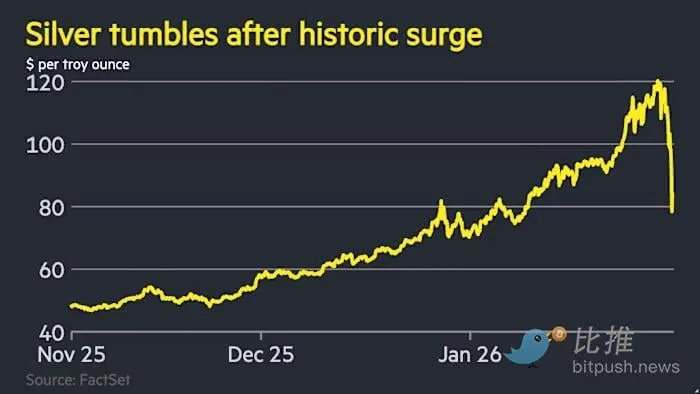
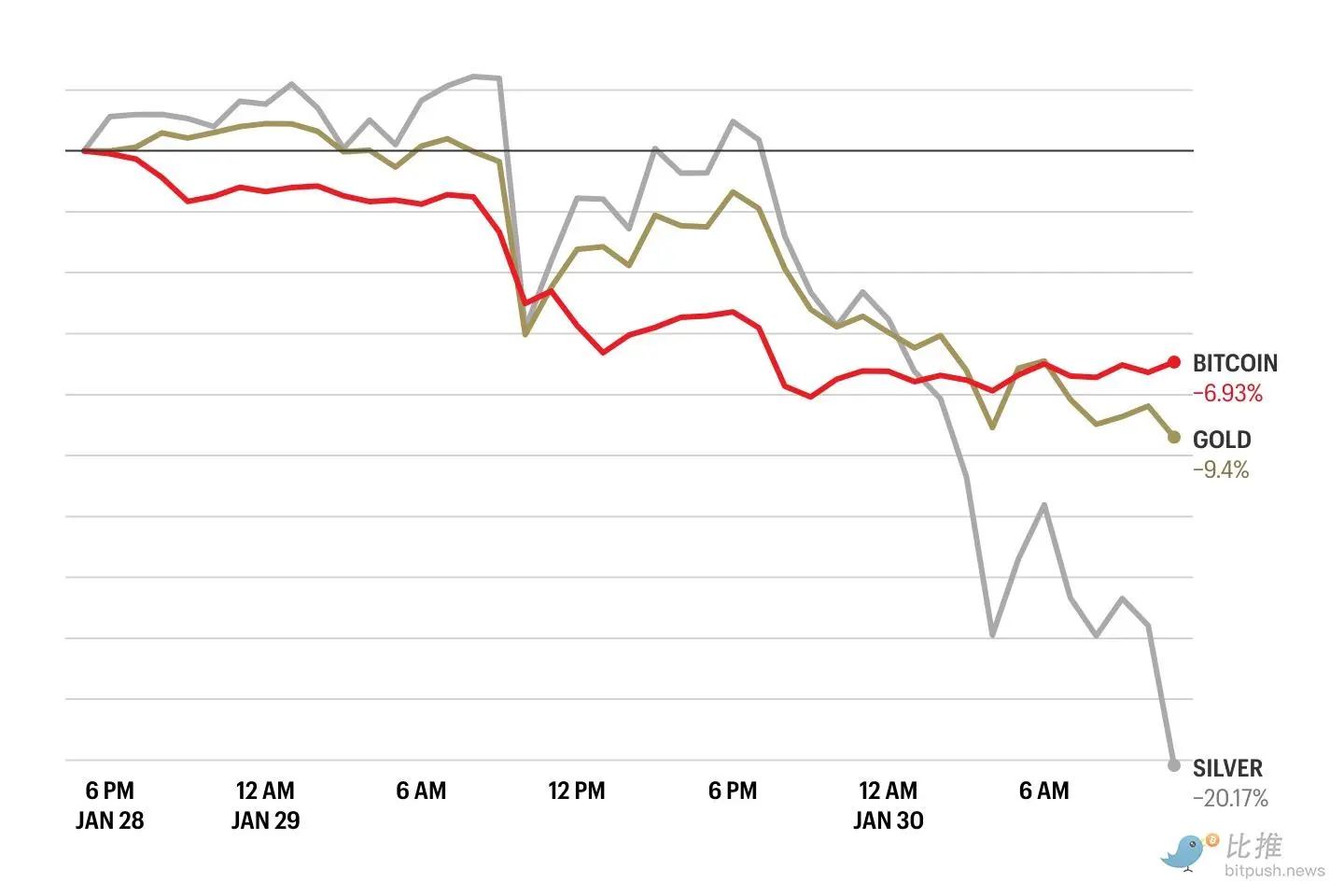
Spot silver experienced the largest single-day decline in history, plunging over 30% at one point during the session; spot gold was not spared, with a single-day drop of over 9%, marking the worst loss since the early 1980s. Meanwhile, the previously weak US dollar index (DXY) surged like a weed after a drought, posting the largest single-day increase since July last year, rebounding about 0.9%.
In the US stock market, the S&P 500 index fell 0.4%, the Dow Jones Industrial Average declined 0.4%, and the tech-heavy Nasdaq dropped 0.9%.
The cryptocurrency market was also not immune. Bitcoin (BTC) briefly plummeted 4% to $81,045, touching a two-month low since November last year. Although it rebounded somewhat afterward, it remained weak under the pressure of ETF outflows.
This global asset reorganization not only wiped out trillions of dollars in market value from the precious metals sector but also marked the first major correction since Trump returned to the White House, challenging the “weak dollar, strong gold and silver” trading logic.
Policy “Hurricane”: Waugh Nomination Sparks US Dollar Counterattack
The direct trigger for the sharp decline in gold and silver was a major personnel appointment by the Trump administration. On Friday, news broke that Trump had chosen Kevin Warsh to be the next Federal Reserve Chair.
This decision caused multiple shocks in the market:
- Defending the Fed’s independence: Previously, markets were highly concerned that Trump would choose a completely obedient figure inclined toward aggressive rate cuts, which had directly driven the dollar lower throughout January. Warsh, a former Fed governor known for his academic rigor and inflation vigilance, greatly eased Wall Street fears of the Fed becoming politicized, restoring confidence in its independence.
- Reshaping rate expectations: Warsh has historically shown a clear “hawkish” stance, with near-zero tolerance for inflation. Compared to the previously popular candidates who might have brought deep rate cuts, markets quickly adjusted expectations toward “more moderate and cautious” monetary policy. As an asset that does not generate interest, gold and silver’s appeal sharply declined under the expectation that rates might stay high.
- Dollar short covering: In January, the dollar index fell about 1.4%, with extremely crowded short positions. Warsh’s nomination prompted a large number of dollar shorts to cover, causing the dollar index to rapidly rise above 96.74, dealing a heavy blow to dollar-denominated precious metals.
Krishna Guha, Vice Chairman of Evercore ISI, said that the market is trading based on “hawkish Warsh,” and “Warsh’s nomination helps stabilize the dollar and reduces the unilateral risk of continued dollar weakness, challenging the logic of ‘currency devaluation trade’—which is also the reason for the sharp decline in gold and silver.”
Liquidity Crisis in Overbought Zones
If Warsh’s nomination is the “Mars,” then the extremely overbought condition of the gold and silver markets is the “dry tinder.”
Before the crash on January 30th, spot gold once approached the $5,600 per ounce level, and silver soared past $120 per ounce. Since the beginning of the year, silver has gained as much as 63%, and gold has increased nearly 20% within the month. A Wall Street quant strategist said, “This is no longer a rally explainable by fundamentals but a typical FOMO (Fear of Missing Out) driven speculative bubble.”
Multiple technical factors led to Friday’s “stampede” decline:
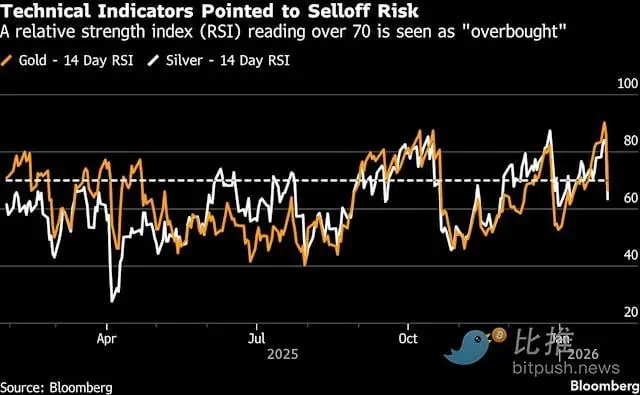
RSI Peak: Gold’s Relative Strength Index (RSI) hit a 40-year high before the plunge (approaching 90), indicating extreme overbought conditions.
Forced Liquidation: Due to its high leverage, the silver market triggered large-scale algorithmic stop-losses after breaking key support levels. Estimates suggest that the market cap of gold and silver shrank by as much as $7.4 trillion on Friday. Such a scale of sell-off has evolved into a “liquidity contraction,” with investors forced to sell the most liquid assets—gold and silver—to cover margins elsewhere.
Profit-taking: Early investors showed a strong desire to cash out when faced with policy signals shifting.
The combination of a strengthening dollar and plunging gold and silver directly hit commodity currencies among G10 currencies.
AUD (Australian Dollar): Dipped over 2% intraday. As a resource-exporting leader, the collapse of gold and silver directly damaged its trade foundation, making it the “biggest casualty” among G10 currencies that day.
CHF (Swiss Franc): Fell about 1.5%. The plunge in gold prices completely cut off the safe-haven premium of the Swiss Franc, causing funds to panic and flow into the dollar supported by hawkish expectations.
SEK (Swedish Krona): Dropped nearly 1.8% intraday.
Market Outlook: “Bull Market Correction” or “End Signal”?
For the future, a research report from Citibank offers a calm perspective. Citibank points out that half of the risk factors supporting gold (such as geopolitical tensions, US debt concerns, AI uncertainties) may diminish later in 2026.
- Middle East and Russia-Ukraine uncertainties: As the Trump administration strives for “American-style stability” before the 2026 midterm elections, easing tensions in Russia-Ukraine and Iran could further erode gold’s safe-haven premium.
- American-style gold stability: Citibank’s mention of “American-style gold stability” suggests that if Warsh successfully takes office and stabilizes the Fed’s credibility, the dollar will regain favor among international capital, exerting medium-term downward pressure on gold prices.
However, some analysts hold different views.
Nanhua Futures pointed out that despite short-term turbulence, demand for silver in new energy and industrial sectors remains strong, and supply gaps are long-term. The recent plunge is more about “deleveraging” and “popping bubbles” rather than a fundamental breakdown.
JPMorgan analysts are optimistic about gold’s long-term prospects. In their latest report, they stated that both private investors and central banks are increasing their allocations to gold.
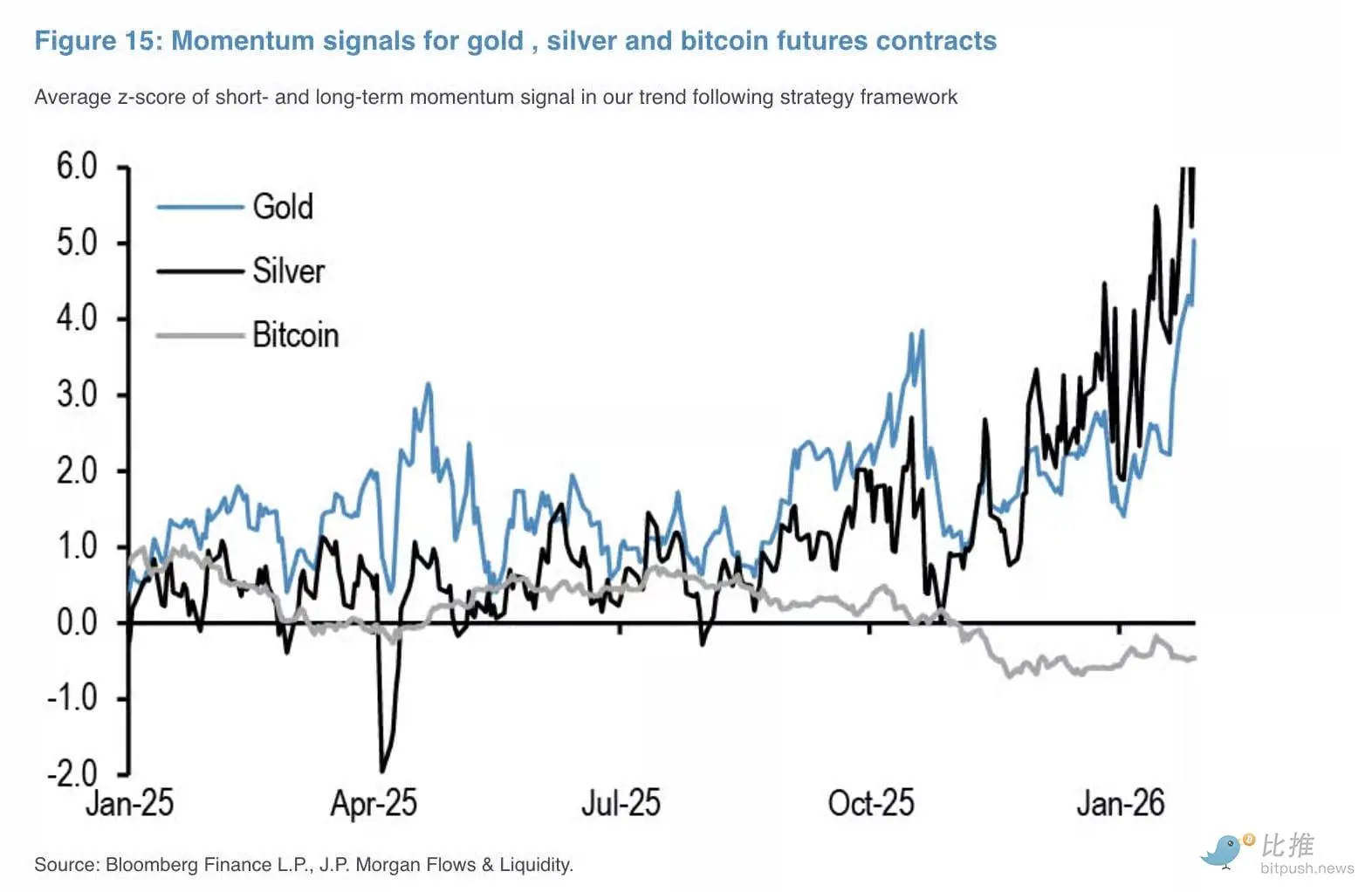
Analysts used the Hui-Heubel ratio (a measure of market breadth and liquidity) to emphasize the structural differences in liquidity among assets. Charts show that gold’s Hui-Heubel ratio has always been relatively low, indicating stronger liquidity and higher market participation. Silver’s ratio is higher, reflecting weaker liquidity. Assuming people continue to substitute gold for long-term bonds as a hedge against stocks, the proportion of private investors’ gold holdings could rise from just above 3% to about 4.6% in the coming years. Under this scenario, analysts believe the theoretical price range for gold could reach $8,000 to $8,500 per ounce.
For ordinary investors, the key point now is:
If Warsh takes office and the Fed’s policy focus truly shifts from “blindly supporting growth” to “returning to monetary discipline,” 2026 could become a pivotal year for the global financial environment.
This shift would mean: the dollar index is expected to end its year-long decline and regain its dominance as the world’s reserve currency; meanwhile, gold and silver, pushed to the peak by previous frenzy, may be forced into a long and painful consolidation phase to digest the bubble premiums accumulated over the past few years. The outlook for Bitcoin will become even more uncertain.
Related Articles
Bitcoin Breaks Through $72,000: The Iran–Israel ceasefire boosts risk assets, with $427 million in short positions liquidated, but Polymarket shows disagreement on end-of-year outlook
Bitcoin broke through $72,000 on April 10, mainly due to a fragile ceasefire agreement between the U.S. and Iran that boosted market risk appetite, with funds flowing from safe-haven assets into Bitcoin. Increased institutional inflows and a rebound in Large Investors’ holdings are driving the price higher. Technical analysis shows that the main resistance lies in the $72,200 to $73,500 range. Despite a bullish outlook in the short term, there is still disagreement over forecasts for Bitcoin’s price by year-end, and the risk of a pullback also needs to be watched.
ChainNewsAbmedia16m ago
TAO (Bittensor) down 16.28% over the past 24 hours
Gate News message, on April 10, according to Gate market data, as of the time of publication, TAO (Bittensor) is trading at $269.80, down 16.28% over the past 24 hours. It reached a high of $341.10 and fell to a low of $248.60. The 24-hour trading volume is $14.71 million. The current market cap is approximately $2.59B.
Bittensor is an open-source protocol that supports a decentralized, blockchain-based machine learning network. Machine learning models train collaboratively and earn rewards in TAO based on the value of the information they provide to the collective. TAO also enables external access, allowing users to extract information from the network and adjust network activity according to their own needs.
---
Key recent news about TAO:
1️⃣ **
GateNews1h ago
The Strait of Hormuz is open! Iran demands tolls be paid in Bitcoin, and the Persian Gulf still has “big ships”
The Iranian government charges oil tankers a $1 per-barrel toll for passage through the Strait of Hormuz and requires payment in bitcoin to bypass U.S. sanctions. This move has caused extreme volatility in the cryptocurrency market, with bitcoin’s price surging, highlighting the importance of digital assets in geopolitics. Global shipping has been disrupted, Iran and the United States have taken differing positions in ceasefire talks, and financial markets have also roiled in response to this event.
CryptoCity1h ago
Bitcoin sees over 27k options contracts expire! Analyst: Bear market characteristics continue to dominate
According to Greeks.live data, April 10 saw BTC and ETH options expire. For BTC options, the number of contracts was 27,000, the Put/Call Ratio was 0.71, and the maximum pain point was $69,000. For ETH, it was 151,000 contracts, and the Put/Call Ratio was 0.77. The analysis indicates that market characteristics are skewed bearish, and falling implied volatility suggests the market expects less short-term volatility. Despite the recent rebound, internal momentum in the market has not formed, and no clear sentiment shift has been observed.
MarketWhisper1h ago
Fed Minutes Keep Bitcoin Traders Guessing as Iran Risk Clouds the Next Four Weeks
The Federal Reserve's recent minutes revealed mixed signals on potential rate changes, influenced by inflation and geopolitical tensions. Bitcoin's price is currently around $71,000, with analysts divided on its future amid these macroeconomic pressures, relying on factors like the Iran ceasefire and inflation trends.
CryptoNewsFlash3h ago
Liquid Capital founder Yihua Yi: Long-term bullish but must respect market cycles; currently focusing on AI transformation
Liquid Capital founder Yi Lihua analyzed the reasons the market is under pressure during an AMA, emphasizing that the long-term outlook remains bullish on ETH, but that the market cycle and volatility must be respected. He pointed out the importance of AI technology for business transformation and shared his successful experience investing in companies after they adopted AI for transformation.
GateNews3h ago


