
- Vitalik Buterin has donated to Shielded Labs, an independent organization that advances Zcash’s privacy-focused technology.
- He donated to support the development of Crosslink, a security upgrade to Zcash that adds a finality layer on top of the network, preventing rollback attacks.
Ethereum founder Vitalik Buterin has shown support for privacy-focused crypto project Zcash by donating to a company advancing the network’s security. Shielded Labs announced that the revered crypto leader had donated to its cause, with the funding being channeled to the development of Crosslink, a security upgrade that would prevent rollback attacks on the Zcash network.
https://t.co/wC7b7TmD5u
— Shielded Labs (@ShieldedLabs) February 6, 2026
Shielded Labs is an independent organization based in Switzerland that supports the development of the Zcash network. It survives on donations and has never received support from the network’s Development Fund. The organization stated:
“The contribution will be used to advance Crosslink from its current prototype stage toward a persistent, incentivized testnet and eventual production readiness.”
On his part, Buterin lauded the work that Zcash and its founder, Zooko Wilcox, are doing, adding that introducing a hybrid proof-of-stake consensus mechanism to the network would greatly improve it.
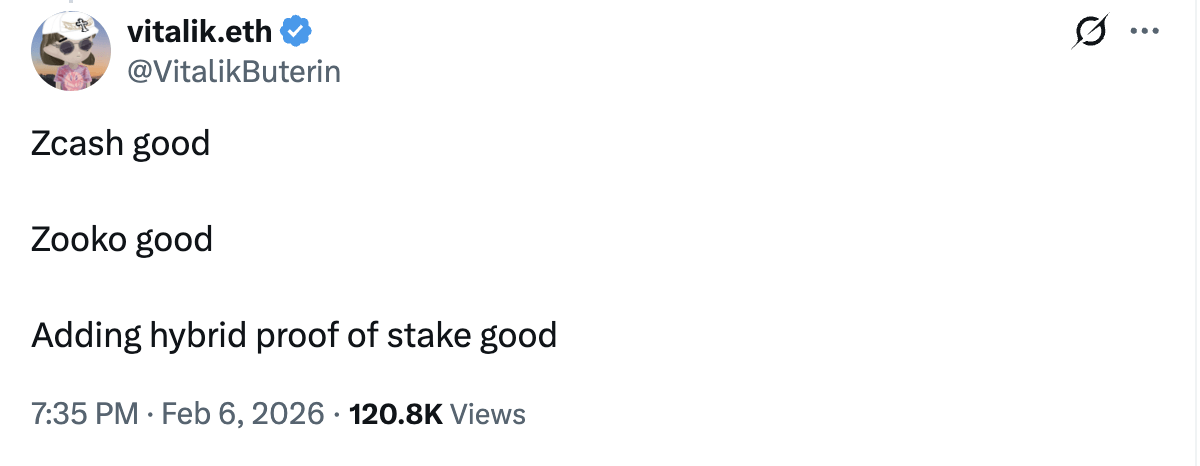
Image courtesy of Vitalik Buterin on X.
He added, “Zcash is one of the most honorable crypto projects with a steadfast focus on privacy. Shielded Labs’ Crosslink work will allow Zcash to be more secure and on a lower security budget, supporting its long-term sustainability.” Buterin is a long supporter of privacy initiatives. In November, he funded Session and SimpleX, two projects working on on-chain privacy, as we reported.
How Crosslink Changes ZCash
Crosslink is a protocol upgrade that adds a new finality layer on Zcash’s existing proof-of-work mechanism. This new layer would depend on proof-of-stake, making Zcash a hybrid network.
If adopted, miners would continue to add blocks, but ZEC holders would stake their coins and vote on PoW blocks, which cannot be reorganized once finalized. Theoretically, Zcash blocks can be rolled back under the current setup in a reorganization attack, although it hasn’t happened yet.
One of the big changes under Crosslink would be the economic model. Today, the miners receive 80% of the block reward for each new block, which is currently at 1.5625 ZEC per block, or $363 at current prices. Under the proposed model, they would have to split this with the stakers and validators, although the exact split has not been finalized.
Shielded Labs says:
“Stronger finality allows for shorter confirmation requirements for exchanges, improves reliability for cross-chain integrations, and provides the consistency required by applications that depend on predictable settlement. These improvements make Zcash easier to integrate into the broader crypto ecosystem while maintaining its existing security properties.”
Josh Swihart, the former CEO of Electric Coin Company (ECC), is among the top Crosslink critics. ECC is the company that founded Zcash, with Swihart becoming the network’s de facto leader after original founder Wilcox stepped back. As we reported, ECC departed from the ecosystem in January after a dispute with Bootstrap, a non-profit overseeing development.
Swihart dismissed claims that Crosslink makes the network more secure or faster, saying there are better ways to create shielded stables without adding complexity. He added that there are other upgrades on the pipeline, like Tachyon, that achieve the stated goals without compromising on the network’s usability.
While I appreciate the ideas and people behind Crosslink and ZSAs, I don’t believe either is right for Zcash.
The protocol and ZEC are elegant in their simplicity of use cases as an encrypted store of value and medium of exchange.
There is no need to add complexity.
— Josh Swihart 🛡 (@jswihart) November 23, 2025
ZEC trades at $235.60, and after a brutal week during which it lost more than a third of its value, it has gained 10% in the past 24 hours as the markets recover.
Disclaimer: The information on this page may come from third parties and does not represent the views or opinions of Gate. The content displayed on this page is for reference only and does not constitute any financial, investment, or legal advice. Gate does not guarantee the accuracy or completeness of the information and shall not be liable for any losses arising from the use of this information. Virtual asset investments carry high risks and are subject to significant price volatility. You may lose all of your invested principal. Please fully understand the relevant risks and make prudent decisions based on your own financial situation and risk tolerance. For details, please refer to
Disclaimer.
Related Articles
Robert Kiyosaki warns of a “fake coin” crash, insisting Bitcoin is the safest asset for 2026
Robert Kiyosaki, in a recent post, said that Bitcoin and Ethereum could become the safest investments of 2026, because the United States continues to print money, debt is rising, and inflation is worsening. He criticized the safety of U.S. Treasuries as “the biggest lie,” and noted that real assets and cryptocurrencies can preserve wealth during inflation. His investment recommendations include holding Bitcoin, gold, silver, and commodities. Although some of his predictions weren’t accurate, some of his long-term predictions have come true.
MarketWhisper2h ago
ETH 15-minute surge of 0.97%: Tightened on-chain net outflows and DeFi lockups both supporting the price rise
2026-04-05 15:15 to 2026-04-05 15:30 (UTC), during this period ETH’s return within 15 minutes was +0.97%, the price range was 2040.32 to 2063.89 USDT, and the amplitude reached 1.15%. During this period, market attention increased, volatility clearly intensified, and short-term capital remained active, driving ETH slightly higher.
The main drivers of this abnormal move are ETH’s net outflows from exchanges and the persistently high DeFi locked-in amount. According to on-chain data, the 24-hour net outflow amount reached -11,970.54 E
GateNews3h ago
ETH 15-minute drop of 0.62%: Large funds withdrawing in size and ETF net outflows converging to amplify volatility
From 2026-04-05 12:30 to 12:45 (UTC), the ETH price range is 2022.11 to 2037.82 USDT. The 15-minute K-line return is -0.62%, and the amplitude is 0.77%. Against the backdrop of elevated on-chain activity, market attention has increased, volatility has picked up, and this reflects stronger short-term risk-averse sentiment.
The main driver behind this unusual move is that large funds have continued flowing out of exchanges. Data shows that in the past 24 hours, ETH net outflows were as high as -11,970.54 coins, and in the $1M-$10M range, large net outflows were -5
GateNews6h ago
10x Research: Tether’s USDT issuance on Ethereum surpasses Tron—ETH could become the main beneficiary of stablecoin growth
10x Research noted that over the past five years, Ethereum (ETH) has performed lackluster, with its price trading around $2,000, mainly due to weak on-chain activity leading to insufficient demand. After falling 57% from its 2025 peak, ETH’s current valuation remains low, while capital accumulation is still ongoing; USDT’s issuance has surpassed Tron, sparking discussion that ETH could become a leading beneficiary of stablecoin growth. Analysts are now re-evaluating ETH’s potential turning point.
GateNews7h ago


