Decred (DCR) has experienced a recovery of over 7% at the time of writing on Friday, following a three-session correction that caused the price to drop nearly 14%. This upward momentum was significantly supported by a trading volume surge of approximately 60% over the past 24 hours, reflecting a clear improvement in demand in the spot market. However, from a technical perspective, Decred still faces considerable resistance around the $26 mark — a zone that has repeatedly limited its upward movement since late November.
Decred Continues Effort to Break Through Key Resistance Zone
According to data from CoinMarketCap, Decred’s trading volume reached $6.3 million as of Friday, marking an impressive 57% increase compared to 24 hours earlier. This movement aligns with the recovery seen on Friday and indicates that market sentiment is increasingly bullish.
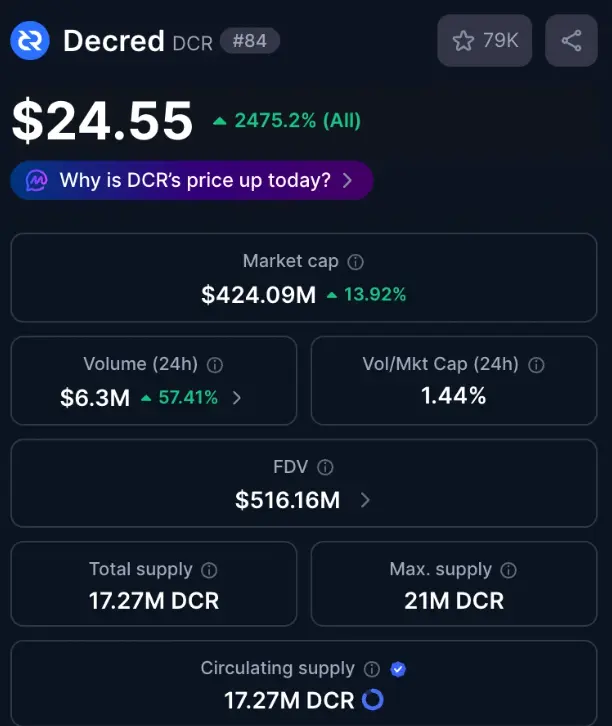 Decred Market Statistics | Source: CoinMarketCap## Technical Outlook: Will Decred Extend Gains Beyond Critical Resistance?
As of Saturday when this article was written, Decred is trading around the $24 level, showing a recovery after three consecutive declines with a gain of over 7%. Notably, this privacy-focused token remains above the 50-day and 200-day exponential moving averages (EMAs) — a technical signal suggesting that the bullish trend still dominates.
However, Decred’s recovery faces a significant obstacle at the Fibonacci 38.2% retracement level near $26.13. This level is based on the decline from the peak of $70.00 on November 4 to the bottom of $14.21 on December 23. In a positive scenario, if the price can break through and close firmly above this resistance zone on the daily timeframe, Decred is likely to target higher resistance levels at the Fibonacci 50% and 61.8%, corresponding to $31.54 and $38.07 respectively.
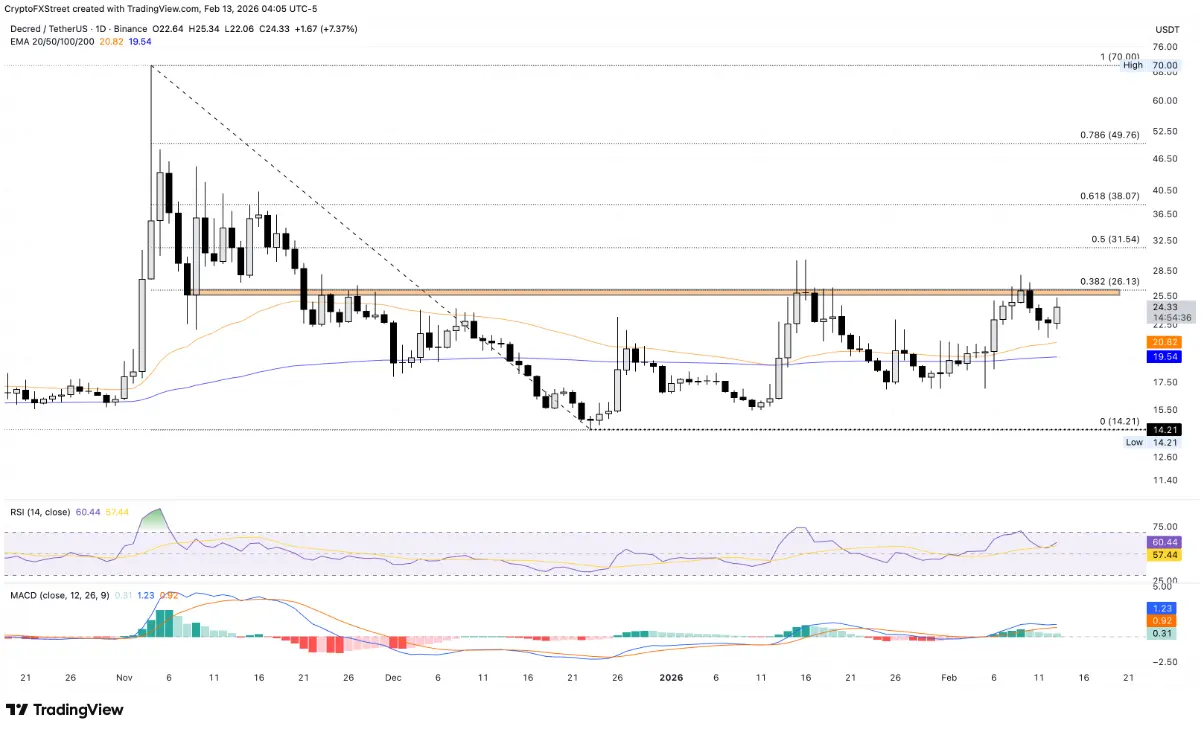 Daily DCR/USDT Chart | Source: TradingViewTechnical indicators on the daily chart are currently sending mixed signals, reflecting market indecision around the key price zone. The Relative Strength Index (RSI) at 60 indicates that the price has moved above the neutral line, implying increasing short-term buying pressure with room to continue upward before entering overbought territory.
Conversely, the MACD indicator is trending sideways and faces the risk of crossing below the signal line — a potential sign of weakening momentum. Additionally, the shrinking green histogram bars suggest diminishing bullish momentum, increasing the likelihood of a correction in the near future.
On the support side, the 50-day and 200-day EMAs, located at $20.82 and $19.54 respectively, are expected to serve as important buffers if selling pressure resumes.
SN_Nour
Disclaimer: The information on this page may come from third parties and does not represent the views or opinions of Gate. The content displayed on this page is for reference only and does not constitute any financial, investment, or legal advice. Gate does not guarantee the accuracy or completeness of the information and shall not be liable for any losses arising from the use of this information. Virtual asset investments carry high risks and are subject to significant price volatility. You may lose all of your invested principal. Please fully understand the relevant risks and make prudent decisions based on your own financial situation and risk tolerance. For details, please refer to
Disclaimer.
Related Articles
Michael Saylor: The next phase of Bitcoin is digital credit
MicroStrategy founder Michael Saylor proposes the concept of digital credit as a development direction for the cryptocurrency market. Using STRC preferred stock as an example, he emphasizes its low volatility and high yield characteristics. In Saylor's three-layer digital capital framework, digital credit aims to provide stable returns and bridge the gap in institutional crypto allocations, although it also faces critics' concerns about its sustainability.
MarketWhisper10m ago
JPMorgan: Bitcoin absorbs Iran war hedge funds, gold ETF experiences significant outflows
JPMorgan report indicates that due to the Iran conflict, Bitcoin outperformed gold and silver, the latter of which experienced significant declines due to rising interest rates and a strong dollar. Gold's high-position holdings were forcibly liquidated under market pressure, leading to capital outflows. Bitcoin remained stable, demonstrating its appeal as a safe-haven asset, especially amid geopolitical tensions. The report also emphasizes that Bitcoin's market liquidity has surpassed gold, indicating an improvement in its structural position.
MarketWhisper40m ago
Why did Bitcoin drop today? Trump extends Iran ceasefire period by 10 days, negotiations face disagreements.
U.S. President Trump extends the ceasefire period with Iran until April 6, but Iranian officials deny the request, leading to continued market pessimism about the prospects of negotiations. As the U.S. 10-year Treasury yield rises to 4.42%, the attractiveness of high-risk assets like Bitcoin diminishes, preventing a rebound and instead continuing to face selling pressure. The market is sensitive to liquidity conditions, and in the short term, attention should be paid to the direction of yields and spot demand.
MarketWhisper45m ago
Today, the cryptocurrency Fear & Greed Index rose to 13, indicating extreme fear in the market.
Gate News reports that on March 27, data from Alternative.me shows that today’s cryptocurrency Fear and Greed Index has risen to 13, indicating the market is in a state of "extreme fear." Yesterday, the index was 10, also in the "extreme fear" zone.
GateNews1h ago
23.91% Plunge for KMD: What It Means for Traders
KMD has seen a significant decline, trading at $0.005324 after dropping 54.20% in 24 hours. Increased market activity and liquidation events in the derivatives market are contributing to the volatility, prompting traders to focus on risk management.
Coinfomania1h ago


