
President Trump’s Peace Commission plans to implement a US dollar stablecoin in the Gaza Strip to rebuild the collapsing payment system and cut off Hamas funding. However, the project currently faces concerns over the lack of a regulatory framework.
President Trump’s Peace Commission Explores US Dollar Stablecoin as Gaza Reconstruction Plan
The Financial Times reports that five informed sources say officials collaborating with the Peace Commission established by Trump are evaluating the feasibility of issuing a stablecoin for the Gaza Strip, aiming to reshape the severely damaged local economy.
The Gaza stablecoin is expected to be pegged to major currencies like the US dollar. Discussions are still in the early stages, and specific implementation details in Gaza are yet to be determined.
The Peace Commission was established in January this year, with membership requiring contributions of $1 billion from each country, including Israel, Saudi Arabia, Hungary, and El Salvador as founding members. The United States has pledged $10 billion.
Conflict Disrupts Traditional Banking and Payments in Gaza
During the two-year war between Israel and Hamas, Gaza’s economy has completely collapsed, and traditional banking and payment systems have been severely damaged. ATMs have been destroyed or shut down, and Israel has blocked new cash inflows, severely limiting residents’ access to cash, forcing them to turn to digital transactions.
Another informed source revealed that, besides providing digital transaction solutions, the initiative also aims to reduce cash circulation in Gaza to cut off any funding channels for Hamas.
- **Related report:**Understanding the Israel-Palestine Conflict in 5 Minutes! Who Can Resolve a Century-Old Grudge? Will the Middle East Crisis Hurt the Global Economy?
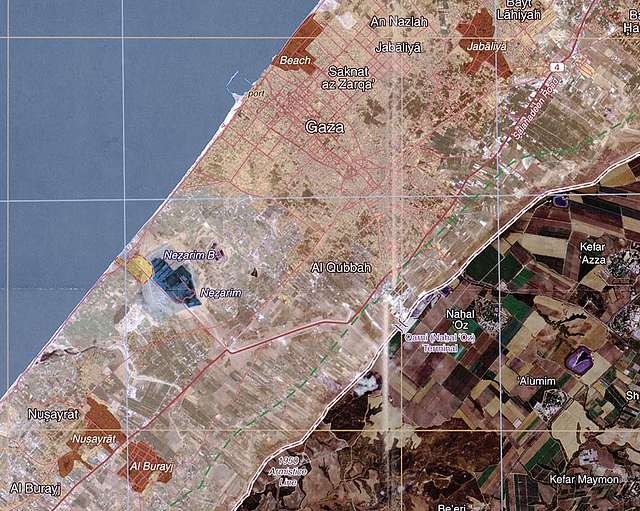
Image source: Collections - GetArchive Map of Gaza Strip in 2025
Commission Aims to Have an International Expert Team Lead Gaza Stablecoin Framework
Sources say that the stablecoin issued in Gaza is expected to be pegged to the US dollar, and they hope that Gulf Arab countries and Palestinian businesses with digital currency expertise can assist in advancing this plan. They do not intend to issue a new Gaza-specific currency; the main goal is to provide Gaza residents with digital transaction channels.
The concept of Gaza stablecoin is currently led by Israeli tech entrepreneur and retired military officer Liran Tancman, who is serving as a volunteer advisor at the US-based Peace Commission responsible for Gaza reconstruction.
Participants also include the Palestinian new tech bureaucratic government, the Gaza Administrative National Committee composed of fourteen members, and the Office of the High Representative led by former UN Special Envoy Nickolay Mladenov. Both organizations operate under the framework of the Peace Commission.
Lack of Regulatory Framework Raises Industry Concerns Over Gaza Stablecoin
The Financial Times did not specify which entity would be responsible for issuing the stablecoin if the commission proceeds with the plan.
Snir Levi, CEO of blockchain information platform Nominis, questions this, stating that the Gaza stablecoin proposal is still very immature.
He points out that over the past two years, over $100 million worth of stablecoins have been transferred through unregulated over-the-counter (OTC) markets in Gaza, and he worries that future Gaza stablecoins could face similar regulatory issues.
Gaza Administrative National Committee Building Secure Digital Infrastructure
While expanding digital transactions can help Gaza’s local businesses continue operating despite changes in Israeli government policies, some participants worry that if future digital currencies are not controlled by the Palestinian Financial Authority, it could further sever Gaza’s economic ties with the West Bank.
Tancman stated at a Washington conference last week that the Gaza Administrative National Committee is working to establish a secure digital backbone network and open platform to support electronic payments, financial services, digital learning, and healthcare. They also pledged to upgrade Gaza’s network by July this year, providing free high-speed internet to maintain basic services.
Further reading:
Even authoritarian regimes are not afraid! Uganda’s recent election week saw forced internet shutdowns, and decentralized communication app BitChat has become the top download.
Disclaimer: The information on this page may come from third parties and does not represent the views or opinions of Gate. The content displayed on this page is for reference only and does not constitute any financial, investment, or legal advice. Gate does not guarantee the accuracy or completeness of the information and shall not be liable for any losses arising from the use of this information. Virtual asset investments carry high risks and are subject to significant price volatility. You may lose all of your invested principal. Please fully understand the relevant risks and make prudent decisions based on your own financial situation and risk tolerance. For details, please refer to
Disclaimer.
Related Articles
Bitcoin, stocks rise, oil slides, after report of Iran's willingness to end conflict
Bitcoin rose to $68,169.65, gaining nearly 2%, alongside U.S. stocks as Iran’s President hinted at potential conflict resolution. This sparked optimism, easing fears of disruptions in oil supply and negative impacts on global markets.
CoinDesk3h ago
During the Iranian blockade, traffic through the Strait of Hormuz increased; the number of weekly two-way transits rose from 5 ships to 7 ships.
The number of ships transiting the Strait of Hormuz has been increasing slowly, reaching 7 vessels per week, even as Iran continues to blockade most commercially operated ships that have not received permission. This shift suggests that non-hostile Asian country fleets are still passing through the strait, and that Iran’s blockade strategy is gradually evolving into an economic warfare tool.
GateNews3h ago
Iran’s Islamic Revolutionary Guard Corps: As of April 1, it will designate U.S. companies in the region as targets for attack
Gate News update: On March 31, according to Iranian state media, the Islamic Revolutionary Guard Corps said in a statement that, in retaliation for attacks against Iran, it will designate U.S. companies in the region as targets for strikes starting April 1.
GateNews5h ago
Bitcoin Tops $68K Briefly as Risk Sentiment Improves on Iran War Report
Bitcoin's price surged to $68,000 amid easing geopolitical tensions and improved investor sentiment. However, weak ETF inflows and extreme market fear signal a cautious outlook, indicating potential challenges to a sustained recovery.
LiveBTCNews5h ago
U.S. Defense Secretary Hegseth: The world should be prepared for an escalation of the situation in the Strait of Hormuz
Gate News reports that on March 31, the U.S. Secretary of Defense, Lloyd J. Austin, recently issued a statement regarding the situation in the Strait of Hormuz, warning the world to be prepared for potential escalation. The Strait of Hormuz is a narrow waterway connecting the Persian Gulf and the Gulf of Oman. Approximately one-third of the world's seaborne oil shipments pass through this channel. The geopolitical tensions in this region have long had a significant impact on global energy markets and financial markets.
GateNews7h ago
Google Quantum AI Warns Crypto Wallet Encryption May Be Easier to Break Than Expected
Google Quantum AI warns that 256-bit elliptic curve cryptography could be compromised in minutes with under 500,000 qubits, urging the crypto industry to swiftly adopt post-quantum cryptography to enhance security.
CryptoNewsFlash7h ago


