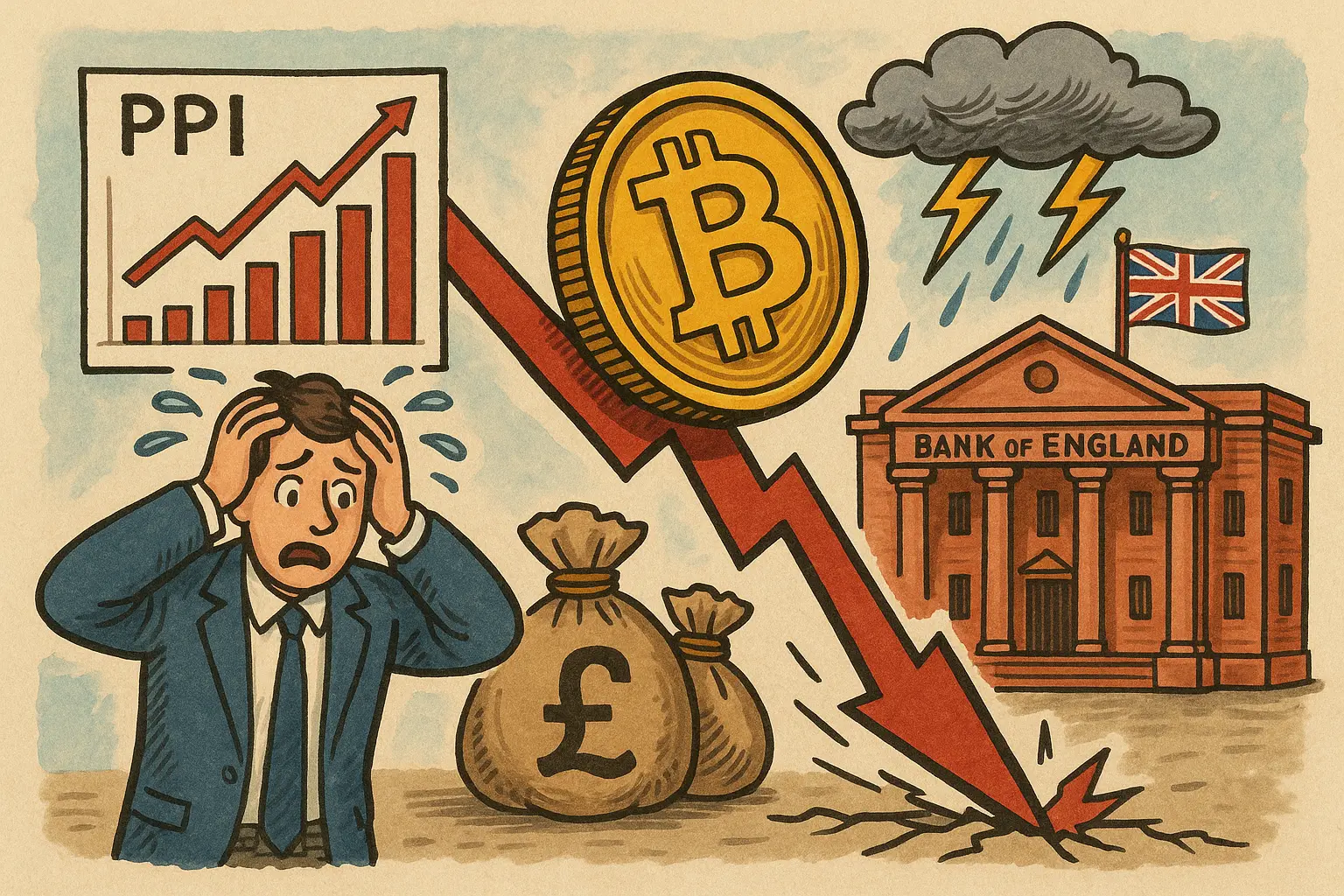
Bitcoin declined today under pressure, as the US January Producer Price Index (PPI) far exceeded expectations. The core PPI increased by 0.8% month-over-month, raising concerns about persistent inflation and increasing uncertainty regarding Federal Reserve policies. Meanwhile, the bankruptcy of major UK lender Market Financial Solutions (MFS) triggered systemic panic over excessive leverage in the private credit market, leading to sharp declines in the stock prices of several well-known financial institutions and a general downturn in risk assets.
Macro Triggers: PPI Inflation Surpasses Expectations, Fed Faces Dilemma
The US January PPI data became the immediate catalyst for the recent decline in risk assets. PPI for January rose 0.5% month-over-month, above the expected 0.3%. Core PPI surged significantly by 0.8%, well above the forecasted 0.3%, indicating that inflationary pressures have not eased as markets anticipated.
Integrated Partners Chief Investment Officer Stephen Kolano pointed out that this inflation increase is mainly driven by the service sector, suggesting companies are passing on tariff-related costs to consumers. The Federal Reserve faces a dilemma: should it cut interest rates to stimulate growth or maintain high rates to curb inflation? “Inflation is not yet resolved,” he warned, which will intensify market uncertainty about the policy direction for the rest of the year.
Top 3 Macro Pressures Behind Bitcoin’s Drop Today
- PPI Inflation Surpasses Expectations: Core PPI at 0.8% (vs. 0.3%), significantly weakening expectations of a rate cut in June.
- UK MFS Credit Crisis: The bankruptcy of major lender MFS sparks systemic panic over excessive leverage in private credit, with stocks like Apollo (-8%+) and Jefferies (-9%+) plunging.
- Tech Sector Continues to Underperform: Zscaler down 12%, CoreWeave down 18%, NVIDIA continues to retreat, with Nasdaq down over 3% in February.
Credit Crisis Chain Reaction: MFS Bankruptcy Impacts Market Confidence
UK-based major lender Market Financial Solutions Ltd. (MFS) officially filed for bankruptcy this Wednesday. Court proceedings revealed serious allegations of fraud and concerns over double-pledging of assets. MFS’s debt exposure involves several top institutions: Barclays and Apollo’s structured credit division Atlas provided hundreds of millions of dollars in loans, with other creditors including Jefferies, Santander, Wells Fargo, and Castlelake LP.
MFS’s collapse is not an isolated event. Last year, the failure of US auto parts supplier First Brands Group and subprime lender Tricolor Holdings already raised alarms in credit markets. JPMorgan Chase CEO Jamie Dimon warned this week that some competitors’ pursuit of high returns reminded him of the pre-2008 financial crisis. Systemic stress in the private credit sector has heightened risk aversion, spilling over into high-risk assets like Bitcoin.
Technical Analysis: $64,000 Is the Last Defense for Bulls and Bears
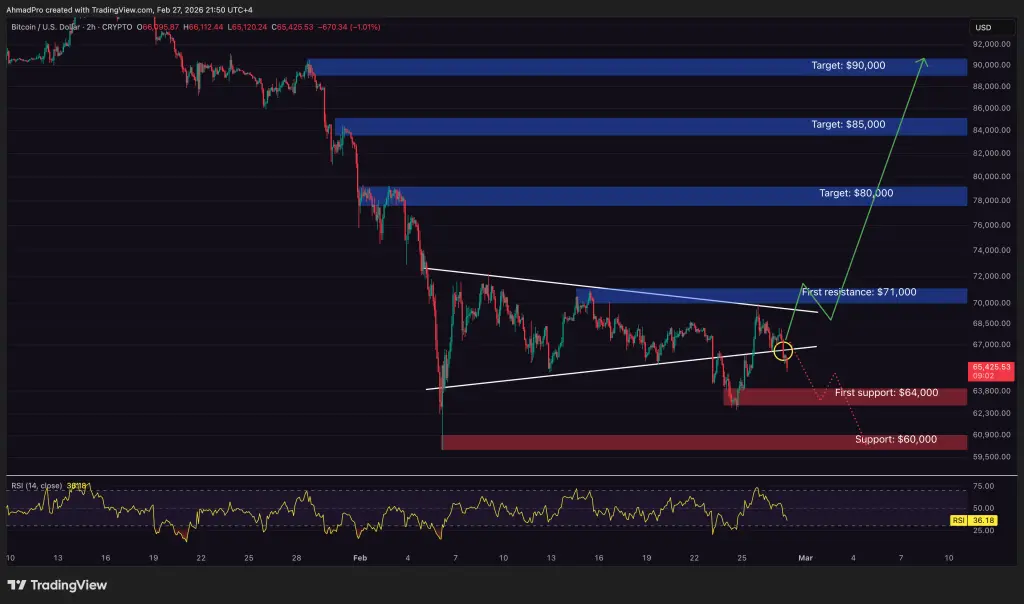
(Source: TradingView)
After breaking below the contracting triangle’s lower boundary, the short-term market structure has officially turned bearish. The failed attempt to push above $71,000 signals the end of the bullish rally, with price retreating toward around $64,000, as selling momentum reasserts itself.
$64,000 remains the most critical technical support level. A clean break below this could open the door to $60,000, potentially transforming the current triangle pattern into a distribution phase, leading to deeper liquidity sweeps. However, on higher timeframes, as long as $60,000 holds, the long-term bullish outlook remains intact.
Frequently Asked Questions
Why did Bitcoin fall today?
Bitcoin’s decline today was driven by three main pressures: US January core PPI up 0.8% MoM (far exceeding expectations), increasing inflationary stickiness and Fed policy uncertainty; the bankruptcy of UK lender MFS triggering systemic panic in private credit markets; and ongoing weakness in the tech sector (Zscaler, CoreWeave, NVIDIA), dragging down overall risk sentiment.
How does MFS bankruptcy affect Bitcoin?
MFS’s bankruptcy directly impacts major creditors like Apollo and Jefferies, sparking sell-offs in private credit markets and heightening fears of overly loose credit standards. This risk aversion spreads from traditional financial markets to high-risk assets like Bitcoin, creating cross-asset selling pressure.
What happens if Bitcoin drops below $64,000?
If $64,000 is effectively broken, the next major support is at $60,000. Losing this level could invalidate the long-term bullish structure on higher timeframes, potentially triggering deeper liquidity sweeps and reinforcing the short-term bearish trend.
Disclaimer: The information on this page may come from third parties and does not represent the views or opinions of Gate. The content displayed on this page is for reference only and does not constitute any financial, investment, or legal advice. Gate does not guarantee the accuracy or completeness of the information and shall not be liable for any losses arising from the use of this information. Virtual asset investments carry high risks and are subject to significant price volatility. You may lose all of your invested principal. Please fully understand the relevant risks and make prudent decisions based on your own financial situation and risk tolerance. For details, please refer to
Disclaimer.
Related Articles
FTX to Compensate at 2022 Coin Prices, SBF's Parents' Defense of Son Rejected by Creditors
FTX founder SBF's parents argued in a CNN interview that customer funds were never lost, claiming full compensation had been made. However, creditors countered that the compensation was calculated based on cryptocurrency prices at the time of bankruptcy in 2022, meaning they actually lost the potential for asset appreciation. SBF is now sentenced to 25 years, and the possibility of a pardon is also extremely low.
MarketWhisper41m ago
USR Stablecoin Collapse: Hackers Mint $80 Million in Unsecured Tokens, 70% Price Crash Triggers Trust Crisis
On March 23rd, USR, a stablecoin under Resolv, experienced a major security incident. Attackers exploited a private key leak to mint approximately $80 million in unbacked tokens, causing USR's price to collapse to $0.27, a decline exceeding 70%. Resolv has suspended smart contracts and burned 9 million anomalous tokens, with 71 million unbacked USR remaining in circulation. This incident reflects the fragility of stablecoins in terms of security and transparency, posing challenges to market confidence.
GateNews46m ago
A certain CEX has listed Resolve (RESOLV) as a trading alert asset.
Gate News reports that on March 23rd, a certain CEX listed Resolve (RESOLV) as a trading caution variety. Once designated as a trading caution variety, the exchange typically conducts detailed reviews of the digital asset to determine whether to extend the caution period, lift the caution, or ultimately terminate trading support.
GateNews52m ago
ZachXBT Exposes Fake Account Warning of War-Related Crypto Scams
Blockchain investigator ZachXBT warns about a fraudulent account named "Rashid bin Saeed," suspected of misleading users into cryptocurrency "pump-and-dump" schemes. Despite having over 353,000 followers, it was only verified in February 2026 and often changes its name, promoting low-cap meme coins like CHIBI. This highlights a familiar pattern of gaining followers through sensational content before pushing low-liquidity tokens. The warning comes as the Crypto Fear and Greed Index plunges into extreme fear, increasing market manipulation risks.
TapChiBitcoin58m ago
ZachXBT Exposes 350,000 Fake Followers: War Misinformation Drives Traffic, Crypto Scam Resurfaces Pump-and-Dump Scheme
On-chain investigator ZachXBT exposed an account named "Rashid bin Saeed" that attracted attention through false geopolitical information and is suspected of manipulating crypto assets. The account promoted a meme coin called CHIBI and was consistent with high volatility cases, reminding investors to be vigilant about information sources to prevent market manipulation.
GateNews1h ago
ZachXBT exposes fake war accounts: exploiting Iran panic to promote scam tokens
Investigator ZachXBT exposed "Rashid bin Saeed" as a fake account that rapidly accumulated followers by posting war-related content with the aim of promoting the low-market-cap token CHIBI for manipulation. Through characteristics such as frequent username changes, abnormally rapid verification status updates, and disproportionate follower counts, the account displayed typical signs of fraud. In an extremely fear-driven market, such manipulation tactics are more likely to succeed.
MarketWhisper1h ago


