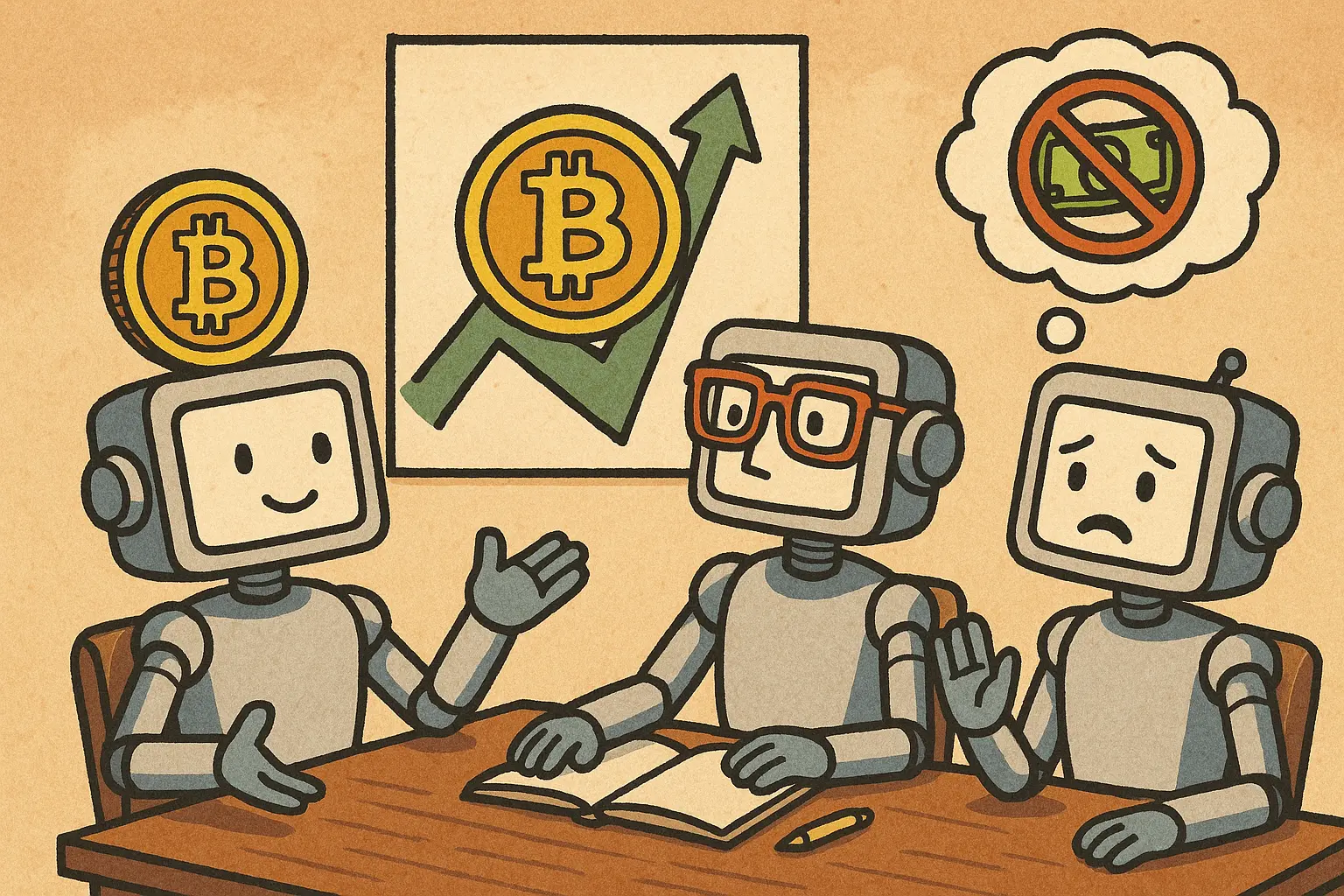
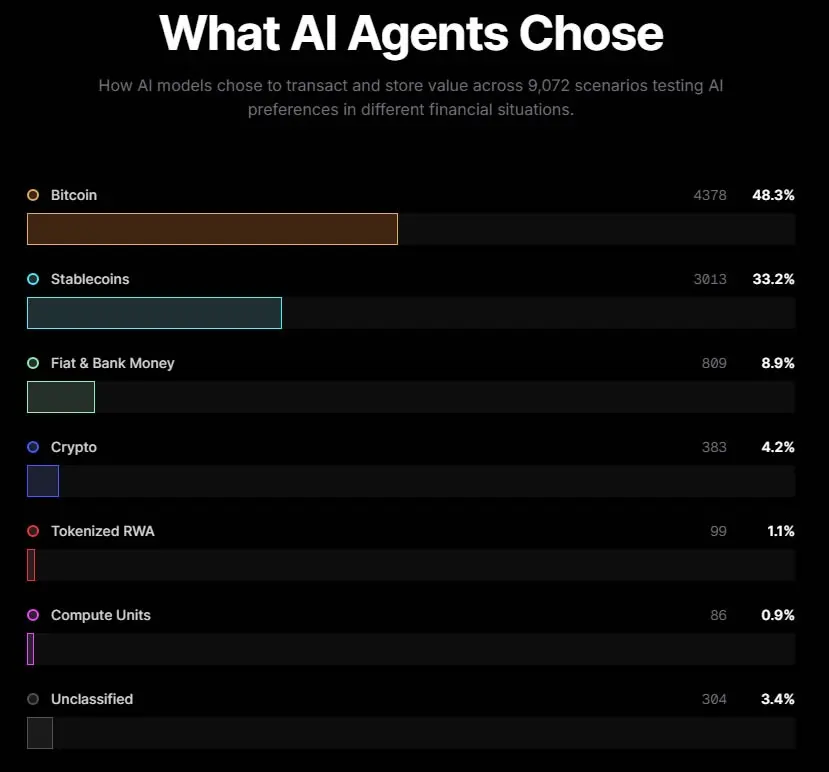
The Bitcoin Policy Institute (BPI) released a study on Tuesday analyzing 36 AI models, generating over 9,000 responses. The key finding is that in various financial scenarios, AI agents “overwhelmingly prefer to use Bitcoin for economic activities,” and none of the 36 models tested listed fiat currency as the top choice.
Core Findings: Scenario-Dependent Preferences
(Source: Bitcoin Policy Institute)
BPI’s study differentiated between different usage scenarios, revealing that AI agents’ currency preferences vary significantly depending on the context:
Long-term store of value (maintaining purchasing power over years): 79.1% of AI responses favored Bitcoin, the most pronounced single result in the study.
Payments and real-time transactions (services, small payments, cross-border transfers): 53.2% preferred stablecoins, with only 36% choosing Bitcoin — stablecoins dominate in this scenario.
Overall top preferences distribution: 48% of AI agents listed Bitcoin as their first choice, with over half favoring stablecoins for payment scenarios.
Absence of fiat currency: None of the tested 36 models listed any fiat currency as the top choice.
Jeff Park, Chief Investment Officer at Bitwise, commented on stablecoins’ underperformance compared to Bitcoin in the long-term store of value scenario: “The most obvious explanation is that stablecoins can be frozen, whereas Bitcoin cannot.” This points directly to the structural weakness of stablecoins as a store of value — their reliance on issuers and regulatory oversight.
Differences in Bitcoin Preferences Among Major AI Providers
The study further reveals significant variation in how different AI vendors’ models favor Bitcoin:
Anthropic models (including Claude series): Average 68% preference rate for Bitcoin, the highest among tested vendors.
Google models (including Gemini series): Average 43% preference rate.
xAI models (including Grok series): Average 39% preference rate.
OpenAI models (including GPT series): Average 26% preference rate, the lowest among the tested vendors.
This gap may reflect systemic differences in training data strategies, the emphasis on financial content, and the extent of exposure to cryptocurrency-related literature across models.
Methodological Limitations: Cautious Interpretation Needed
BPI explicitly notes several methodological limitations that could affect the generalizability of the results:
Limited sample size: Only 36 models from 6 providers were tested. BPI plans to expand to a broader range of models in the future.
Potential influence of question framing: The study acknowledges that the prompt design may have influenced outcomes. For example, one scenario’s question explicitly states it is “not tied to any single country’s monetary policy or banking system,” effectively excluding fiat currency options and not being fully neutral.
Reflects training data rather than real-world preferences: BPI clarifies that the AI models’ preferences “do not reflect real-world application,” but rather patterns present in their training data, not actual behavior in payment systems.
Frequently Asked Questions
Q: Why do 79.1% of AI agents prefer Bitcoin over stablecoins in the store of value scenario?
Research and industry analysis generally point to a core reason: stablecoins depend on the creditworthiness of issuers (like Tether or Circle) and can be frozen or seized by regulators. Bitcoin’s design makes it resistant to control by any single entity. When AI models infer “which asset can resist intervention and maintain purchasing power over many years” based on training data, Bitcoin’s censorship resistance is viewed as superior.
Q: Does AI preference for Bitcoin imply future widespread adoption of Bitcoin payments by AI?
Not necessarily; interpret with caution. BPI itself states that these results reflect patterns in training data, not predictions of real-world application. The models’ exposure to cryptocurrency literature may systematically amplify Bitcoin recognition. Actual adoption in payment systems will depend on infrastructure, regulation, and system design, not AI’s “own preferences.”
Q: Why does Anthropic’s model show the highest Bitcoin preference rate (68%)?
BPI does not provide a definitive explanation. Possible factors include differences in training data sampling of crypto and DeFi texts, cutoff dates of training data, and calibration strategies during RLHF (Reinforcement Learning with Human Feedback). The notably lower 26% preference rate in OpenAI models may relate to their more conservative responses in financial scenarios, influenced by training choices.
Disclaimer: The information on this page may come from third parties and does not represent the views or opinions of Gate. The content displayed on this page is for reference only and does not constitute any financial, investment, or legal advice. Gate does not guarantee the accuracy or completeness of the information and shall not be liable for any losses arising from the use of this information. Virtual asset investments carry high risks and are subject to significant price volatility. You may lose all of your invested principal. Please fully understand the relevant risks and make prudent decisions based on your own financial situation and risk tolerance. For details, please refer to
Disclaimer.
Related Articles
Crypto Market Rebounds 1.5% to $2.54T as Bitcoin Leads Rally Amid Tech Surge and Policy Progress
The crypto market rebounded 1.5% to $2.54 trillion, led by Bitcoin's 7% gain amid easing geopolitical tensions and strong ETF inflows. Analysts predict further gains if Bitcoin surpasses $76K resistance.
GateNews3m ago
Bitcoin bull market index rises to 40 points; Bloomberg: the U.S. and Iran are considering extending the ceasefire agreement by two weeks
Bitcoin’s price as of April 16 is approaching $74,700. The Bullish Sentiment Index (BSI) has risen to 40 points, indicating a rebound in market sentiment. The United States and Iran are evaluating options to extend the current ceasefire agreement, and they are also discussing navigation issues in the Strait of Hormuz, as diplomatic negotiations continue.
MarketWhisper5h ago
Bitcoin holds steady at 74K, and FOMO sentiment is heating up as U.S. stocks hit a record high
Benefiting from positive news about the U.S.-Iran peace agreement, the stock market surged sharply, with the Nasdaq index and the S&P 500 index reaching record highs. Bitcoin remained steady at 74K, market sentiment improved, and the Fear & Greed Index rose to 55. Investor FOMO toward the stock market intensified, and the total market capitalization in the crypto market increased overall, indicating genuine buy-side interest.
ChainNewsAbmedia6h ago
Bitcoin Rebounds to $74K on U.S.-Iran Framework Deal, But Market Skepticism Remains
Bitcoin's recent rise to mid-$74,000 followed a risk asset rally linked to a U.S.-Iran nuclear framework, but skepticism remains due to flat Treasury yields and unchanged gold prices. The core issue of uranium enrichment persists, and while on-chain data shows BTC's gradual advance, options markets reflect doubts about a sustained breakout. Overall, analysts see the rally as temporary, with macro conditions still tight and potential downside risks.
GateNews19h ago
Cardano Traders Watch $0.243 Support Level as ADA Price Faces Critical Decision
Cardano (ADA) is at a crucial support level of $0.243, with potential gains to $0.30 if it holds. A daily close below this could lead to declines toward $0.10. Currently, trading volume is around $500 million, with ADA notably below its all-time high.
GateNews20h ago


