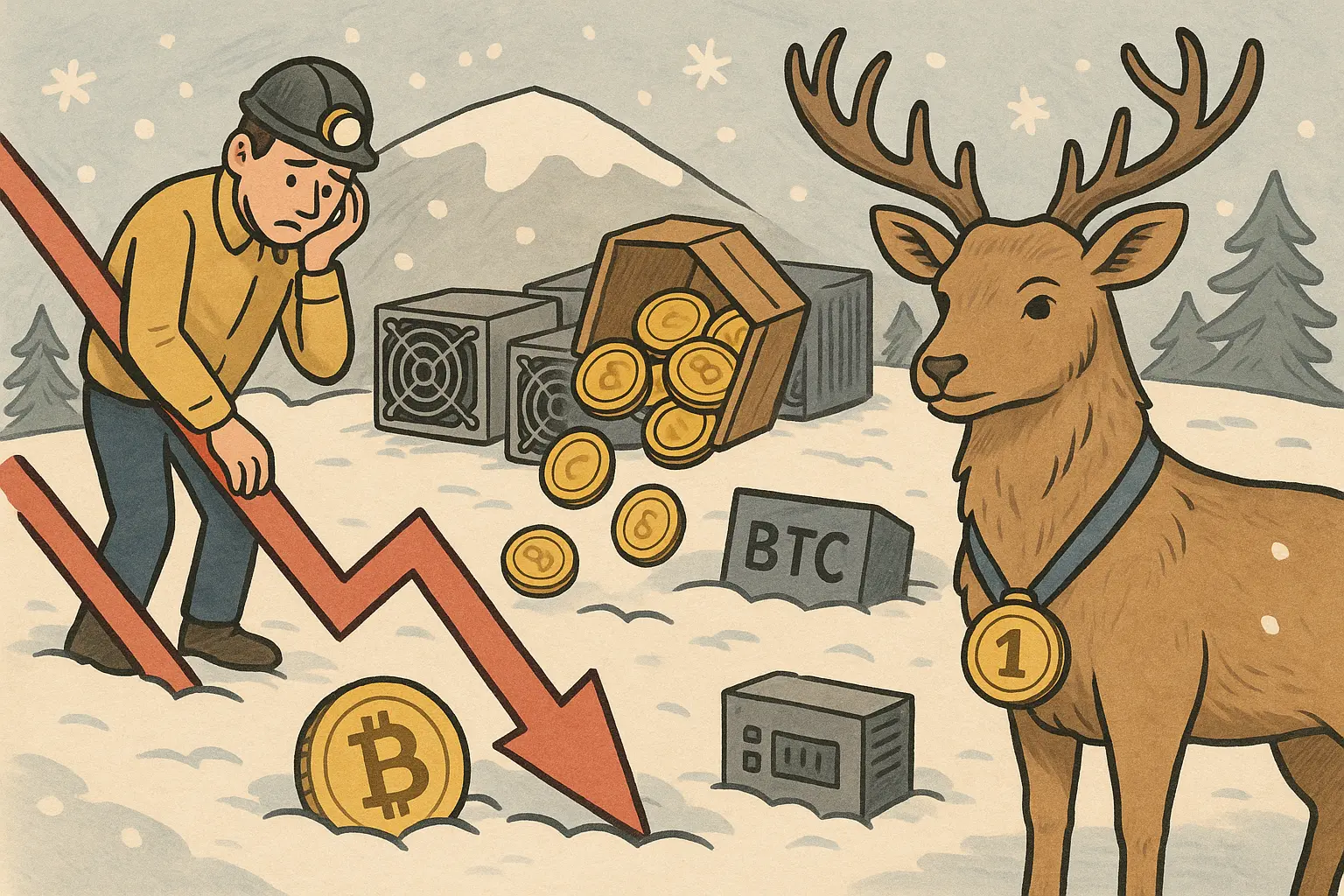
The key profitability indicator for Bitcoin mining, Hashprice, fell to a historic low in February. According to Luxor Technology data, the daily revenue per TH is approximately $0.03. Meanwhile, Bitdeer Technologies Group (NASDAQ: BTDR) liquidated all its own Bitcoin holdings but surpassed MARA with self-mining capacity of 63.2 EH/s.
Hashprice Hits Record Low: Mining Profitability Fully Contracted
Amid Bitcoin dropping below $70,000, rising energy costs, and the impact of a US winter storm, many mining companies have been forced to shut down some equipment. QCP Capital pointed out that Bitcoin’s current price remains significantly below the average mining cost of about $84,000, with liquidity pressures on miners continuing to increase. F2Pool also warned that at around $75,000 per BTC, mining machines with an energy efficiency of approximately 23.3 W/T are nearing break-even point. If prices decline further, high-energy-consuming models will face greater operational challenges.
VanEck Digital Asset Research Director Matthew Sigel noted that the current mining pressure is driven by five overlapping factors: rapid deleveraging of high leverage positions (Bitcoin futures open interest dropped from $61 billion to $49 billion within a week), increased miner selling pressure, cooling of infrastructure investment return narratives, rising concerns over quantum computing risks, and the re-emergence of four-year cycle market psychology.
Bitdeer Liquidates BTC Holdings but Becomes Hashrate Leader: Contradictory Signals Explained
As of February 20, 2026, Bitdeer’s own BTC holdings dropped to zero. The 189.8 BTC produced that week were fully sold, with a net BTC change of -943.1 BTC. However, during the same period, leveraging its self-developed SEALMINER mining machines, Bitdeer maintained a self-mining capacity of 63.2 EH/s, surpassing MARA to become the publicly listed miner with the highest self-mining capacity (confirmed by JPMorgan analysts).
Founder Wu Jihan responded that holding zero BTC now does not mean it will remain so in the future. The liquidation aims to prepare liquidity in advance and evaluate multiple opportunities for land and power acquisitions. Simultaneously, Bitdeer announced a private placement of $300 million in convertible senior notes due 2032, mainly to fund data center expansion, high-performance computing (HPC), and AI cloud services.
Summary of Major Mining Company Performance and Events in February
MARA Holdings: Q4 2025 net loss of $1.7 billion, mining capacity increased to 66.4 EH/s, holding 53,822 BTC at year-end.
Hut 8: Full-year 2025 net loss of $248 million, signed a 15-year, approximately $7 billion AI leasing agreement with Google.
Canaan (嘉楠科技): Acquired a 49% stake in Cipher Mining’s three mining farms for about $39.75 million, with a total power capacity of 120 MW.
NFN8 Group: Filed for Chapter 11 bankruptcy protection in Texas, with assets valued below $50,000.
BitRiver (Russia): Initiated bankruptcy proceedings due to debt disputes; multiple data centers shut down; founder and CEO under house arrest.
Mining Industry Accelerates Transformation: AI/HPC as New Industry Pathways
MARA partnered with Starwood Capital Group to convert Bitcoin mining farms into AI/HPC data centers, initially with about 1 GW capacity, expandable to 2.5 GW. Aggressive investor Starboard Value pressured Riot Platforms to reallocate approximately 1.7 GW of Texas power capacity for AI/HPC, which could generate over $1.6 billion in annual EBITDA. Tether also announced the launch of MOS (Mining OS by Tether), an open-source Bitcoin mining operating system, aiming to enter the mining infrastructure management market.
Paradigm’s research report states that Bitcoin mining should be positioned as a flexible demand asset for power grids rather than an energy burden. Miners can dynamically adjust their electricity consumption based on price signals, actively reducing load during grid stress to provide demand-side flexibility.
Frequently Asked Questions
What is Hashprice, and why is it a key profitability indicator for mining?
Hashprice measures the daily revenue generated per unit of hash rate (per TH/s), directly reflecting the real-time profitability of mining operations. When Hashprice declines, high-energy-consuming miners will reach break-even points first, making it a core quantitative metric for assessing the overall health of the mining industry.
Does Bitdeer liquidating its Bitcoin holdings indicate a loss of confidence in the mining industry?
Bitdeer’s official stance is that this is a liquidity management decision aimed at preparing funds for data center expansion and AI business development, not a negative outlook on the industry. Founder Wu Jihan explicitly stated that holding zero BTC now does not determine future direction; the company’s mining capacity deployment continues to expand.
Can AI/HPC transformation effectively replace Bitcoin mining revenue?
There is significant overlap between the power infrastructure used for mining and that required for AI data centers, making such a transition technically feasible. However, based on the financial reports of Hut 8 and TeraWulf, HPC revenue currently accounts for a relatively small portion of total income. Mining remains the primary cash flow source for most miners, and a full transformation is expected to take several years.
Disclaimer: The information on this page may come from third parties and does not represent the views or opinions of Gate. The content displayed on this page is for reference only and does not constitute any financial, investment, or legal advice. Gate does not guarantee the accuracy or completeness of the information and shall not be liable for any losses arising from the use of this information. Virtual asset investments carry high risks and are subject to significant price volatility. You may lose all of your invested principal. Please fully understand the relevant risks and make prudent decisions based on your own financial situation and risk tolerance. For details, please refer to
Disclaimer.
Related Articles
Bitcoin Halving Two-Years Anniversary: Annual inflation rate drops to 0.85%, officially becoming a rarer asset than gold
The Bitcoin halving in April 2024 lowered its annual inflation rate to 0.85%, for the first time below gold’s 1.5–2%. Bitcoin’s scarcity comes from code rules: supply will gradually decrease, and another halving is expected again in 2028. This halving cycle witnessed increased participation from institutional investors, strengthening Bitcoin’s position as digital gold.
ChainNewsAbmedia11m ago
Bhutan Reduces Bitcoin Stash From 13000 BTC to Under 4000 in 18 Months
_Bhutan cuts Bitcoin holdings from 13,000 BTC to 3,954 BTC in 18 months, with $215.7M transferred out and mining inflows declining_
Bhutan has reduced its Bitcoin holdings over the past 18 months, based on new blockchain data.
Arkham data shows a steady decline in the country’s reserves since
LiveBTCNews28m ago
'Not Going to Stop at Bitcoin': Morgan Stanley Weighs Tokenization, Tax Solutions in Crypto Push
In brief
Amy Oldenburg, head of digital-asset strategy at Morgan Stanley, sees a tokenized money-market fund as a natural path forward for its crypto roadmap.
What’s more, the investment bank with $9.3 trillion in client
Decrypt49m ago
Crypto analyst Murphy: The current difficulty of trading BTC in the short term is extremely high—sharing my personal trade records and risk management strategies
Bitcoin’s short-term trading difficulty is increasing. Analyst Murphy recommends adopting a DCA (dollar-cost averaging) strategy over the next six months, with a win rate approaching 100%. He emphasizes the need to distinguish between investing and trading, avoid wishful thinking, follow the long-term trend, and strictly adhere to short-term trading discipline.
GateNews1h ago
Bitcoin Hits $73K as US CPI Data Cools, Gas Prices Hit 60-Year High
Bitcoin traded near the $73,000 zone after the March CPI print came in cooler than some forecasts, easing some inflation fears and setting the stage for a cautious push higher. The Bureau of Labor Statistics showed the consumer price index rose modestly, with energy costs driving the month’s big
CryptoBreaking1h ago


