
Crypto market cap drops 6%, Bitcoin concept stocks face a bloodbath. MicroStrategy falls 9.63% to $143.19, crashing 70% from its peak, with a price-to-book ratio below 1. MicroMine drops 9.89%, holding 4.24 million ETH, with a loss of $3.8 billion. Despite four buy-ins of 710,000 BTC this month, MicroStrategy’s stock still plummets. The core issue: market doubts about the sustainability of leveraged coin hoarding, with increasing dilution of equity.
MicroStrategy’s $54 Billion Big Bet Breaks the Price-to-Book Barrier
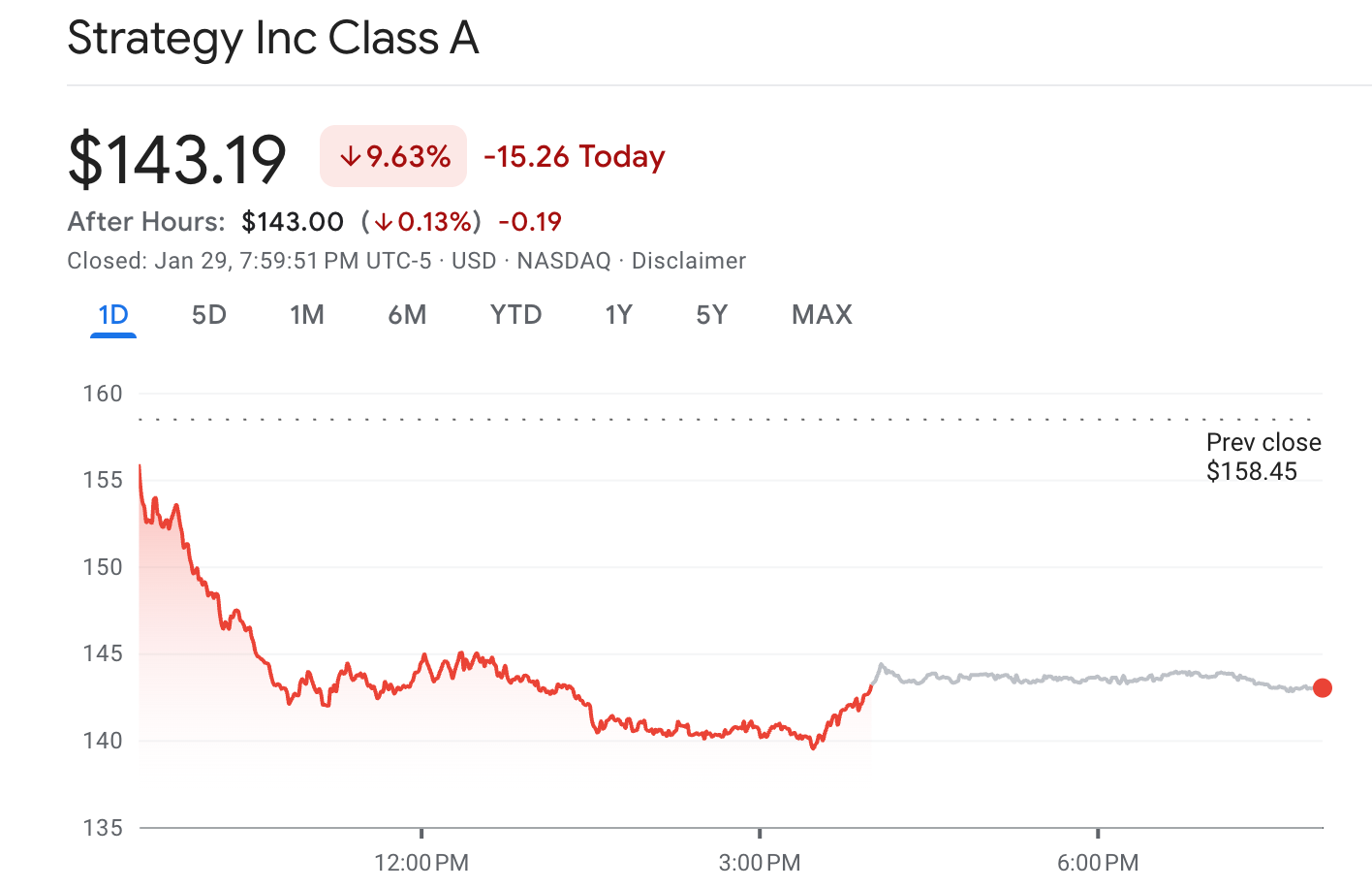
(Source: Google Finance)
According to Google Finance data, MicroStrategy’s stock price fell 9.63% on Thursday, closing at $143.19, the lowest since September 2024. After-hours trading saw a further decline of 0.13%. Economist and prominent Bitcoin critic Peter Schiff commented on the decline, noting that MSTR’s stock price has dropped nearly 70% from its peak.
“Saylor spent $54 billion over the past five years to buy over 712,000 Bitcoin, at an average price slightly above $76,000 per coin. His unrealized gains total less than 11%. Too bad he didn’t buy gold!” he wrote. While this sharp criticism is biased (Schiff has long been bearish on Bitcoin and bullish on gold), it highlights the core problem of MicroStrategy’s model: minimal book gains from massive investments.
As the stock price declines, the company continues to double down on Bitcoin investments. On January 26, Strategy disclosed its latest Bitcoin purchase, acquiring $264.1 million worth of Bitcoin at an average price of $90,061 per coin. This is the fourth large Bitcoin transaction this month, bringing its total holdings to 712,647 BTC, worth about $59.1 billion. However, continued buying has not prevented the stock from crashing, exposing fundamental doubts about its business model.
Moreover, the company’s core strategy faces more severe constraints. As its P/B ratio falls below 1.0, with Bitcoin’s appreciation approaching zero per share, shareholder equity dilution intensifies, and dependence on capital markets deepens. Unless the equity premium returns, continuous accumulation of Bitcoin may dilute ownership. The P/B ratio is the ratio of stock price to net asset value per share; falling below 1.0 indicates the market values the company’s assets (71 million BTC) below their book value.
More critically, the “zero growth per share BTC” dilemma. MicroStrategy’s business logic is to issue shares at a premium to buy more Bitcoin, increasing BTC holdings per share. But when the stock price crashes, issuing new shares severely dilutes existing shareholders’ equity. If MicroStrategy issues $100 million in new stock at the current $143 per share, it needs to issue about 69,900 shares, which can only buy roughly 1,123 BTC (at $89,000 per BTC). Existing shareholders’ BTC holdings per share will be diluted, undermining the entire “reflexive flywheel” model.
The Threefold Dilemma Facing MicroStrategy
P/B ratio below 1: stock price below net assets, market does not recognize the value of holdings
Zero growth in BTC per share: after a sharp decline, cannot issue at a premium; new financing dilutes shareholders
Rising debt pressure: holding $9.48 billion in debt, potential margin calls if BTC continues to fall
BitMine’s $3.8 Billion Ethereum Loss and the Dilemma
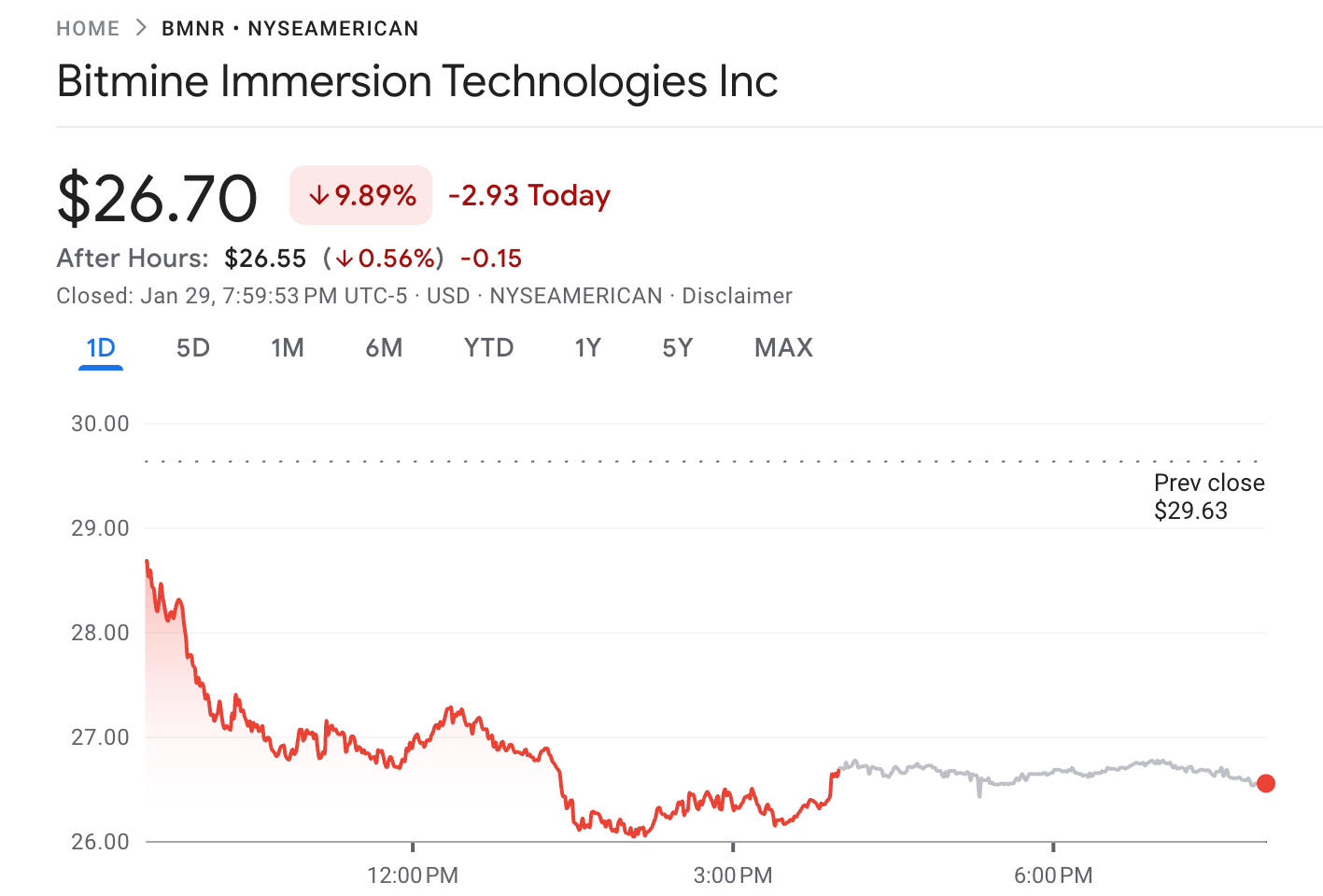
(Source: Google Finance)
Similar to MicroStrategy, BitMine’s stock (BMNR) also declined, closing at $26.70 on Thursday, down 9.89%. The lowest since November 2025. Notably, earlier this week, the company completed its largest Ethereum purchase for 2026, acquiring 40,000 ETH. The company currently holds about 4,243,338 ETH, valued at approximately $11.68 billion.
BitMine’s ETH holdings account for 3.5% of total ETH supply, with over half staked. However, on-chain data from CryptoQuant shows that BitMine faces an unrealized loss of about $3.8 billion, highlighting the increasing pressure on crypto-focused fund management strategies amid current market downturns.
This $3.8 billion loss means the average cost basis of BitMine’s holdings is far above the current market price. If the average cost is around $3,700 (424 million ETH, total investment about $157 billion), and the current price is only $2,750, each ETH is at a loss of about $950, totaling nearly $4 billion in unrealized losses. While these are unrealized (not realized until sold), they severely impact investor confidence.
Worse, Ethereum’s fundamental challenges make a rebound uncertain. Layer-2 scaling solutions’ revenue, ETH burn rate decline, and weaker institutional adoption compared to Bitcoin all hinder ETH from returning above $4,000. If ETH remains in the $2,500–3,000 range long-term, BitMine’s losses could persist for years. Staking yields (~4% annually) provide some buffer but are insufficient to offset such large losses.
The plunges in both MicroStrategy and BitMine are not isolated. Other crypto-focused firms, including Metaplanet, Strive, and Sharplink, also saw declines, though less severe. This industry-wide downturn indicates the market is reassessing the risk-reward of “corporate coin hoarding” models.
The Life-and-Death Test of Leveraged Coin Hoarding
In the past 24 hours, the total crypto market cap fell 6%, with major asset prices plunging sharply. The sell-off affected not only digital tokens but also leading crypto fund managers like BitMine and MicroStrategy. Despite their continued accumulation, reflecting firm confidence in crypto markets, this decline exposes increasing pressures on digital asset fund management firms.
According to BeInCrypto reports, macroeconomic tensions over the past 24 hours have pressured the crypto market. Bitcoin dropped 6.7%, Ethereum’s decline expanded to 7.6%. During Asian morning trading, both assets hit two-month lows on Binance. Notably, the companies holding the most of these assets also suffered from the market crash, which affected precious metals, cryptocurrencies, and equities.
This synchronized decline reveals the core risk of Bitcoin concept stocks: leverage amplification. MicroStrategy’s beta coefficient is typically 2-3 times that of Bitcoin, meaning a 10% BTC drop could lead to a 20–30% decline in MSTR. This leverage effect is advantageous in a bull market (BTC up 10%, MSTR up 30%) but disastrous in a bear market. When Bitcoin falls from $108,000 to $82,000 (-24%), MicroStrategy’s stock crashes 70% from its peak, exemplifying this leverage backlash.
For investors, this crash offers a vital lesson: Bitcoin concept stocks are not “safer ways to invest in Bitcoin,” but “higher-risk leveraged investment tools.” If bullish on Bitcoin, direct spot or ETF purchases may be more prudent; if investing in concept stocks, be prepared for double or triple volatility. Under current conditions, unless Bitcoin reclaims over $100,000 and MicroStrategy’s equity premium recovers, MSTR and BMNR may continue to face downward pressure.
Related Articles
BTC edges up 0.46% in 15 minutes: institutional fund outflows and macro risk-off sentiment in sync drove the move
From 15:00 to 15:15 (UTC) on 2026-04-16, BTC logged a +0.46% return within 15 minutes. The price fluctuated in a range of 73,939.7 to 74,440.0 USDT, with an amplitude of 0.68%. During this time window, market attention increased, short-term volatility intensified, and fund-flow characteristics changed noticeably.
The main driver of this deviation is the continued outflow of large amounts of capital from exchanges. According to on-chain data, in the past 24 hours the net flow was -14,408.84 BTC, mainly concentrated in large transfer ranges of more than $1 million (especially>$10M net outflow -12,987.03 BTC). This shows that institutions and large holders actively reduced their BTC holdings on exchanges, and short-term selling pressure was significantly lowered. Against the backdrop of persistently weak liquidity, with order book depth remaining at a low level for a long time, the price has become more sensitive to medium-sized buy orders—amplifying the impact of even modest inflows on spot market price action.
In addition, macro conditions changed in parallel and produced a synchronized effect: easing geopolitical tensions in the Middle East boosted overall market sentiment. International gold prices rose, global equity markets hit new highs, and the market re-evaluated the probability of the Federal Reserve cutting rates within the year, further increasing investor attention to safe-haven assets (including BTC). At the same time, on-chain data indicates that the “whale” trading activity during this phase is at an annual low (>$1M transfers fell to 1,485 transactions). With heavy market wait-and-see sentiment and limited short-term supply, BTC’s responsiveness to sudden buy-side capital was further enhanced.
Investors should be reminded that current market liquidity is still fragile. Insufficient order book depth increases the market’s sensitivity to large capital movements, and short-term volatility may intensify. Going forward, focus on further shifts in on-chain large-fund flows, changes in price action as it breaks through support or resistance regions, and the risks and opportunities brought by related macro policies and geopolitical developments. Please continue to track key data and stay alert to any sudden shocks during the period of abnormal moves.
GateNews38m ago
Bitcoin Transactions Face 70-Page Tax Filing Burden Annually
According to Nicholas Anthony of the Cato Institute's Center for Monetary and Financial Alternatives, spending Bitcoin on everyday purchases creates an unexpected tax compliance nightmare. The IRS treats Bitcoin as property, not currency, meaning every transaction—even a $5 coffee
CryptoFrontier1h ago
Bitcoin, Ethereum and Solana ETFs Record Positive Net Inflows on April 16
Gate News message, according to the April 16 update, Bitcoin ETFs recorded a 1-day net inflow of +2,855 BTC (+$209.95M) and a 7-day net inflow of +11,849 BTC (+$871.52M). Ethereum ETFs showed a 1-day net inflow of +15,477 ETH (+$35.44M) and a 7-day net inflow of +90,366 ETH (+$206.94M). Solana ETFs
GateNews1h ago
Bitcoin Breaks Below $74K as 24-Hour Decline Reaches 0.02%
Gate News message, April 16 — Bitcoin fell below the $74,000 level, currently trading at $73,906 with a 24-hour decline of 0.02%.
GateNews1h ago
Newly Created Wallet Withdraws 1,470 BTC Worth $109M from Major CEX
Gate News message, April 16 — According to Onchain Lens, a newly created wallet withdrew 1,470 BTC, valued at approximately $109 million, from a major CEX.
GateNews1h ago
BTC falls below 74000 USDT
Gate News bot message, Gate quotes show that BTC has fallen below 74000 USDT, with the current price at 73988.8 USDT.
CryptoRadar2h ago


