Author: Virtuals Protocol
Translation: Deep潮 TechFlow
Early founders are often forced to invest significant personal and reputational capital before validating market demand. Traditional accelerators, venture capital, and token launches typically require early commitments, with limited feedback loops.
The 60-Day Plan Introduces an Experimental Path
Founders publicly build for 60 days, during which real users discover the product, and capital accumulates through transaction fees and optional Growth Allocation.
At the end of the window, founders decide whether to commit. If they commit, the token continues to exist, and the raised funds are unlocked over time for further growth and development. If they do not commit, the token is liquidated, and all raised funds are returned to token holders.
The 60 Days Framework Is Built on Five Core Principles:
- Founder Sovereignty: Founders retain full control over whether to commit or withdraw at the end of the 60-day window. Nothing is automatically unlocked.
- Market Testing: Demand is formed through real user behavior and voluntary support.
- Reversibility Design: Each launch begins in a fully reversible state. Closure is an expected and reasonable outcome, not a failure condition.
- Reputation Protection: If the project liquidates, all raised funds are returned to supporters, and the founder’s reputation remains intact. No permanent on-chain blemishes.
- Risk and Reward Alignment: Supporters back genuine progress, not promises. Founders can only access capital after choosing to commit. Upside and downside are transparently shared.
Operation Mechanism of the 60 Days Plan
Each participating founder enters a 60-day open build and testing period.
During this time, founders need to:
- Regularly build and release product updates
- Interact with users and gather feedback
- Iterate, adjust direction, and publish progress reports
- Maintain transparent metrics
- Participate in community review
At the end of Day 60, founders must declare one of two outcomes:
- Commit: Transition to long-term development
- Do Not Commit: If the project liquidates, all accumulated funds will be refunded
Launching the 60 Days
Projects can launch a public token using a standardized bonding curve. Tokens can be traded during build and testing. Pricing dynamically adjusts based on demand. All 60 Days launches are conducted on the BASE network. Initially, projects run in a private pool. Once total trading volume reaches 42,000 VIRTUAL, liquidity migrates to Uniswap V2 pool, enabling open market access.
Token holders can participate in project milestones and performance, but if founders do not commit, they are still protected through a refund mechanism.
Token Economics Model
The 60 Days economic model primarily aims to support founders’ long-term sustainability while maintaining aligned incentives with supporters.
It consists of three core components:
- Trading Tax
- Automated Capital Formation (ACF)
- Growth Allocation (GA)
Founders also receive support during the 60 days through these mechanisms.
Trading Tax
All token trades incur a 1% trading fee.
- 30% allocated to the protocol
- 70% allocated to founders (Founder Trading Tax)
Founders’ share is locked during the trial period and only released after commitment.
If founders do not commit, this allocation is redirected to the refund pool.
This mechanism rewards founders who complete the plan and prevents uncommitted launches.
Automated Capital Formation (ACF)
ACF is an automated financing mechanism that continuously allocates capital to founders based on market participation and trading activity.
- Released ACF funds are used for operational expenses, infrastructure, and early expansion
- Unreleased ACF allocations remain locked and are not included in refunds until officially released
ACF enables founders to raise funds gradually without relying on traditional funding rounds.
More details about ACF can be found in related documentation.
Growth Allocation (GA)
Founders can choose to open a Growth Allocation (GA) pool, funded by the sale of up to 5% of their team’s tokens. Participants deposit USDC in exchange for token allocations at a fixed public FDV (Fully Diluted Valuation) determined by the founder.
Funds in the GA pool are held in escrow until the commitment outcome is determined. If founders do not commit, the funds are fully refunded.
If founders commit, the GA funds are subject to a six-month vesting period. After commitment, GA tokens are linearly released over six months.
If founders do not commit, all GA funds are refunded, and vesting is canceled. This structure protects founders and early supporters from short-term speculation.
Allowance Mechanism
To support founders during the 60 days, founders will receive an allowance. Every 30 days (Day 30 and Day 60), founders receive 10% of the current collected funds (from trading tax income and released ACF), capped at 5,000 USDC.
Example: Day 30 Calculation:
- Total collected from founder trading tax income and any released ACF: 35,000 USDC
- 10% calculation: 35,000 × 0.10 = 3,500 USDC
- Cap check: 3,500 < 5,000 cap
- Founder allowance payout: 3,500 USDC
Day 60 Calculation:
- Total collected from founder trading tax income and any released ACF: 58,000 USDC
- 10% calculation: 58,000 × 0.10 = 5,800 USDC
- Cap check: 5,800 > 5,000 cap
- Founder allowance payout: 5,000 USDC (reaching the cap)
At the End of Day 60: Outcomes
Handling Founder Commitment
Founders can choose to commit at any time during the 60-day trial. Once sufficient traction and validation are achieved, early commitment is permitted.
If Founders Commit:
- Founder trading fee distribution is immediately released to the founder’s wallet
- Released ACF funds are unlocked
- Growth allocation (if any) vesting schedule begins
- Participant allocations start to take effect
- Activation of long-term infrastructure and distribution support
- Project transitions to ongoing development
Committing indicates the founder is ready to pursue long-term execution and accountability.
Proportional Distribution of Growth Allocation
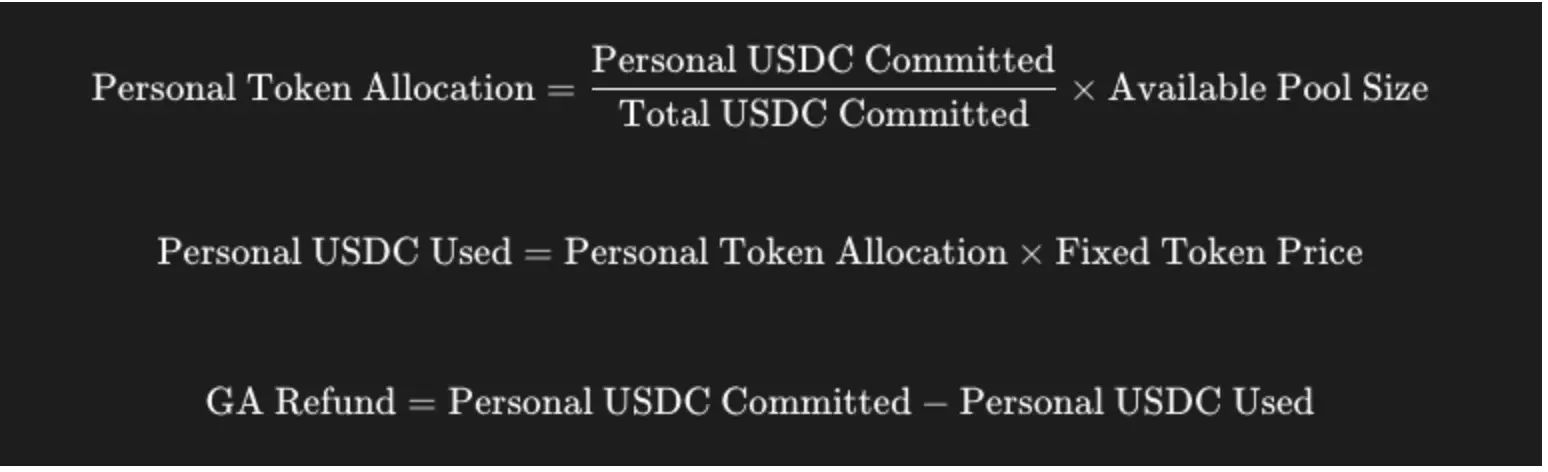
Distribution is proportional to each participant’s contribution to the growth pool. If the pool is oversubscribed, allocations are proportionally adjusted, and any unused USDC is automatically refunded.
Proportional Allocation Calculation
Each participant receives a proportionate share based on their USDC contribution:
Example
Available growth allocation pool: 50,000 tokens
GA token price: 0.20 USDC per token
Maximum possible raise: 50,000 × 0.20 = 10,000 USDC
Total USDC committed by all participants: 15,000 USDC
Participant Contribution Example
Alice commits 5,000 USDC | requests 25,000 tokens at 0.20 USDC
Bob commits 4,000 USDC | requests 20,000 tokens at 0.20 USDC
Carol commits 3,500 USDC | requests 17,500 tokens at 0.20 USDC
Dave commits 2,500 USDC | requests 12,500 tokens at 0.20 USDC
Total: 15,000 USDC | requests 75,000 tokens
Since participants requested 75,000 tokens but only 50,000 are available, the pool is oversubscribed by 150% (75,000 ÷ 50,000).
All participants will receive tokens at the same fixed price of 0.20 USDC per token.
Proportional Distribution Example
Alice:
Proportion: 5,000 ÷ 15,000 = 33.33%
Token allocation: 50,000 × 0.3333 = 16,667 tokens
USDC used: 16,667 × 0.20 = 3,333
Refund: 1,667 USDC
Bob:
Proportion: 4,000 ÷ 15,000 = 26.67%
Token allocation: 50,000 × 0.2667 = 13,333 tokens
USDC used: 13,333 × 0.20 = 2,667
Refund: 1,333 USDC
Carol:
Proportion: 3,500 ÷ 15,000 = 23.33%
Token allocation: 50,000 × 0.2333 = 11,667 tokens
USDC used: 11,667 × 0.20 = 2,333
Refund: 1,167 USDC
Dave:
Proportion: 2,500 ÷ 15,000 = 16.67%
Token allocation: 50,000 × 0.1667 = 8,333 tokens
USDC used: 8,333 × 0.20 = 1,667
Refund: 833 USDC
Handling Non-Commitment of Founders
If Founders Do Not Commit:
- End of the trial period
- Liquidity pool is emptied
- Token issuance stops
- Refund mechanism is triggered
- Accumulated funds are distributed to eligible token holders
In this case, the project is officially closed within the 60 Days framework, with no further capital release.
Refund Mechanism
If founders do not commit, remaining funds are distributed from the accumulated fund pool to eligible token holders.
Funds are accumulated from three sources:
Accumulated funds = Released ACF funds + Founder trading tax + Remaining $VIRTUAL in LP
Founder trading tax = 70% of the collected 1% trading fee
How Refunds Are Calculated
Total refunds consist of funds from two sources:
Refunds from released ACF funds and founder trading tax
This part is calculated from the released ACF funds and the founder trading tax (i.e., 70% of collected token trading fees). Your share is based on your proportion of eligible holdings:
Refund (released ACF + founder trading tax) = (Your token holdings / total eligible holdings) × (Released ACF funds + founder trading tax)
Refunds from the liquidity pool ($VIRTUAL)
This part is based on the remaining $VIRTUAL in the liquidity pool. Your share is proportional to your holdings relative to total eligible holdings, including initial team purchase:
Refund (LP $VIRTUAL) = (Your token holdings / total eligible holdings including team initial purchase) × remaining $VIRTUAL in LP
Eligible holdings
Only balances from:
- Public sale token holdings
- Ecosystem airdrops at snapshot time
Excluded from refunds
- Team reserved tokens
- Unreleased ACF allocations
- Tokens bought back
Tokens obtained from the initial team purchase are only eligible for refunds from the liquidity pool, not from ACF or trading fee refunds.
Important Notes
⚠️ Refunds are distributed proportionally based on ownership at the snapshot time.
⚠️ Due to potential changes in fund balances during the 60 days, full refunds are not guaranteed.
⚠️ Please review project details and risks before participating.
Refunds depend on available funds and are not guaranteed to be full.
Reducing Risks in Market Building
For trusted AI founders, token issuance has historically required disproportionate reputational exposure. Traditional models enforce early, irreversible commitments before product-market fit is validated. Once launched, expectations become fixed, capital is immediately unlocked, and reputational consequences persist regardless of outcome.
This dynamic hampers serious builders.
60 Days aims to substantially reduce this risk.
It creates a structured experimental window where experimentation is expected, reversibility is built-in, and commitments are voluntary. Founders can test distribution, validate demand, and iterate quickly without permanently anchoring their reputation to unfinished products. Capital accumulates transparently, but access to that capital remains contingent on explicit commitment decisions.
This is especially important for high-level AI teams, whether building agent infrastructure, robotic systems, or coordination layers. It allows them to leverage crypto-native distribution and monetization methods without bearing irreversible downside risks early in research and product development.
Conversely, supporters back observable progress rather than static promises. If confidence grows, the project transitions to ongoing development. If confidence wanes, funds are refunded, and reputational damage is minimized.
60 Days redefines tokenization from a one-way launch event to a reversible experimental framework.
In doing so, it aligns capital formation with the actual way serious AI innovation happens: iterative, open, responsible, and conditional.
aGDP.


