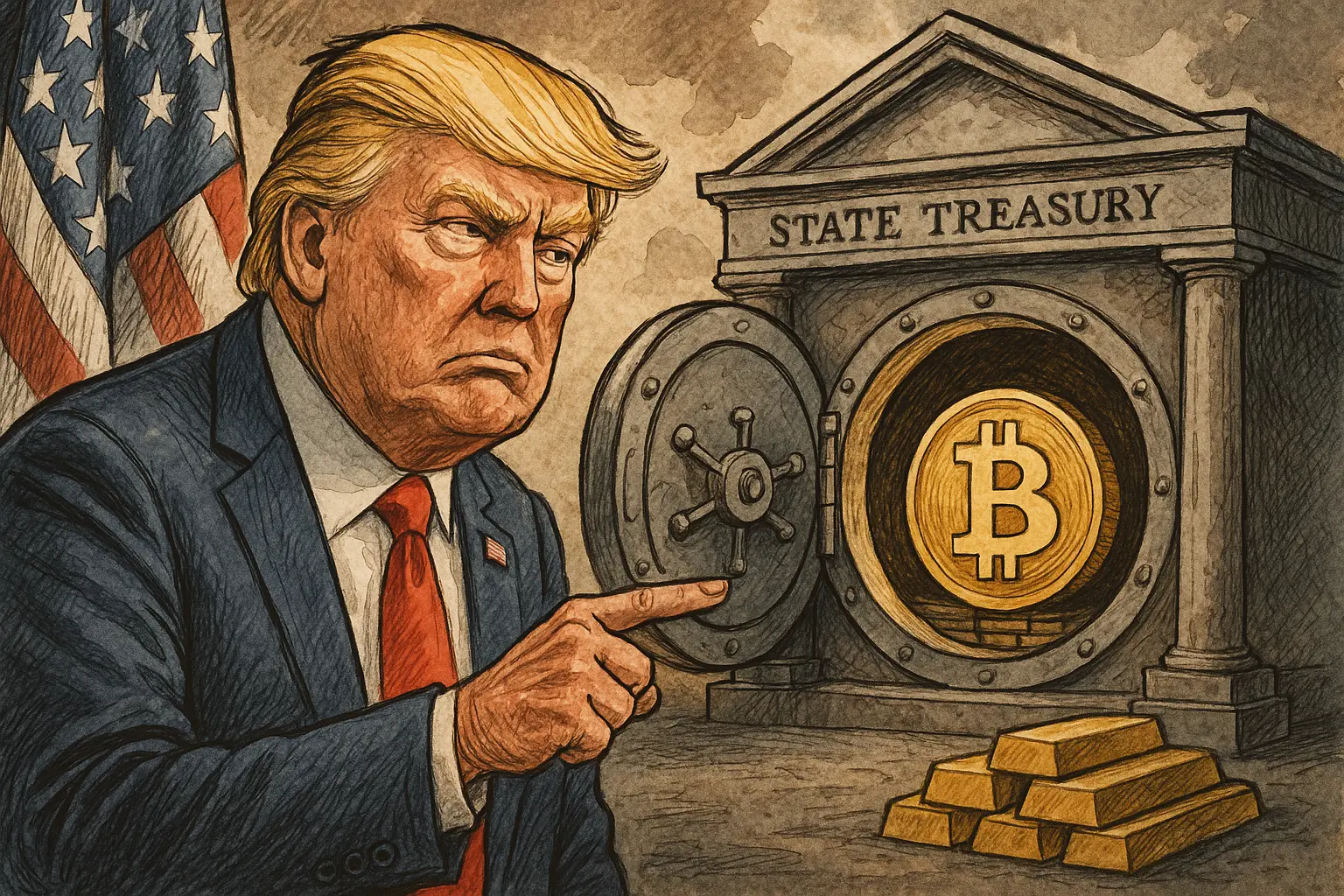
David Bailey, who previously served as a cryptocurrency advisor in the Trump administration, stated at the New York Bitcoin Investor Week that merely “liking Bitcoin” is far from enough for the U.S. government. He pointed out that while the Trump administration took an important first step, there is still a long way to go beyond words, especially as progress on strategic Bitcoin reserves has nearly stalled to date.
Bailey’s Core Criticism: Political Capital Is the True Test
 (Source: Anthony Pompliano)
“At the end of the day, liking Bitcoin isn’t enough,” Bailey directly addressed the core issue — expressing support for Bitcoin does not equate to actual policy action. He emphasized that only by investing necessary political capital and mobilizing resources to push concrete initiatives forward can Bitcoin’s policy environment truly change.
“Just because you like Bitcoin doesn’t mean you’ve invested the necessary political capital to make things happen,” Bailey said. “Whether you like Bitcoin or not, without real action, you’ll ultimately get the same results.” He added that Trump is the first politician to genuinely embrace the “Bitcoin worldview,” but changing perspectives alone isn’t enough to push Bitcoin to $1 million per coin.
Bailey’s Five Key Points
“Liking Bitcoin” isn’t enough: Support is the first step, but political capital must be converted into concrete policy actions.
Stalled Bitcoin Reserves: Executive orders have been signed, but the U.S. government still doesn’t know how much Bitcoin it holds.
Bitcoin Will Ultimately Succeed: Long-term success doesn’t require government intervention, regardless of whether the government takes action.
Voters Are Key: More annual Bitcoin holders are needed to make this issue an unavoidable election issue.
The Timeline Could Be Long: Favorable policy environments may take 10 to 20 years to truly establish.
Broader Context of Stalled Bitcoin Reserves and Policy
Bailey’s criticism is backed by concrete facts. In March 2025, Trump signed an executive order to establish a strategic Bitcoin reserve, but a year later, the U.S. government had yet to begin accumulating new holdings outside of confiscated Bitcoin. Bailey directly pointed out, “As far as I know, we don’t even know how much Bitcoin we actually hold.” According to Arkham Intelligence, the U.S. government currently holds about 378,372 Bitcoins, valued at approximately $22.48 billion at the time of writing.
White House AI and Cryptocurrency Director David Sacks explained two months after the executive order that accumulating Bitcoin requires a “budget-neutral” approach to avoid tax increases or expanding national debt, leading to a conservative accumulation pace. Galaxy Digital research head Alex Thorn predicted a high likelihood of accumulation by the end of 2025, but this forecast has yet to materialize.
However, Bailey remains optimistic about Bitcoin’s long-term prospects: “Bitcoin’s success doesn’t require government intervention. Whether in four, ten, or twenty years, we will eventually have a government that creates favorable rules for Bitcoin’s success.” Besides the strategic reserve, the potential passage of the CLARITY Act is also attracting market attention, with Trump stating on Truth Social that “the U.S. needs to complete market structure reforms as soon as possible.”
Disclaimer: The information on this page may come from third parties and does not represent the views or opinions of Gate. The content displayed on this page is for reference only and does not constitute any financial, investment, or legal advice. Gate does not guarantee the accuracy or completeness of the information and shall not be liable for any losses arising from the use of this information. Virtual asset investments carry high risks and are subject to significant price volatility. You may lose all of your invested principal. Please fully understand the relevant risks and make prudent decisions based on your own financial situation and risk tolerance. For details, please refer to
Disclaimer.
Related Articles
Trump’s net worth jumps 60% to $6.3 billion as business expansion sparks controversy over potential conflicts of interest
Trump’s net worth is estimated at $6.3 billion, up about 60% before his return to the White House. This growth is mainly driven by his family’s expansion into overseas real estate deals and the cryptocurrency sector. Government ethics experts say they are concerned and believe there may be conflicts of interest. The White House and the Trump Organization deny such claims.
GateNews46m ago
Citigroup raises its U.S. stock market rating to “Buy,” favoring defensive stocks
Gate News message, April 14, Citi Group’s strategists raised their rating for the U.S. stock market from "Neutral" to "Buy," aligning with the views of other analysts on Wall Street. Citi said that heightened uncertainty in the war situation has made investors more inclined to choose companies with higher quality and stronger defensiveness. Based on the principles of a "quality/defensive tilt," Citi adjusted its global asset allocation. Meanwhile, Citi downgraded its emerging market stock rating from "Buy" to "Neutral," saying these markets are more vulnerable to energy shocks, and that a stronger U.S. dollar puts additional pressure on them.
GateNews1h ago
Iranian Ambassador to India: Indian oil tankers have not paid the Strait of Hormuz transit fees to Iran
Iran’s ambassador to India, Fattahali, said that Indian tankers passing through the Strait of Hormuz did not pay the transit fee to Iran, and the Indian government also denied having paid any fee. Since the outbreak of the Iran war, Iran has blockaded that route, and there are still 15 Indian vessels stuck in the Persian Gulf.
GateNews2h ago
JPMorgan CEO Dimon Warns: A Possible Iran War Could Reignite the Inflation Pressure, and the Federal Reserve’s Interest Rates May Stay High for Longer
JPMorgan Chase CEO Jamie Dimon warned in his annual shareholder letter that a war with Iran could trigger persistent oil and commodity price shocks, creating inflation pressure that is stickier than the market expects, and that the Federal Reserve may need to maintain high interest rates for longer. He noted that the war’s economic impact is widespread, including a global restructuring of supply chains and rising energy prices. In addition, Dimon still holds a positive view of the U.S. economy, but warned that the economic shocks from the war could weaken that resilience.
ChainNewsAbmedia2h ago
U.S. Vice President Vance: The U.S. withdrew from the U.S.-Iran talks because Iran’s representatives lacked sufficient authorization
U.S. Vice President Vance disclosed the reason for the deadlock in the U.S.-Iran nuclear talks, saying that the U.S. side withdrew from the negotiations because Iran’s representative lacked authorization under the agreement. Vance emphasized that Trump is willing to normalize relations between the U.S. and Iran, but only on the condition that Iran does not pursue nuclear weapons and does not support terrorism. Any future progress in the talks would require approval from Iran’s leadership in Tehran.
GateNews4h ago
U.S. stocks have recovered the losses since the Iran war, while Bitcoin pushes up to 74K
Due to market expectations that the United States and Iran will reach an agreement, the S&P 500 index has rebounded to its highest level since the war, and Bitcoin has also surged to $74,900. Despite the failure of peace talks between the U.S. and Iran, the U.S. has imposed a maritime blockade to pressure Iran. MicroStrategy once again made a large-scale purchase of Bitcoin, indicating that investor confidence is picking up.
ChainNewsAbmedia4h ago


